Waikiki Surf Lessons — 2026 Complete Guide
Waikiki Surf Lessons: The Only Guide You’ll Need to Ride Your First Wave with Aloha
Aloha! Dreaming of gliding across those famous turquoise waves but overwhelmed by the choices? You’re searching for the best Waikiki surf lessons — but you’re worried about picking a crowded tourist trap instead of a genuine, soul-stirring experience. You want to feel the real spirit of the ocean, the same one the legendary Duke Kahanamoku shared with the world right here on these shores. This 2026 guide gives you everything you need to choose wisely, prepare confidently, and ride your first wave with a smile that never fades.
⚡ Key Takeaways — Waikiki Surf Lessons Essentials
- Waikiki’s unique, long-rolling waves with sandy bottoms create the world’s safest and most forgiving classroom for first-time surfers.
- Group lessons start around $75; semi-private lessons are $100–$130; private lessons run $125–$175 — all include board, rash guard, and expert instruction.
- The best Waikiki surf schools use small group ratios (4:1 or better), CPR-certified instructors, and always begin with a thorough land-based safety briefing.
- Morning lessons (7–10 a.m.) deliver calmer winds, smoother waves, and less crowded lineups — the ideal time for beginners.
- Learning with instructors who carry the direct legacy of the original Waikiki Beachboys transforms your lesson into a living cultural experience, not just a tourist activity.
- Children under 10, nervous adults, and fast-track learners get the most value from private one-on-one instruction.
Why Waikiki Is the World’s Best Place to Learn to Surf
There are thousands of surf destinations on the planet. But there is only one Waikiki. This isn’t marketing language — it is ocean geography and cultural history working together in a way that exists nowhere else on Earth. When you take Waikiki surf lessons here, you are standing on the same stretch of sand where the ancient Hawaiian sport of he’e nalu (wave sliding) was practiced for centuries before it spread to the world.
The Wave Physics That Make Waikiki Magical for Beginners
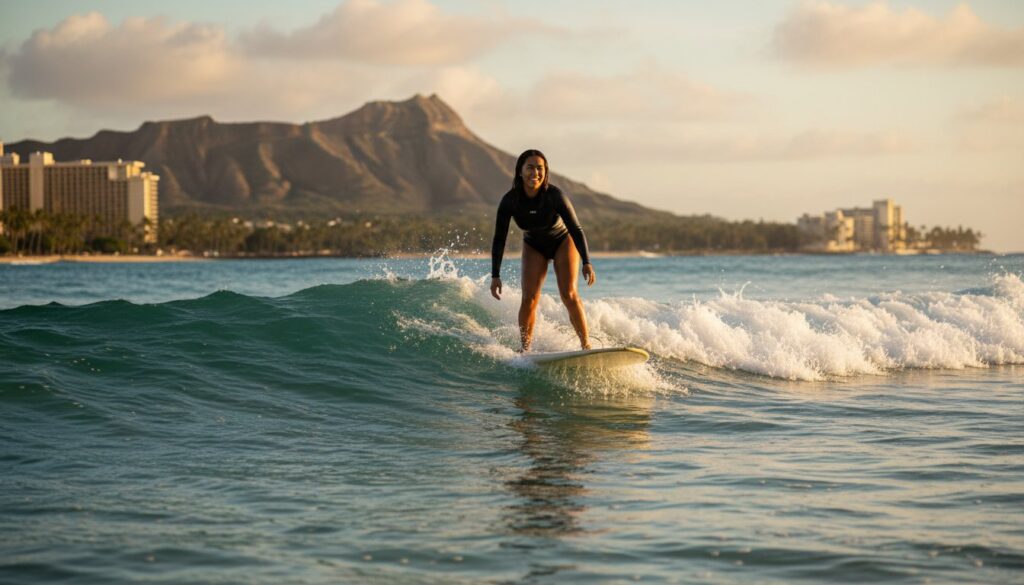
Waikiki’s surf breaks are the product of a rare natural design. Offshore reefs slow and shape incoming ocean swells into long, mellow, rolling waves that peel consistently and predictably. The result is waves that: For a deeper walkthrough, see our Waikiki Surf Guide 2026: Ride the Waves with the Original Beach Boys.
- Travel slowly enough to give beginners ample time to pop up and find their balance
- Break over soft, sandy bottoms — not sharp reef — meaning wipeouts are harmless and fun
- Arrive with consistent, readable intervals so instructors can time your ride perfectly
- Reach a comfortable height of 1–3 feet most days, with forgiving push rather than overwhelming force
- Occur in warm 76–80°F water year-round — no wetsuit required, ever
These are not lucky accidents. These are the specific conditions that made Duke Kahanamoku choose this beach to share surfing with the world — and they’re why nearly every first-time surfer who comes to Waikiki stands up on their board before their lesson ends.
The Birthplace of Aloha Surfing and the Legacy of Duke Kahanamoku
Waikiki is not merely a beautiful beach — it is the spiritual origin point of modern surfing as the world knows it. Duke Kahanamoku, a native Hawaiian Olympic swimmer and the undisputed father of modern surfing, built his legacy right here. He and the original Waikiki Beachboys were not just instructors; they were ocean ambassadors, cultural stewards, and watermen of the highest order who introduced the history and spirit of surfing to visitors from every nation.
That legacy is alive and present every single day on this beach. Taking Waikiki surf lessons here isn’t a vacation checkbox — it is a living cultural rite of passage. You are joining a tradition that has flowed through these waters for generations, guided by the same Aloha spirit that Duke himself embodied. That is something no other surf destination on Earth can authentically offer.
The Best Surf Breaks for Beginners in Waikiki
Waikiki is not a single surf spot — it is a chain of named breaks stretching along the coastline, each with its own personality. Understanding which breaks are right for beginners — and which require more experience — helps you ask the right questions when booking your Waikiki surf lesson.
Canoes — The Classic Beginner Break
Canoes is the most famous and most beloved beginner break in all of Waikiki — and arguably the world. Named for the outrigger canoe rides that have launched from this spot for over a century, Canoes produces long, slow, friendly waves that give beginners the longest possible ride time. Most reputable Waikiki surf schools conduct their beginner lessons here. The bottom is sandy, the crowd is beginner-friendly, and the energy is electric with people experiencing their first wave. This is where surf history was made and where your story begins.
Populars (Pops) — The Next Step
Populars, or “Pops,” sits just to the west of Canoes and offers slightly more powerful, faster-breaking waves. This is a great progression break for those who have had one or two lessons and want to build on their fundamentals. Expect a livelier lineup with a mix of locals and visitors. Intermediate-level surf students will feel at home here.
Queens — Gentle and Wide
Queens is another classic Waikiki break that offers long, wide rides with a gentle slope. It is often less crowded than Canoes during peak morning hours and provides a wonderful alternative for beginner and lower-intermediate surfers. Ask your instructor about Queens if you want a slightly different experience on your second lesson.
🏄 Pro Tip: Always ask your surf school exactly which break your lesson will be held at and why they chose it for beginners. A school that can answer that question clearly and specifically — referencing the wave type, the bottom composition, and the crowd level — is a school that genuinely prioritizes your learning and safety.
How to Choose an Authentic Waikiki Surf School
Walk along the sand and you will see them everywhere: colorful tents, rows of longboards, smiling faces. The marketing all looks the same. But the actual experience — and more importantly, your safety — can be worlds apart. Here is exactly how to separate the real thing from a tourist assembly line when choosing your Waikiki surf lessons.
Credentials and Certification — Non-Negotiable Standards
Before anything else, verify these credentials:
- State of Hawaii Business License: All surf schools operating commercially in Waikiki must be properly licensed. If they can’t confirm this immediately, walk away.
- City & County of Honolulu Beach Concession Permit: Operating on Waikiki Beach requires a specific permit. Schools with permanent, permitted operations are accountable in ways pop-up operators are not.
- CPR and First Aid Certification: Every instructor in the water should carry current certification. This is not optional — it is a fundamental safety requirement.
- General Liability Insurance: Reputable schools carry it. Ask directly.
Instructor Quality — The Heart of Your Lesson
The quality of your instructor makes or breaks your Waikiki surf lesson. Look beyond a friendly smile and ask real questions: For a deeper walkthrough, see our Surfing Terms 101: A Guide to Waikiki Surf Lingo and Hawaiian Traditions.
- Local roots and lineage: Native Hawaiian or multigenerational local instructors carry cultural knowledge that no training manual can replicate. They understand the ocean, the currents, and the history of this place as an inheritance, not a job.
- Years of experience in Waikiki specifically: Reading these specific breaks takes years. An instructor who learned in California or Australia brings different knowledge than one raised on these exact waters.
- Communication style: The best instructors have a gift for translating complex body mechanics into simple, encouraging cues. Ask how they explain the pop-up to a nervous beginner.
- Student-to-instructor ratio: A maximum of 4:1 is the industry standard for beginner group lessons. Anything higher dilutes the coaching you receive and compromises safety.
Lesson Structure — What a Quality School Always Includes
Every high-quality Waikiki surf lesson follows a proven structure. If a school skips any of these, consider it a red flag:
- Equipment fitting: Proper board selection for your height, weight, and experience is essential. Beginners need large, stable longboards — not shortboards.
- Land-based safety briefing: At least 15 minutes on the sand covering body positioning, the pop-up technique, how to fall safely, surf etiquette, and ocean awareness before entering the water.
- Active water coaching: The instructor should be in the water with you — not standing on the shore watching. They should be reading waves, lining you up, and physically assisting your rides.
- Post-session debrief: A brief recap of what you did well and what to work on next is a hallmark of instructors who genuinely care about your progression.
✅ Your Complete Waikiki Surf School Checklist
- Licensed and permitted by the State of Hawaii and City & County of Honolulu
- All instructors CPR and First Aid certified
- School carries general liability insurance
- Maximum 4:1 student-to-instructor ratio for beginner groups
- Native Hawaiian or multigenerational local instructors with Waikiki-specific experience For a deeper walkthrough, see our Top Surf Instructors in Waikiki.
- Mandatory land-based safety briefing before entering the water
- Instructor actively in the water during your lesson
- Positive, verifiable reviews on Google, TripAdvisor, and Yelp with responses from ownership
- Genuine Aloha spirit — you feel welcomed as a person, not processed as a transaction
Group vs. Private vs. Semi-Private Waikiki Surf Lessons: Full Comparison
One of the most important decisions you will make is choosing the right lesson format. Each option has a specific ideal student profile, and picking the wrong format can significantly affect your experience. Here is an honest, detailed comparison.
Group Waikiki Surf Lessons — Social, Affordable, and Full of Stoke
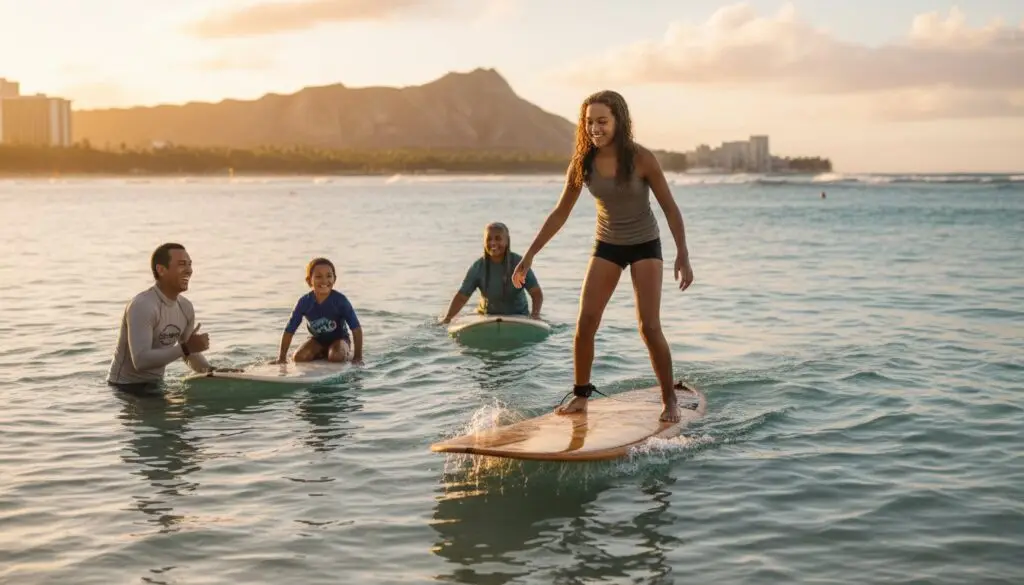
Group lessons gather 2–6 students with one instructor for a shared learning experience. The energy is infectious, the price is accessible, and the social dimension adds real joy to the experience.
- Pros: Most affordable format; high-energy, fun atmosphere; social motivation as you cheer each other on; you learn by watching your group succeed and make corrections.
- Cons: Instructor time is shared; pace is set by the group, not you individually; less suitable for students with mobility challenges, anxiety, or very young children.
- Best for: Healthy adults on their first or second surf, solo travelers looking to meet people, groups of friends wanting a shared laugh, budget-conscious adventurers.
- Typical price in Waikiki (2026): $75–$95 per person.
Private Waikiki Surf Lessons — Maximum Coaching, Fastest Results
A private lesson means 100% of your instructor’s focus, 100% of the time. Every wave, every tip, every correction is tailored exclusively to you. Surfing is now officially recognized as an official high school sport in Hawaii — and the same focused coaching principles that develop competitive young surfers are applied in premium private lessons.
- Pros: Fastest progression, maximum safety, completely personalized pacing, ideal for students with specific needs or physical considerations.
- Cons: Highest price point; some students actually thrive more with the social energy of a group setting.
- Best for: Children under 10 (keiki), adults with a fear of water or anxiety, serious beginners aiming to surf independently within their trip, anyone with physical limitations.
- Typical price in Waikiki (2026): $125–$175 per person.
Semi-Private Waikiki Surf Lessons — The Smart Middle Ground
Semi-private lessons pair 2–3 students with one instructor. You get significantly more personal attention than a group lesson while sharing the cost and the fun. This is the single best value format for most visitors.
- Pros: Near-private level of attention, meaningful cost savings vs. private, retains the social fun of learning alongside someone.
- Cons: Requires coordinating with another person; not available at all surf schools.
- Best for: Couples, a parent-and-child pair, or two best friends who want to share the experience and the waves side by side.
- Typical price in Waikiki (2026): $100–$130 per person.
| Format | Group Size | Price / Person | Attention Level | Best For |
|---|---|---|---|---|
| Group | 2–6 students | $75–$95 | Shared | Social adults, budget travelers |
| Semi-Private | 2–3 students | $100–$130 | High | Couples, parent & child |
| Private | 1 student | $125–$175 | 100% focused | Kids under 10, nervous beginners, fast-trackers |
Waikiki Surf Lesson Pricing Breakdown (2026)
Understanding the full cost of your Waikiki surf lesson before you book prevents surprises and helps you evaluate what is and isn’t included. Here is what a fair, transparent pricing structure looks like in 2026.
What Should Always Be Included in the Price
- Surfboard rental for the duration of your lesson (beginner-appropriate longboard) For a deeper walkthrough, see our Waikiki Surfboard Rental Guide: Gear Up with the Original Beach Boys.
- Rash guard (long-sleeve for sun and board protection)
- Surf leash attached to your ankle
- Land-based instruction before entering the water
- In-water instructor assistance for the full session duration
What May Cost Extra
- Reef-safe sunscreen (bring your own and apply 20 minutes before arrival)
- Waterproof action camera footage — some schools offer GoPro video packages as add-ons
- Extended lesson time beyond the standard 90-minute session
- Board rental after the lesson if you want to keep surfing independently
Red Flags in Pricing
- Prices dramatically lower than the market rate often indicate unlicensed operators or inflated student-to-instructor ratios
- Hidden fees added after booking for equipment that should be included
- No cancellation policy clearly stated upfront
💡 Value Tip: The best investment you can make is not always the cheapest lesson — it is the lesson that gives you the highest chance of standing up on your first wave. A $150 private lesson that gets you confidently riding is a far better value than a $60 group lesson where you spent 90 minutes on your stomach. Match the format to your specific needs and goals.
What to Expect Step-by-Step: Your First Beachboy Lesson
The warm Waikiki sun is on your skin. The sound of gentle waves fills the air. The moment you have been imagining is finally here. Here is an honest, minute-by-minute look at what your first Waikiki surf lesson with a real Beachboy instructor actually feels like, so you can arrive calm, prepared, and ready to have the time of your life.
- Arrival and Check-In (Minutes 0–10): You arrive at the beach tent and are greeted by name. A staff member confirms your booking, collects any waivers, and introduces you to your instructor. The vibe is relaxed, warm, and immediate — no fluorescent-lit lobby, no hold music. You are already part of the family.
- Equipment Fitting (Minutes 10–15): Your instructor selects the right board for your height and weight — always a large, stable foam-top longboard for first-timers. They size your rash guard, attach the leash to your ankle and explain exactly what it does, and answer any questions you have before you take a single step toward the water.
- Land-Based Safety Briefing (Minutes 15–30): This is the most important 15 minutes of your lesson. On the sand, your instructor draws lines, demonstrates body positioning, and walks you through the pop-up technique step by step. You will practice it multiple times — lying on the board, hands under your chest, springing to your feet — until the movement feels automatic. You will also learn: how to fall safely (always fall flat, away from the board), basic surf etiquette (right of way rules in the water), and how to read small waves so you understand what your instructor is watching for.
- Paddling Out (Minutes 30–40): Your instructor accompanies you into the water, board in hand. They guide you through the small shore break — which feels much larger when you’re in it for the first time — and paddle with you to the inside position at Canoes. This is an experience in itself: looking back at the famous Waikiki skyline from the water, the warm ocean around you, the gentle swell lifting and lowering your board. Most students later say this moment alone was worth the trip.
- Your First Waves (Minutes 40–80): Now for the main event. Your instructor watches the horizon, reads incoming swells, and positions your board perfectly. When the right wave arrives, they give you the signal and, if needed, give your board a firm push to connect you to the wave’s energy. You hear it: “Paddle, paddle, paddle — NOW!” The board accelerates. You feel the ocean taking you. You push up, plant your feet, and… you are standing. Whether your first ride lasts 3 seconds or 30, the feeling is identical: pure, unfiltered joy. Your instructor will repeat this process throughout the session, offering real-time feedback and encouragement between every wave.
- Post-Session Debrief (Minutes 80–90): Back on the sand, your instructor takes a few minutes to recap your session honestly. What you did well. What your body naturally got right. What to focus on if you surf again. Many students book their next lesson right here, still grinning, board tucked under their arm.
Best Time of Year and Time of Day for Waikiki Surf Lessons
Timing your Waikiki surf lesson correctly makes a real difference in the quality of your experience. Here is what the locals know that the tourists often don’t.
Best Time of Day: Early Morning Is King
Book a morning lesson — ideally between 7:00 a.m. and 10:00 a.m. Here’s why:
- Calmer winds: Waikiki’s trade winds build throughout the day. Morning sessions feature the smoothest, glassiest wave surfaces — ideal for reading the ocean and catching clean rides.
- Less crowded lineup: Fewer surfers mean more waves per student, less waiting, and a more relaxed, safe environment.
- Lower UV intensity: Cooler morning light is easier on first-timers before the midday Hawaiian sun reaches full strength.
- More consistent swell: Morning swells tend to arrive with greater consistency before afternoon onshore winds chop the surface.
Best Time of Year: Waikiki Works Year-Round
One of Waikiki’s greatest gifts is its year-round consistency. The water temperature stays between 74°F and 80°F every month of the year — no wetsuit, no cold shock, just warm, welcoming ocean. Here is what changes seasonally:
- Summer (May–September): South swells deliver the most consistent beginner waves to Waikiki’s south-facing breaks. This is peak surf lesson season. Expect larger crowds but excellent wave conditions. For a deeper walkthrough, see our Surf Rental in Waikiki: The Ultimate Guide to Riding the Waves with Aloha.
- Winter (October–April): North swells light up the famous North Shore surf but actually keep Waikiki’s south-facing breaks smaller and even more gentle — making winter an underrated time for beginners. Fewer tourists also means more personal attention from instructors.
- Spring and Fall “shoulder” seasons: The sweet spot. Good waves, manageable crowds, and competitive lesson pricing. If you have flexibility in your travel dates, April–May or September–October are outstanding times to book your Waikiki surf lessons.
What to Wear and Bring to Your Waikiki Surf Lesson
Preparation is simple. Here is the complete list of what to wear, bring, and do before your lesson so you can focus entirely on catching waves.
What to Wear
- Swimsuit or board shorts: Your primary layer. Wear something snug enough not to shift in the water.
- Rash guard: Your school will provide one, but you can wear your own under theirs if you prefer extra coverage.
- No jewelry: Remove watches, rings, and necklaces before entering the water. Lost jewelry in the ocean is gone forever.
What to Bring
- Reef-safe sunscreen: Apply 20–30 minutes before you arrive so it has time to absorb. Hawaii law mandates reef-safe formulas — look for mineral (zinc or titanium dioxide) sunscreens. This protects the coral reef and your skin.
- Towel and dry change of clothes: You will be soaked and you will want to be comfortable after your session.
- Water bottle: Ocean activity in the Hawaiian sun is dehydrating. Drink before and after your lesson.
- A small snack: A light snack 60–90 minutes before your lesson keeps your energy high without making you feel heavy in the water.
- Leave your phone in your bag (or hotel): It will only tempt you and slow down your learning. Be present. The waves and the Aloha deserve your full attention.
What Your School Provides
- Beginner foam-top longboard (sized to you)
- Surf leash
- Long-sleeve rash guard
- Expert instruction, safety briefing, and in-water coaching
Waikiki Surf Lessons for Kids and Families
Waikiki is one of the most genuinely family-friendly surf destinations on the planet. The gentle, warm waves and the nurturing spirit of authentic Beachboy instruction create an environment where children thrive and parents relax. Here is how to make your family’s first surf experience a memory that lasts decades.
Minimum Age and Physical Requirements
- Most schools accept children as young as 5 years old for surf lessons, provided they can follow basic instructions and are comfortable in the water.
- All students — children and adults alike — must be comfortable in the ocean and able to swim at a basic level. You do not need to be an Olympic swimmer, but you must be able to handle yourself if you fall off your board in waist-to-chest-deep water.
- Children under 10 years old should always be booked for private one-on-one lessons. The additional attention is not a luxury for young keiki — it is essential for their safety, confidence, and enjoyment.
Tips for a Successful Family Surf Day
- Book separate lesson formats by age and ability: A parent who has surfed before may want a different instructor or format than a 7-year-old learning for the first time.
- Morning lessons are especially important for children: Kids are more energetic and focused before the afternoon heat and fatigue set in.
- Apply children’s reef-safe sunscreen 30 full minutes before the lesson and bring a small bottle for reapplication after.
- Celebrate every moment: The goal is not standing for a full wave — it is the joy of trying. Children who feel celebrated at every stage learn faster and love surfing for life.
Beyond Surfing: Outrigger Canoe Rides and Waikiki Water Adventures
Surfing is the heart of Waikiki’s ocean culture, but it is not the entire story. The original Waikiki Beachboys were masters of every form of ocean navigation — and that tradition of multi-craft ocean mastery is alive and available to you today.
Outrigger Canoe Surfing — Ride the Waves as Ancient Hawaiians Did
An outrigger canoe ride at Waikiki is one of the most exhilarating and culturally profound experiences available anywhere in the Hawaiian Islands. You and your family or group paddle out into the lineup, your guide reads the incoming swells, and on the right wave — the crew paddles hard and the canoe surges forward, accelerating down the face of the wave. The sheer speed and power is unlike any experience on a surfboard. It is primal, joyful, and deeply connected to Hawaiian heritage. No experience is required — just a willing heart and ready arms.
This is a perfect companion activity to your surf lesson: experience both the individual challenge of surfing and the collective, communal power of canoe surfing on the same day.
Why Star Beachboys Is Waikiki’s Most Trusted Surf School
You have now done the research. You know what to look for, what questions to ask, and what separates a genuine cultural experience from a tourist assembly line. So let us be direct about who we are and why we believe we deserve to be your guide on the water.
Over 50 Years of Living Legacy
The Rutledge family has been sharing the spirit of Aloha on this beach for over 50 years. Our instructors are not seasonal hires or gap-year travelers passing through Hawaii with a surfboard. They are career watermen — uncles, brothers, cousins — who have spent their entire lives reading these specific waves at Canoes and Queens. This is their home. The ocean is their life. That is not marketing copy. That is the unvarnished truth, and it shows in every lesson. Author: Star Beachboys (Rutledge family), longtime Waikiki watermen — see About page for instructor bios and credentials.
We are the living continuation of the original Waikiki Beachboys — the men who stood beside Duke Kahanamoku and carried the torch of Aloha into the modern era. We don’t teach surfing as a product. We share it as a culture, a heritage, and a genuine act of welcome. When you take Waikiki surf lessons with Star Beachboys, you become part of our ʻohana — our family — not just for the duration of a 90-minute session, but as part of a story that stretches back generations.
What Makes Star Beachboys Different
- Family-owned and operated: We are not a corporate chain with rotating management and anonymous staff. The same family that built this operation still shows up on this beach every single day.
- Authentic cultural connection: Our instructors carry the direct legacy of the original Waikiki Beachboys — not as a brand story, but as lived family history.
- Safety is our first value: All instructors hold current CPR and First Aid certification. Small group ratios are a firm commitment, not a guideline we bend when business is busy.
- Outrigger canoe experiences: In addition to surf lessons, we offer authentic outrigger canoe surfing — the complete Waikiki ocean experience under one roof. For a deeper walkthrough, see our Hawaii Surf Lessons in Waikiki: Experience the Authentic Beach Boy Legacy.
- Top-rated by real guests: Our reputation has been built entirely through word of mouth and genuine guest experiences — not paid placement or manufactured reviews.
The waves are waiting. Our family is on the sand.
Come share the stoke with the original Waikiki Beachboys and make a memory that will last a lifetime. For a deeper walkthrough, see our Waikiki SUP Rental Guide 2026: Paddle Through Paradise with the Star Beachboys.