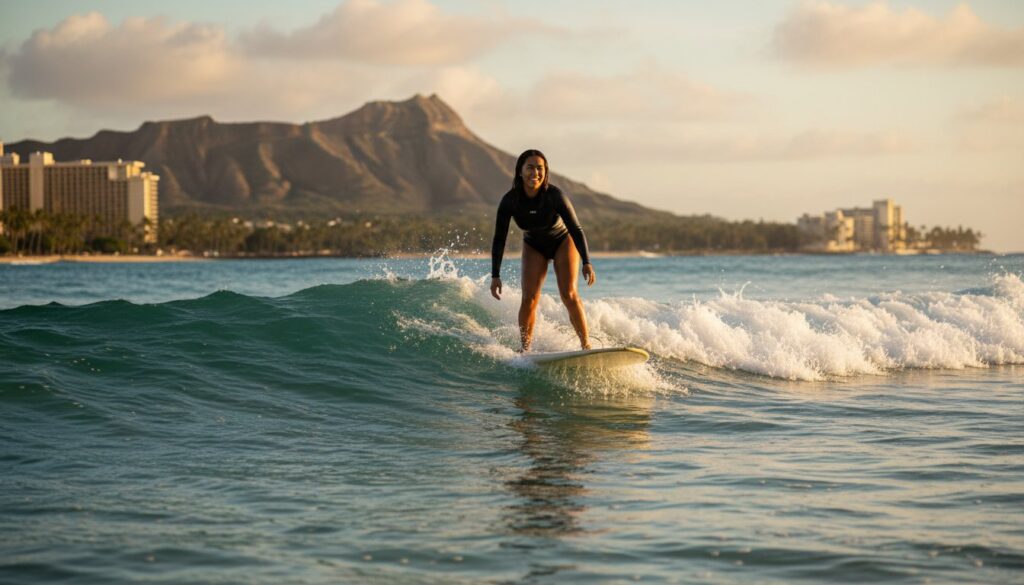
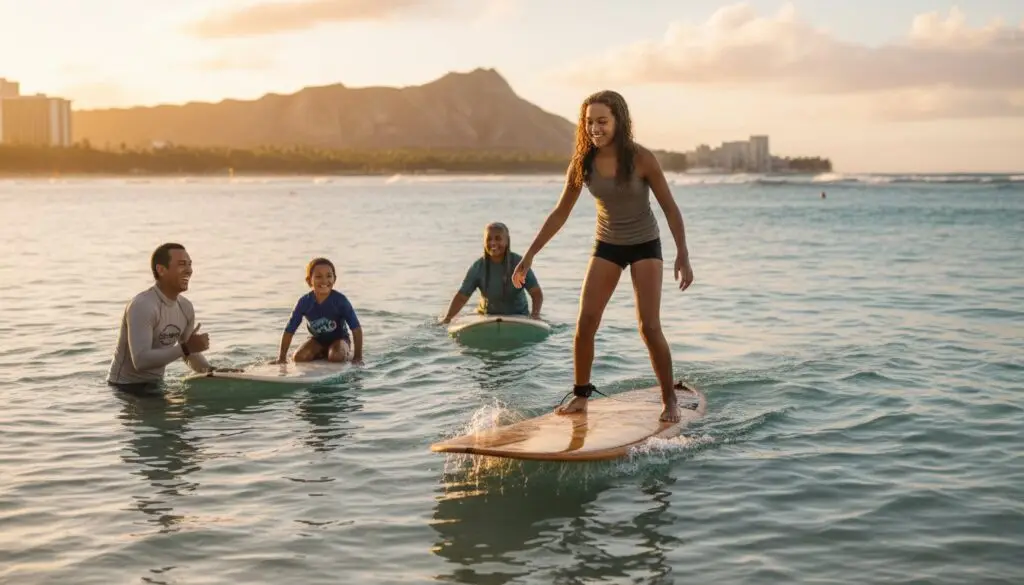
What if the key to the perfect Waikiki surf experience wasn’t about finding an empty wave but about having a trusted Waikiki Surf Guide and the right Ohana? You’ve seen the photos of Waikiki’s legendary turquoise rollers and dreamed of gliding across that warm, glassy water. Then you see the crowds and the questions start: Where do I go? Is it safe for my kids? Will I just get in the way? What’s it actually like out there? That feeling is shared by nearly every visitor who first stands on this sand.
Aloha! We’re the Star Beachboys — a family rooted in Waikiki surf culture since 1974. This isn’t a generic travel article. It’s your personal invitation to ride the waves the way Duke Kahanamoku himself rode them: with skill, joy, and deep respect for the ocean. We’ll show you every break on the strip, break down exactly what to expect from your first lesson, teach you the local code of conduct that earns respect in the lineup, and help you feel the living spirit of Hawaiian surfing.
Ready to discover the waves, the history, and the Ohana? Let’s paddle out.
⚡ Key Takeaways
- Pinpoint the perfect Waikiki surf break for your skill level — from the gentle rollers at Canoes to the long walls of Queens and the outer peaks of Populars.
- Know exactly what to expect before, during, and after your first surf lesson, including what’s included, how much it costs, and what the “First Wave” guarantee means.
- Master local lineup etiquette — the unwritten rules of Aloha that keep every session safe, fun, and welcoming for everyone.
- Understand when to book a lesson vs. rent a board, including which board types work best in Waikiki’s conditions.
- Connect with the deep roots of Hawaiian surf culture, from Duke Kahanamoku’s legacy to the original Waikiki Beach Boys — and why it all still matters today. For a deeper walkthrough, see our Best Surf School in Waikiki: Star Beach Boys Complete Guide.
- Get practical planning details: best time of day to surf, what to wear, parking, reef-safe sunscreen laws, water temperature, and more.
The Heart of Waikiki Surf: A Living Legacy of Aloha
Welcome to Waikiki — where Diamond Head keeps its ancient watch over the world’s most storied surf break. This isn’t just a beautiful beach. It is the cradle of modern surfing, the shore where Hawaiian royalty first rode waves on massive olo boards carved from koa wood. The same royal energy that drove those early riders still flows through every gentle swell that reaches these shores. You feel it the second your feet touch the sand.
The practice of heʻe nalu — wave sliding — is one of the oldest traditions in Polynesian culture. Ancient Hawaiian society structured social life around the surf: certain breaks were reserved for aliʻi (chiefs), while commoners rode others. This deep cultural reverence for the ocean is what gave birth to the Aloha Spirit — an ethic of joy, generosity, and mutual respect that remains the living code of the Waikiki surf lineup today.
Duke Kahanamoku: The Father of Modern Surfing
No figure looms larger over Waikiki surf history than Duke Paoa Kahanamoku. Born in Honolulu in 1890, Duke was a five-time Olympic swimming medalist — earning his first gold at the 1912 Stockholm Games — and a native Hawaiian waterman of extraordinary grace. He used his global platform to share the sport of surfing with the world, giving demonstrations in California, Australia, and beyond. His famous 1914 surfing exhibition in Sydney, Australia, is widely credited with introducing surfing to that continent.
Duke taught that surfing was not sport alone — it was a philosophy. A way to connect with the ocean’s mana (spiritual power) and to share joy freely with every person who stepped onto the sand. His bronze statue stands at the edge of the water on Kalakaua Avenue, lei-draped and facing the sea, a daily reminder of what Waikiki surf culture truly stands for: grace, humility, and pure aloha.
The Original Waikiki Beach Boys
In the early 1900s, as the first wave of visitors discovered Hawaiʻi, a remarkable group of local men took up positions on the sand in front of the Moana and Royal Hawaiian hotels. These were the original Waikiki Beach Boys — true watermen who served as the world’s first professional surf instructors, lifeguards, outrigger canoe captains, and cultural ambassadors all in one. Duke himself was among them.
They were storytellers and entertainers who shared their profound knowledge of tides, currents, and wave patterns with every visitor who walked their stretch of sand. That tradition — now well over a century old — is exactly what the Star Beachboys carry on today. It’s not a recreation. It’s an unbroken lineage, and it makes every lesson here unlike anything else in the surf world.
Why Waikiki Is Still the World’s Best Place to Learn in 2026
There is no better classroom on Earth for your first waikiki surf experience. Here’s the evidence:
- Wave quality: Long, slow, rolling swells that break over a mostly sandy bottom — giving you rides of hundreds of feet with forgiving, stable form. Not the violent shore-dump you see in surf movies.
- Year-round warm water: Ocean temperatures average 76°F–82°F (24°C–28°C), meaning no wetsuit required on more than 320 days of the year.
- Multiple skill-level breaks: One stretch of coastline contains beginner, intermediate, and advanced waves — all within paddling distance of each other.
- Deep instructional culture: The Beach Boy tradition ensures an unmatched depth of local knowledge available to visitors at every level.
- Welcoming community: The lineup is genuinely inclusive — surfers from age 5 to 85, from every corner of the world, riding waves together with shared stoke.
Every Waikiki Surf Break Explained: From Beginner to Advanced
The Waikiki coastline stretches roughly two miles from the Hilton Hawaiian Village in the west (Ewa direction) to Diamond Head in the east (Diamond Head direction). Think of it as a natural surf school with multiple classrooms, each suited to a different skill level — see our Surf Waikiki guide for a deeper historical perspective.
🏄 Canoes — The Beginner Playground
Skill level: True beginner | Wave height: 1–3 ft | Bottom: Mostly sand | Best tide: Mid-tide
Directly in front of the Moana Surfrider hotel sits Canoes — the best place to learn in Waikiki. The waves here are long, gentle rollers that peel slowly and predictably, giving beginners enormous amounts of time to get to their feet. The sand bottom is forgiving on falls. Rides can extend for several hundred feet, which is rare anywhere in the world at a beginner break. You’ll share the water with traditional outrigger canoes gliding through a marked channel; stay to the Ewa (west) side of that channel and you’ll have plenty of room to play. Pro tip: Mid-tide produces the magic here — at low tide some reef patches can be exposed, and at high tide the wave goes a bit mushy.
🏄 Queens — The Crown Jewel of Waikiki Longboarding
Skill level: Beginner-intermediate | Wave height: 2–5 ft | Bottom: Shallow reef | Best swell: South swell 2 ft+
Paddle just west of Canoes and you reach Queens — arguably the most beloved waikiki surf break on the strip. On a solid south swell, the right-hand wave at Queens peels beautifully for over 100 yards, making it a longboarder’s paradise — learn more about nearby Waikiki surf spots and how each break behaves.
🏄 Publics — Faster, More Competitive
Skill level: Intermediate | Wave height: 2–5 ft | Bottom: Reef | Vibe: Busier, faster-paced
Just past Queens, Publics offers a slightly faster, more dynamic wave that draws a more competitive crowd. The etiquette here matters more than anywhere else at Waikiki — lineup positioning, right-of-way, and take-off timing are non-negotiable. Understanding these rules before you paddle out at Publics will make the difference between a frustrating session and a great one. This is also where Hawaiian surf tradition most visibly meets modern competitive surfing culture.
🏄 Populars (“Pops”) — The Outer Escape
Skill level: Intermediate | Wave height: 2–6 ft | Bottom: Reef | Paddle time: 10–15 min from shore
Far from shore, visible as a long rolling wall far out to sea, Populars — affectionately called “Pops” — offers a mellow, uncrowded refuge from the busy inside breaks. The 10-to-15-minute paddle can feel daunting for first-timers, but our Beach Boys know the tidal channels that make the journey far easier than it looks. Once you’re out there, you’ll find an older, calmer crowd — the local aunties and uncles who have surfed Pops since before most visitors were born. The waves are longer and more consistent than the inside breaks, and the payoff for the effort is real.
🏄 Threes & Fours — Diamond Head Side Power
Skill level: Intermediate–advanced | Wave height: 3–8 ft | Bottom: Reef | Swell direction: South–southeast
Moving toward Diamond Head, the breaks at Threes and Fours pick up considerably more power and speed on solid south and southeast swells. These breaks are where Waikiki transitions from a beginner paradise into a true surfer’s wave — faster sections, more powerful lips, and a local crowd that earns its priority through years in the water. Not recommended for first-timers, but a meaningful progression target for anyone who wants to grow their surfing in Waikiki‘s natural classroom.
🏄 Rice Bowls & Outside Castles — For the Experienced
Skill level: Advanced | Wave height: 4–10 ft+ | Bottom: Reef | Access: Long paddle or water taxi
The outermost reef breaks off Waikiki come to life on larger south swells, producing powerful, barreling waves that bear no resemblance to the gentle rollers at Canoes. These spots are for experienced surfers only — heavy reef, strong current, and a lineup that has no patience for beginners. But for skilled riders, they represent the raw power of the Hawaiian ocean at its finest.
When and How to Surf Waikiki: Tides, Swells, Seasons & Timing
One of the most underrated skills in surfing is knowing when to paddle out. The same break can feel completely different depending on the tide, the swell direction, the wind, and the time of day. Here’s everything you need to plan the best possible waikiki surf session.
Best Time of Day to Surf Waikiki
The ideal window is 7:30 AM to 11:00 AM. Here’s why:
- Wind: Hawaiʻi’s trade winds typically build from the northeast through the morning. Early sessions catch the calmest surface conditions — glassy, smooth water that makes waves far easier to read and ride.
- Crowds: Fewer people in the water, especially at Canoes, means more waves per session and a more relaxed vibe for beginners.
- Visibility & heat: The early sun lights up the water beautifully without the punishing midday heat. UV intensity is significantly lower before 10 AM.
- Afternoon trade winds typically pick up around 1 PM, making the water choppier — still surfable, but less forgiving for beginners.
Best Swell Season for Waikiki
- Summer (May–September): South swells generated by storms in the Southern Hemisphere light up all of Waikiki’s main breaks. This is peak season for the classic waves at Canoes, Queens, and Pops. Wave heights typically range from 1 to 5 feet — ideal for beginners and intermediates.
- Winter (November–March): North swells dominate and hit the North Shore hard, but Waikiki sits in the swell shadow of the island and typically remains gentle. Winter is often smaller at Waikiki, which can actually make it even more beginner-friendly.
- Spring & Fall: Transitional seasons offer a mix of smaller south and wrap-around swells. Conditions vary but are generally very pleasant for learning.
Reading Tides at Waikiki
Waikiki has a mixed semi-diurnal tide cycle, meaning two high and two low tides per day of varying heights. For most of the main breaks:
- Mid-tide (incoming): The gold standard for Canoes and Queens. Waves are well-formed, the sand bottom is covered, and the break is consistent.
- Low tide: Some reef sections become exposed at Canoes, creating hazards. Better avoided for beginners. Queens and Publics can actually get a bit sharper and more defined at low tide — fine for intermediates.
- High tide: Waves tend to go soft and mushy at Canoes. Fine for canoe surfing, less ideal for surfboard lessons.
Surf Lessons vs. Board Rentals: Making the Right Choice
You’re standing on the warm sand of Waikiki. Diamond Head is glowing behind you. The question now is simple: how are you getting on those waves? Here’s an honest breakdown of both options.
✅ Book a Surf Lesson If You:
- Have never surfed (or have fewer than 5 sessions under your belt)
- Are bringing children or family members who need 1-on-1 attention
- Want to progress fast and avoid developing bad habits
- Care about safety in a crowded lineup
- Want to understand Waikiki’s cultural history, not just ride a wave
- Want a guaranteed stoke experience — not trial and error
🏄 Choose a Board Rental If You:
- Already know how to paddle, pop up, and read waves
- Are comfortable navigating a crowded lineup independently
- Understand basic lineup etiquette and right-of-way rules
- Simply want extended time in the water on familiar waves
- Have surfed before and want an affordable, flexible session
Choosing the Right Surfboard for Waikiki
In Waikiki, volume is your best friend. The gentle, rolling waves reward larger boards, and the crowded conditions demand stable, predictable equipment. Here’s how to pick:
- Soft-top longboard (9–12 ft): The gold standard for beginners and casual surfers. Maximum stability, maximum wave-catching ability, and soft rails that won’t hurt if the board bumps into you or another surfer. Rentals start at $20/hour.
- Epoxy longboard (9–11 ft): For intermediate surfers who want more glide and the ability to walk the board. Slightly less forgiving on impact but offers a truer longboard feel.
- Funboard / Mini-Mal (7–8.5 ft): A versatile middle ground for surfers who have mastered the basics and want to start exploring more dynamic surfing. Still stable enough for Waikiki’s conditions.
- Shortboard (under 7 ft): Not recommended for Waikiki’s break style unless you’re an experienced surfer. The gentle waves simply don’t generate enough power to make a shortboard perform well here.
2026 Surf Lesson Pricing in Waikiki
Waikiki surf lesson prices in 2026 typically range from $100 to $200 per person, depending on format and provider. For comparisons of nearby instruction options and schooling styles, see best surf schools to decide what fits your goals.
- Group lesson (up to 4 students, 90 min): $125 per person — includes board, rash guard, and certified instruction from a native Hawaiian Beach Boy.
- Private lesson (1-on-1, 90 min): $195 per person — maximum attention, fastest progression, ideal for children or anyone with specific goals.
- Canoe surf ride (shared outrigger, 30 min): Available for families and non-surfers — the most accessible way to feel a Waikiki wave.
- Board rentals: From $20/hour, with secure beachside lockers available.
All lesson prices include equipment, instruction, and our signature “First Wave” guarantee. No hidden fees. Just stoke.
What to Expect in Your First Waikiki Surf Lesson (Step by Step)
Over 95% of our first-time students catch a real wave and stand up during their very first lesson. That’s not marketing — it’s the result of a methodology refined over 50 years on this exact beach. Here’s precisely what happens from the moment you arrive to the moment you paddle back in with a massive smile.
- Check-in & board fitting (5 min): You meet your instructor under the red umbrellas in front of the Moana Surfrider. They assess your height, weight, and experience level and hand-pick a longboard sized precisely for your body — not a generic rental grabbed off a rack.
- Gear up (5 min): You’re fitted with a clean, long-sleeved rash guard for sun protection. Your instructor checks that your reef-safe sunscreen is applied and that you’re ready for the ocean.
- On-sand instruction — the “pop-up” drill (15 min): Before touching the water, you practice the pop-up movement on the sand until it’s muscle memory. Your instructor breaks the motion into three simple steps, corrects your stance, and builds the neural pathway you’ll use automatically once the wave picks you up. This is the secret to our 95%+ success rate — most people who fail to stand up do so because they never drilled this on land.
- Water entry & paddling technique (10 min): In waist-deep water, your instructor teaches you how to lie on the board correctly, paddle efficiently, and avoid the most common beginner mistake: paddling with your hands instead of your whole arm. They also show you how to read an incoming set and position yourself.
- Catching your first wave (60 min): This is where the magic happens. Your instructor paddles alongside you, reads the incoming sets, and tells you exactly when to paddle. They physically push the board at the right moment, the wave grabs you, and you pop up. Repeat, improve, celebrate.
- Debrief & next steps: Your instructor shares feedback, celebrates your progress, and recommends what to work on if you want to keep surfing — whether that’s tomorrow on a rental or your next trip to Waikiki.
⚠️ Safety first: All Star Beachboys instructors are certified in water safety and CPR. U.S. Coast Guard-approved life vests are available for any student who requests one. Our instructors maintain a constant visual of every student in the water at all times. Your safety is the foundation of everything we do — and it’s why the Beach Boy tradition has maintained a perfect safety record on this beach for over a century.
Lineup Etiquette: Surfing with the Spirit of Ohana
Out here, the ocean is our living room, and you’ve just walked through the front door. The Waikiki surf lineup is one of the most diverse, welcoming places on any ocean — but only when everyone follows the unwritten code. These aren’t arbitrary rules. Every one of them exists to keep people safe and keep the stoke alive for everyone sharing the water.
The Core Rules of the Lineup
- Right of way — the peak rule: The surfer closest to the peak (the spot where the wave first begins to break) has the right of way on that wave. Always look both ways before committing to a paddle. If someone is already up and riding toward you, that’s their wave. Attempting to take off on it is called “dropping in,” and it’s the single most disrespectful and dangerous thing you can do in the lineup.
- One surfer, one wave: The basic principle of rotating turns ensures everyone gets a chance. Party waves with friends are a celebrated exception — just make sure it’s genuinely mutual and fun, not you cutting off a stranger.
- No snaking: Don’t repeatedly paddle around other surfers to get closer to the peak and “steal” their position. The lineup is a queue. Wait your turn. This kind of positioning play earns zero respect and will get you cold-shouldered fast.
- Hold your board: In a crowded lineup, a runaway surfboard is a weapon. If you fall near other surfers, never throw your board away from you — hold on or control its direction. Your board is your responsibility.
- Communicate: A quick “You going?” before paddling for a wave can prevent a collision. “Heads up!” warns people nearby of a fall or incoming board. Communication is free and saves everyone pain.
- The shaka: This simple hand gesture — pinky and thumb extended, middle fingers folded — is the universal language of Waikiki. It means: I see you. I respect you. We’re cool. Use it freely.
Respecting Local Surfers and the Land
You will see men and women in the Waikiki surf lineup who have been riding these exact waves since the 1960s. They are the living keepers of this tradition. Give them space. Watch how they move. Let a wave pass if they’re clearly in position for it. You are a guest in their home, and acting like it — with genuine respect, not performance — is always noticed and always rewarded with warmth.
The concept of malama ʻaina — to care for the land — extends into the ocean. Since Hawaii’s Act 104 went into effect on January 1, 2021, only reef-safe sunscreen is permitted in the state’s waters. Chemical sunscreens containing oxybenzone and octinoxate are harmful to coral reef ecosystems and are now prohibited. Use a mineral-based SPF 30+ sunscreen applied at least 20 minutes before entering the water. The reef thanks you.
Hazard Awareness at Waikiki
Waikiki is friendly — but it’s still the Pacific Ocean, and the Pacific Ocean demands respect. Be aware of:
- The east-side current: On south swells over 3 feet, a channel current forms to the east of the Royal Hawaiian Hotel (the pink one). It can pull surfers eastward without warning. Your Beach Boy instructor will identify this for you before you paddle out. Understanding Hawaiian wave safety is a core part of our instruction.
- Reef falls: When falling near reef, fall flat — arms out, like a starfish or pancake. Never stand up suddenly in shallow water. Never plant your feet straight down. This prevents injuries and is reflexively taught in every lesson we give.
- Canoe zones: Traditional outrigger canoes use marked channels at Canoes break. Stay out of these channels to avoid a collision with several hundred pounds of moving wooden boat.
- Sharks: Encounters near Waikiki’s shallow, busy surf breaks are extremely rare. In over 50 years of operations, Star Beachboys has never had a negative shark encounter during a lesson. Our instructors remain vigilant, and the active, populated nature of this stretch of ocean means it is not preferred shark habitat.
What to Bring, Wear & Know Before You Go
Great surfing starts on shore. Here’s everything you need to know so that when you arrive at the beach, the only thing on your mind is the wave in front of you.
What to Wear
- Swimsuit or board shorts: Form-fitting, flexible, and secure. Avoid anything with metal buckles or drawstrings that could catch on the board.
- Rash guard: Provided by Star Beachboys for all lessons. Protects against sunburn and board chafing during the lesson. Long-sleeved is recommended.
- No wetsuit needed: With water temperatures between 76°F and 82°F year-round, wetsuits are unnecessary for the vast majority of Waikiki sessions. One less thing to pack.
What to Bring
- Reef-safe sunscreen (SPF 30+): Applied 20 minutes before your lesson. This is not optional — it’s legally required and environmentally essential in Hawaiian waters.
- A towel: For after your session. Everything else is provided.
- Water bottle: Surfing is physical exercise. Stay hydrated, especially in the tropical sun.
- A secure place for valuables: Star Beachboys offers beachside lockers. Don’t leave anything visible in your car or unattended on the beach.
- Your sense of adventure: Seriously. That’s all. We handle everything else.
Getting to Waikiki Beach & Parking
Waikiki is accessible via TheBus (Honolulu’s public transit), rideshare apps (Uber/Lyft are widely available), and bicycle. Driving to Waikiki during peak hours (8–10 AM and 3–6 PM) comes with significant traffic and limited, expensive parking. The best option for a morning surf lesson is to stay within walking distance of the beach or use transit. If you drive, the Waikiki Beach Center parking lot and several nearby city garages offer validated or metered parking — arrive before 8 AM to secure a spot without stress.
📍 Finding Star Beachboys: Look for the iconic red umbrellas directly in front of the Moana Surfrider hotel on Kalakaua Avenue. You can’t miss the biggest smiles on Waikiki Beach. Walk up and say Aloha — we’re ready when you are.
The Ultimate Waikiki Experience: Star Beachboys
You’ve learned about the waves, the breaks, the etiquette, and the history. Now it’s time to meet the family. At Star Beachboys, we don’t sell surf lessons. We share a living legacy. Since 1974, the Rutledge family has stood on this exact stretch of sand — more than 50 consecutive years of carrying on what the original Beach Boys began over a century ago. That kind of continuity doesn’t exist anywhere else in the world of surf instruction. This guide is produced and reviewed by the Rutledge family (Star Beachboys), local instructors with over 50 years of continuous Waikiki experience.
Our native Hawaiian instructors don’t just know technique — they know this ocean the way you know your neighborhood. They know which swell direction produces magic at Queens. They know the tide stage that makes Canoes perfect. They know where the current runs and which channel makes the paddle to Pops feel effortless. This is knowledge passed down through generations, not learned from a certification manual. It makes every lesson here genuinely different from anywhere else you could surf in the world.
Canoe Surfing: The Most Accessible Waikiki Wave Experience
Not ready to stand on a board? Perfect — we have the next best thing. Our traditional Hawaiian outrigger canoe rides are the most accessible way for absolutely anyone to feel the thrill of a Waikiki wave; learn about our family-friendly options and multi-generation experiences on Family surf lessons.
The outrigger canoe isn’t a modern tourism gimmick. It is the oldest form of wave riding in Hawaiian culture — a tradition that predates surfing as the world knows it. Riding one with a Beach Boy at the helm connects you directly to that ancient history. It’s the original party wave, and the smiles are 100% guaranteed.
The Rutledge Legacy — 50+ Years of Aloha
When you paddle out with a Star Beach Boy, you’re not getting a transaction. You’re becoming part of an extended Ohana — a family that has welcomed visitors to this shore through more than five decades of changing tides, seasons, and generations. That’s the Rutledge promise: a safe, fun, and deeply authentic experience where you leave the water not just as a better surfer, but as someone who genuinely understands what Waikiki surf culture means and why it matters.
Ready to Ride?
The waves are perfect. Your board is ready.
Join the Ohana — Surf Lessons on Waikiki or canoe ride online today. We’ll see you under the red umbrellas!
Frequently Asked Questions About Waikiki Surf
The joy of being on the water isn’t limited to any one coast or activity. For those who love exploring scenic waterways with family and friends, a different kind of adventure awaits in the Pacific Northwest. If you’re looking for a luxury charter experience in that region, check out Roam Yacht Charters.
Your Waikiki Wave Awaits
Paddle Into the Legacy
You’ve learned about the breaks, the history, and the Ohana. Now it’s your turn. Come ride where it all began — with the family who has kept this tradition alive for over half a century. Rated #1 for authentic Waikiki beach experiences.