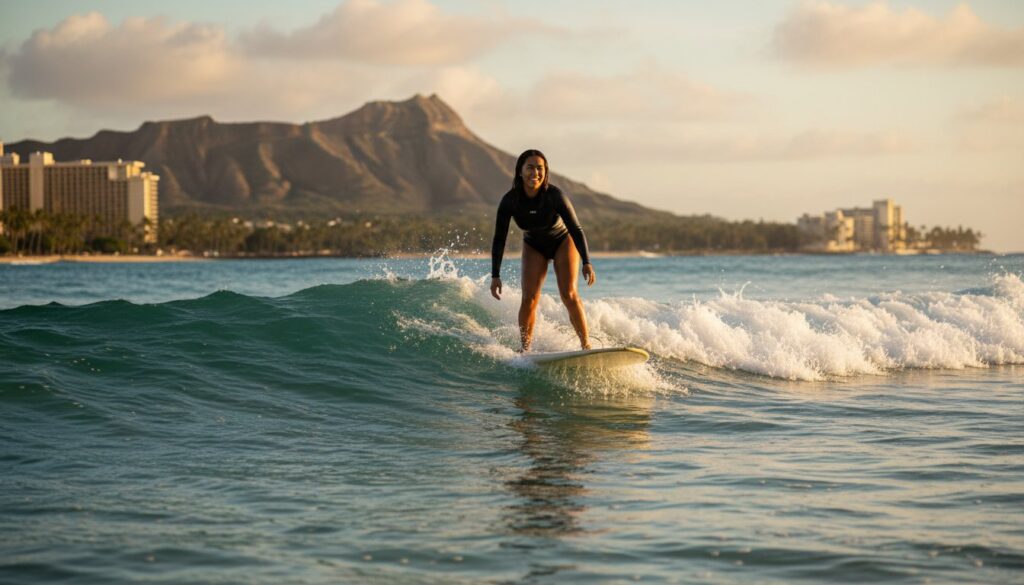
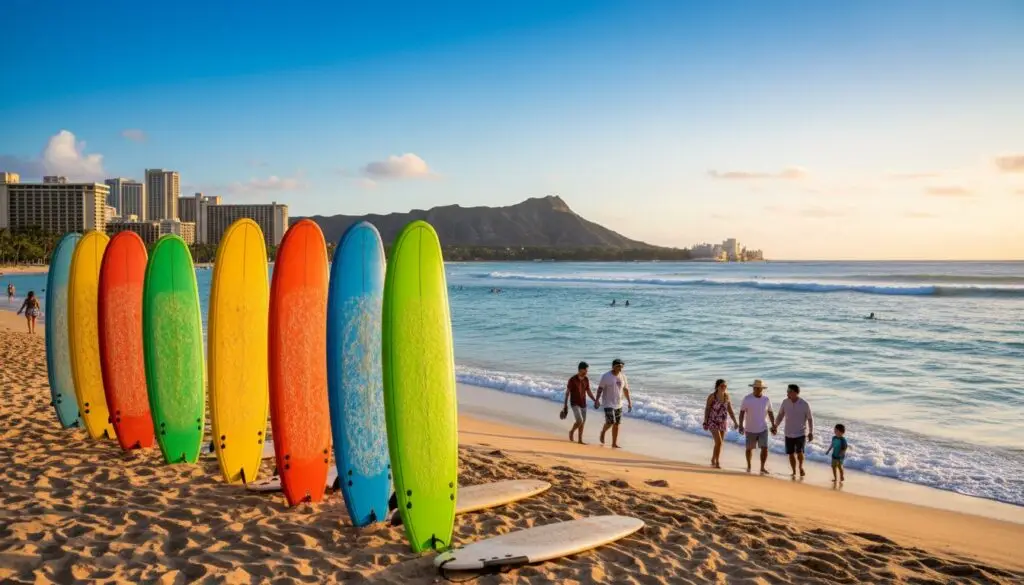
Family Surf Lessons Oahu — Star Beachboys · Waikiki, Oahu · Est. 1972
Family Surf Lessons Oahu: The Complete 2026 Guide to Multi-Generational Surfing in Waikiki
Everything your ohana needs to know — from choosing the right lesson and understanding what to expect in the water, to safety tips for kids and seniors, what to pack, and how to book Waikiki’s most authentic experience. For a deeper walkthrough, see our What Should I Expect from My First Surfing Lesson?.
Family Surf Lessons Oahu — Aloha! Picture this: your whole ohana laughing under the Hawaiian sun, riding long, gentle Waikiki waves together. It’s the vacation memory that lasts a lifetime. But the planning? That’s where the stress sneaks in. Will the little ones be safe? Is it really OK for grandma and grandpa to try? What do you do when one kid is fearless and another is terrified of the ocean? And how do you avoid the tourist traps that leave families bored, sunburned, and overcharged?
We hear you — and we’ve answered every one of those questions below. This is the most complete guide to best surf school for families Oahu has to offer in 2026. Whether you’re planning for toddlers, teens, seniors, or everyone at once, you’ll find everything you need right here — from the science behind why Waikiki’s waves are perfect for beginners, to exactly what happens during a lesson, what gear is provided, what it costs, and how to lock in your spot before they sell out.
At Star Beachboys, we have been sharing the spirit of Aloha on this legendary beach since 1972 and leading families into the ocean. Learn more about our family surf lessons Oahu.
Key Takeaways
- Waikiki’s unique reef geology creates the safest, most forgiving beginner waves on the planet — ideal for every generation simultaneously. For a deeper walkthrough, see our Best Surf School Waikiki: The Complete 2025 Guide to Every Top Option.
- The right lesson type (private, semi-private, or group) depends on your family’s ages, ability levels, and group size — and we break all of it down clearly. For a deeper walkthrough, see our Are There Discounts for Group Surf Lessons?.
- Children under 12 should always receive 1-on-1 instruction; seniors benefit from modified technique coaching that protects joints and builds confidence fast.
- All gear — soft-top boards, leashes, rash guards — is included. You just need reef-safe sunscreen, a swimsuit, and a towel.
- Book 3–6 months ahead for summer and holiday dates; morning sessions (7–9 AM) offer the calmest conditions and smallest crowds.
- Star Beachboys is Waikiki’s only surf school rooted in the original Native Hawaiian Beach Boy tradition — over 50 years of cultural authenticity no franchise can replicate. For a deeper walkthrough, see our Hawaiian Surfing Lessons: Learn to Surf in Paradise.
Why Waikiki Is the World’s Best Classroom for Family Surf Lessons
When you’re searching for the best family surf lessons Oahu can offer, location is the single most important decision you’ll make before you ever step into the water. Learn more about surf lessons on Waikiki and why the reef-formed waves favor beginners. Waikiki doesn’t just happen to be a great learning spot — it is, by the physics of its underwater geography, literally engineered for beginners of every age. Understanding why gives every parent and grandparent one less thing to worry about.
The Geology Behind Waikiki’s “Gentle Giant” Waves
Waikiki’s waves are soft, long, and predictable for a very specific scientific reason. A wide, shallow coral reef shelf lies just below the surface and acts as a natural energy diffuser. As ocean swells move over this reef, their energy is spread across a large area and their speed dramatically slows. Instead of rearing up into a steep, crashing wall of water (like you’d find on the North Shore), the waves at Waikiki crumble gently into white water — what surfers call “mush” — and roll steadily toward shore for 100 feet or more.
That long ride time is everything for a beginner. It means a seven-year-old and a sixty-five-year-old have the same generous window to find their feet, balance, and stand up. There is no rush, no punishment, and no danger. It’s the reason surf instructors around the world call Waikiki the most consistent beginner break on earth.
Star Beachboys operates directly in front of two of the most celebrated beginner breaks on this stretch: “Canoes” and “Queens.” These two spots are our home breaks — and they have been for over 50 years. Canoes, named after the outrigger canoes that launched from this spot for centuries, offers wide, rolling waves that allow multiple riders to share the same wave simultaneously. We call these “party waves,” and they are the reason entire families can ride side by side, cheering each other on, on the very same swell.
North Shore vs. Waikiki: Why the Choice Matters for Families
This is one of the most common questions we receive from mainland families planning an Oahu trip. The North Shore of Oahu is legendary for producing the most powerful surf in the world — home to the Banzai Pipeline and the Vans Triple Crown of Surfing. In winter (October through April), waves regularly reach 20 to 40 feet. Even in summer’s “flat season,” North Shore breaks are unpredictable and powerful compared to Waikiki.
For a family’s first surf experience, there is simply no comparison. Waikiki is safer, more consistent, more culturally historic, and objectively more appropriate for beginners of every generation. If you have an experienced teenage surfer in the family who wants to advance beyond beginner lessons, we can discuss appropriate North Shore spots for supervised surf sessions — but for learning together as an ohana, Waikiki is the answer every time.
Surfing Where Hawaiian Royalty Once Played
This is no ordinary beach. The history of surfing traces directly to these waves. The aliʻi — Hawaiian chiefs — once reserved the best breaks at Waikiki for themselves, riding carved wooden boards in a practice called heʻe nalu (wave sliding). This royal tradition gave birth to the Waikiki Beach Boys, a brotherhood of Native Hawaiian watermen who kept the culture alive and shared it with visitors from around the world beginning in the early 1900s.
The greatest of all Beach Boys, Duke Kahanamoku — Olympic gold medalist, ambassador of Aloha, and the man who introduced surfing to the world — called this stretch of sand home. Our stand sits just steps from his iconic bronze statue. When your family learns to surf with us, you’re not just taking a water sports lesson — you’re stepping into a living tradition that is more than a century old and deeply woven into the soul of Hawaii.
Choosing the Right Lesson Type for Your Ohana: Private, Semi-Private & Group Explained
The biggest planning mistake families make when booking family surf lessons in Oahu is assuming one format fits everyone. Your choice of lesson type directly determines how much personal attention each family member receives, how safely the kids are managed in the water, and ultimately how much fun everyone has. If you need guidance specifically for youngsters, see surf lessons for kids. Here is a complete breakdown to help you decide.
Private Family Lessons — The Gold Standard for Multi-Generational Groups
Best for: Families with children under 12, mixed ability levels, nervous beginners of any age, toddler-to-grandparent combos, or any family that wants the undivided attention of a dedicated instructor.
In a private lesson, one of our experienced Beach Boy instructors is dedicated solely to your family from the moment you arrive on the sand. There are no other students, no shared attention, and no waiting. Your instructor adapts in real time — spending extra minutes helping your hesitant six-year-old build confidence on the shore break while simultaneously coaching your teenager to improve their pop-up technique.
For young keiki (children), private instruction is not a luxury — it is the safest and most effective choice. Your instructor can physically position themselves beside or behind each child in the water, time the push precisely, and be right there in the first moments of every ride. This level of supervision simply cannot happen in a group setting with multiple students competing for one instructor’s attention. Private lessons can accommodate families of five, six, or more — just let us know your group size at booking.
Semi-Private Lessons — Shared Stoke, Personal Coaching
Best for: Couples, siblings or friends with similar ability levels, or small groups of 2–4 confident swimmers aged 12 and older.
Semi-private lessons offer an excellent middle ground: you share an instructor with a small group, which reduces the per-person cost while still ensuring meaningful personal coaching time. This format works beautifully for pairs or trios who are relatively matched in comfort level. You’ll cheer each other on, share laughs at the inevitable wipeouts, and still receive enough individual feedback to make real progress. Semi-private lessons are not recommended for children under 12, as the divided attention reduces both safety and learning outcomes.
Group Lessons — Social, High-Energy, Budget-Friendly
Best for: Teenagers and adults aged 13+, confident swimmers, family reunions, and cost-conscious travelers who prioritize shared energy over personalized coaching.
Group lessons are high-energy, social, and undeniably fun. You’ll learn the basics alongside other adventurous people, riding the same waves and building that universal camaraderie that only comes from shared staggering wipeouts and unexpected triumphs. Group lessons cover all the fundamentals thoroughly — paddling technique, pop-up mechanics, ocean awareness — and are the most cost-effective entry point for larger groups of teens and adults. For families where the adults want a budget-friendly session while the young kids take private lessons, this hybrid approach is one of our most popular booking strategies.
Managing the “Age Gap”: What to Do When Your Family Has Mixed Abilities
This is the most nuanced planning question we receive, and it deserves a direct answer. Let’s say your family consists of a 6-year-old, a 14-year-old who has surfed once before, two adult parents who are beginners, and a grandparent who is cautious about physical activity. Here is the framework we recommend:
- Children 5–11: Always book 1-on-1 private instruction. Non-negotiable for safety and success.
- Teens 12–17 with zero experience: Private or semi-private is ideal; they can join a group lesson if they are strong, confident swimmers who are socially comfortable in a group setting. For a deeper walkthrough, see our What Is the Difference Between Group and Private Surf Lessons?.
- Adults with no prior surf experience: All three formats work well. Choose based on budget and desired pace — private if you want the most coaching, group if you want the most fun energy. For a deeper walkthrough, see our How Do I Choose a Surf School for My Family?.
- Seniors and guests with physical considerations: Private instruction is strongly recommended. Our instructors can adapt the entire technique approach to accommodate mobility, balance, or flexibility needs in ways that are impossible in a group format.
Not sure which format is right for your specific group? Contact us directly before booking. We are happy to talk through your family’s exact makeup and recommend the best structure to ensure every single person has a great time. Surfing is described by cultural scholars as an integral part of Hawaiian identity and cultural expression — we take our responsibility to introduce it properly very seriously.
What to Expect: A Complete Walk-Through of Your Surf Lesson
One of the biggest sources of family anxiety before a surf lesson is simply not knowing what’s going to happen. Parents worry their child will be pushed into deep water immediately. Nervous adults fear they’ll be the only one who can’t stand up. Seniors wonder if the pace will overwhelm them. We eliminate all of that uncertainty right here. See the best surf school for families for comparison and booking tips.
- Arrival & Check-In (0–10 minutes): Find our iconic blue-and-white tent just to the Diamond Head side of the Duke Kahanamoku statue on Waikiki Beach. Our team will greet you, confirm your booking, fit you with your rash guard, and pair you with your instructor. This is also the moment to raise any physical concerns, medical notes, or special requests — the more we know before you hit the sand, the better we can tailor the experience.
- The Land Lesson (10–30 minutes): Everything starts on the sand — no water yet. Your instructor will teach you the four core skills that determine whether you stand up on your first wave: (1) proper paddle technique, (2) the “pop-up” — how to go from lying to standing in one fluid motion, (3) basic stance and balance, and (4) ocean awareness — how to read the incoming wave, understand where the white water is, and know when to paddle. For young keiki, this land session often includes playful games and humor to dissolve nerves. For seniors, the instructor will demonstrate and coach a modified, lower-impact pop-up variation right here on the sand before anyone touches the water.
- Entering the Water & Board Introduction (30–40 minutes): Your instructor leads the group into the water at a pace set by the most cautious member of your family — no rushing, no drama. You’ll begin in the shallow white water section, where waves have already broken and are simply rolling toward shore in a calm, knee-deep wash. Here, your instructor will demonstrate wave timing in real conditions and give each person a first feel for how the board moves beneath them. For very young children, this may also include a tandem ride — your child sits or lies on the front of the instructor’s board for their very first wave, so they experience the feeling of riding with zero pressure or risk.
- Catching Your First Waves (40–75 minutes): This is where the magic happens. Your instructor will position each family member on the board, read the incoming wave, and give a well-timed push at exactly the right moment. In our experience, the overwhelming majority of first-time riders — children and adults alike — stand up on their first or second attempt in Waikiki’s forgiving white water. Your instructor is in the water beside you for every ride, offering real-time feedback, making small adjustments to your stance, and escalating the challenge as your confidence grows. For families with mixed abilities, private lessons allow instructors to work with one person at a time while others practice independently in the shallow break.
- Wrap-Up, Photos & Post-Lesson Stoke (75–90 minutes): The final stretch is about consolidating what you’ve learned and celebrating together. Your instructor will gather the family for a brief debrief — what you did well, what to work on if you return for a second lesson, and any questions you have. If you’ve brought a waterproof camera or GoPro, your instructor will help you organize group shots in the water. Our professional beach photographers (available for an additional booking) are positioned on the sand during peak session hours and know exactly when to capture that triumphant standing-on-the-board moment. This is when you’ll hear your family cheering for each other — a sound you’ll carry home with you.
A Note on Wipeouts: They’re Part of the Fun
Every new surfer wipes out. It is not a failure — it is an unavoidable, often hilarious part of learning. Our land lesson covers proper wipeout technique: how to fall off the board sideways rather than forward, how to protect your head, and how to surface calmly. In Waikiki’s shallow, gentle white water, a wipeout means you slide off your board and stand up in waist-deep water. There is no drama. The children almost always laugh. The adults almost always do too, eventually.
Safety Deep-Dive: The Beach Boy Standard for Kids, Teens & Seniors
“Is it really safe?” is the first question every parent and every adult child of a senior asks us. The answer is yes — and we’ll explain precisely why, because “trust us” is not enough when your family is involved. When you choose Star Beachboys for your family surf lessons in Oahu, safety is not a marketing bullet point. It is a half-century-old operating standard built into every decision we make, from where we position our lessons to which boards we put your children on. Here is exactly how we keep your ohana safe.
Our Instructors: Native Hawaiian Watermen with Generational Ocean Knowledge
Our instructors are not seasonal hires. Many are Native Hawaiian watermen who grew up on the Waikiki breaks where modern surfing began and who have spent their entire lives reading these specific currents, tides, and swells. This ancestral connection to the Moana (ocean) means they do not just read waves intellectually — they feel them. They know, before a set arrives, whether conditions are right or need adjustment. All instructors are certified in water safety and first aid, and they operate in continuous communication with each other across the surf zone.
This is the critical difference between learning with a legacy school and booking with a pop-up operator who hires seasonal staff. Ocean intelligence is earned over years, not memorized from a training manual.
The Gear That Protects Your Family
- Soft-Top Surfboards: Every student learns on a foam-top (soft-top) board — the widest, most stable, most buoyant learning platform available. These boards are specifically designed to maximize beginners’ ability to stand up and minimize the impact of any board contact during a wipeout. The foam deck provides grip and the rounded rails prevent sharp edges. These are not cheap rental boards — they are professional-grade teaching tools.
- Ankle Leashes: Every board is equipped with a leash that attaches to your ankle, keeping the board close after a wipeout and preventing it from washing away or becoming a hazard to other surfers.
- High-Visibility Rash Guards: We provide bright, distinctively colored rash guards for every student. This serves two purposes: sun protection across a long session in the Hawaiian sun, and easy visual identification of every member of your group in the water. Your instructor can scan the break and immediately locate every person in your family at any moment.
- Daily Condition Assessment: Before every session, our team assesses wind, wave height, current direction, and water clarity. If conditions fall below our safety threshold at any point — for any reason — we will pause or relocate the lesson. Your safety always takes precedence over schedule.
Surfing with Keiki (Children Ages 5–12)
Our minimum age for surf lessons is five years old. Beyond age, we assess each child individually for ocean comfort, attention span, and physical readiness during the land lesson. No child is pressured into the water before they are emotionally ready — we have learned over decades that a child who enters the water on their own terms and in their own time almost always has a breakthrough experience. Forcing the moment creates fear; earning trust creates surfers.
For very young or nervous children, we begin with a tandem ride — your child rides on the front of the instructor’s board, feeling the wave and experiencing the sensation of surfing with zero physical risk. This trust-building first ride is often the moment a hesitant child transforms into an eager surfer. From there, we progress to white water solo rides with the instructor holding the board, then to independent catching of small broken waves as confidence grows.
Swimming ability requirement for children: Your child does not need to be a competitive swimmer, but they should be comfortable in water and able to float independently. The lesson takes place in shallow, knee-to-waist-deep water. If your child is not yet a comfortable swimmer, we recommend signing them up for a 1-on-1 private lesson so the instructor can remain at their side at all times.
Surfing for Seniors and “Silver Surfers” — You Are Never Too Old
We have helped guests in their 70s and 80s ride their first wave on Waikiki. This is not marketing hyperbole — it happens regularly, and the reactions are among the most joyful moments we witness in any given season. Surfing in Waikiki’s gentle white water is a low-impact activity that places minimal stress on joints when executed with proper technique.
For seniors, our instructors are trained in several important adaptations:
- Modified Pop-Up Technique: The traditional pop-up requires significant upper body strength and hip flexibility. For guests with limited mobility, we teach a “step-up” alternative — a two-stage movement that is much easier on the lower back, knees, and wrists while still getting you to a standing position on the board.
- Longer Boards: We select the most stable, longest boards in our inventory for senior students — maximum volume, maximum stability, minimum difficulty.
- Assisted Entry and Exit: Our instructors assist seniors entering and exiting the water, navigating the sandy bottom, and stabilizing the board whenever needed.
- Health Consultation Before the Lesson: If you or a family member has a cardiovascular condition, recent surgery, significant joint issue, or any other concern, please inform us at booking and again at check-in. We can make appropriate adjustments and, if necessary, recommend a brief consultation with your physician before participating.
The therapeutic effects of ocean immersion — what researchers call “blue mind” science — are well documented. Saltwater exposure, gentle physical activity, and the sensory richness of the ocean environment have demonstrated benefits for stress reduction, mood elevation, and cognitive engagement. For seniors in particular, the combination of gentle exercise, social interaction with family, and the profound sense of achievement from standing up on a wave for the first time produces an emotional response that many describe as one of the highlights of their lives. We do not say that lightly.
Logistics & Planning: Booking, Timing, Costs & What to Pack
The practical details matter just as much as the experience itself. Here is everything you need to know to plan the perfect day of family surf lessons in Oahu without a single logistical headache. For a deeper walkthrough, see our Group Surf Lessons Hawaii: Learn to Ride the Waves Together.
When to Book — And How Far Ahead
Waikiki surf lesson spots — especially private sessions — fill up much faster than most families expect. Here is our general booking timeline recommendation based on travel season:
- Summer (June–August) and Holiday Weeks (Thanksgiving, Christmas, Spring Break): Book 3–6 months in advance. These are peak periods and private morning slots are frequently sold out weeks before arrival.
- Spring and Fall Shoulder Seasons: 4–8 weeks ahead is generally sufficient, though earlier is always better.
- Winter (December–February, excluding holiday weeks): 2–4 weeks ahead is usually adequate, but mornings still book quickly — don’t wait until arrival day.
The Best Time of Day for Family Surf Lessons
Without question, the ideal window for family surf lessons on Oahu is 7:00 AM to 9:00 AM. This is not arbitrary — it is determined by four distinct environmental factors that converge in the early morning and dissipate by mid-morning: For a deeper walkthrough, see our Honolulu Surf Lessons: Learn to Ride Waves in Hawaii.
- Trade Wind Behavior: Hawaii’s trade winds pick up significantly by 10–11 AM, creating choppy surface conditions that make wave reading harder and paddling more tiring for beginners. Early mornings are typically glassy and calm.
- Crowd Levels: Waikiki becomes increasingly crowded as the morning progresses. By 11 AM, the break is shared with dozens of other surfers, stand-up paddleboarders, and outrigger canoes. Early sessions give your family more space and better positioning for waves.
- Sun Intensity: Early morning UV levels are significantly lower than midday. After a 90-minute lesson, the family has a full day ahead without the exhaustion of a peak-sun surf session.
- Children’s Energy: Young children are typically at their freshest, most cooperative, and most patient in the morning. An early lesson means everyone is in the best possible mental state to learn something new.
Where to Find Us
Look for our iconic blue and white tent on the sand, just to the Diamond Head (east) side of the Duke Kahanamoku statue on Waikiki Beach. For complete background about lesson spots and conditions see our Waikiki surf lessons guide.
For grandparents or family members who prefer to stay on shore: The shaded seating areas near the large banyan trees directly behind our tent offer a front-row view of the lesson break. They will be able to see every wave, every wipeout, and every triumphant stand-up from the comfort of the shade. Designate them the official photo crew — they will love it.
Complete Packing List for Your Surf Day
What to bring:
- Reef-Safe Sunscreen: Apply at least 20–30 minutes before you enter the water, so it has time to absorb. Oxybenzone and octinoxate-based sunscreens are banned in Hawaii due to coral reef damage — look for mineral-based formulas with zinc oxide or titanium dioxide. Reapply after the lesson.
- Swimsuit or Board Shorts: That’s all you need to wear in the water. We provide rash guards. Avoid anything with metal hardware (buckles, rivets) that can snag the board or cause skin irritation.
- Towels and a Change of Clothes: One per person minimum. A dry layer to change into post-lesson makes the rest of your Waikiki afternoon dramatically more comfortable.
- Water Bottle: Ocean activity in the Hawaiian sun is dehydrating even in the early morning. Bring one per person, filled before you arrive.
- Light Snack: Particularly important for children — a small snack to eat after the lesson prevents the “I’m starving” meltdown on the walk back to the hotel.
- Waterproof Camera or GoPro: If you want in-water footage of your family’s session. Our instructors are happy to help with filming during lesson downtime.
What to leave at the hotel:
- Wallets, passports, and non-waterproof electronics
- Jewelry (particularly rings and necklaces, which can be lost or damaged in the surf) For a deeper walkthrough, see our How Long Does It Take to Learn to Surf?.
- Anything you would be genuinely upset to lose to the ocean
What we provide: Properly sized soft-top surfboard, ankle leash, and a clean rash guard for every participant. All included in your lesson price. Nothing additional to rent or source.
What Happens if Weather or Conditions Are Poor?
Your safety is always our first concern. We monitor ocean and weather conditions continuously, including wind speed, wave height, lightning risk, and current strength. If we determine that conditions are unsafe on your scheduled lesson day — for any reason — we will contact you proactively and offer a full reschedule or a complete refund. We will never run a lesson in conditions our instructors consider hazardous.
A note on Hawaiian rain: brief tropical showers are extremely common in Waikiki and do not constitute unsafe conditions. You’re going to get wet anyway — a little warm Hawaiian rain typically just adds to the experience and gives everyone a great story to tell. Lessons proceed in light rain. Only lightning, high winds, or unusually large surf will result in a cancellation.
Beyond Surfing: Outrigger Canoe Rides & Other Water Activities for the Whole Family
Surfing is the headline act, but Waikiki’s ocean has more to offer your ohana — and Star Beachboys has been central to all of it for more than 50 years. Here are the complementary experiences that make a full day on the water with us unforgettable.
Outrigger Canoe Rides — Waikiki’s Other Great Tradition
The outrigger canoe is to Hawaii what the surfboard is to California — a vessel of cultural identity, a tool of exploration, and a vehicle for community. Long before the first tourist ever visited Waikiki, Native Hawaiian navigators crossed thousands of miles of open ocean in these remarkable craft. Riding in an outrigger canoe on the same waters where the aliʻi once paddled is a genuinely moving experience — and it is available to every age, every fitness level, and every member of your family who would rather experience the waves without a surfboard under their feet.
Our canoe rides launch directly from our beach location. You paddle out through the gentle Waikiki break with your guide, position the canoe to catch an incoming swell, and then ride it all the way to shore — an experience that is thrilling, accessible, and deeply connected to Hawaiian cultural tradition. Outrigger canoe rides are available as an add-on to any surf lesson booking or as a standalone activity, and they are genuinely perfect for the family members who watch the surf lesson from the beach and decide, halfway through, that they want to be in the water too.
Cultural Storytelling and History in the Water
Every session with Star Beachboys is also a cultural experience. Our instructors — most of whom are Native Hawaiian and grew up in this tradition — naturally weave the history of Waikiki, the story of Duke Kahanamoku, the significance of the breaks you’re surfing, and the meaning of Aloha into the lesson itself. This is not a scripted cultural performance; it is genuine, living knowledge shared from one generation to the next. Your children will go home not just knowing how to surf, but knowing whose shoulders they stood on when they did it.
The Star Beachboys Difference: Authentic Aloha Since 1972
Waikiki has no shortage of surf operations. You can find boards for rent, lessons for hire, and activity desks in nearly every hotel lobby. So why does choosing the right provider matter so much? Because most of them have no roots. They have a business license and a tent. We have 50 years of history, a family legacy, and a direct line to the original Waikiki Beach Boys who gave surfing to the world.
Star Beachboys was founded in 1972 by the Rutledge family and has operated continuously on this beach ever since. We are not a franchise. We are not a hotel-affiliated activity desk. We are a local, Hawaiian family that has been part of this community, this beach, and this tradition for generations. The philosophy has never changed: you are not a customer. You are Ohana. Family.
Our Connection to Duke Kahanamoku and the Original Beach Boys
Duke Kahanamoku — five-time Olympic medalist, sheriff of Honolulu, and the man credited with spreading surfing from Hawaii to the world — embodied the belief that the ocean was meant to be shared and that the spirit of Aloha was the greatest gift any person could offer another. The original Waikiki Beach Boys took that philosophy and made it their life’s work: welcoming every visitor who came to their beach, teaching them to surf, and sending them home carrying a piece of Hawaiian culture they could never have found in a hotel brochure.
Our instructors are the current generation of that lineage. They teach the way the original Beach Boys taught — with patience, humor, deep technical knowledge, and an infectious love for the ocean. When you see your child stand up for the first time and your instructor’s face breaks into a genuine grin that matches your own, you’re witnessing something that cannot be manufactured or scaled by a franchise operation. That is the Beach Boy tradition in its most authentic form.
Supporting a Local Hawaiian Business
When you book with Star Beachboys, your money stays in Hawaii. It supports Native Hawaiian families, funds jobs for local watermen, and helps preserve a cultural tradition that belongs to this place. In an era where large corporate tourism operators have commodified much of the Waikiki experience, choosing a locally owned, family-operated institution is a meaningful act of cultural stewardship — and it produces a better experience for your family in the process. Mahalo for making that choice.
How to Book Your Family Surf Lesson
Our online booking system makes it simple to reserve your spot, select your lesson type, indicate your group size, and note any special requirements — all from the comfort of home. We recommend booking as early as possible for summer and holiday dates. Morning slots go first. Don’t wait until you’re already in Waikiki and find the calendar full.
We can’t wait to see your ohana on the water. Come find us at the blue and white tent, just past Duke, right where we’ve always been. The waves are waiting.
Your Ohana’s Waikiki Adventure Awaits
You now have everything you need to plan the perfect multi-generational surf experience on Oahu. You know why Waikiki’s reef-formed waves are uniquely suited to every age and ability level. For more background and local tips, read our Waikiki surf guide.
The best family surf lessons Oahu has to offer are not the ones with the slickest website or the most hotel-lobby partnerships. They are the ones where your child stands on a board for the first time and your whole family erupts simultaneously. They are the ones where the instructor has spent a lifetime in this water and can’t help but share that joy. They are the ones rooted in 50 years of tradition, Native Hawaiian culture, and genuine Aloha.
That is what we have been offering since 1972. And we will be right here on the sand, ready for your ohana. For a deeper walkthrough, see our What Are Some Tips for Choosing the Right Surf School?.
Frequently Asked Questions About Family Surf Lessons on Oahu
What is the minimum age for children to take a surf lesson on Oahu?
Our minimum age for family surf lessons in Oahu is five years old. Beyond age, we assess each child individually during the land lesson for ocean comfort, focus, and physical readiness. No child is pushed into the water before they are emotionally ready. All children under 12 receive 1-on-1 private instruction for maximum safety and success. The most important factor is not the child’s age but their comfort level in the water — a confident, water-loving five-year-old will almost always have a better first lesson than a nervous eight-year-old.
Do we all need to be strong swimmers for a family surf lesson in Oahu?
You do not need to be a competitive swimmer. A basic comfort level in the water and the ability to float independently is all that is required. Our family surf lessons on Oahu take place in Waikiki’s shallow white water, where depths are knee-to-waist level for most participants. All instructors are water-safety certified and remain in the water with your group at all times. For children or adults who are not yet confident swimmers, a 1-on-1 private lesson ensures the instructor can remain at their side throughout the session.
What is the difference between a private and group family surf lesson in Oahu?
A private lesson dedicates one instructor exclusively to your family group — no other students, full attention, completely flexible pace. This is the recommended choice for any family with children under 12, mixed ability levels, seniors, or nervous beginners of any age. A group lesson shares one or two instructors among multiple students (typically 6–8 people) and is best suited for teens and adults aged 13+ who are comfortable swimmers and prefer the social energy of learning alongside others. Group lessons are more cost-effective; private lessons produce faster skill development and more personalized safety management. Semi-private lessons split the difference for pairs or small groups of matched ability.
Is Waikiki better than the North Shore for a family’s first surf lesson?
Emphatically yes. For any first-time family surf experience on Oahu, Waikiki is the correct choice. The unique coral reef shelf at Waikiki slows and softens ocean swells into long, gentle, crumbling white water waves that are predictable, forgiving, and perfect for beginners of every age. The North Shore produces some of the world’s most powerful surf, with winter waves reaching 20–40 feet — appropriate only for experienced surfers in guided sessions. Waikiki’s “Canoes” and “Queens” breaks are where modern surfing was born and where the original Beach Boys taught the world to surf. It remains the best beginner surf environment on the planet.
Can seniors and older adults really participate in family surf lessons in Oahu?
Absolutely. We regularly teach guests in their 70s and beyond. Waikiki’s gentle waves make surfing accessible at any age, and our instructors are trained to use modified, low-impact techniques — including a “step-up” alternative to the traditional pop-up — that are easy on joints and backs. We also select the most stable, longest-volume boards for senior students and provide physical assistance entering and exiting the water. If you have a health condition, cardiac history, or mobility concern, please let us know at booking so we can tailor the approach. Private instruction is strongly recommended for seniors.
What equipment is included in the lesson price?
Everything you need is included: a properly sized soft-top surfboard, an ankle leash, and a clean high-visibility rash guard for each participant. You do not need to bring or rent any additional equipment. Just bring a swimsuit, reef-safe sunscreen, a towel, and water. Everything else is provided.
What happens if weather or conditions are unsafe on our lesson day?
We monitor conditions continuously and contact you proactively if we determine the session cannot proceed safely due to high winds, lightning, unusually large surf, or other hazards. In that event, we offer a full reschedule or a complete refund — whichever you prefer. Light rain does not cancel lessons; tropical showers are common in Waikiki and typically brief. Only conditions that present genuine safety risks result in cancellation.
Can a family of five or six book a private surf lesson together?
Yes, and this is one of our most popular booking formats. We accommodate families of five, six, or more in private group lessons with dedicated instructors assigned to your ohana. Simply indicate your group size when booking and we will confirm instructor availability and board count. The more information you provide about ages and abilities, the better we can prepare for your specific group.
How far in advance should we book our Oahu family surf lesson for 2026?
For summer (June–August) and holiday weeks (Thanksgiving, Christmas, Spring Break), we strongly recommend booking 3–6 months in advance. Morning private sessions during these periods frequently sell out weeks before arrival. For spring and fall shoulder seasons, 4–8 weeks is generally adequate. Winter non-holiday periods can often be booked 2–4 weeks out. Whenever you are traveling, booking early is the only way to guarantee your preferred lesson type, date, and time slot.