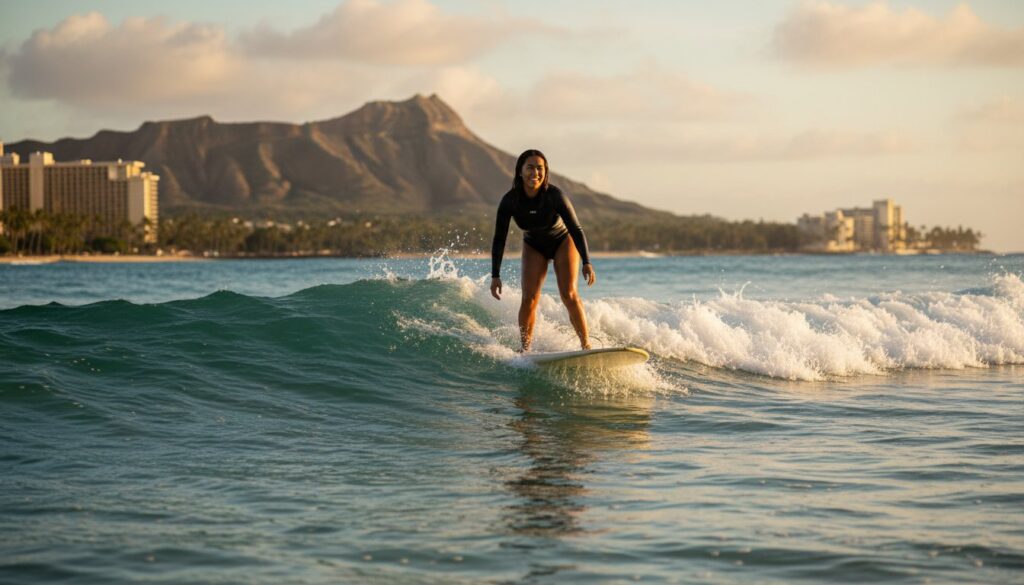
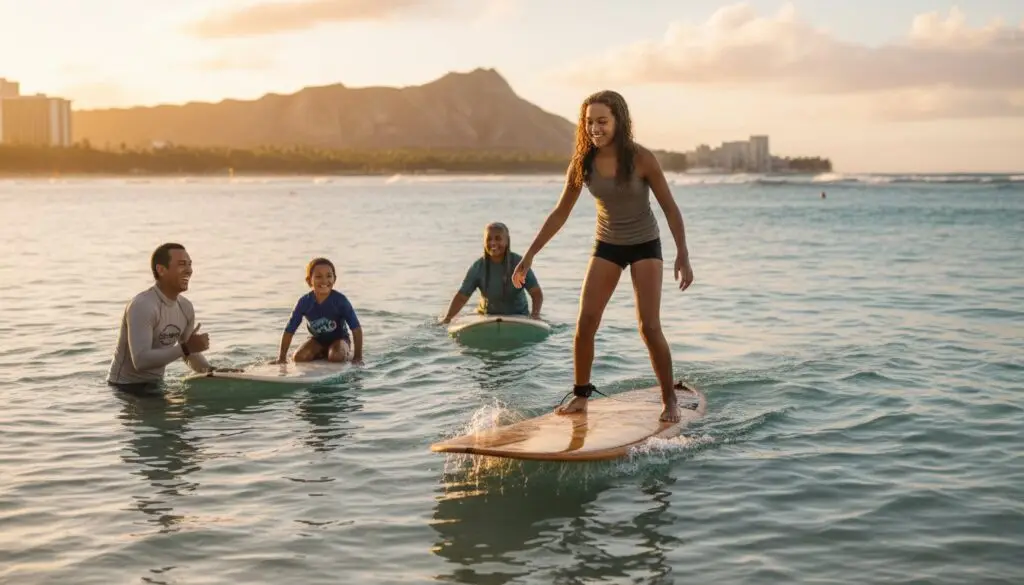
Aloha! That dream of gliding across a perfect Waikiki wave is calling your name — and we hear it too. Maybe a little voice in your head is asking the honest questions: Is it safe? Will I look silly? How do I find a great instructor and not just a tourist trap? We get it completely. Finding the right surf lessons Waikiki Beach has to offer shouldn’t be stressful. It should be the beginning of the most unforgettable story you’ll ever tell.
This is the most complete, locally-rooted guide to Waikiki surf lessons on the internet — packed with real knowledge you won’t find on a brochure stand. We’ll walk you through exactly what makes Waikiki the world’s greatest beginner surfing destination, how to choose between schools (and red flags to avoid), what every minute of your first lesson feels like, how much it really costs, what the surf breaks are actually named, and how the legendary Beachboy tradition will make your experience genuinely different from anywhere else on earth. Let’s go!
⚡ Key Takeaways
- Waikiki’s gentle, rolling waves over a soft sandy bottom make it the safest, friendliest surfing classroom on the planet — no experience required.
- The legendary Waikiki Beachboy tradition, born with Duke Kahanamoku, is what separates a genuine lesson from a tourist transaction.
- Safety credentials, instructor-to-student ratios, and authentic Hawaiian roots are the criteria that actually matter when choosing a surf school.
- Most first-time students stand up and ride a wave during their very first lesson — here’s exactly how that happens, step by step.
- Waikiki surf lesson prices typically range from $75 (group) to $150+ (private) — and what’s included varies enormously between schools.
- Year-round warm water and consistent waves mean there is truly no bad time to book your Waikiki surf lesson.
📋 Table of Contents
- Why Waikiki Beach Is the World’s Best Place to Learn to Surf
- Waikiki’s Famous Surf Breaks: Canoes, Queens & Beyond
- The Waikiki Beachboy Legacy & the Spirit of Aloha
- Duke Kahanamoku: The Father of Modern Surfing
- Your First Surf Lesson: A Complete Step-by-Step Walkthrough
- What to Bring, Wear & Expect on the Day
- How to Choose the Best Surf School in Waikiki
- Group, Private & Semi-Private Lessons Compared
- How Much Do Surf Lessons in Waikiki Cost? (Full Pricing Breakdown)
- Best Time of Day & Year to Take Surf Lessons in Waikiki
- Waikiki Surf Safety: What Every Beginner Must Know
- Learn With Star Beachboys: 50+ Years of Authentic Waikiki Surf Lessons
- Frequently Asked Questions
Why Waikiki Beach Is the World’s Best Place to Learn to Surf
Forget the intimidating barrels you’ve seen in surf movies. Waikiki Beach surf lessons happen in some of the most beginner-friendly water on the planet — and that’s not marketing, it’s pure geography. This is where surfing was rediscovered by the modern world for a reason.
Here’s exactly what sets Waikiki apart from every other beginner surf destination on earth:
🌊
Long, Rolling Waves
Waikiki’s waves travel for what feels like forever, giving you ample time to find your balance, get comfortable, and actually enjoy the ride instead of panicking.
🏖️
Soft Sandy Bottom
No sharp reef, no rocky shallows. The sandy ocean floor at Waikiki takes the fear out of falling completely, making wipeouts a laugh rather than a worry.
🌡️
Warm Water Year-Round
Water temperatures hover between 75°F–80°F (24°C–27°C) all year. No wetsuits, no cold-water shock — just pure, welcoming Pacific Ocean.
📏
Waist-to-Chest Depth
Beginner lessons happen in waist-to-chest-deep water. You can stand up at any time, which is a critical confidence-builder for absolute first-timers.
What makes Waikiki even more special is its natural protection. While other parts of Oahu — like the famous North Shore — are renowned for powerful, expert-level surf, Waikiki is a sheltered bay. Offshore reefs and the geography of the bay itself calm and shape the incoming swells into those long, consistent, welcoming waves. It’s not a coincidence that this is where surfing culture was shared with the world. It was simply the perfect place.
With the majestic Diamond Head (known by its Hawaiian name Lēʻahi) watching over the shore, every moment becomes a living postcard. The setting alone makes your surf lesson at Waikiki Beach unlike anything you’ll experience anywhere else.
Waikiki’s Famous Surf Breaks: Canoes, Queens, and Everything In Between
One of the things that makes choosing Waikiki for your first surf lesson so exciting is the history beneath your feet — or rather, your board. The surf breaks here aren’t just geography; they’re legends in the history of surfing. Here’s your insider guide to the main breaks you’ll hear about:
Experienced Beach Boy instructors have spent their entire lives reading these breaks. They know which spot is working best on any given morning based on tide, wind, and swell direction — and they’ll put you exactly where you’ll have the most success. That local knowledge is genuinely priceless and something no app or guidebook can replicate.
The Waikiki Beachboy Legacy: Surfing with the Spirit of Aloha
Waikiki isn’t just a world-famous beach with beginner-friendly waves. It is the cradle of modern surfing. Before it became the destination the world knows today, this was where legends were born and where the gift of surfing was freely given to the world by extraordinary people called the Waikiki Beachboys.
The original Waikiki Beachboys were native Hawaiian watermen — surfers, canoe paddlers, fishermen, and ocean guides — who made their home on this shore in the early twentieth century. They weren’t employees of a surf school. They were the ocean’s ambassadors, and they shared what they loved with anyone who came to the beach. The first informal surf lessons at Waikiki Beach weren’t commercial transactions; they were acts of genuine Aloha. The very DNA of what a Waikiki surf lesson should feel like comes directly from these men and women.
“The sport of surfing, the spirit of Aloha, the culture of sharing the ocean — none of it spreads to the rest of the world without the Waikiki Beachboys. They are the original surf instructors.” For a deeper walkthrough, see our Surf Waikiki Hawaii: The Ultimate Guide to the Birthplace of Surfing (2026).
— A truth embedded in the documented history of Waikiki Beach
When you choose a surf school that carries this legacy, you get something no chain operation can offer. Learning to surf here means learning malama i ke kai — to respect and care for the ocean. It means becoming part of a surfing ʻohana that stretches back through the generations. It means something.
What ‘Aloha’ Actually Means in Your Surf Lesson
Aloha isn’t just a greeting. In the water with a true Beachboy instructor, Aloha is the entire approach to teaching:
- Patience without judgment: Your instructor is genuinely there for you — whether it takes one attempt or twenty to find your balance. There is no impatience, no clock-watching.
- Encouragement that’s real: You are not a ticket number. Your progress matters. Your instructor shares your stoke, your victories, and your laughter.
- Joy as the fundamental goal: Surfing is supposed to be one of the most joyful experiences a human being can have. The entire lesson is shaped around making sure you feel that.
- Cultural respect: You leave knowing something real about Hawaiian culture, the ocean, and your place in it. That’s a gift that lasts longer than the tan.
Duke Kahanamoku: The Father of Modern Surfing
You cannot talk about surf lessons at Waikiki Beach without talking about Duke Paoa Kahinu Mokoe Hulikohola Kahanamoku. Born in 1890 and raised in Waikiki, Duke was an Olympic gold-medal swimmer who became the living embodiment of the Aloha spirit. He is credited with introducing surfing — a sport that had existed in Hawaii for over a thousand years — to the world beyond the Pacific.
Duke Kahanamoku: Key Facts Every Waikiki Surf Student Should Know
- Born: August 24, 1890, Honolulu, Hawaii
- Olympic medals: Gold in 100m freestyle at the 1912 Stockholm Games; multiple medals across three Olympics
- Global surfing ambassador: Gave surfing demonstrations in Australia (1914), California, and across the United States, effectively igniting a global surf culture
- Life-saving hero: In 1925, he used his surfboard to rescue eight people from a capsized yacht in Newport Beach, California
- Waikiki legacy: Lived on these shores his entire life; his bronze statue stands on the beach at Waikiki to this day
- His gift: He didn’t just share a sport — he shared a philosophy of welcome, respect, and joy that defines authentic Waikiki surf culture to this day
When you take a surf lesson with an instructor descended from the Beachboy tradition, you are learning from people who carry Duke’s torch directly. That lineage is not a marketing tagline. It is the reason choosing the right school matters so much.
Your First Waikiki Surf Lesson: A Complete Step-by-Step Walkthrough
Ready to ride your first wave? The best way to banish any nerves is to know exactly what’s coming. Here is a complete, honest walkthrough of every stage of your first surf lesson at Waikiki Beach — from the moment you arrive to the moment you walk off the sand grinning.
-
1
Arrival & Check-In (15 minutes before your lesson)
Show up at the beach tent or meeting point listed when you book. You’ll meet your Beach Boy instructor — someone who grew up on these waves, not a seasonal hire. Your instructor will check you in, learn your name, ask about your swimming ability, and introduce you to the rest of your group (if applicable). This is when the aloha begins.
-
2
Gear Up
You’ll be fitted with a soft-top foam surfboard — these are wide, buoyant, and stable, specifically designed to make learning easier and safer. You’ll also get a rash guard (a lightweight, long-sleeved shirt that protects against sun and board rash) and a board leash that attaches to your ankle. Everything you need is provided. No gear rental fee, no extra cost for essentials at a quality school.
-
3
The Sand Lesson: Mastering the Pop-Up (20–30 minutes)
This is the most important part of your entire lesson — and the secret weapon that means most beginners stand up on their first wave. On the beach (stable, forgiving sand), your instructor walks you through the fundamentals:
- Paddling technique: How to lie on the board, where to position your body, and how to paddle efficiently to catch a wave.
- The pop-up: The explosive motion from lying flat to standing. Hands flat near your chest → push up → back foot plants → front foot slides through → arms out for balance. You’ll drill this until it’s automatic.
- Stance: Regular (left foot forward) vs. goofy (right foot forward) — your instructor helps you find what feels natural.
- Balance: How to hold your arms, bend your knees, and keep your weight centered.
- Ocean safety: How to fall safely, what to do if you wipe out, and basic ocean awareness for beginners.
This beach instruction tradition is part of Waikiki’s rich surf history, passed down from the days of Duke Kahanamoku himself.
-
4
Into the Water: Reading the Waves
Your Beach Boy leads you into the water with your board. You’ll walk out to waist-to-chest depth — the shallow, sandy-bottom zone of the Canoes break. Your instructor begins reading the incoming waves, teaching you to see the rhythm and timing. This is real local knowledge; they’re watching for the perfect wave that will give you the longest, smoothest ride.
-
5
Catching Your First Wave
You’re lying on the board. Your instructor is behind you, watching the incoming sets. The perfect wave rises behind you. “Paddle, paddle, paddle — NOW!” They give you a helpful push at exactly the right moment, timing the wave perfectly. You paddle hard, feel the board lift, the wave takes you — and then the miracle: you pop up, your feet find the board, your arms go wide, and you’re riding. That moment? It’s one of the most joyful feelings a human being can have. Most students stand up during this very first session.
-
6
More Waves, Real-Time Coaching (Remaining Lesson Time)
The rest of your lesson time is spent catching as many waves as possible, with your instructor refining your technique in real time. They’ll correct your stance, help you with your paddle timing, and push your progress at exactly the pace that’s right for you. A good group lesson gives every student multiple waves. A private lesson is virtually unlimited.
-
7
Post-Lesson Debrief & What’s Next
Back on the beach, your instructor reviews what you accomplished, celebrates your progress, and gives you honest advice on what to work on next. This is also the perfect time to ask about follow-up lessons, board rentals, or the traditional outrigger canoe experience. You’ll leave with a skill, a story, and an invitation to come back.
What to Bring, Wear & Expect on the Day of Your Lesson
Preparation is minimal — that’s one of the beautiful things about Waikiki Beach surf lessons. Here’s everything you need to know so your morning runs smoothly and you spend zero time stressed before hitting the water.
✅ What’s Provided by Your School
- Stable, wide soft-top surfboard
- Long-sleeve rash guard (sun protection)
- Ankle board leash
- Expert instruction from a certified Beach Boy
- Ocean safety briefing
🎒 What to Bring From Home
- Swimsuit or board shorts
- Reef-safe sunscreen (SPF 50+ recommended)
- Towel for afterward
- Water bottle
- A change of dry clothes (optional but nice)
- Your sense of adventure!
⚠️ Leave Behind: Jewelry, watches, prescription glasses (contacts are fine if comfortable), and any valuables. There’s no secure storage on the beach, so travel light. The sand is your locker room.
What to Eat (and When) Before Your Lesson
This is a practical detail almost nobody tells you before a surf lesson: avoid eating a heavy meal for at least two hours beforehand. Surfing involves lying on your stomach and paddling — a full stomach makes this uncomfortable. Have a light breakfast (fruit, toast, something easy) and bring water. You’ll be burning energy, and you’ll be hungry afterward. That post-surf breakfast is one of life’s great pleasures.
How to Choose the Best Surf School in Waikiki: The Complete Checklist
Walking along Waikiki Beach, you’ll find plenty of options — folding tables, pop-up tents, and enthusiastic hawkers offering lessons of all kinds. It can feel overwhelming. But here’s the truth: not all Waikiki surf schools are created equal, and making the wrong choice can turn a dream experience into a forgettable or even unsafe one. Use this checklist to make the right call.
1. Safety Credentials — Non-Negotiable
Ask directly: Are your instructors CPR and First Aid certified? Are they trained in ocean water safety? Any school worth your money will answer this without hesitation. Also confirm student-to-instructor ratios. The ideal ratio for beginners is 4:1 or better. Anything over 6:1 for a true beginner lesson is a red flag — it means you won’t get the attention you need.
2. Instructor Authenticity & Experience
How long have they been teaching on Waikiki? Are they local? Do they have roots in the Beachboy tradition? This matters for two reasons: first, instructors who grew up on these specific waves have a depth of ocean knowledge that no amount of formal training can replace; second, an authentic Waikiki cultural experience is simply a better, richer lesson than one given by a seasonal hire who learned to surf in New Jersey.
3. Longevity & Reputation on the Beach
How long has this operation been running? A school that has been on Waikiki Beach for decades has survived because they genuinely deliver. Read verified reviews on Google, TripAdvisor, and Yelp — and pay attention to recurring themes, both positive and negative. A long review history is always more trustworthy than a handful of recent perfect-five-star entries.
4. Equipment Quality
Are their boards in good condition? Are the rash guards clean? Good equipment isn’t a luxury — it directly affects your safety and your ability to learn. A worn-out, waterlogged board is harder to balance on. Don’t be shy about looking at the gear before you book.
5. Red Flags to Watch Out For
- Unusually low prices with no explanation of what’s included
- Instructors who can’t or won’t answer questions about certifications
- Large groups with a single instructor (10+ students per instructor)
- No mention of safety instruction at any point
- High-pressure sales tactics before you’ve had a chance to look around
Group, Private & Semi-Private Surf Lessons in Waikiki: Which Is Right for You?
Most quality Waikiki surf lesson providers offer three lesson formats. Here’s the honest breakdown of each, including who each format is best suited for:
Our honest recommendation: For most first-time adults, a group lesson is the sweet spot — it’s affordable, social, and the energy of cheering each other on adds enormously to the fun. If you’re bringing children under 10, seriously consider semi-private or private. Kids get more focused attention, less wait time between waves, and are less likely to get distracted or nervous in a larger group.
How Much Do Surf Lessons in Waikiki Cost? (2026 Full Pricing Breakdown)
One of the most common questions we get is simply: how much are surf lessons at Waikiki Beach? The honest answer is that pricing varies significantly based on lesson type, school reputation, and what’s included. Here’s a transparent, realistic breakdown:
💡 Insider Tip on Pricing: The cheapest lesson is almost never the best value. A school that charges $40 per person is almost certainly compromising somewhere — on instructor quality, student-to-instructor ratios, equipment, or safety standards. A $75–$90 group lesson from a reputable, long-standing school with certified instructors is where the real value lies. Don’t let sticker shock push you toward an inferior experience. The difference in outcome is dramatic.
What Should Always Be Included in the Price
Regardless of the price point you choose, these elements should be standard inclusions at any reputable school offering Waikiki surf lessons:
- Soft-top surfboard (appropriate size for your body weight)
- Rash guard for sun and abrasion protection
- Board leash
- Land-based safety and technique instruction before entering the water
- Active in-water supervision for the entire lesson duration
Best Time of Day & Year for Surf Lessons in Waikiki Beach
Best Time of Day
The early morning is unambiguously the best time to take a beginner surf lesson in Waikiki. Here’s why in specific terms:
- Calmer trade winds: Hawaii’s trade winds typically build throughout the morning. Early lessons (8–11 a.m.) catch the stillest, smoothest water conditions of the day.
- Smaller crowds: The beach gets significantly busier after 10 a.m., especially in summer. Fewer people in the water means more space, better wave access, and less anxiety for beginners.
- Cooler temperatures: You’re lying on your stomach paddling — in midday Hawaiian sun, this gets tiring and uncomfortable fast. Morning lessons are far more comfortable.
- The sunrise effect: There is something genuinely magical about surfing at sunrise with Diamond Head behind you. That golden-hour memory is part of what makes early morning lessons so beloved by guests.
Recommended booking window: 7:30 a.m. – 10:30 a.m. for the best overall experience.
Best Time of Year
Here’s the beauty of Waikiki: it’s always surf season for beginners. But there are seasonal nuances worth knowing:
☀️ Summer (May–September)
South swells arrive from the Southern Hemisphere, producing longer, gentler waves at Canoes and Queens. Widely considered the best season for beginner surf lessons. Water temperature is at its warmest. Book early — July and August are extremely popular.
🌺 Winter (October–April)
While the North Shore sees massive 20-40 foot waves, Waikiki remains sheltered and manageable. Winter waves at Canoes are typically a bit more energetic than summer — still perfect for lessons, but with a tiny bit more excitement. Fewer tourists mean smaller classes and more personal attention. Water temperature drops slightly to around 75°F but remains very comfortable.
Waikiki Surf Safety: What Every First-Time Surfer Must Know
Safety is the foundation of every great surf lesson. Waikiki is genuinely one of the safest places on earth to learn to surf — but that doesn’t mean you go in uninformed. Here’s the honest safety picture, so you feel confident before you even touch the water.
🦈 About Sharks in Waikiki
The ocean is a living ecosystem, and marine life is always present. However, shark sightings in the shallow, sandy-bottom Waikiki surf zones are extremely rare. The breaks where beginner lessons are taught are not typical feeding grounds for large sharks. In decades of teaching on these shores, instructors at reputable schools will tell you the same thing: you are far more likely to encounter a friendly Hawaiian green sea turtle (honu) — considered a good omen — than anything that would concern you. Your physical safety is orders of magnitude more at risk from sunburn than from ocean wildlife at Waikiki.
🏊 Do You Need to Know How to Swim?
Yes — basic swimming ability is required. While lessons occur in shallow, waist-to-chest-deep water and you’ll be tethered to a highly buoyant foam surfboard via your ankle leash, comfort in the water is essential for your safety and your enjoyment. You don’t need to be a competitive swimmer. You need to be able to swim 25 meters and feel comfortable standing in moving water. If you’re not confident in your swimming ability, be honest with your instructor — they will match the lesson to your comfort level.
🌊 Rip Currents: What They Are and Why Waikiki Is Safer
Rip currents are the most common ocean hazard for swimmers and beginner surfers globally. Waikiki’s natural bay shape and the presence of offshore reefs significantly reduce the power and frequency of rip currents compared to open beach breaks. The areas where surf lessons are conducted are specifically chosen for their safety profile. Your instructor will always brief you on the current conditions and where to position yourself to avoid any issues.
☀️ Sun Safety Is a Real Concern
Hawaii is at 21° North latitude — closer to the equator than anywhere in the continental US. UV radiation is intense, even on cloudy days. Apply reef-safe SPF 50 sunscreen to all exposed skin before your lesson, reapply after getting out, and wear your rash guard during the lesson. The rash guard protects both from UV rays and from minor board abrasions. Do not skip the sunscreen — a bad sunburn on day one of your vacation is entirely avoidable.
Learn With Star Beachboys: 50+ Years of Authentic Waikiki Surf Lessons
You’ve learned about the history, the breaks, the techniques, and what to look for in a school. Now meet the team that has been living this every day for over half a century: Star Beachboys.
Star Beachboys is not a franchise or a hotel-backed surf program. We are a family of native Hawaiian watermen and women, born and raised on the shores of Waikiki, who have been teaching surf lessons at Waikiki Beach for more than 50 years. Many of our instructors are direct descendants of the original Beachboys who shaped the culture of this beach under Duke Kahanamoku’s legacy.
Why Star Beachboys Is Different
- 50+ years on Waikiki Beach — not a new operation that opened last season
- Native Hawaiian instructors who carry the Beachboy tradition authentically, not performatively
- Low student-to-instructor ratios because we believe every student deserves real attention
- CPR and water safety certified instructors — your safety is our first responsibility, always
- Quality soft-top boards, rash guards, and leashes included — no surprise fees for essentials
- A genuine ʻohana experience — you’re not a booking number here. You’re family from the moment you arrive.
More Than a Lesson: An Invitation to Our ʻOhana
In Hawaiian, ʻOhana means family — and it’s a bond that extends beyond blood to community, to the land, and to the ocean. When you step onto the sand with us, you are welcomed as family. That’s not a line. That’s the way we were raised to treat every person who comes to share the water with us.
“The entire Star Beachboys crew treated us like family! They were so encouraging and made sure our first time surfing was an absolute blast. Mahalo nui loa!”
— The Johnson Family
Beyond Surfing: Outrigger Canoe Rides
Want to experience another slice of authentic Waikiki ocean culture? Ask us about traditional outrigger canoe rides — an adventure that was the original Waikiki ocean experience long before surfboards became the main attraction. It’s a perfect addition to your lesson day, and a memory the whole family will treasure.
Ready to Ride Your First Waikiki Wave? — Surf Lessons Waikiki Beach — Surf Lessons Waikiki Beach — Surf Lessons Waikiki Beach — Surf Lessons Waikiki Beach — Surf Lessons Waikiki Beach — Surf Lessons Waikiki Beach — Surf Lessons Waikiki Beach — Surf Lessons Waikiki Beach — Surf Lessons Waikiki Beach — Surf Lessons Waikiki Beach — Surf Lessons Waikiki Beach
The waves are calling. The spirit of Aloha is waiting. Book your spot online to guarantee your lesson — early morning sessions fill up fast, especially in summer.
Your Waikiki Legacy Awaits
Waikiki isn’t just a place to surf. It’s where the heart of modern surfing beats — where the spirit of Aloha was translated into a wave for the entire world to ride. You’ve now seen exactly why its gentle, rolling waves make it the world’s friendliest classroom, what the legendary Beachboy legacy truly means, how to choose the right school, what every step of your first lesson looks like, how much it costs, when to go, and how to stay safe.
At Star Beachboys, we’ve been sharing the stoke on these very sands for over 50 years. When you’re ready to make that memory — the one you’ll describe to people for the rest of your life — we’ll be here. The ocean is calling. We’ll see you on the water.
Frequently Asked Questions About Surf Lessons at Waikiki Beach
Is it hard to learn to surf in Waikiki?
Not at all — and that’s the honest truth, not a sales pitch. Waikiki’s waves are unusually long, slow, and forgiving compared to virtually any other beach in the world. Combined with a sandy bottom, warm shallow water, and instructors who have spent their lives teaching on exactly these waves, the learning curve is genuinely gentle. Most first-time students stand up and ride a wave during their very first lesson. The place was literally designed by nature to teach people how to surf.
How much do surf lessons cost at Waikiki Beach in 2026?
In 2026, expect to pay approximately $75–$90 per person for a group surf lesson at Waikiki Beach, $100–$130 for semi-private, and $150–$200 for a private one-on-one session. All prices at a reputable school should include your soft-top board, rash guard, leash, land safety instruction, and active in-water supervision. Be cautious of prices significantly below $75 — something is usually being cut to make that price work.
What is the best time of day for a beginner surf lesson in Waikiki?
Early morning, specifically between 7:30 a.m. and 10:30 a.m., is the optimal window. Trade winds are calmest in the early morning, producing smoother water conditions. The beach is less crowded, giving you more space and more waves. The sun is less intense, making the experience more comfortable. And those early golden-hour views of Diamond Head over the water are a bonus that makes early rising completely worth it.
Do I need to know how to swim to take a surf lesson in Waikiki?
Yes. Basic swimming ability is required for your safety. You don’t need to be an Olympic swimmer — but you should be able to comfortably swim at least 25 meters and feel relatively at ease in moving water. During your lesson, you’ll be in waist-to-chest-deep water with an ankle leash connecting you to a very buoyant foam board, and your instructor will be right beside you at all times. But comfort in the water is foundational to both your safety and your ability to enjoy the experience.
Are there sharks in the water at Waikiki?
The ocean is a living ecosystem, and marine life does exist in Hawaiian waters. However, shark encounters in the shallow, sandy-bottom surf zones where Waikiki lessons take place are extremely rare. These gentle, sheltered areas are not typical feeding grounds. In generations of teaching on these shores, concerns about shark activity in the lesson areas are genuinely minimal. You are statistically far more likely to encounter a friendly honu (Hawaiian green sea turtle) than anything alarming. Your much more relevant safety concern is sunburn.
What should I wear for my surf lesson?
A comfortable swimsuit or board shorts is all you need from home. Your school provides the long-sleeve rash guard, which handles sun protection and prevents minor board abrasion. Apply waterproof, reef-safe sunscreen to your face and any skin the rash guard doesn’t cover before you arrive. Leave jewelry, watches, and sunglasses safely ashore. Bring a towel for afterward and a change of dry clothes if you’d like — you’ll be soaked and salty when you walk off the beach, and that’s the best feeling.
Can kids take surf lessons in Waikiki?
Absolutely — Waikiki is one of the best places in the world for children to learn to surf. The gentle waves, warm shallow water, and sandy bottom create an ideal environment for young beginners. Most schools accept children as young as 5–6 with a parent or guardian present. For kids under 10, we strongly recommend semi-private or private surf lessons at Waikiki Beach over large group lessons. Children thrive with more direct, focused attention, and the lesson becomes a much safer, more productive, and more fun experience for them.
How long does it take to stand up on a surfboard for the first time?
Most students stand up during their very first lesson. The beach-based pop-up instruction, the perfect timing provided by an experienced instructor pushing you into the wave at exactly the right moment, and the ideal conditions at Waikiki’s Canoes break all work together to make it happen faster than you’d expect. A minority of first-time students need a second lesson to fully nail a consistent pop-up, and that’s perfectly normal — everyone’s body learns differently. But the vast majority leave their first session having experienced the genuine thrill of riding a wave on their feet.
What are the best surf breaks for beginners in Waikiki?
Canoes is the undisputed best surf break for complete beginners anywhere in the world. Its long, slow, predictable waves and central location on the beach make it the ideal learning spot. As you progress through one or two lessons, Queens is the natural step up — slightly longer, slightly more powerful waves that provide a satisfying challenge once you’ve found your basic balance. Your instructor will guide you to whichever spot is best given the conditions on your specific lesson day.
Is there a weight or age limit for Waikiki surf lessons?
Most reputable Waikiki surf schools welcome students of all ages and body types. There is no universal upper age limit — surfing is genuinely for everyone, and we regularly celebrate students in their 60s, 70s, and beyond catching their first waves. Some schools have minimum age requirements (usually 5–7 years old, sometimes requiring a parent in the water). For students with significant physical limitations or health concerns, a conversation with the school before booking is always recommended to ensure the appropriate lesson structure and instructor support is in place.