Aloha! Picture this. You’re paddling out into the gentle waves of Waikiki for the very first time. The sun is warm, Diamond Head stands tall, and your instructor yells something about a “clean-up set” on the “outside.” It’s totally normal to feel a little lost when you first hear the unique language of the ocean. We get it. That feeling of confusion can keep you from truly enjoying the ride, but learning the local surfing terms is the first step to feeling like part of our ohana.
This guide is your key to unlocking the lingo! We promise that by the end, you’ll understand everything from wave descriptions to the unwritten rules of the lineup. Get ready to dive into a complete glossary and discover the Hawaiian traditions that will help you paddle out with the confidence of a seasoned Waikiki Beach Boy on day one. Let’s share the stoke!
Key Takeaways
- Learn to spot the perfect part of a wave to catch for a longer, smoother ride.
- Understand the simple rules of surf etiquette to safely share the waves and show respect in the water.
- Mastering a few key surfing terms will help you understand your instructor and communicate clearly during your lesson.
- Discover unique Waikiki slang and the traditions of the original Beach Boys to connect with the true spirit of surfing in Hawaii.
What Are Surfing Terms? Understanding the Language of He’e Nalu
Aloha! Welcome to Waikiki, where the ocean speaks a language all its own. Surf lingo is so much more than slang shouted between waves. It’s a vibrant mix of technical jargon, safety commands, and pure cultural expression. This is the language of stoke, born right here on these shores. Understanding it is your key to unlocking the true spirit of surfing.
From the moment you paddle out, you’ll hear it. It’s a code that ensures everyone stays safe and has a great time. Knowing the difference between a “set” and a “lull” isn’t just cool, it’s critical for communicating in the water. The original Waikiki Beach Boys, our heroes, knew this. They blended ancient Hawaiian knowledge with a new, welcoming vocabulary to teach the world their art. At Star Beachboys, we carry that legacy forward, sharing the language of the waves with our entire ohana. You’re about to become part of the conversation!
The Roots of Hawaiian Surfing Vocabulary
Long before it was called surfing, ancient Hawaiians practiced he’e nalu, which beautifully translates to “wave sliding.” It was a spiritual and cultural cornerstone, not just a sport. They rode massive, handcrafted wooden boards called papa he’e nalu, some weighing over 150 pounds. The language they used was one of deep respect for the ocean, or kai. This tradition of respect and community, the very essence of the Aloha spirit, still shapes how surfers communicate with each other in the lineup today.
That spirit was carried into the 20th century by Duke Kahanamoku and the first Waikiki Beach Boys. They became surfing’s greatest ambassadors, teaching visitors from around the globe how to ride our waves. To do that, they created a bridge between ancient traditions and modern fun, developing a unique set of surfing terms that were easy to understand. This blend of old and new has since exploded into a full-blown dialect, with an entire Glossary of surfing terms now used by wave riders worldwide. But its heart will always beat right here in Hawaii.
Why Beginners Should Learn the Lingo
Learning the lingo isn’t about showing off; it’s about speeding up your success and boosting your confidence. During your first lesson, everything happens fast! When your Star Beachboys instructor yells, “Paddle hard, look to the shore, and pop up now!” you need to translate those words into action instantly. Knowing the vocabulary ahead of time removes hesitation and helps you catch that very first wave. It’s an amazing feeling!
It also helps you feel like you belong. You won’t feel like a “kook” (a total beginner) when you can confidently ask questions about the “break” or the “lineup.” You become part of the flow. Most importantly, think of surf speak as a critical tool for ocean safety, allowing for quick, clear commands that prevent collisions and keep everyone safe. It’s the language that protects our ohana in the water. Learning it is your first step to not just riding a wave, but truly understanding the magic of Waikiki.
Talking About the Ocean: Wave and Water Terminology
The ocean has its own language. It speaks in swells, winds, and tides. Here in Waikiki, we’ve been listening for generations. Understanding these basic surfing terms is your first step to joining the conversation and truly connecting with the spirit of heʻe nalu (wave sliding). It’s not just jargon; it’s a way to see the water through a surfer’s eyes. This knowledge is part of a deep cultural heritage, and many of these concepts are rooted in ancient Hawaiian surfing traditions that we honor every day.
Let’s get you tuned in. Pay attention to these words when you’re on the beach, and you’ll start to see the patterns in the waves before you even touch the water.
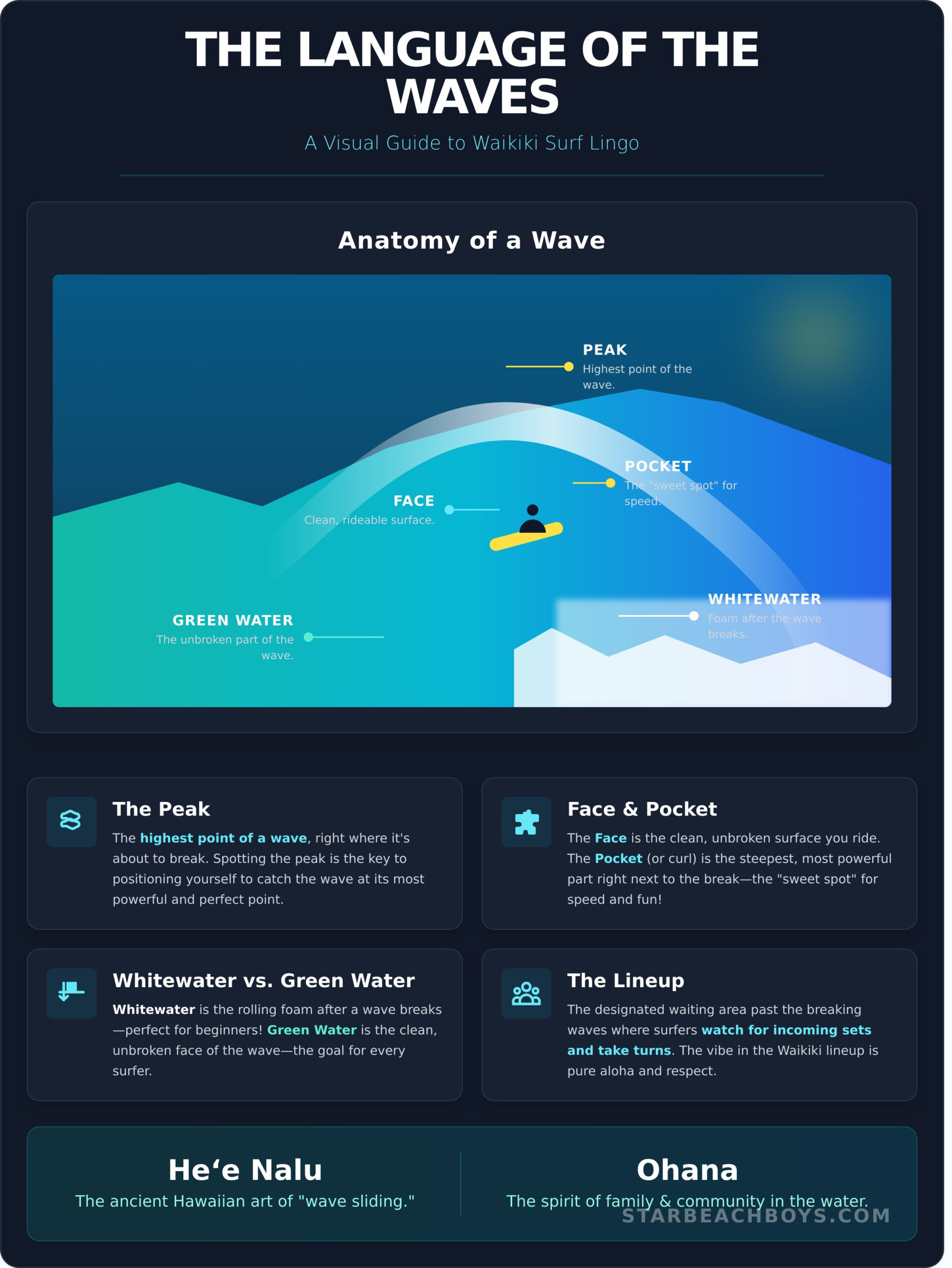
- The Peak: This is the highest point of a wave, right where it’s about to break. Think of it as the starting line. Spotting the peak is the key to positioning yourself to catch the wave at its most powerful and perfect point. From the peak, a wave breaks both left and right.
- Face and Pocket: The face is the clean, unbroken surface of the wave that you ride on. The pocket, or curl, is the steepest, most powerful part of the face, right next to where the wave is breaking. This is the “sweet spot” where you’ll get the most speed and fun!
- Whitewater vs. Green Water: After a wave breaks, it becomes a rolling wall of foam called whitewater. This is your best friend when you’re learning! It has plenty of gentle power to push you and your board. Green water refers to the unbroken face of the wave-the goal for every surfer once they master the basics.
- The Lineup: Look out past the breaking waves. See that group of surfers sitting on their boards, waiting patiently? That’s the lineup. It’s the designated waiting area where surfers watch the horizon for incoming waves and take turns. The vibe in the Waikiki lineup is pure aloha, and our instructors can show you the proper etiquette to make sure everyone shares the stoke.
Anatomy of a Waikiki Wave
Not all parts of a wave are created equal. Knowing the different zones helps you plan your ride.
- Shoulder: The soft, sloping part of the wave face, farther away from the breaking peak. It’s less steep and powerful, making it a great place for a long, cruisey ride, especially on a longboard.
- Lip: This is the very crest of the wave as it pitches forward and crashes down. You want to stay ahead of the lip, as it’s what creates the whitewater behind you.
- Tube or Barrel: When a powerful, hollow wave breaks, it can form a tunnel with the rider inside. This is the famous tube or barrel. While Waikiki’s gentle waves rarely form deep barrels, you’ll definitely hear this term used to describe the ultimate surfing experience!
Describing Wave Conditions
The ocean’s mood changes daily. Here’s how we talk about it.
- Glassy vs. Choppy: When there’s no wind, the ocean surface is smooth like glass. We call these glassy conditions, and they are absolutely perfect for surfing. When the wind picks up, it creates ripples and texture on the water, which we call choppy.
- Closeout: A closeout is a wave that breaks all at once along its entire length, offering no wall to ride. You learn to spot these to avoid paddling for a wave that goes nowhere.
- Set: Waves almost always arrive in groups, called sets. There will be a lull, and then a set of anywhere from 3 to 8 waves will roll in. On a classic Waikiki day, you can expect sets to arrive every 10 to 15 minutes. Patience is key; wait for the set!
Board Anatomy and Maneuvers: The Gear and the Moves
Ready to talk story about your board? Awesome! Knowing your gear is the first step to feeling that true Waikiki stoke. Your surfboard isn’t just a piece of foam and fiberglass; it’s your partner out there on the water, your connection to the energy of the ocean. Let’s break down the essential surfing terms so you can feel like a pro before you even get your feet wet.
First up, the board itself. Every surfboard has a few key parts you should know:
- Nose: The front tip of the board. It leads the way into the wave.
- Tail: The back end. Its shape, whether it’s a square, pin, or swallow tail, affects how the board turns.
- Rails: The edges of the board. You’ll learn to use your rails to carve and steer through the water.
- Stringer: Look closely and you’ll see a thin strip of wood running down the center of most hard boards. That’s the stringer. It’s the board’s spine, giving it strength and rigidity.
Next, you have the hardware that keeps you safe and in control. The Fins are the rudders underneath your board that provide stability and direction. Without them, you’d just spin out! And your Leash is your lifeline. This urethane cord connects to your ankle and the board, ensuring it never gets away from you. It’s a critical piece of safety gear that protects you and everyone else in our ocean Ohana.
Ever tried standing on a wet, slippery bar of soap? It’s impossible! That’s why grip is everything. We apply a special Surf Wax to the top of the board to create sticky, grippy bumps for your feet. Some boards also have a Traction Pad, a permanent foam grip pad at the tail for your back foot.
And the single most important move for any beginner? The Pop-up! This is the fluid motion of going from lying on your stomach to standing on your feet, all in one go. We’ll have you practice it on the sand until it’s second nature. Nail the pop-up, and you’re surfing!
Essential Beginner Maneuvers
Paddling is the engine of surfing. It’s 90% of your time in the water! The key is long, deep strokes right alongside your rails. It’s a workout, but the reward is the ride of your life. To get out past the breaking waves on a big board, you’ll learn the Turtle Roll, where you flip the board over and hold on as the wave passes. The Duck Dive is a more advanced move for shortboards. Your first real turn is the Bottom Turn, a gentle carve at the base of the wave that directs you along the open face. It’s the foundation for everything that comes next!
Understanding Board Types
At Waikiki, you’ll see a few different kinds of boards. The Longboard is the king of our gentle waves. At 9 feet or longer, these boards are stable, easy to paddle, and perfect for that classic, graceful surfing style. A Shortboard is built for high-performance action, designed for speed and aggressive turns in more powerful waves. For your first time, you’ll be on a Soft-top. These boards have a soft, forgiving foam deck, making them incredibly safe and stable. Their high volume helps you float, paddle, and catch waves with ease. It’s all about building confidence and having fun, which is why we use them for all our Waikiki surf lessons!
The Unwritten Rules: Surf Etiquette Terms You Must Know
The ocean has its own rhythm and its own rules. Here in Waikiki, we call it the spirit of Aloha. It’s about respect for the water, for the culture, and for each other. More than just knowing the lingo, understanding these unwritten rules is the key to sharing the waves and the stoke. These are the most important surfing terms related to etiquette you’ll need.
So, who gets the next wave? It’s all about the Right of Way. The rule is simple: the surfer closest to the peak, or the breaking part of the wave, has priority. Look to your left and right before you paddle. See someone deeper than you, already paddling for it? That’s their wave. Let them have it. Another set is always on the way!
Breaking that rule leads to the ultimate surfing foul: Dropping In. This is when you catch a wave that another surfer with the right of way is already riding. It’s dangerous, disrespectful, and the quickest way to get a bad vibe in the water. Always, always look before you take off. A quick glance can save you from a collision and keep the good times rolling.
A sneakier move is Snaking. This happens when a surfer paddles around another person to steal the priority position right as the wave arrives. It’s cutting in line, plain and simple. It goes against everything the Aloha spirit stands for. We’re all out here to have fun. Wait your turn, and you’ll get plenty of waves. We promise.
But this is Waikiki! The birthplace of modern surfing has a special tradition. Welcome to the Party Wave! On our long, gentle rollers, you’ll often see multiple surfers sharing a wave, all hooting and smiling. As long as there’s space and everyone is aware, sharing a ride is part of the fun. It’s a beautiful thing to see and even better to experience!
Social Lingo in the Water
You might hear someone called a Kook. It’s not about being new; it’s about being clueless to the etiquette. A kook is someone who drops in, snakes, or doesn’t control their board. Don’t be a kook! On the flip side, the goal is to be Stoked. That’s the pure, bubbling joy you feel after a great wave. It’s a feeling we’ve been sharing here for over 100 years. And a simple Shaka, the classic “hang loose” gesture, says it all. It’s “hello,” “thank you,” and “all good” rolled into one.
Safety-Critical Etiquette
Sometimes you’ll get Caught Inside, which means you’re stuck in the impact zone where waves are breaking on your head. Stay calm, hold onto your board, and wait for a lull to paddle back out. If a collision is about to happen, you might need to consider Bailing, which is ditching your board. Only do this as a last resort. Your board can hit someone. Control your gear! Respecting the lineup and the safety of everyone in it is the ultimate sign of Aloha. Want to learn the lineup from the pros who know it best? Book a lesson with our Ohana, and we’ll show you how to surf with true confidence and respect.
Waikiki-Specific Slang: The Legacy of the Beach Boys
Some of the most important surfing terms you’ll hear in Waikiki aren’t about maneuvers; they’re about a legacy. They come from the original Waikiki Beach Boys, the legendary watermen who have been sharing the spirit of Aloha on this very beach since the early 1900s. These aren’t just instructors. They are cultural ambassadors, the direct descendants of a tradition started by icons like Duke Kahanamoku. They created a unique language of welcome and respect right here on the sand. Come join the ohana. We’ll show you what it’s all about!
The fun isn’t just on a surfboard. For a true taste of Hawaiian tradition, you have to try outrigger canoe surfing. It’s a team sport, a floating party, and a straight shot of pure joy. But before you jump in, you’ll need to know the lingo. The most famous beginner surf breaks in Waikiki are even named after this history. You’ll find us at “Canoes,” a long, gentle wave right out front, perfect for your first ride. Next to it is “Queens,” a world-class wave named in honor of Queen Liliuokalani’s nearby beach home. Surfing here is surfing through history.
The Original Beach Boy Vocabulary
When you learn with us, you’ll hear a few key phrases that carry deep meaning. An elder instructor is always called “Uncle” as a sign of respect for his wisdom and years on the water. Our goal is simple: sharing the stoke. That’s the pure, infectious joy that comes from riding a wave. You’ll also notice how slang changes across the island. The heavy-wave talk of Makaha to Waikiki is like a different language. Here, it’s all about fun and Aloha.
Canoe Surfing Terminology
Ready to paddle out together? Riding an outrigger canoe on a Waikiki wave is an experience you will never forget. It’s all about teamwork, and your steersman will guide you with a few essential commands. These are the key canoe surfing terms you need to know.
- Steersman: This is your captain! The steersman sits at the back, guiding the canoe with a long steering paddle. They read the ocean, pick the perfect wave, and tell the crew exactly what to do. Listen to them and you’re guaranteed an amazing ride.
- Stroke: This is the rhythm of your paddling. The steersman will call out commands like “Hut, ho!” to keep everyone paddling in perfect sync. This teamwork is what gives the canoe the power to catch a wave. Paddle hard together!
- Huli: This means to flip or capsize the canoe. Don’t worry! It rarely happens in Waikiki’s gentle waves, and our expert steersmen know how to keep the canoe balanced. If it does happen, it just means a fun swim in our warm, beautiful water. We’ll have you back in the canoe in no time.
At the end of your lesson, after you’ve ridden your last wave and your face aches from smiling, there’s one final word to know: Mahalo. It means “thank you,” but it carries a deeper sense of gratitude. When you say it to your Star Beachboys instructor, you’re thanking them for sharing their knowledge, their ocean, and a piece of their incredible heritage. It’s the perfect way to end a perfect day on the water.
From Lingo to Legend: Your Turn to Ride the Waves!
You’ve got the lingo down! From understanding the difference between a ‘barrel’ and a ‘break’ to knowing the unwritten rules of the lineup, you’re ready to join the conversation. Knowing these essential surfing terms is the first and most important step in truly connecting with the ocean and the ancient Hawaiian tradition of He’e Nalu. It’s the language of respect and pure stoke.
But reading about the thrill is one thing; feeling it is everything. It’s time to paddle out and make your own memories on the same waves where it all began. Come learn from the real deal. Our authentic Hawaiian instructors carry on a legacy started over 50 years ago, sharing the Aloha spirit of the Original Waikiki Beach Boys. There’s a reason we were voted the best surf school in Honolulu; we don’t just teach a sport, we welcome you into our family.
The Waikiki waves are waiting for you. Book Your Waikiki Surf Lesson with the Original Beach Boys!
Let’s get you on a board and share the magic. We’ll see you in the water!
Frequently Asked Questions
What does “kook” mean in surfing?
A “kook” is a beginner surfer who doesn’t understand surfing etiquette or safety. They might paddle with their board backward, put their fins on wrong, or get in the way of other surfers. It’s not about being new; it’s about being unaware of the ocean’s unwritten rules. We were all kooks once! The goal is to learn respect for the water and the people in it. A quick lesson can help you avoid these simple mistakes.
What is a “party wave” in Waikiki?
A “party wave” is when two or more people ride the same wave together. While this is a serious mistake at most surf spots, it’s part of the fun on Waikiki’s gentle waves! The long, rolling surf at breaks like Canoes is perfect for sharing a ride with friends or family. You’ll often see our instructors guiding students on the same wave. It’s a Waikiki tradition that celebrates sharing the joy of surfing.
What is the difference between regular and goofy footed?
The difference between regular and goofy footed is which foot you place forward on the surfboard. A “regular” footed surfer stands with their left foot forward. A “goofy” footed surfer stands with their right foot forward. About 75% of all surfers are regular footed. Not sure which you are? Think about which foot you’d use to kick a ball; that’s usually your back foot. We’ll help you figure it out on the sand before we paddle out!
What does it mean to be “stoked”?
To be “stoked” means you are incredibly excited, happy, or enthusiastic. It’s the ultimate feeling of joy in surf culture, and it’s one of the most important surfing terms you’ll hear. You can be stoked about catching a perfect wave, seeing a beautiful sunset, or just sharing a great day on the water with your friends. It captures the pure energy and passion for the ocean. We live to share the stoke with everyone who visits us!
What is “dropping in” and why is it bad?
“Dropping in” is when a surfer catches a wave that another surfer with the right of way is already riding. This is the number one rule you don’t want to break. It’s dangerous because it can cause collisions, and it’s disrespectful because it ruins the ride for the person who was there first. The surfer closest to the peak, or the breaking part of the wave, always has priority. Always look both ways before you paddle for a wave!
What is a “wipeout”?
A “wipeout” is simply falling off your surfboard while trying to ride a wave. Everyone wipes out, from first-timers to world champions with 11 titles like Kelly Slater. It’s a normal part of learning and pushing your limits in the water. The key is to learn how to fall safely by covering your head and staying relaxed. The sandy bottom and gentle waves of Waikiki make it one of the safest places in the world for your first wipeouts.
How do I use the “shaka” sign correctly?
To use the “shaka” sign correctly, you make a fist and then extend only your thumb and pinky finger. You then turn your hand so the back of it faces the person you are greeting. It’s a local gesture that can mean “hang loose,” “thank you,” or just a friendly “hello.” Legend says it originated with a local man named Hamana Kalili from Laie in the early 1900s. It’s a true symbol of our island’s friendly spirit.
What is the “lineup” in surfing?
The “lineup” is the area in the ocean where surfers sit on their boards and wait to catch waves. It’s usually just beyond where the waves are breaking. From here, surfers can watch the horizon for the next set of waves rolling in. Understanding where the lineup is and how to behave in it is key to catching the best waves and showing respect for the other surfers in the water. It’s where you’ll learn the most just by watching.