Surf instruction for all ages turns a single beach morning into a shared adventure for grandparents, parents, and kids alike, no matter where each person is starting from. At Star Beach Boys, this philosophy means a five-year-old and a fifty-year-old can paddle out during the very same session and each receive coaching tuned to their own pace, strength, and nerve. Because a first-time seven-year-old and a fit forty-year-old traveler need very different guidance, no single lesson plan can serve both well. Instead, experienced instructors adjust board choice, wave selection, and teaching style to the person actually standing in front of them — not to an assumed average student.
Quick answer: Surf instruction for all ages means every lesson is structured so children, adults, and seniors can learn together in the same program, with instructors adapting board size, wave selection, and coaching pace to each individual’s skill level and comfort in the water.
What Is Surf Instruction for All Ages?
Surf instruction for all ages is a coaching model built around flexibility rather than a fixed curriculum. In practice, this means an instructor might guide a nervous eight-year-old through a first wave, then pivot minutes later to help a retired vacationer refine a pop-up. As a result, no student feels rushed or left behind, because the lesson bends around the person, not the other way around.
This model works well because surfing rewards patience over raw athleticism. Consequently, a well-run all-ages program depends on small student-to-instructor ratios, soft foam boards for beginners, and calmer inside sections of the surf zone where waves break gently and predictably. In contrast, a rigid one-track lesson plan often forces a child to keep up with adult pacing, or forces an adult to sit through drills designed for a six-year-old — and neither outcome builds real confidence.
Why Age-Inclusive Surf Lessons Matter for Every Traveler
Coastal towns attract a mix of visitors: families on holiday, solo adults chasing a bucket-list moment, and retirees looking for a gentle new hobby. Therefore, a surf school that teaches only one age bracket automatically excludes a large share of interested guests. In contrast, a program built around every age group can serve an entire family in one booking, which simplifies planning and often lowers the cost per person.
Furthermore, mixed-age instruction tends to build stronger motivation. When a child sees a parent wobble, fall, and get back up to try again, the lesson feels less intimidating for everyone. For a deeper look at how age affects the learning curve, this guide on whether you can learn to surf at any age breaks down exactly what to expect at different life stages.
Surf Programs for Kids and Teens
Young students generally respond best to short, playful drills rather than long technical explanations. Specifically, instructors often use games on the sand to teach balance and paddling posture before ever entering the water. Because attention spans are shorter at this age, kids’ sessions are broken into small blocks with frequent breaks and steady encouragement.
Teens, meanwhile, can typically handle longer sessions and more direct feedback on technique. Many schools group teens separately from younger children so pacing matches their improved coordination and stamina — a distinction that a generic, one-size lesson plan usually misses entirely.
Surf Training for Adults and Beginners
Adult beginners often carry more self-consciousness into a first lesson than children do, which is why instructors usually start with a clear, no-pressure explanation of ocean safety and board mechanics. From there, the focus shifts to repetition: paddling, timing, and popping up until the movement becomes automatic.
Adults wanting a faster, more focused path can explore surf training built for adults, which concentrates entirely on adult pacing and goals instead of splitting attention across a mixed-age class.
Family Surf Classes That Keep Everyone Together
Family classes solve a common travel problem: how do you keep a group with wildly different skill levels engaged at the same time? Above all, instructors handle this by assigning multiple coaches to one family unit, so a toddler-aged sibling and a confident teenager both stay supervised without either one feeling ignored.
Families looking for this exact setup can review these family-friendly surf classes, designed specifically to keep parents and children in the same lesson while each progresses individually.
Surf Instruction for Seniors and Older Beginners
Older beginners are often the most overlooked group in generic surf marketing, yet they make up a growing share of first-time students. Similarly to children, seniors benefit most from wider, more buoyant boards that make catching a wave easier without requiring explosive strength. In particular, instructors watch stamina closely, keep sessions shorter, and choose the calmest part of the break so a sixty-year-old student never feels pushed past a comfortable limit.
Because joint mobility and balance vary widely among older adults, a good instructor asks about any physical limitations before the lesson begins. That said, most healthy seniors with reasonable water comfort can stand and ride a small wave within their very first session.
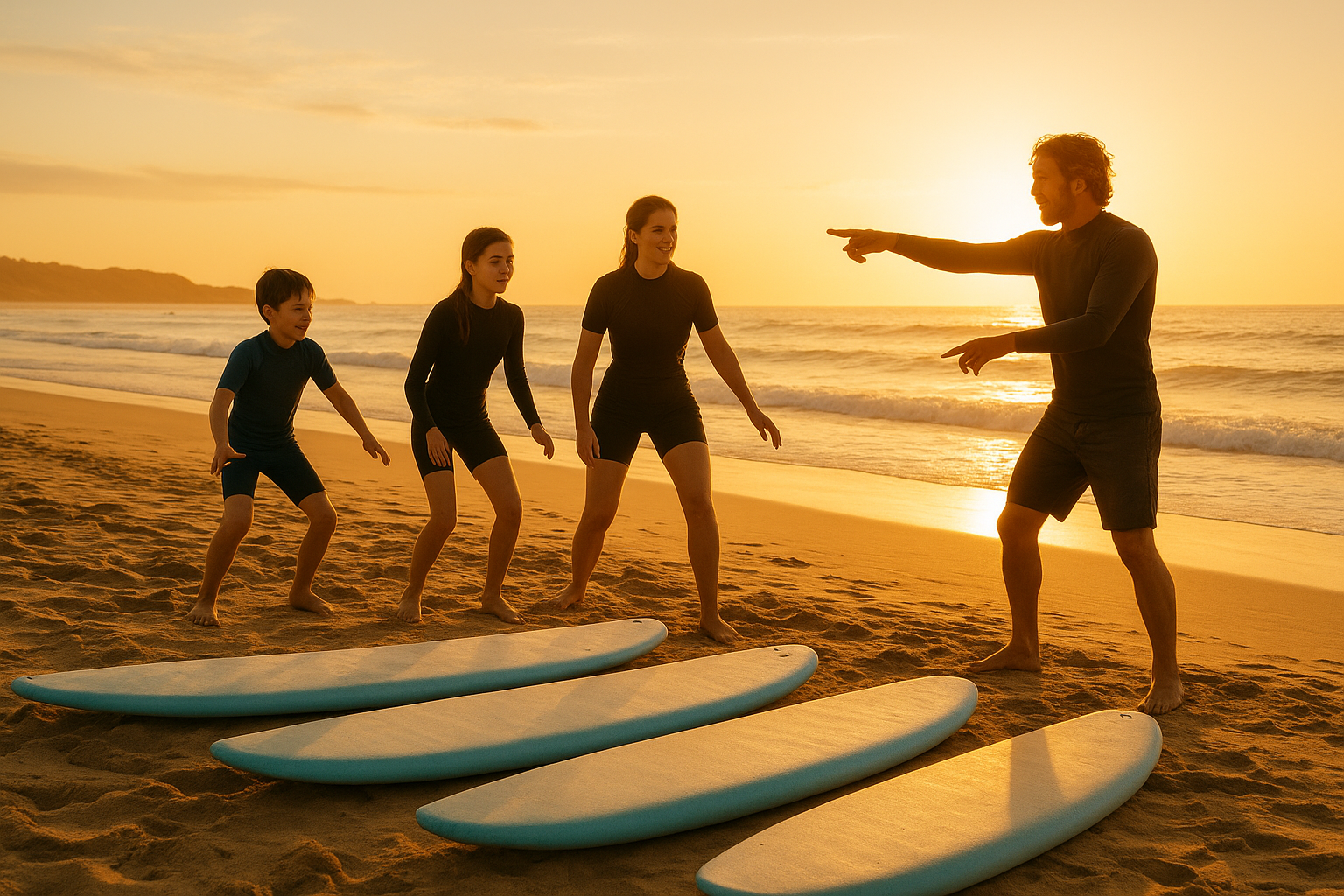
Surf instruction for all ages brings kids, teens, adults, and seniors into the same lesson, with coaching adapted to each person standing on the sand.
How to Get Started With Surf Instruction for All Ages
Getting started is simpler than most first-timers expect. In fact, most reputable schools follow a similar sequence regardless of a student’s age or experience level.
- Schedule an assessment. Share the student’s age, swimming ability, and fitness level so the instructor can recommend the right starting board and wave zone.
- Choose the right program. Decide between a kids’ class, an adult beginner session, a senior-friendly lesson, or a combined family lesson based on who is attending.
- Attend the land briefing. Arrive early for a short safety talk covering paddling posture, board handling, and basic ocean hazards before anyone touches the water.
- Complete the guided water session. Practice paddling and catching small waves with the instructor close by to correct form and timing in real time.
- Progress to the next level. Book follow-up lessons to build endurance and gradually move toward slightly larger waves as confidence and balance improve.
Those wanting instruction tailored closely to their own goals, rather than a standard group format, might prefer this personalized surf instruction option, which adjusts pacing session by session.
What Makes a Great All-Ages Surf School
Not every surf school handles mixed ages equally well. Consequently, a few qualities separate strong all-ages programs from generic beginner classes:
- Low student-to-instructor ratios, especially for children under ten and first-time adult beginners.
- Certified coaches trained in water rescue and CPR, not just surfing technique.
- A wide range of board sizes suited to different weights, heights, and skill levels.
- Clear communication with parents or family members about progress and pacing throughout the session.
According to the history and technique of surfing as documented on Wikipedia, the sport’s learning curve has always rewarded gradual, supervised progression over rushed attempts at bigger waves. That principle still guides how reputable schools structure their lesson tiers today, regardless of a student’s age.
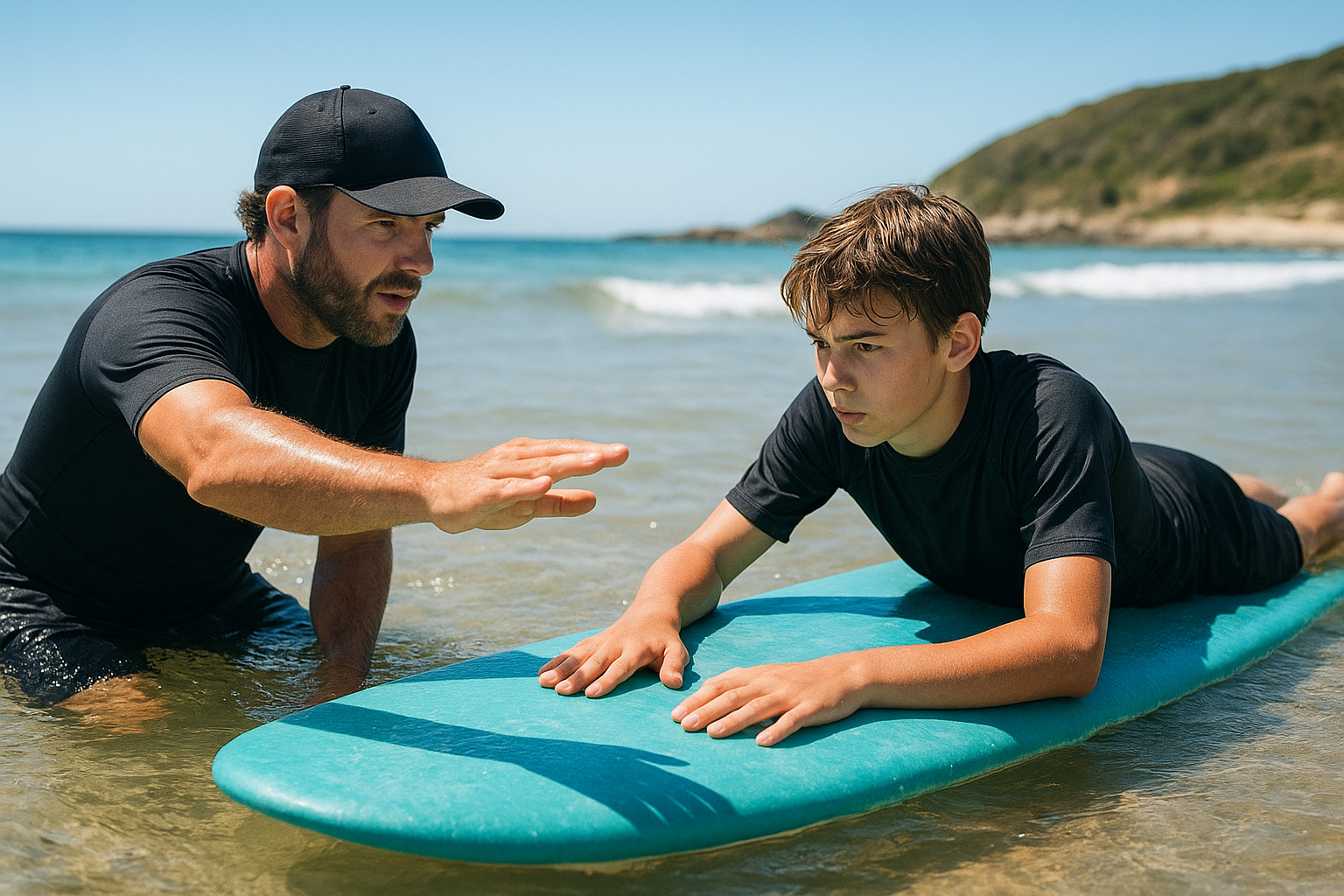
Hands-on coaching like this helps students of every age correct small technique errors early, before they become bad habits.
Safety Considerations in All-Age Surf Coaching
Safety naturally looks different across age groups. For younger children, instructors typically stay within arm’s reach at all times and choose the calmest section of the break. For adults and seniors, the bigger risk factors often involve fatigue and overestimating physical readiness, so instructors monitor stamina closely throughout the session.
In particular, understanding rip currents — powerful, narrow channels of water flowing away from shore — matters for every age group. The National Weather Service’s rip current safety guidance notes that rip currents contribute to the majority of ocean rescues along U.S. beaches each year, which is exactly why instructors check conditions before every single lesson.
Water safety habits learned during a lesson also carry over well beyond surfing itself. The CDC’s water safety resources reinforce many of the same principles instructors teach, including close supervision, swim readiness, and recognizing hazardous conditions early. Additionally, the CDC’s physical activity guidelines for adults help explain why moderate activities like surfing lessons offer real cardiovascular and balance benefits for older beginners, not just fun on vacation.

Shared lessons let families walk into the water together while each member progresses at their own pace.
Group vs. Private Surf Instruction for All Ages: Which Fits Your Family?
Choosing between a group class and private coaching often comes down to budget, group size, and how much individual feedback each student needs. Group lessons tend to be more affordable per person, and they add a social, encouraging atmosphere that suits families and friends learning together. In contrast, private coaching offers faster technical progress through undivided attention, which can matter for a nervous first-timer or a student chasing a specific skill.
- Group lessons: Lower cost per person, social energy, ideal for families and mixed-age friend groups.
- Private lessons: One-on-one feedback, faster technical correction, flexible scheduling for a single student or couple.
- Semi-private lessons: A middle-ground option for two to three students who want personal attention without the full private rate.
Ultimately, neither format is universally better — the right choice simply depends on the group’s size, budget, and comfort level in the water.
Where to Book Surf Instruction for All Ages in Hawaii
Location matters just as much as instructor quality. Gentle, predictable breaks make a measurable difference for first-time surfers of every age, which is why many families specifically seek out Waikiki surf lessons, known for calm, forgiving conditions that suit both nervous kids and cautious adults.
For travelers planning a full group trip, it also helps to browse examples of family surf lessons in Oahu before booking, since seeing how other multi-generational groups structured their sessions can make planning your own trip considerably easier.
Health and Confidence Benefits of Surfing at Any Age
Beyond the fun of catching a wave, surfing builds balance, core strength, and cardiovascular fitness for students of every generation. For children, it supports coordination and outdoor confidence. For adults, it offers a low-impact full-body workout that rarely feels like exercise. For seniors, it encourages gentle mobility work in a supportive, supervised setting.
Even more importantly, the confidence built during a lesson tends to carry well beyond the beach. In particular, watching a parent or grandparent try something new — and stumble a little before succeeding — often teaches children more about persistence than any classroom lesson could.
Frequently Asked Questions About Surf Instruction for All Ages
What is surf instruction for all ages?
Surf instruction for all ages is a teaching approach where coaching, board choice, and pacing are adapted to a student’s age, fitness, and confidence rather than following one fixed lesson plan. It allows children, adults, and seniors to learn side by side while each receives guidance suited to their needs.
What is the minimum age to start surfing lessons?
Most reputable surf schools accept children from around age five or six, provided they are comfortable in water. Younger children typically start on soft-top boards in gentle, shallow water with close supervision.
How long does it take to learn to surf?
Most beginners can stand and ride a small wave within their first one or two lessons. However, building real confidence usually takes three to five sessions of consistent practice.
How much does surf instruction cost?
Pricing varies by location, lesson length, and group size, with group lessons generally costing less per person than private coaching. Many schools also offer family or multi-day packages that lower the overall rate.
Can seniors learn to surf safely?
Yes, seniors can learn to surf safely when instructors adjust wave selection, board size, and pacing to match mobility and stamina. A larger, more stable board and calmer conditions make the learning curve much gentler.
What should beginners bring to their first surf lesson?
Beginners should bring swimwear, a towel, reef-safe sunscreen, and water, since most schools provide the board and leash. A light snack beforehand also helps maintain energy during an active session.
Why choose group lessons over private surf coaching?
Group lessons tend to be more affordable and add a social, encouraging atmosphere, which suits families and friends learning together. Private coaching, by contrast, offers faster technical progress through undivided attention.
What is the difference between kids’ and adults’ surf lessons?
Kids’ lessons usually emphasize play and balance games, while adult lessons focus more directly on paddling technique and wave timing. Both use age-appropriate boards and matching safety supervision.
How do instructors keep young children safe in the water?
Instructors keep young children safe by staying within arm’s reach, choosing calm surf zones, and limiting group sizes. Frequent verbal check-ins also help track each child’s comfort level throughout the lesson.
What common mistakes do beginner surfers make?
Beginners often stand up too early, look down at their feet, or choose waves that are too steep for their skill level. Correcting these habits early with an instructor’s feedback speeds up progress considerably.
Is prior swimming experience required for surf lessons?
Basic swimming comfort is recommended, though it is not always required for a first lesson, since instructors stay close in shallow water. Stronger swimmers, however, generally progress faster toward bigger surf.
What equipment is provided during surf instruction for all ages?
Most schools provide the surfboard, leash, and often a rash guard, with sizing adjusted for the student’s age and weight. Wetsuits may also be supplied when water temperatures are cooler.
How can families book a surf lesson together?
Families can typically book a shared session online or by phone, choosing a group package that places children and adults in the water together with matched instructor ratios. This keeps everyone together while each person still progresses individually.
Can people with physical limitations take surf lessons?
Many surf schools can accommodate certain physical limitations by adjusting board size, entry points, and session length, though it is best to discuss specific needs with the school beforehand. Adaptive equipment and additional instructor support are often available on request.
How many students are typically in an all-ages surf lesson group?
Well-run group lessons usually keep a ratio of no more than three or four students per instructor, and family bookings often include an extra coach so no one waits too long between waves.
What is the best time of year for surf instruction for all ages?
Calmer summer swells generally make surf instruction for all ages easier and safer for first-time students, though many coastal schools run beginner-friendly lessons year-round by choosing sheltered breaks regardless of season.
Final Thoughts on Surf Instruction for All Ages
Ultimately, surf instruction for all ages proves that the ocean does not need to divide a family or a group of friends by skill level or birth year. Instead, with the right coaching structure, a seven-year-old, a thirty-five-year-old, and a retiree can all catch their first wave on the very same morning. For a broader look at how age influences readiness, this complete beginner’s guide to surfing offers additional context worth reading before booking.
Whether the goal is a single vacation memory or a lifelong hobby, choosing a program built around surf instruction for all ages means every participant gets coaching matched to where they actually are — not where a generic lesson plan assumes they should be. Visitors ready to start can explore current programs directly through Star Beach Boys and get matched with the right class for their group.