Surf training for adults is a structured, coach-led program that teaches grown-ups how to read ocean waves, paddle with power and efficiency, and stand confidently on a surfboard — regardless of age or prior experience. According to the Surfrider Foundation, surfing participation among adults over 30 has grown steadily for more than a decade, making it one of the fastest-rising recreational sports in that demographic. If you have ever wondered whether surfing is within reach for you, the answer is a firm yes — and this guide shows you exactly how to get there.
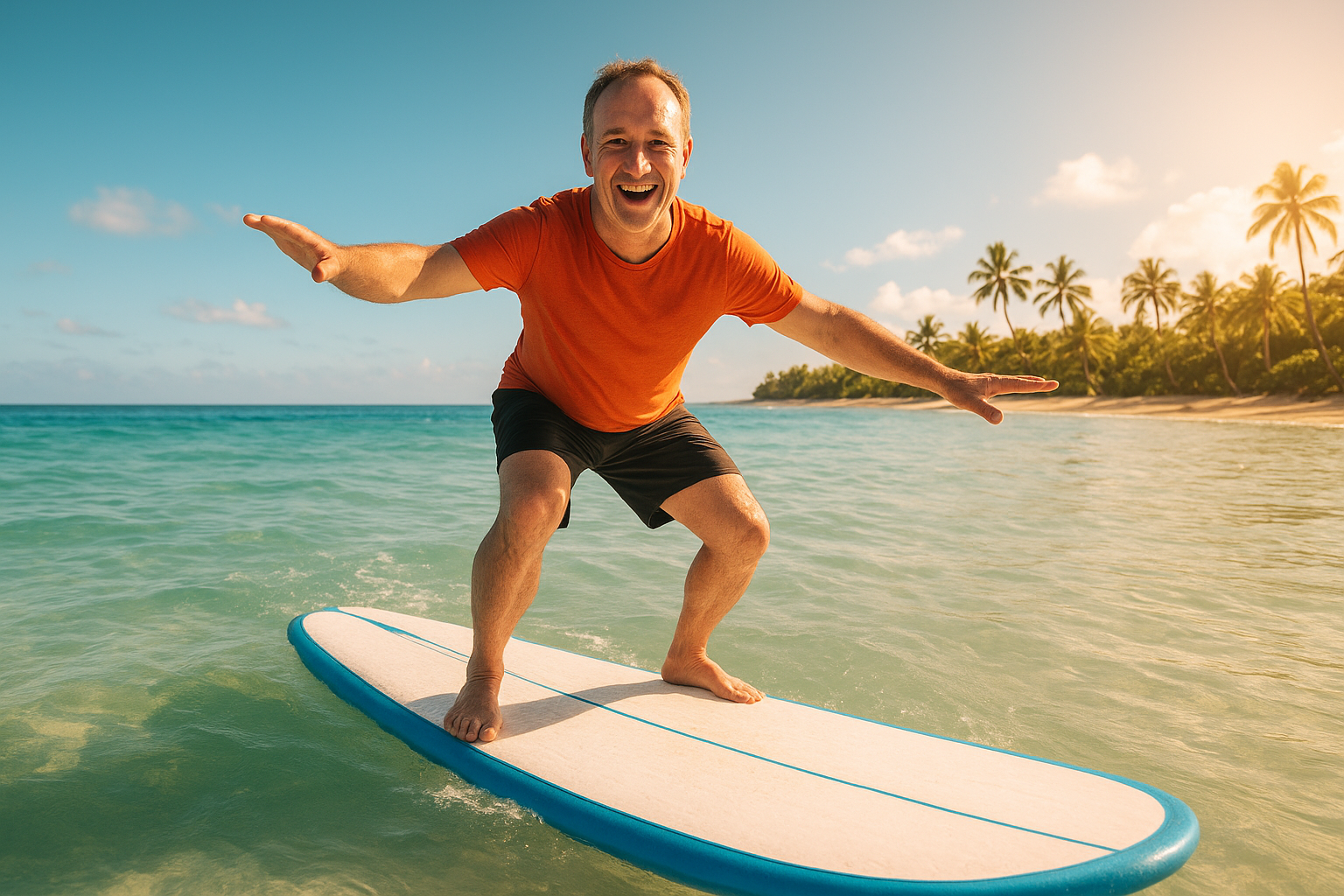
Surf training for adults begins in shallow, manageable water — building real confidence from the very first session.
What Is Surf Training for Adults?
Surf training for adults is a purpose-built learning experience that differs meaningfully from lessons designed for children or teenagers. Adults learn differently. They tend to analyze movements carefully, ask detailed questions, and need a clear explanation of the why behind each technique — not just the what. Therefore, quality adult surf programs combine meaningful water time with structured coaching that respects how mature learners absorb new physical skills.
Furthermore, adult programs address specific concerns — fitness levels, injury prevention, ocean safety, and self-consciousness — in far greater depth than a standard beginner lesson. Instructors at reputable surf schools understand that an adult student may feel more cautious or self-aware than a younger learner, and they adapt their coaching accordingly.
In short, adult surf training is not a watered-down version of a kids’ program. Instead, it is a thoughtfully designed system that meets adults exactly where they are — physically, mentally, and experientially — and moves them forward step by step.
Why Adults Can Absolutely Learn to Surf
One of the most persistent myths about surfing is that it is only for the young. However, this is simply not true. Adults bring powerful advantages to the learning process — including patience, discipline, attention to detail, and a genuine willingness to follow instruction carefully. These qualities frequently lead to faster technical improvement than impulsive younger learners manage. Read more on learning to surf as an adult.
Additionally, research published by the National Institutes of Health confirms that adults retain the capacity to develop new motor skills — complex physical movements — well into later decades of life. The brain remains highly adaptable. The key ingredients are consistent practice and quality instruction.
Moreover, the adult surfing community is larger and more welcoming than most beginners expect. Many surf schools now run adult-only sessions specifically because demand is so strong. If you are wondering whether age is a genuine barrier, explore this complete guide on learning to surf at any age — it will likely put your mind at ease entirely.
Essential Land-Based Training Exercises Before You Hit the Water
One critical element that separates effective surf training for adults from a rushed beginner lesson is the emphasis on land-based preparation. Practicing on dry ground removes the unpredictable variables of the ocean, allowing your body to rehearse the precise movements surfing requires — without the distraction of waves, current, or nerves.
Specifically, skilled instructors spend considerable time on the sand before anyone enters the water. These drills are not filler — they are the foundation of rapid, safe progress.
Pop-Up Drills
The pop-up is the single most important movement in beginner surfing. It is the explosive transition from lying flat on the board to standing upright on it. On the beach, instructors have students practice the sequence repeatedly until it becomes automatic. Furthermore, the land environment lets your coach correct your foot placement, hip position, and arm movement before bad habits form.
Paddling Motion Practice
Efficient paddling is what gets you into waves. On the sand, instructors demonstrate the correct arm stroke path, head position, and board trim (the angle at which you lie on the board). Adults who practice this on land first consistently paddle more effectively in the water — and therefore catch far more waves.
Stance and Balance Exercises
Understanding your natural stance — whether regular (left foot forward) or goofy (right foot forward) — is established during beach drills. Instructors also use balance exercises to help adults feel the correct weight distribution over the board before they ever encounter a moving wave.
Wipeout and Self-Protection Techniques
Falling is an unavoidable part of learning to surf — and doing it correctly prevents injury. On land, instructors teach adults how to fall flat and wide (to avoid hitting the bottom), how to cover their head when surfacing, and how to retrieve their board safely. This training reduces anxiety significantly and makes adults far more willing to commit to riding waves.
How to Get Started: A Step-by-Step Guide to Surf Training
Getting into surf training does not have to feel overwhelming. In fact, breaking the process into clear, sequential steps makes it approachable for any adult, regardless of starting point. Here is the exact how long does it take used by professional surf coaches:
- Choose a reputable surf school — Look for certified instructors, strong safety records, positive reviews from adult learners specifically, and a school that supplies equipment and adapts lessons to your level. starbeachboys.com offers expert-led programs designed for all skill levels, including complete adult beginners.
- Complete a full beach safety briefing — Before entering the water, attend a thorough briefing that covers ocean awareness, rip current recognition and escape, surf etiquette, board control, and how to fall safely to minimize injury risk.
- Practice land-based drills: pop-up, paddling, and stance — On dry sand, rehearse the paddling motion and the pop-up until the sequence feels natural and automatic. Nail your foot placement and body position before waves add complexity.
- Enter the water and practice wave timing — Wade into shallow water and practice reading incoming waves, positioning your board perpendicular to the wave face, and timing your paddle stroke to catch the wave at peak momentum.
- Ride your first wave and receive structured feedback — Attempt to stand and ride under your instructor’s close supervision. Immediately after each attempt, receive specific, constructive feedback on your pop-up timing, stance width, gaze direction, and arm position — then apply it on your next wave.
Consequently, following this sequence — rather than plunging straight into the water — dramatically reduces frustration and accelerates your learning curve. Most adults successfully learn to surf within their very first lesson using this structured approach.
Key Skills Covered in Adult Surf Lessons
A well-designed adult surf training program covers far more than simply standing on a board. Specifically, quality coaching addresses a range of interconnected skills that build progressively on each other throughout your lessons.
Ocean Reading
Understanding how waves form, peak, and break is foundational. Instructors teach students to identify the optimal takeoff zones — the spots where a wave gives you the longest, smoothest ride — and to recognize which conditions are appropriate for their current level.
Paddling Technique
Efficient paddling conserves energy and positions you correctly in the lineup — the waiting area beyond breaking waves. Poor paddling form is one of the most common reasons adult beginners struggle to catch waves. Therefore, coaches dedicate significant time to refining this skill through both land drills and in-water feedback.
The Pop-Up Movement
The pop-up is the explosive movement from lying prone (flat) on the board to standing upright on it. It requires precise coordination and timing. Instructors break it into manageable stages — the push-up phase, the tuck and place phase, and the stand — so adults can master it methodically rather than guessing.
Balance, Stance, and Trim
Proper foot positioning, knee bend, and body weight distribution are critical for staying upright on a moving wave. Coaches use visual demonstrations, verbal cues, and hands-on adjustments to correct stance issues in real time. Additionally, board trim — how you angle your weight to direct the board along the wave — is introduced as students progress.
Ocean Safety and Surf Etiquette
Above all, knowing how to handle wipeouts, avoid collisions with other surfers, and navigate rip currents is non-negotiable. Safety education — including the formal rules of surf etiquette like right-of-way — is woven into every session at a professional school. Responsible surfing protects not just you, but everyone sharing the water.
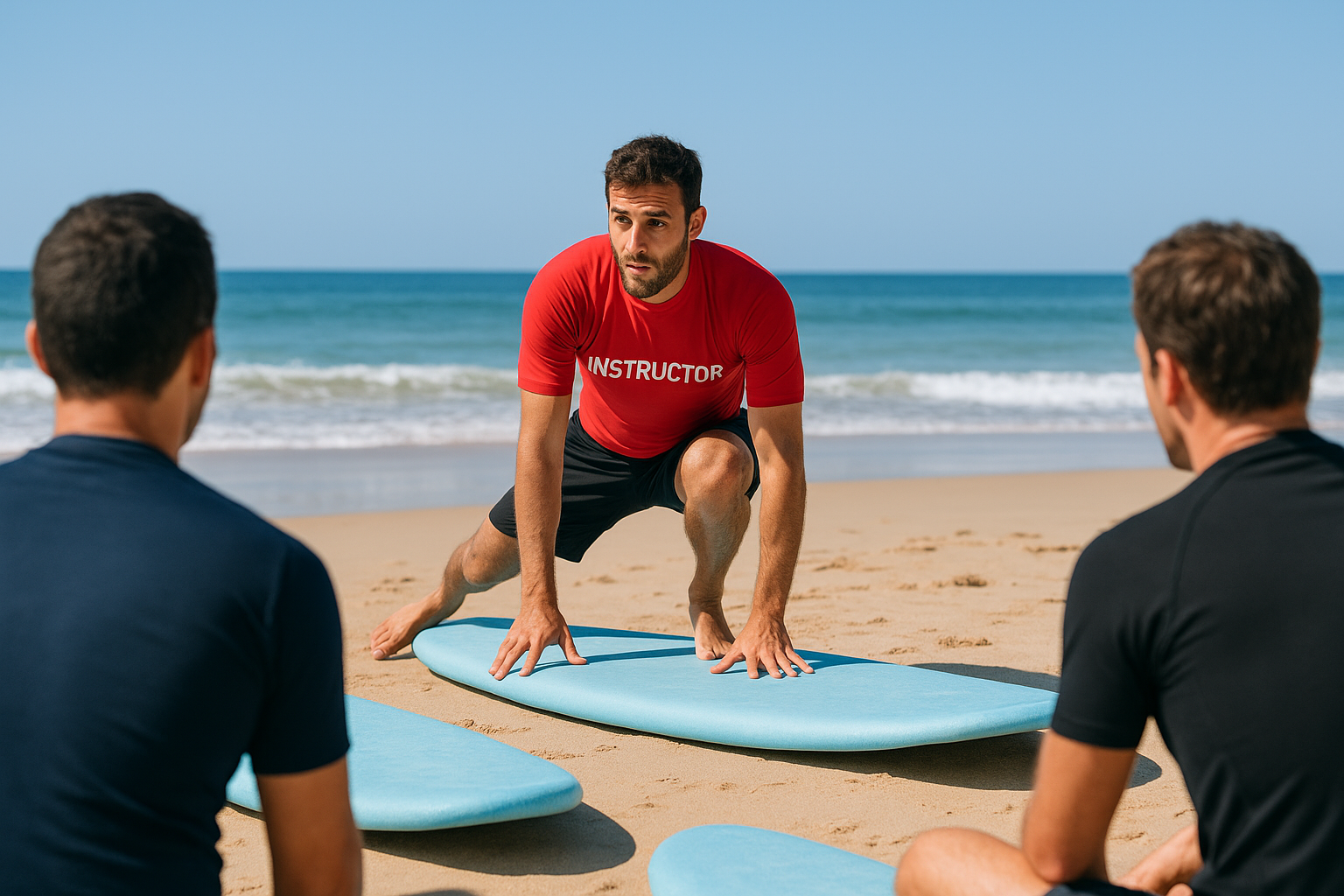
Land-based pop-up drills are a cornerstone of every structured adult surf training program.
Cross-Training and Fitness Preparation for Adult Surfers
Physical preparation accelerates surf training for adults significantly. Surfing demands a unique combination of upper body endurance, core stability, explosive leg power, and cardiovascular fitness. Fortunately, several accessible cross-training activities build all of these qualities — even before your first lesson.
Swimming
Swimming is the most directly transferable cross-training activity for surfers. It builds paddling endurance, breathing control, and water comfort simultaneously. In addition, swimming regularly helps adults feel genuinely at ease in the ocean rather than anxious — a significant mental advantage during your first surf lessons.
Yoga and Mobility Work
Yoga improves the hip flexibility, spinal rotation, and ankle mobility that the pop-up movement specifically demands. Furthermore, regular yoga practice develops body awareness — known as proprioception (your sense of where your body is in space) — which is essential for balancing on a moving surfboard.
Balance Board Training
A balance board — a platform that rocks on a cylinder or pivot — simulates the unstable surface of a moving surfboard. Using one regularly at home trains the specific stabilizer muscles in your ankles, knees, and hips that surfing relies on. Even 10 minutes of daily balance board practice creates noticeable improvements in your in-water stability.
Core Strengthening
A strong core — the muscles of the abdomen, lower back, and hips — is the engine of surfing. Exercises like planks, dead bugs, and bird-dogs target these areas directly. Specifically, a stronger core improves your paddling efficiency, your pop-up speed, and your ability to absorb the bumps and turns of wave riding without losing balance.
Choosing the Right Equipment for Adult Beginners
Equipment choice has a massive impact on how quickly adult beginners progress. Fortunately, most reputable surf schools supply everything you need, so you do not have to invest in gear before your first lesson. However, understanding what equipment is used — and why — helps you make better decisions as your skills evolve. Learn more about personalized surf instruction for tailored equipment advice.
The Foam Soft-Top Surfboard
For beginners, a large foam soft-top surfboard — typically 8 to 10 feet long — is the gold standard. These boards offer superior stability and buoyancy, which makes balancing far easier while you learn the fundamentals. The soft construction also reduces the risk of injury from contact with the board during wipeouts. As your skills develop, instructors will guide you toward a board matched to your evolving ability.
Surf Leash
A surf leash is a cord that connects your ankle to the tail of the surfboard. It is essential — after a wipeout, it prevents the board from washing into other surfers or swimmers and becoming a serious hazard. Every beginner wears one, always.
Rash Guard and Wetsuit
A rash guard — a lightweight, stretchy shirt — protects your skin from board friction (known as board rash) and UV exposure. In cooler water, a wetsuit provides thermal insulation and additional protection. The thickness of the wetsuit you need depends on the water temperature of your surf destination.
The World Surf League and major surf coaching organizations consistently recommend that beginners avoid shortboards until they have developed solid fundamentals on longer, more forgiving boards. Similarly, avoid boards with hard rails or sharp noses until you are consistently comfortable in the water.
How to Improve Your Surfing Skills Quickly After Your First Lessons
Progress in surfing is directly tied to the frequency and quality of your practice. However, repeating the wrong habits can actually slow you down significantly — which is exactly why surfing tips for beginners matters so much in the early stages.
Specifically, surfing two to three times per week during your learning phase dramatically accelerates muscle memory development. In addition, reviewing video footage of your sessions — a technique routinely used by professional surf coaches — reveals errors that are very difficult to detect by feel alone.
Moreover, setting specific session goals — for example, “I will focus entirely on my pop-up timing today” — is far more productive than simply paddling out and hoping for improvement. Deliberate, focused practice creates faster neurological adaptation than unfocused repetition.
For a comprehensive breakdown of acceleration strategies, this expert guide on improving surfing skills quickly provides detailed, actionable advice. Furthermore, understanding the full benefits of professional surf lessons compared to self-teaching will clarify why guided instruction produces faster and safer results at every stage.
Ocean Safety: The Non-Negotiable Foundation of Surf Training
Safety is the absolute foundation of every professional adult surf program. Before any student enters the water, qualified instructors cover ocean hazards, surf etiquette, emergency procedures, and first-response protocols comprehensively.
Rip currents are one of the most misunderstood ocean hazards. According to the National Weather Service, rip currents account for over 80% of surf beach rescues in the United States. Therefore, recognizing the visual signs of a rip current — a channel of churned, discolored water moving seaward — and knowing how to escape one (swim parallel to shore, not against it) is a critical skill embedded in every responsible surf lesson. See our surfing safety tips for practical rescue avoidance and safety drills.
Surf etiquette — the informal but universal code of conduct in the lineup — is equally important. Understanding right-of-way rules, how to communicate with other surfers, and how to safely manage your board around other people prevents accidents and earns you respect in the water from day one.
If you have concerns about your swimming ability, you are far from alone — and it should not stop you from starting. This resource on taking surf lessons without being a strong swimmer explains how professional instructors manage this situation safely and confidently.
The Physical and Mental Health Benefits of Surf Training for Adults
Beyond the thrill of riding a wave, surf training for adults delivers a remarkable range of proven physical and mental health benefits that extend far beyond the beach.
Physical Health Benefits
Surfing is a genuine full-body workout. Paddling builds upper body and shoulder endurance. The pop-up and stance on the board strengthen the core, glutes, and legs. Balancing on a moving wave trains deep stabilizer muscles that traditional gym exercises rarely reach. Cardiovascular fitness improves steadily as sessions become longer and more demanding.
Mental Health Benefits
Time in the ocean is strongly associated with reduced stress, improved mood, and enhanced mindfulness. The intense focus required to read waves and respond in real time naturally clears the mind of everyday worries. Research from the Blue Mind Project — a body of scientific research exploring the cognitive and emotional effects of water — consistently shows that proximity to and immersion in water significantly reduces cortisol (the primary stress hormone) levels. Many adult surfers describe the experience as profoundly meditative.
Social and Community Benefits
In addition to physical and mental gains, the social dimension of surf culture creates a sense of belonging that many adults find deeply fulfilling. Surf school environments are notably welcoming and supportive spaces — adults of all backgrounds, ages, and fitness levels learn together, cheer each other on, and share the particular joy of a first successful wave. This community aspect keeps many adults coming back far beyond their initial lessons.
What to Expect on Your First Day of Adult Surf Training
Knowing what to expect removes the anxiety of the unknown and lets you arrive focused and ready to learn. A typical first adult surf lesson follows this general structure:
- Welcome and introductions — Your instructor introduces themselves, outlines the session plan, and collects any relevant information about your fitness level, experience, or physical limitations.
- Equipment fitting — You are fitted with a rash guard or wetsuit, and your board (typically a large soft-top) and leash are explained and attached correctly.
- Beach safety briefing — A thorough overview of ocean hazards, surf zone rules, and emergency procedures before anyone gets near the water.
- Land drills — Pop-up practice, paddling motion rehearsal, and stance exercises on the sand. This phase typically lasts 20 to 30 minutes and is the most instructionally dense part of the session.
- Guided wave riding — You enter shallow water, practice catching small waves, and attempt to stand with your instructor close by providing real-time feedback and support.
- Debrief and next steps — After the session, your instructor reviews what you did well, identifies areas to focus on next time, and answers your questions.
In contrast to an informal self-taught session, this structure ensures you spend every minute productively and leave with a clear picture of your progress and your path forward.
Group Lessons vs. Private Lessons: Which Is Right for You?
Adult surf schools typically offer both group and private lesson formats — and both have genuine advantages depending on your goals and learning style.
Group lessons are social, affordable, and energizing. Learning alongside other adults normalizes the experience, reduces self-consciousness, and creates natural motivation. Group sizes at quality schools typically stay small — four to six students per instructor — to ensure everyone receives meaningful attention.
Private lessons deliver undivided instructor attention and completely personalized coaching. Progress tends to be faster because every correction, drill, and wave selection is tailored specifically to you. Private lessons are particularly well-suited to adults who have specific technique goals, physical limitations, or simply prefer a less public learning environment.
In terms of cost, group lessons typically range from $50 to $100 per session depending on location and school. Private lessons generally run $100 to $200 per session. Multi-session packages at most surf schools offer meaningful savings and are the most effective investment for consistent progress.
Frequently Asked Questions About Surf Training for Adults
What is surf training for adults?
Surf training for adults is a structured, coach-led program that teaches grown-up beginners and intermediate surfers how to paddle efficiently, perform the pop-up, balance on a board, and ride ocean waves safely. Lessons are specifically tailored to adult fitness levels, learning styles, physical limitations, and personal goals. Byline: Star Beach Boys surf team — certified instructors with years of adult coaching experience. Last updated: 2026-07-27.
Is it too late to start surfing as an adult?
No — it is never too late to start surfing. Adults learn in their 30s, 40s, 50s, and well beyond with excellent results. With proper instruction and consistent practice, adults progress quickly and safely. You can also read more about learning to surf at any age for further reassurance.
How long does it take an adult to learn to surf?
Most adults stand up and ride a wave within their first one to three lessons. Developing confident, independent surfing typically takes several weeks to months of regular practice, depending on lesson frequency, ocean conditions, and cross-training effort between sessions.
What exercises should I do before starting surf training?
Swimming, yoga, core strengthening exercises (planks, dead bugs), and balance board training are the most effective preparations for surf training for adults. These activities build the paddling endurance, hip flexibility, core stability, and proprioception that surfing demands from your very first session.
Do I need to be a strong swimmer to take adult surf lessons?
You do not need to be an expert swimmer, but basic comfort in the water is recommended. Professional instructors always prioritize safety and select conditions appropriate for your current skill and confidence level. Beginners always stay in shallow water close to shore during their initial sessions.
What equipment do I need for adult surf training?
Beginners need a large foam soft-top surfboard (8–10 feet), a surf leash, and a rash guard or wetsuit depending on water temperature. Most reputable surf schools provide all necessary equipment as part of their lesson packages, so you need not purchase anything before your first session.
How physically fit do I need to be to start surf training for adults?
A basic level of fitness helps, but you do not need to be an athlete to begin. Surfing itself builds strength, balance, and endurance progressively over time. Instructors adapt sessions to each individual student’s current fitness and mobility level, ensuring no one is pushed beyond safe limits.
What is the best surfboard for adult beginners?
A large foam longboard or soft-top surfboard is universally recommended for adult beginners. These boards offer maximum stability and buoyancy, making it far easier to learn fundamental balance and wave-riding skills without frustration or injury risk.
How many lessons should an adult take before surfing independently?
Most adults benefit from at least three to five structured lessons before attempting to surf independently. Ongoing coaching further accelerates progress and ensures technique remains safe and effective as skills develop. Multi-session packages deliver the best value and the most consistent improvement.
What common mistakes do adult beginner surfers make?
Common mistakes include looking down at the board instead of ahead, popping up too slowly or one foot at a time, paddling with bent arms, and standing with feet too close together. A qualified instructor identifies and corrects these patterns early, preventing them from becoming ingrained habits.
Are group or private surf lessons better for adults?
Both options deliver real value. Group lessons are social, energizing, and budget-friendly — ideal for adults who enjoy learning alongside others. Private lessons offer fully personalized coaching and faster skill development, particularly for adults with specific goals or physical considerations.
What should I expect during my first adult surf lesson?
Your first surf training session includes a welcome and equipment fitting, a comprehensive beach safety briefing, land-based pop-up and paddling drills, guided shallow-water wave riding with real-time instructor feedback, and a post-session debrief covering your progress and next steps.
Is surf training safe for older adults?
Yes — surf training is safe for older adults when led by certified instructors in age-appropriate conditions. Instructors carefully assess each student’s physical capabilities, select the safest possible surf environment, and ensure sessions are stimulating without exceeding safe physical boundaries.
How much does adult surf training typically cost?
A single group lesson typically ranges from $50 to $100, depending on location and school. Private lessons generally cost $100 to $200 per session. Multi-session packages offer the best value and are strongly recommended for adults committed to making consistent progress.
Conclusion: Start Your Surf Training Journey Today
Surf training for adults is one of the most rewarding investments you can make in your physical health, mental well-being, and personal sense of adventure. Above all, it proves that the ocean belongs to everyone — regardless of age, fitness level, or prior experience. With the right instruction, the right environment, and a genuine willingness to embrace the learning process, any adult can discover the deep, lasting joy of riding waves.
Whether you are a complete beginner stepping into the ocean for the very first time, or a returning intermediate looking to sharpen your technique, a professional surf school provides the structured, safe, and exhilarating experience you deserve. The team at starbeachboys.com specializes in exactly this — guiding adults of all skill levels through personalized surf programs that build genuine competence and lasting confidence in the water.
Therefore, do not wait for the perfect conditions — the best time to start your surf training is right now. Book your first lesson, show up with an open mind, and let the ocean take care of the rest. Your surfing journey begins today.