Private Surf Lessons Waikiki: The Complete Guide to Riding Your First Wave
Private Surf Lessons Waikiki: everything you need to know — from what to expect on day one to why Waikiki is the world’s greatest classroom for new surfers.
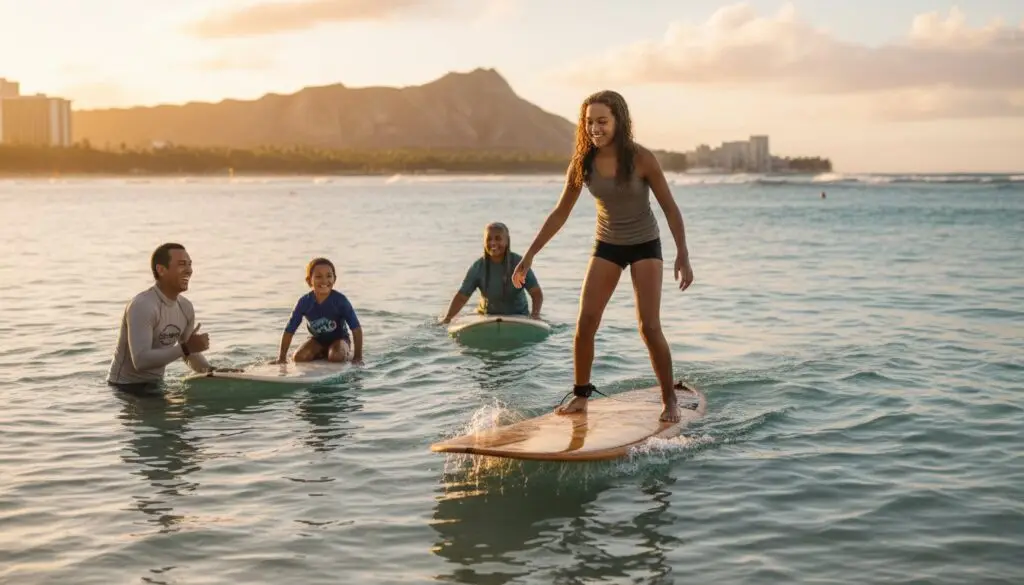
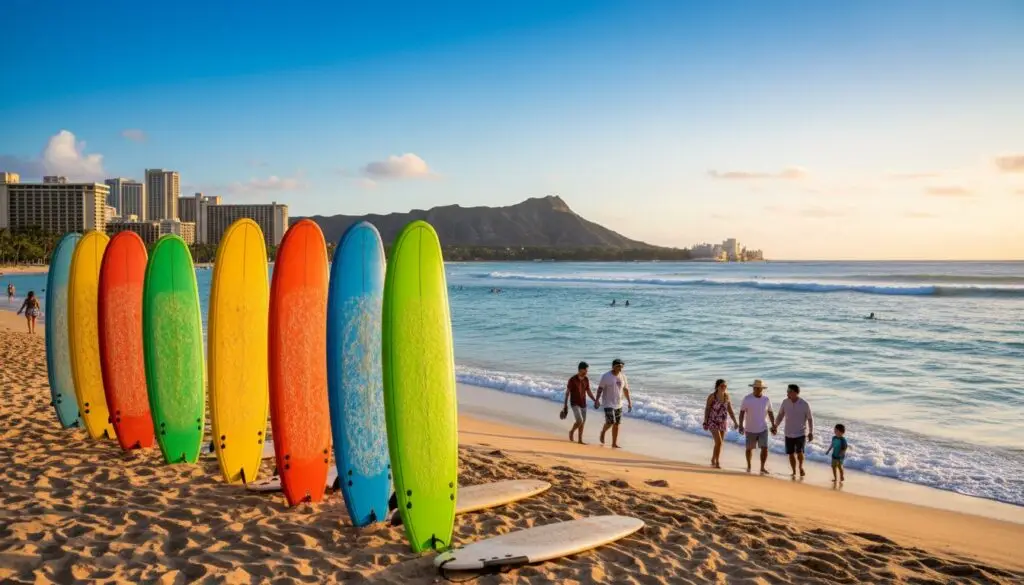
Private surf lessons Waikiki are the fastest, most personalized route to standing on a surfboard and riding a real ocean wave — because every second of instruction is dedicated entirely to you. Waikiki Beach, on the south shore of Honolulu, Hawaii, is the birthplace of modern recreational surfing and the most beginner-friendly surf destination on the planet. Whether you have never touched a board or you want to break a stubborn bad habit, one-on-one coaching at Waikiki delivers results that group classes simply cannot match.
In this guide, you will find a complete breakdown of what private surfing lessons at Waikiki involve, how they compare to group instruction, what to bring, how to prepare, what common mistakes to avoid, and exactly how to choose the right school.
What Are Private Surf Lessons Waikiki?
Private surf lessons Waikiki are one-on-one sessions between a single student and a certified surf instructor, held directly on the waves of Waikiki Beach. Unlike group classes, there are no other students competing for attention. Therefore, every correction, every wave selection decision, and every technique tip is tailored specifically to your body, your fitness level, your fear threshold, and your learning pace.
According to Wikipedia’s entry on Waikiki, this stretch of coastline is historically recognized as the birthplace of modern recreational surfing, with Hawaiian royalty riding waves here for centuries. That deep cultural legacy, combined with consistently gentle south swells and a sandy bottom, makes Waikiki the world’s most forgiving environment for beginner surfers and the most productive setting for one-on-one instruction.
Quick Answer: A private surf lesson at Waikiki gives you a certified instructor’s undivided attention for 60 to 90 minutes on the ocean’s most beginner-friendly waves. Most students stand up on their very first wave within the session — something rarely achieved in group instruction.
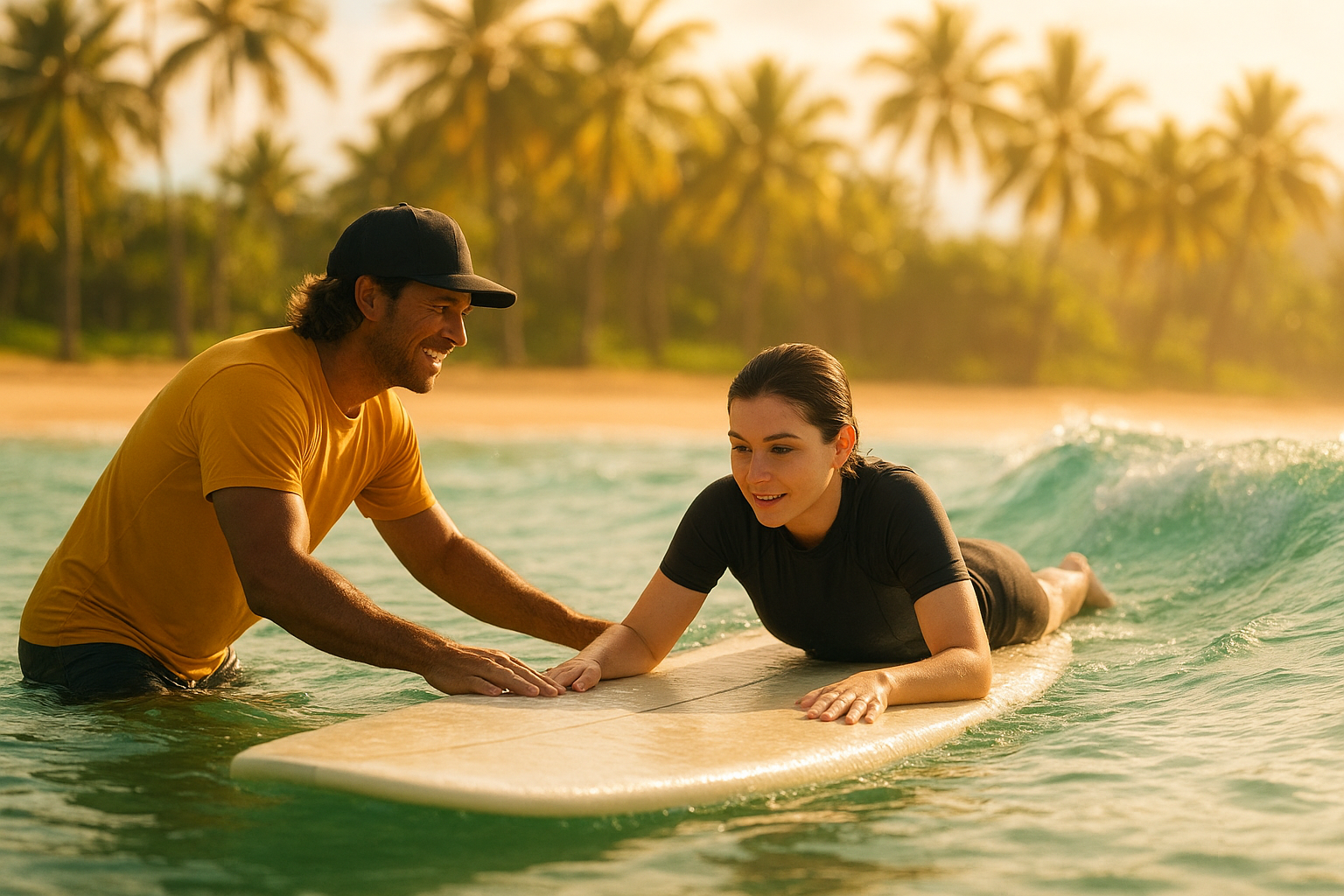
One-on-one coaching during private surf lessons at Waikiki means real-time feedback on every single wave you catch. For a deeper walkthrough, see our Local Surf Spots Waikiki: Best Breaks Guide.
Why Waikiki Is the World’s Best Location for Beginner Surf Lessons
Not every surf destination is equal, and Waikiki stands far apart from the rest for several specific reasons. First, the waves here break slowly and consistently over a sandy — not reef — bottom, giving beginners extra seconds to find their footing before each ride ends. Additionally, the water temperature hovers around a comfortable 78°F year-round, meaning physical comfort is never an obstacle to learning.
Furthermore, Waikiki’s south-facing shore receives rideable swell throughout the entire year, so there is genuinely no bad season to book a lesson. In contrast, many famous surf destinations around the world are too powerful, too cold, or too unpredictable for first-time riders. As a result, instructors at Waikiki can focus completely on building your technique rather than managing environmental risk or fear responses.
Key Advantages of Waikiki’s Surf Environment
- Slow-breaking waves — Long ride windows give beginners more time to react and adjust.
- Sandy bottom — Dramatically reduces injury risk compared to reef breaks found elsewhere.
- Warm, clear water — 78°F year-round eliminates thermal discomfort as a distraction.
- Consistent year-round swell — No need to wait for a specific season or weather window.
- Shallow beginner zones — Designated areas kept shallow add a critical layer of physical safety.
- Generational instructor expertise — Local instructors have spent their lives reading these specific waves.
Private vs. Group Surf Lessons: Which Option Is Right for You?
Group lessons are a popular and affordable entry point. However, they come with real trade-offs that matter most to people who want genuine skill development. When an instructor manages four or five students simultaneously, each person receives only a fraction of the available coaching time. Moreover, the lesson pace is set by the slowest learner in the group, which can be deeply frustrating for faster-progressing students.
A private lesson, by contrast, moves entirely at your speed. Specifically, if you master the pop-up technique in ten minutes, your instructor immediately advances you to wave-reading and trimming skills. If you need additional time on paddling mechanics, the session pauses there for as long as necessary. Because of this flexibility, most private students achieve in one session what group students typically need two or three sessions to accomplish.
✅ Private Surf Lesson
- Undivided instructor attention
- Personalized pace and technique
- Faster skill progression
- Ideal for anxious, advanced, or child learners
- Real-time corrections on every wave
- Flexible session focus based on your needs
👥 Group Surf Lesson
- More affordable upfront
- Social, energetic atmosphere
- Shared instructor time
- Fixed pace for all students
- Fewer wave attempts per person
- Less immediate feedback per ride
Who Benefits Most from Private Lessons?
Private instruction at Waikiki is particularly valuable for specific types of learners. Above all, anxious or nervous first-timers benefit enormously — because an instructor focused solely on one student can monitor body language, adjust the approach instantly, and build confidence without the social pressure of a group setting. Similarly, children learn far more effectively with individual attention, since instructors can adapt their language, board size, and wave selection to suit a younger learner’s needs precisely.
Intermediate surfers also gain significant value from private coaching. Specifically, surfers who have been riding for a year or two often develop ingrained bad habits — back-foot weighting, rushed pop-ups, poor paddle timing — that are almost impossible to self-correct. A skilled private instructor identifies these patterns within minutes and provides targeted drills to eliminate them efficiently.
How to Prepare for Your First Private Surf Lesson in Waikiki
Preparation makes a significant difference in how much you learn and enjoy your lesson. Therefore, follow these five steps to arrive fully ready:
- Choose a certified, local surf school. Research providers with current water safety certifications, strong verified reviews, and a clear guarantee of true one-on-one instruction. Star Beach Boys is a long-established Waikiki surf school known for experienced local instructors who have spent decades reading these specific waves.
- Book 24 to 48 hours in advance — earlier during peak season. Private slots fill quickly, particularly during summer months and holiday periods. Early booking also allows you to request a specific instructor if a particular coach comes recommended.
- Apply reef-safe sunscreen before you arrive. Hawaii law requires reef-safe formulas to protect coral reef ecosystems. Apply sunscreen at least 15 minutes before your session so it fully absorbs into the skin rather than washing straight into the ocean.
- Engage fully with the land-based orientation. Your instructor will guide you through the pop-up technique on dry sand before entering the water. This 10 to 15 minute drill is not optional small talk — practicing the correct motion on stable ground dramatically increases your success rate on the first wave.
- Commit completely when your instructor signals. Trust the wave timing and selection your instructor provides, then commit to the pop-up without hesitation. Hesitation — not ability — is the single most common reason beginners miss their first ride.
What to Bring to Your Waikiki Surf Lesson
- Swimwear — Board shorts or a one-piece swimsuit work well. Avoid loose clothing that creates drag.
- Reef-safe sunscreen — SPF 30 or higher. Confirm the label states “reef-safe” or “mineral-based.”
- A towel — For drying off after the session. Most schools do not provide towels.
- Water bottle — Paddling is physically demanding. Hydration before and after the session matters.
- Any prescription eyewear considerations — If you wear contact lenses, bring a case. Salt water exposure is a common issue.
Most reputable surf schools in Waikiki supply surfboards (typically large foam longboards) and rash guards as part of the lesson fee. However, always confirm equipment inclusions when booking to avoid any surprises on the day.
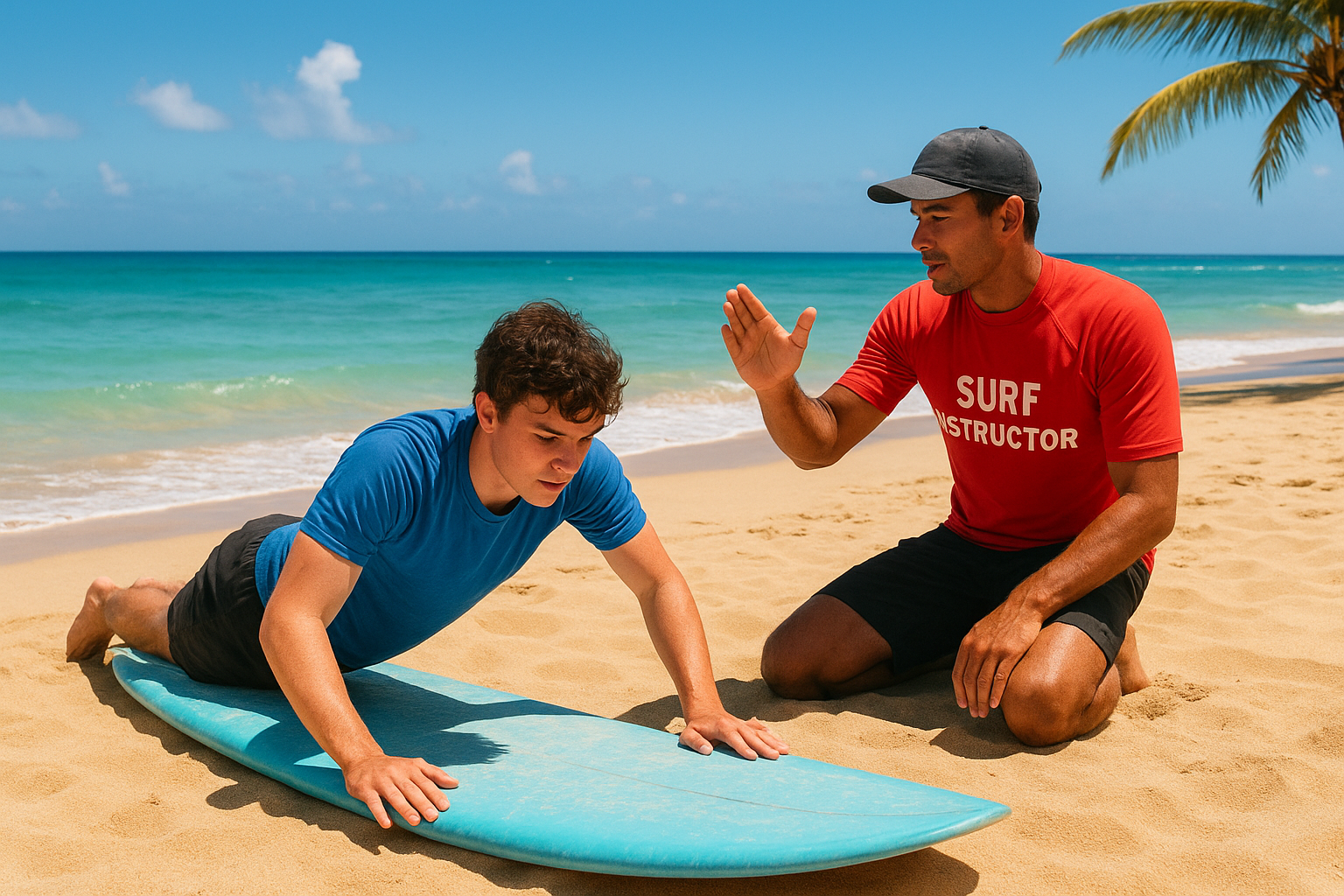
The land-based orientation is a critical part of every surf lesson — mastering the pop-up on dry sand translates directly to success on the water.
What to Expect During Your Private Surf Lesson at Waikiki
A typical private session follows a clear, structured progression. Understanding the format in advance helps you get more from every minute of instruction.
Phase 1 — Beach Briefing and Technique Orientation (10–15 Minutes)
Your session begins on dry sand, not in the water. Your instructor will cover ocean awareness (rip currents, wave sets, other surfers), paddling mechanics, and the pop-up — the movement from lying flat on the board to standing upright. Specifically, you will practice the pop-up repeatedly until the motion becomes instinctive. This is arguably the most important phase of the entire lesson.
Phase 2 — Paddling Out to the Beginner Zone (5–10 Minutes)
After the briefing, you and your instructor paddle together into the designated beginner zone — a shallow area with consistently small, slow-breaking waves. Your instructor manages the board positioning and helps you understand where to sit in relation to incoming swells. Additionally, they will demonstrate how to read the ocean surface to anticipate where and when the next wave will break.
Phase 3 — Wave Catching and Real-Time Coaching (40–65 Minutes)
This is where real progress happens. Your instructor positions you on the board, reads the incoming swell, and pushes you into each wave at the optimal moment. After every single ride, they deliver immediate and specific feedback — not generic encouragement. For example, they might ask you to shift your back foot two inches toward the tail for better control, or remind you to look at the shore rather than down at the board — both of which produce dramatically better balance and direction.
As a result, by the final third of your session, most students are catching waves independently, reading incoming sets with basic confidence, and beginning to understand how to steer using weight distribution. That foundation is something group lessons rarely achieve in a single outing — and it is the core reason why private instruction is worth the investment.
💡 Pro Tip: Book a Morning Session
Early morning hours at Waikiki — typically before 10 AM — bring lighter trade winds and cleaner, glassier wave faces. This creates noticeably better learning conditions than afternoon slots, when onshore winds can chop up the surface and reduce wave quality. Furthermore, the beach is less crowded in the morning, giving your instructor more space to work with you safely.
Common Mistakes First-Time Surfers Make — and How to Avoid Them
Even with expert private coaching, knowing the most common beginner pitfalls helps you progress faster. Your instructor will catch these in real time, but understanding them before you arrive puts you ahead from the first wave.
Looking Down at the Board
The most frequent mistake is fixing your eyes on the board instead of looking toward the shore or the horizon. Because your body instinctively follows your gaze, looking down causes immediate loss of balance and forward tipping. Therefore, train yourself from the very first pop-up — on sand — to lift your chin and fix your gaze forward. This single adjustment has the biggest single impact on balance of any technique correction.
Placing Feet Too Close Together
A narrow stance narrows your base of support, making steering nearly impossible and balance unstable. In contrast, a shoulder-width or slightly wider stance creates a stable platform and allows natural weight distribution between front and back foot. Your instructor will mark or guide your foot placement — pay close attention, because a two-inch adjustment can be the difference between standing and falling.
Tensing the Upper Body
Many beginners tense their arms, shoulders, and core in response to the physical sensation of moving water beneath them. However, rigidity fights the natural motion of the wave. A relaxed upper body allows the board to move and flex underneath you while your legs absorb energy and make micro-adjustments. Think of your arms as a balance aid — held out gently for stability, not gripped for control.
Hesitating on the Pop-Up
Hesitation is one of the most underrated beginner errors. When your instructor signals for you to pop up, a half-second delay means the wave has already begun to pass beneath you, leaving the board unsupported and unstable. Consequently, your instructor will encourage you to commit fully and move explosively — not slowly — when the moment comes. The more you practice the motion on sand, the more automatic and fast it becomes in the water.
Paddling Too Late
Timing your paddle to meet the wave’s energy is a skill that takes time to develop. However, a common error is starting to paddle too late, which means the wave overtakes the board rather than picking it up. Your private instructor reads each incoming wave set for you and directs your paddle start precisely — removing this guesswork entirely and significantly increasing your wave count per session compared to self-teaching or group instruction.
How to Choose the Right Surf School for Private Lessons in Waikiki
With dozens of surf schools operating along Waikiki Beach, choosing the right one matters more than most visitors realize. The difference between a mediocre lesson and a genuinely transformative one usually comes down to four specific factors.
Instructor Certification and Experience
Look for instructors who hold current water safety certifications — such as CPR, first aid, and lifeguard training — and who carry liability insurance. Beyond certifications, however, local experience matters enormously. An instructor who has surfed Waikiki for decades understands the specific tides, currents, shifting sand bars, and wave patterns at each break in ways that no amount of formal qualification can replicate.
Genuine One-on-One Ratio
Some schools advertise “semi-private” lessons with a 2:1 or 3:1 student-to-instructor ratio and present them as comparable to true private instruction. They are not. Specifically, if you want undivided attention and personalized feedback on every wave, confirm in writing that your session is one student per instructor — no exceptions.
Equipment Quality and Inclusion
Reputable providers always include equipment in the lesson price — typically a large foam longboard (8 to 10 feet, which provides significantly more stability than a shorter board) and a rash guard for sun and abrasion protection. Additionally, the best schools maintain their foam boards in good condition. A waterlogged or damaged board is harder to balance on and can negatively affect your first experience.
Verified Reviews and Reputation
Read recent verified reviews on multiple platforms — not just the school’s own website. Look specifically for comments about instructor patience, the quality of individual feedback during the lesson, and whether the reviewer stood up on their first wave. These details reveal far more about lesson quality than generic five-star ratings.
Star Beach Boys is one of Waikiki’s longest-operating surf schools, offering private lessons with instructors who have surfed these waters for decades. Their local knowledge of tides, currents, and wave behavior at different times of day adds meaningful value beyond what any newcomer instructor can offer — and their track record of first-lesson success reflects that expertise.
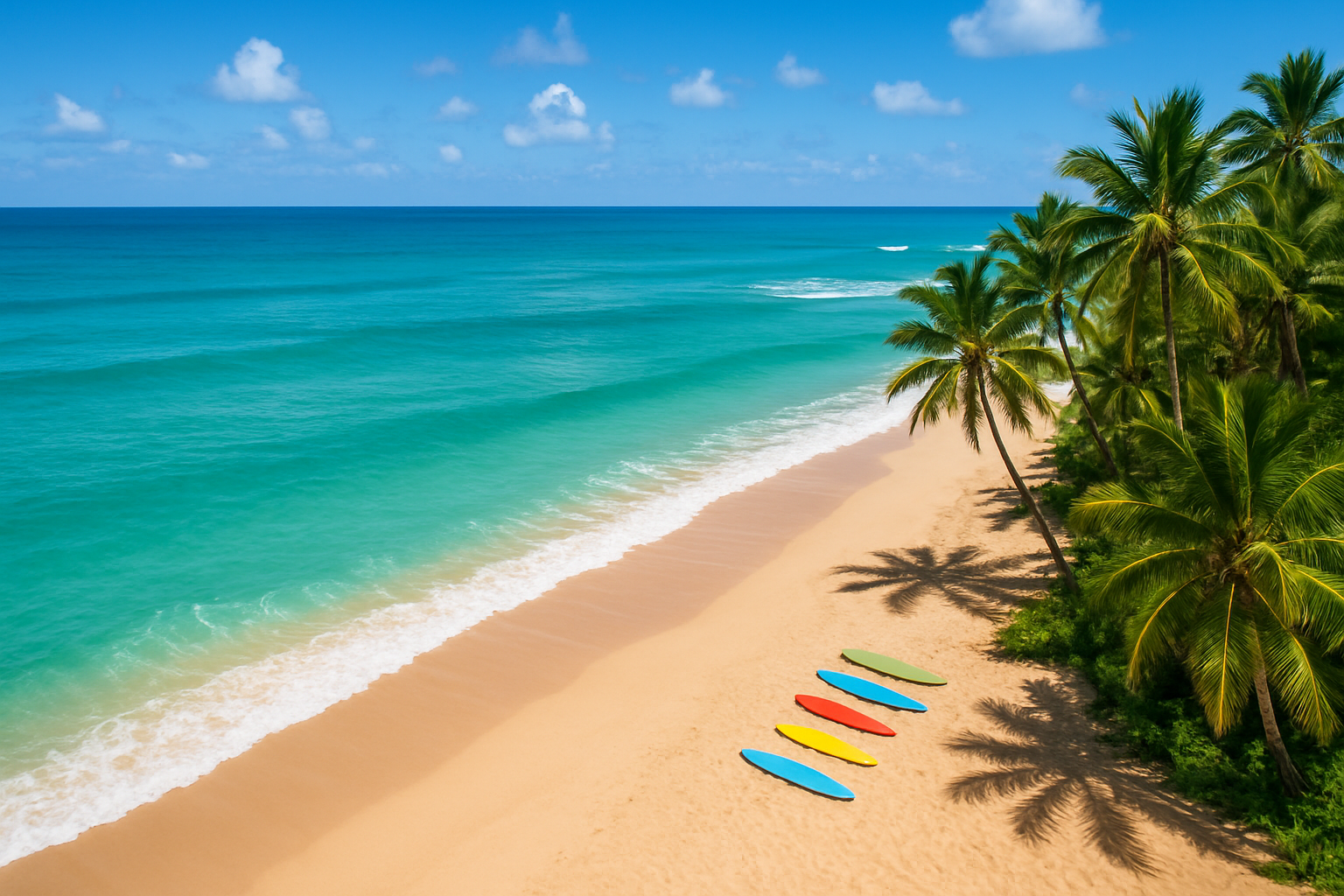
Waikiki’s gentle, consistent waves and warm water make it the ideal environment for first-time surfers learning under private instruction.
Private Surf Lessons Waikiki: Pricing, Duration, and What’s Included
Understanding what you are paying for helps you evaluate providers fairly and avoid being undersold a group lesson disguised as private instruction.
Typical Pricing
Private surf lessons in Waikiki typically range from $150 to $250 per person for a 60 to 90-minute session. Pricing varies depending on the provider, session length, and whether equipment rental is bundled into the fee. Some schools offer extended two-hour sessions for more advanced skill development, which generally fall in the $250 to $350 range.
Session Duration Breakdown
- 60-minute session — Best for absolute beginners with a primary goal of standing up on a wave.
- 90-minute session — Allows time to build on early success. Recommended for most learners.
- 2-hour session — Suited to intermediate surfers working on specific technique corrections or wave-reading skills.
What Should Be Included in the Price
- Surfboard use (large foam longboard)
- Rash guard
- Land-based orientation and pop-up practice
- Full water instruction time with the instructor in the water beside you
- Post-session feedback and recommendations for your next steps
After Your Lesson: Building on Your First Session
Your first private lesson at Waikiki gives you something genuinely valuable — a functional foundation. However, the real question is what to do with it. Most instructors will give you specific recommendations at the end of your session about what to focus on next. Take notes or find surfing lessons to continue improving before your next session.
Booking a Follow-Up Session
If you are staying in Honolulu for more than a few days, booking a second private session two or three days after your first lesson accelerates progress dramatically. The second lesson builds directly on your existing foundation — specifically targeting the weak points your instructor identified in the first session — rather than starting from scratch the way any new group lesson would. Consider Oahu surfing lessons if you plan more practice.
Board Rental Between Lessons
Many surf schools offer board rental by the hour or by the day. Renting a foam longboard and practicing in the beginner zone between lessons helps reinforce the techniques your instructor covered. Even 30 to 45 minutes of independent practice significantly increases muscle memory retention before your next formal session.
Frequently Asked Questions About Private Surf Lessons Waikiki
What are private surf lessons Waikiki?
Private surf lessons Waikiki are one-on-one sessions with a certified instructor on the waves of Waikiki Beach. The instructor’s full attention is dedicated to a single student, allowing for truly personalized coaching, real-time corrections on every wave, and a pace that matches the individual learner’s ability and confidence.
How long does a typical private surf lesson at Waikiki last?
Most private surf lessons at Waikiki run 60 to 90 minutes, including a land-based safety and technique orientation plus full hands-on water instruction. Some providers offer extended two-hour sessions for intermediate students focusing on specific skill development.
Do I need any experience before booking a private lesson?
No experience is required whatsoever. Waikiki’s gentle waves and skilled instructors make it ideal for absolute beginners. However, intermediate surfers also benefit significantly from private coaching to identify and correct ingrained bad habits and accelerate their technique development.
How much do private surf lessons in Waikiki cost?
Private surf lessons in Waikiki typically range from $150 to $250 per person for a 60 to 90-minute session. Extended two-hour sessions generally run $250 to $350. Most reputable schools include the surfboard and rash guard in the quoted price — always confirm what is included before booking.
What is the best time of year to take surf lessons at Waikiki?
Waikiki is surfable year-round. Summer months — May through September — produce the calmest and most consistent south swells, which are ideal for beginners. Winter months bring slightly larger waves that suit intermediate and advanced students seeking more of a challenge.
Is surfing at Waikiki safe for complete beginners?
Yes. Waikiki’s sandy bottom, shallow beginner zones, slow-breaking waves, and warm water make it one of the safest surf environments on Earth. Instructors also provide large foam boards — 8 to 10 feet long — which are significantly more stable and less physically dangerous than hard fiberglass surfboards.
What should I bring to my surf lesson?
Bring swimwear, reef-safe sunscreen (required by Hawaii law), a towel, and a water bottle. Most surf schools supply boards and rash guards as part of the lesson fee. Confirm equipment inclusions with your provider when booking to avoid any surprises on the day of your lesson.
Will I stand up on my first lesson?
Most students stand up on their first wave during a private lesson at Waikiki. The combination of Waikiki’s gentle waves, a skilled instructor managing your wave selection and timing, and undivided coaching dramatically increases the likelihood of first-lesson success compared to group instruction or self-teaching attempts.
Are private surf lessons suitable for children?
Absolutely. Instructors adapt board size, wave selection, and coaching language specifically to suit younger learners. Waikiki’s calm, warm water makes the experience safe and genuinely fun for children as young as five or six years old. Private instruction is particularly valuable for children, as individual attention keeps the experience positive and non-intimidating.
How far in advance should I book my private lesson?
Book at least 24 to 48 hours in advance, and significantly earlier during peak summer months and holiday periods. Popular Waikiki surf schools fill their private slots quickly. Early booking also gives you the best chance of securing your preferred instructor and time of day — ideally a morning session for calmer conditions.
What makes Waikiki the best place in the world to learn to surf?
Waikiki offers consistent, slow-breaking waves over a sandy bottom in warm, clear water year-round. Its historical role as the birthplace of modern surfing has produced generations of expert local instructors who understand these specific waves better than anyone else. No other location combines beginner-friendly ocean conditions, cultural depth, and instructor quality at this level.
How does a private lesson specifically help intermediate surfers?
Intermediate surfers often develop ingrained bad habits — back-foot weighting, poor paddle timing, rushed or mistimed pop-ups — that are extremely difficult to self-identify and correct. A private instructor spots these patterns within minutes and designs targeted drills to eliminate them efficiently. For intermediate learners, private instruction is often the fastest breakthrough available.
Ready to Book Your Private Surf Lesson at Waikiki?
Choosing private surf lessons Waikiki is the single most effective decision you can make if you want to learn to surf confidently, safely, and as quickly as possible. The combination of Waikiki’s world-class beginner waves and an instructor dedicated entirely to your progress creates an experience that is genuinely difficult to replicate anywhere else on the planet.
Furthermore, the memories made riding your first real ocean wave stay with you for a lifetime. Whether you are visiting Honolulu for a long weekend or planning an extended stay, investing 60 to 90 minutes in a private session delivers immediate, tangible results — and inspires every future trip to the water. The feeling of standing up on a wave for the first time is something no amount of planning or reading can fully prepare you for.
Your Next Step
Research certified local providers, confirm your session is genuinely one-on-one, and book your morning slot as early as your schedule allows. Star Beach Boys is a trusted starting point — a Waikiki institution with decades of experience turning first-timers into confident wave riders. For a deeper walkthrough, see our Star Beachboys Waikiki: The Ultimate Ocean Experience.
The waves at Waikiki are waiting. And so is the feeling of riding one for the very first time. For a deeper walkthrough, see our Outrigger Canoe Club Honolulu: A Visitor’s Guide to the Real Waikiki Experience.
Conclusion
Private surf lessons Waikiki offer the most effective, most enjoyable, and most memorable path into the sport of surfing. Waikiki’s year-round gentle waves, warm water, sandy bottom, and world-renowned instructor community create conditions that no other destination can match. Whether you are a complete beginner hoping to stand up on your very first wave, a nervous adult looking for a patient and attentive coach, or an intermediate surfer ready to break through a performance plateau — a private one-on-one session at Waikiki Beach delivers results. Book early, arrive prepared, commit fully to every wave your instructor selects, and you will leave the water a surfer.