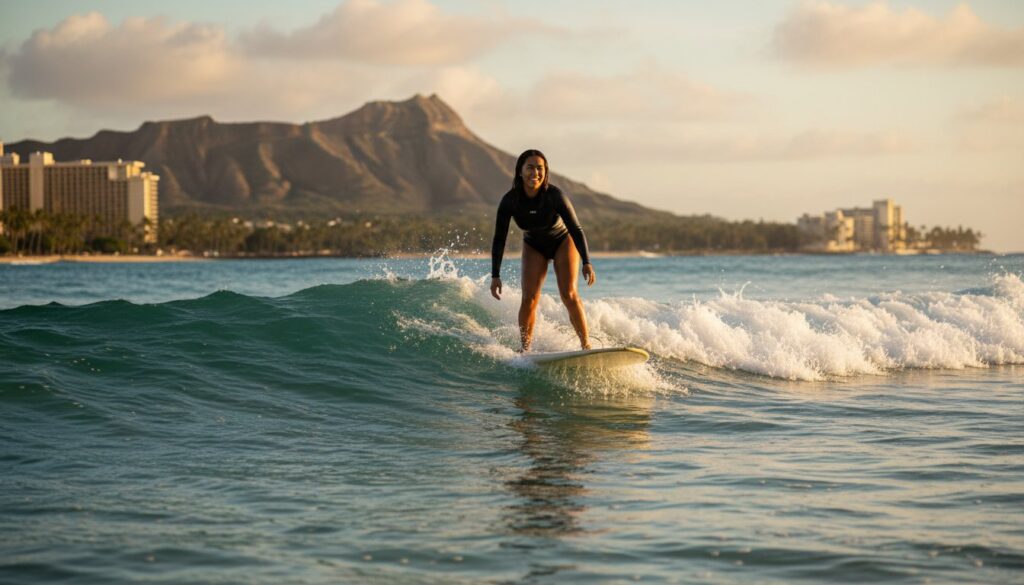
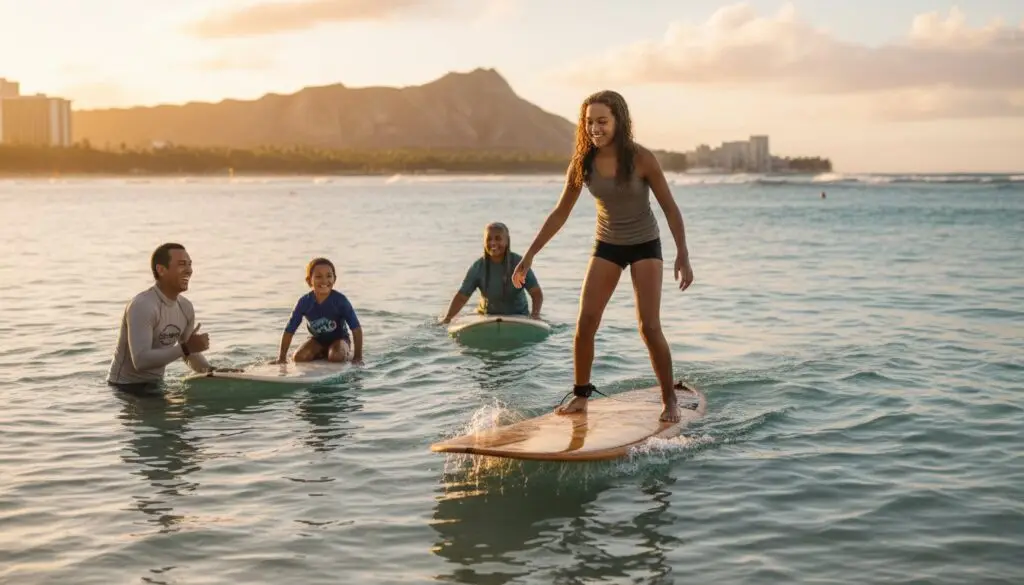
Outrigger Canoe Surfing Waikiki has shaped Waikiki ocean culture for generations.
Outrigger Canoe Surfing in Waikiki: The Complete Insider’s Guide to Riding Hawaiian Waves
Updated: 2025-07-14 | 15-minute read | By Star Beachboys
Outrigger canoe surfing in Waikiki is one of the oldest and most exhilarating ocean traditions on Earth. Aloha! You’re standing on the shores of Waikiki, watching a long, hand-carved canoe surge down the face of a brilliant blue wave, passengers laughing and paddling in perfect sync, Diamond Head glowing behind them. You feel it in your chest — you want that. That electric, ancient, joyful thing. What you’re watching is outrigger canoe surfing, and it has been alive and thriving right here in Waikiki for over a century.
But once you start researching, it gets confusing fast. Private clubs, different operators, famous names — how do you find a genuine experience? How does it actually work? What does it feel like? How much does it cost? Who were the people who invented this tradition? And what makes one canoe ride wildly different from another?
This guide answers every single one of those questions — and then some. We’re the Star Beachboys, and we’ve been sharing the stoke of outrigger canoe surfing on these exact waves for over 50 years. We carry a direct lineage from the original Waikiki Beachboys and from Duke Kahanamoku himself. This is everything you need to know, from the deep cultural roots of the tradition to what you’ll feel the moment that first wave lifts your canoe.
Key Takeaways
- 🌊 Outrigger canoe surfing is one of Hawaiʻi’s oldest ocean traditions — paddled by Hawaiian royalty (the aliʻi) for over a thousand years before becoming a modern adventure experience.
- 🏝️ The private Outrigger Canoe Club Honolulu is a members-only institution — but the authentic canoe surfing tradition it helped preserve is open to every visitor on Waikiki Beach. For a deeper walkthrough, see our Rent a Surfboard in Waikiki: Surf the Legendary Waves of Honolulu (2026).
- 🤙 The Waikiki Beachboys — living heirs to Duke Kahanamoku’s legacy — are the real guides you want. They offer cultural storytelling, expert seamanship, and pure aloha.
- 📋 No experience is required. Rides last 20–45 minutes, typically cost $40–$60 per person, and are safe for all ages — from young keiki to kūpuna.
- 📍 You can book a ride online or simply walk up to the canoes on the sand — no reservations required for walk-ins at most operators.
What Is Outrigger Canoe Surfing? (And Why It’s Unlike Anything Else)
Outrigger canoe surfing is the practice of riding ocean waves aboard a traditional Hawaiian canoe surfing canoe — a long, narrow vessel stabilized by a lateral float called an ama, connected to the main hull by two booms called ʻiako. Unlike a stand-up paddleboard, a kayak, or a boogie board, the outrigger canoe is a team vessel. You paddle together. You catch the wave together. You ride it together. That shared momentum is the heart of the experience.
The Waikiki version of the experience is specifically designed for surf-riding on the famous gentle, rolling waves of the South Shore. A trained steersman — typically a native Hawaiian waterman with years of experience — guides the canoe from the rear, reading the ocean with an almost supernatural intuition. Paddlers sit in tandem, one behind another, each holding a single-blade paddle. When the steersman calls “PADDLE!” every blade hits the water simultaneously, and the canoe accelerates onto the wave’s face.
What happens next is hard to describe and impossible to forget: the wave lifts the bow, the hull begins to plane, and for a long, gliding, breathless moment, you’re surfing — not on a board, not behind a boat, but on a piece of living Hawaiian history. The whole ride from wave-catch to shore can last 30 to 60 seconds. It will feel like both an instant and a lifetime.
🌺 Cultural Note: Outrigger canoe paddling is not just a tourist activity — it is the official team sport of the state of Hawaiʻi. Every time you climb into a canoe on Waikiki Beach, you are participating in a living cultural tradition that stretches back more than a thousand years.
The Deep Roots: From Ancient Hawaiʻi to Modern Waikiki
To truly appreciate outrigger canoe surfing, you have to understand where it comes from. The outrigger canoe — called waʻa in the Hawaiian language — was not invented for recreation. It was the vessel that made human settlement of the Pacific possible. Ancient Polynesian navigators, the greatest seafarers in human history, used large double-hulled outrigger canoes to cross thousands of miles of open ocean, guided only by stars, currents, and wave patterns. The canoe was, and remains, a symbol of courage, skill, and connection to the natural world.
When those voyagers arrived in Hawaiʻi — settling the archipelago between approximately 300 and 600 CE — they brought their canoe culture with them. In the islands, canoe paddling became intertwined with every facet of life: fishing, trade, warfare, ceremony, and play. The aliʻi, Hawaiian royalty, were particularly devoted to ocean sports. Historical accounts describe chiefs and chiefesses riding waves on surfboards and in canoes, with the best breaks near the royal court considered sacred.
Waikiki — whose name translates roughly to “spouting fresh water” — was itself a royal retreat. The gentle, consistent surf of the South Shore made it an ideal playground for canoe surfing. The tradition continued for generations until the 19th century, when Western contact brought dramatic cultural disruption and the near-extinction of Hawaiian ocean sports.
The Revival: Early 20th Century
By the early 1900s, the once-thriving tradition of Hawaiian ocean sports had nearly vanished. Enter a small group of passionate watermen and advocates who refused to let it die. In 1908, journalist Alexander Hume Ford — captivated by what he witnessed in the water off Waikiki — founded the Outrigger Canoe Club with an explicit mission: to preserve and perpetuate the sports of old Hawaiʻi, including surfing and outrigger paddling. Ford recruited a young, gifted native Hawaiian named Duke Kahanamoku, and together they helped ignite a renaissance that would ultimately reshape global ocean culture.
The revival worked beyond anyone’s wildest expectations. Within two decades, surfing and outrigger canoe paddling had spread from Waikiki to California, Australia, and beyond. The outrigger canoe — once nearly forgotten — became an enduring symbol of Hawaiian identity and a worldwide sport.
Duke Kahanamoku and the Original Waikiki Beachboys
No story of outrigger canoe surfing in Waikiki can be told without Duke Kahanamoku. Born in 1890, Duke was an Olympic gold-medal swimmer (five Olympic medals across three Games), a world-famous ambassador of Aloha, and — most importantly for our story — the father of modern surf culture and the godfather of the Waikiki Beachboys.
Duke didn’t just ride waves. He shared them. He believed, with deep conviction, that the ocean was a gift meant for everyone. He gave surfing lessons to visitors on the sand of Waikiki, put them in canoes, and guided them through the break — teaching them both the technique and the spirit of the experience. That radical generosity — that open, joyful, welcoming approach to sharing Hawaiian ocean culture — is what became known as the Aloha spirit. The cultural significance of surfing Duke embodied transformed it from a local practice into a global phenomenon.
Who Were the Original Waikiki Beachboys?
Around Duke, a community of native Hawaiian watermen formed — these were the original Waikiki Beachboys. They were not just surf instructors. They were lifeguards, storytellers, musicians, fishermen, and cultural ambassadors. They worked the beach every day, teaching visitors to surf and paddle, rescuing struggling swimmers, and performing traditional Hawaiian music in the evenings. They were the living bridge between ancient Hawaiian culture and the modern world.
Famous original Beachboys included Chick Daniels, Panama Dave, Louis Kahanamoku (Duke’s brother), Blue Makua, and many others. Their legacy is celebrated in Hawaiian history, literature, and oral tradition. To learn more about these legends, explore our deep-dive on the Waikiki Beachboy Legacy.
The Living Legacy: Our founder, the legendary “Turkey” Love, learned directly from the original Beachboys. When you ride with Star Beachboys today, you are participating in an unbroken chain of tradition stretching directly back to Duke Kahanamoku and the first Waikiki Beachboys. That lineage is not a marketing phrase — it’s the truth of who we are.
The Outrigger Canoe Club Honolulu: History, Legacy, and What It Means for You
If you’ve been researching outrigger canoe surfing in Waikiki, you’ve almost certainly encountered the name Outrigger Canoe Club Honolulu. It’s one of the most famous and frequently searched names in Hawaiian ocean culture — and it’s important to understand exactly what it is and isn’t.
What Is the Outrigger Canoe Club?
Founded in 1908 by Alexander Hume Ford on the sands of Waikiki, the Outrigger Canoe Club is a historic, private institution dedicated to preserving Hawaiian water sports. It has stood on Kalākaua Avenue for over a century, producing championship paddlers, hosting iconic regattas, and serving as a cultural anchor for the Hawaiian ocean sports community. It is, by any measure, one of the most important organizations in the history of surf culture worldwide.
The club is also, critically, a private members-only organization. It is not a public venue, not a tourist attraction, and not a place where visitors can book canoe rides or surfing lessons. Its facilities — the beach, the dining rooms, the canoe sheds — are exclusively available to dues-paying members and their invited guests. Membership is by application and typically involves a waitlist, significant fees, and sponsorship by existing members. For a deeper walkthrough, see our private surfing lessons.
Why Do So Many Visitors Search for It?
The confusion is completely understandable. The name “Outrigger” is everywhere in Waikiki — on hotels, restaurants, retail stores, and surf brands. Many visitors assume that “Outrigger” refers to a public canoe operation. In reality, the club’s name has become so synonymous with Waikiki’s ocean identity that it creates a natural search path for anyone looking to experience canoe surfing.
The great news: the tradition that the Outrigger Canoe Club helped preserve — authentic, wave-riding outrigger canoe surfing guided by native Hawaiian watermen — is alive and open to everyone right on the public beach. You don’t need a membership card. You just need to walk to the sand.
Private Club
Outrigger Canoe Club
- Members and invited guests only
- Annual dues and application required
- Focus on competitive paddling & regattas
- Year-round athletic & social calendar
- Cannot be booked by visitors
Public Experience
Waikiki Beachboys
- Open to everyone — no membership needed
- Walk-up or online booking
- Focus on authentic surf experiences for all
- Cultural storytelling and aloha sharing
- Available every day on the public beach
The Anatomy of an Outrigger Canoe: What Makes It Special
Part of appreciating outrigger canoe surfing is understanding the vessel itself. A traditional Hawaiian outrigger canoe, or waʻa kaukahi (single outrigger), is a masterpiece of functional design refined over centuries of ocean use. Here’s what you’ll see when you walk up to one on the beach:
-
🛶
The Hull (Kino): The main body of the canoe, long and narrow to minimize drag. Traditional canoes were carved from a single koa tree trunk. Modern surf canoes used at Waikiki are typically fiberglass for durability and safety, though they follow the same hydrodynamic shape.
-
⚖️
The Outrigger Float (Ama): The lateral float — usually a smaller, torpedo-shaped hull — extends to the left side of the canoe via two booms. This is the defining feature that gives the canoe its name and its remarkable stability. Without the ama, the narrow hull would be nearly impossible to balance on open water.
-
🔗
The Booms (ʻIako): Two curved crossbars connecting the hull to the ama. Traditional ʻiako were lashed with sennit (woven coconut fiber cord) using specific knots that allowed the outrigger to flex with the waves without breaking. Modern versions use fiberglass or carbon fiber.
-
💺
The Seats and Thwarts: A standard six-person surf canoe has six seats arranged in a single file. Paddlers 1 through 5 face forward; Seat 6 (the steersman) faces forward as well but controls direction using a longer steering paddle.
-
🏄
The Paddles: Single-blade paddles with a slight forward angle on the blade, designed for maximum power in open-ocean paddling. Each paddler switches sides on command from the steersman using the call “Hut!” — synchronizing the team’s effort automatically.
How Outrigger Canoe Surfing Actually Works: Physics, Waves, and Teamwork
There’s something almost magical about how effortlessly a skilled steersman can place a 400-pound canoe on a wave. Understanding the mechanics makes the experience even richer.
Reading Waikiki’s Waves
Waikiki’s South Shore is blessed with a uniquely favorable wave environment for canoe surfing. The waves here are generated by Southern Hemisphere swells that travel thousands of miles, losing their sharp energy and arriving as long-period, gentle rollers — perfect for a heavy, group-sized canoe. The reef breaks that shape these waves — Canoes, Queens, Populars, Publics — have been named and ridden for over a century. Your steersman knows each one personally, the way a farmer knows every field.
The Physics of Wave-Catching
To catch a wave in an outrigger canoe, the canoe must accelerate to match the wave’s forward speed just as the wave’s face arrives beneath the hull. The steersman positions the canoe slightly ahead of the approaching swell, angled toward shore. At precisely the right moment — timing developed through years of experience — the command comes: “PADDLE HARD!”
Every paddler drives their blade deep and pulls with maximum power. The canoe surges forward. The wave’s crest reaches the stern, lifts the back of the boat, and the hull tilts bow-down — now running with the wave, gravity adding to your momentum. The paddling stops. The ocean takes over. You’re surfing.
The steersman uses their long paddle — dragged against the water on one side or the other — to keep the canoe tracking straight and prevent a sideways broach. This is the most skilled part of the operation and takes years to master. A good steersman makes it look effortless. It is anything but.
The Role of Teamwork
Outrigger canoe surfing is fundamentally a team sport. One strong paddler cannot compensate for five weak ones; conversely, five paddlers of modest strength, perfectly synchronized, can move a canoe with surprising power. The rhythm of paddling — every blade entering the water at the same moment, every pull through the same arc — is something you feel as much as you hear. Many first-timers describe the synchronization as unexpectedly emotional, a literal alignment with strangers around a shared purpose. That feeling is ancient and real.
Step-by-Step: What Happens During Your Canoe Surfing Ride
Here is exactly what your outrigger canoe surfing experience looks like, from the moment you arrive at the beach to the final glide onto the sand: For a deeper walkthrough, see our private surfing lessons.
-
1
Check In at the Beach Shack
Walk up to the canoes on the beach (look for the yellow and red canoes, right on Waikiki sand) or check in online. No special equipment needed — just your swimsuit and sunscreen. Life vests and paddles are provided. Sign your waiver, and you’re ready.
- 2 Sand-Side Safety Briefing and Paddling Lesson Before you enter the water, your Beachboy crew gives you a hands-on lesson right on the sand. You’ll learn the correct paddling stroke — how to plant the blade fully, pull through your core (not just your arms), and feather the blade on the recovery. You’ll learn the key commands: “Paddle!” (start paddling hard), “Hō!” (stop immediately), and “Hut!” (switch paddle sides). Takes about 5 minutes — even kids get it quickly.
-
3
Launch Through the Shore Break
The crew pushes the canoe into the water. You’ll climb in quickly — the steersman guides where each person sits. Then comes your first real paddle: you dig in as a team to punch through the shore break and get outside the surf line. This is exhilarating in itself — the burst of speed as the canoe powers through whitewater is a preview of the ride to come.
-
4
Wait for the Perfect Wave
Outside the break, the ocean feels different — open, rolling, powerful. The steersman holds the canoe in position, reading the horizon with practiced eyes, waiting for the right swell. This is when the talking-story often begins — anecdotes about the history of the beach, Duke Kahanamoku, the Beachboys, the ancient tradition you’re now part of. This pause is part of the experience, not dead time.
-
5
The Call — “PADDLE HARD!”
When the steersman spots the wave, there’s no warning — just the call. Everyone digs in at maximum effort. The canoe accelerates. You feel the stern lift as the wave arrives. The paddling suddenly becomes easier — then stops mattering at all. The ocean is doing the work now.
-
6
The Ride — Pure Magic
The canoe surges, Diamond Head appears on the horizon, the water rushes past the hull, and everyone — every single time — lets out some combination of a laugh, a scream, and pure wordless joy. You ride all the way to the sand. Then you paddle back out and do it again. A typical session includes 2–3 wave rides in 20–45 minutes of total water time.
How to Choose the Right Outrigger Canoe Surfing Operator
Not all outrigger canoe operators on Waikiki Beach offer the same experience. Here’s what to look for — and what to watch out for — when choosing your crew:
Green Flags: Signs of an Authentic Operator
- ✔
Native Hawaiian steersmen with demonstrable experience and deep cultural knowledge — not seasonal hired staff.
- ✔
Decades of operation on Waikiki Beach — established operators know these waters like no one else.
- ✔
Proper safety equipment — life vests for every paddler, well-maintained equipment, clear safety briefings before every ride.
For a deeper walkthrough, see our Personalized Surf Instruction: Learn to Ride Waves Fast.
- ✔
Cultural storytelling — the best operators share the history, names, and meaning behind what you’re doing. You should leave knowing more about Hawaiian ocean culture than when you arrived.
- ✔
Transparent pricing with no hidden fees — you should know exactly what you’re paying for before you climb in.
For a deeper walkthrough, see our What Kind of Safety Measures Are in Place During Lessons?.
Red Flags: Watch Out For These
- ✗
Operators who rush guests in and out without any briefing or cultural context — this is a volume business, not an experience.
- ✗
No visible life vests or safety procedures.
- ✗
Steersmen who are not experienced in Waikiki’s specific surf breaks — this is a safety issue, not just a comfort one.
For a deeper walkthrough, see our Private Surf Lessons Waikiki: Learn to Surf Faster.
Safety, Kids, and Families: Everything You Need to Know
Outrigger canoe surfing is genuinely one of the safest ocean activities available in Waikiki, and it is an exceptional experience for families with children. Here’s why: For a deeper walkthrough, see our Outrigger Canoe Rides.
Why It’s So Safe
- Exceptional stability: The outrigger ama makes these canoes dramatically more stable than a kayak or a surfboard. Capsizing during a normal canoe surfing ride is extremely rare — the design actively resists tipping.
- Expert steersman in control: You are never alone in the ocean. A certified, experienced Hawaiian waterman is in command of the vessel at all times. They’ve navigated these specific waves hundreds — often thousands — of times. For a deeper walkthrough, see our Pro Surf Coaching Hawaii: Expert Lessons to Ride Waves.
- Life vests provided: Every paddler wears a properly fitted personal flotation device. Non-negotiable.
- Waikiki’s gentle surf: The South Shore breaks used for canoe surfing are specifically selected for their gentle, rolling character. These are not dramatic, closeout shore breaks — they’re long, rideable swells designed by geography to be forgiving. For a deeper walkthrough, see our Private Surfing Lessons Waikiki: Learn to Surf Fast.
- No swimming required: Riders stay seated in the canoe for the entire experience. You do not need to be a strong swimmer, though basic swimming ability is recommended for all ocean activities.
Age and Physical Requirements
- Minimum age: Most operators welcome children as young as 3–5 years old (seated in a parent’s lap or in a designated seat). Check with your specific operator.
- Weight limits: Standard six-person surf canoes have total capacity limits (typically around 1,000–1,200 lbs for all paddlers combined). Individual weight limits may vary by operator.
- Physical fitness: No special fitness is required. The steersman does the real work. You’ll paddle hard for 30–45 seconds during each wave catch — that’s it. Truly accessible to all fitness levels.
- Pregnancy: Pregnant guests should consult their physician before booking and should disclose their condition to the operator at check-in.
Costs, Timing, and What to Bring
How Much Does Outrigger Canoe Surfing Cost?
Outrigger canoe surfing is one of the best-value ocean experiences available in Waikiki. Typical pricing ranges from $40 to $60 per person for a standard session. This includes:
- Life vest and paddle (all gear provided)
- Sand-side paddling instruction
- Expert certified steersman
- 2–3 wave rides in a 20–45 minute session
- Cultural storytelling and the lifetime memory
Private canoe charters (just your group, no strangers) are available at premium rates — ideal for families wanting their own canoe and a more personalized experience.
Best Times to Ride
- Morning (7 AM – 11 AM): Best for calm conditions, lighter winds, and shorter wait times. The ocean is often glassiest in the early morning hours.
- Midday (11 AM – 2 PM): Popular time, can be busier. Trade winds typically build, but conditions are still excellent for canoe surfing.
- Afternoon (2 PM – Sunset): Beautiful golden light and often good surf, but can be windier. Crowds thin out later in the afternoon.
- Best season: Outrigger canoe surfing in Waikiki runs year-round. Summer (May–September) brings consistent south swells — ideal conditions. Winter swells can be larger, but the Waikiki breaks remain manageable for canoes on most days.
What to Wear and Bring
- Wear: Swimsuit or boardshorts — something you’re happy to get wet in. A rash guard is a great addition for sun protection.
- Sunscreen: Apply reef-safe sunscreen before you arrive. Protect yourself AND the ocean.
- Leave behind: Jewelry, electronics, cash. Leave valuables safely with your operator’s beach shack or in your hotel room.
- Hydration: Drink water before you go. The combination of sun, salt air, and physical activity can dehydrate quickly.
- Footwear: Bare feet are fine and most common. Water shoes work well if you prefer.
Cultural Significance: Why This Experience Matters
We talk a lot about “authentic” experiences in Waikiki, and that word gets overused. So let us be specific about why outrigger canoe surfing with an experienced Beachboy crew is genuinely, irreducibly different from other tourist activities.
Outrigger canoe paddling is the official team sport of the state of Hawaiʻi. It is the sport of chiefs, navigators, and warriors — a practice so central to Hawaiian identity that its near-disappearance in the 19th century was seen as a cultural wound. Its revival in the early 20th century was an act of cultural reclamation, led by real people with real passion for their heritage.
When you paddle out on a canoe with a native Hawaiian steersman, you’re not consuming a staged performance. You’re participating in a practice that has genuine roots in the community, guided by people who grew up with these traditions, whose families competed in regattas, who learned these same waters from their own kūpuna (elders). The stoke they share with you is real. The stories they tell are real. The connection to this place and its history is real.
Choose wisely and this experience is, without exaggeration, one of the most culturally meaningful things a visitor can do in Hawaiʻi. You’ll learn something true about this place while doing something incredible in it. That combination is rare.
“The aloha spirit isn’t a slogan. It’s something real — a way of being with other people that Duke Kahanamoku lived every single day on this beach. When we take someone out on a canoe, we’re not doing a job. We’re continuing something that matters.” For a deeper walkthrough, see our Star Beach Boys reviews.
— The Star Beachboys Crew
Join Our ʻOhana: Your Invitation from Star Beachboys
Here at Star Beachboys, we carry a lineage that runs directly back to the original Waikiki Beachboys. Our founder, the legendary “Turkey” Love, learned this tradition firsthand from the men who created it. For over 50 years, we have been right here on this sand — the same sand, the same waves, the same spirit — sharing the stoke of outrigger canoe surfing with visitors from every corner of the world.
Our crew is made up of experienced native Hawaiian watermen who don’t just work on the water — they live on it, grow up in it, and carry its stories in their bones. Every ride includes real cultural sharing, real ocean expertise, and real aloha. Not a performance. Not a package tour. The actual thing.
Your Ride at a Glance
- Duration20–45 minutes on the water
- Waves Caught2–3 rides per session
- Price$40–$60 per person
- Experience RequiredNone whatsoever
- Ages WelcomeAll ages — keiki to kūpuna
- BookingOnline or walk-up on the beach
Book Your Waikiki Canoe Ride Today
Look for our yellow and red canoes right on Waikiki Beach — we’re here every day. Walk up any time, no reservation required for most sessions.
Frequently Asked Questions About Outrigger Canoe Surfing
The Ocean Is Calling
Catch a Wave with Star Beachboys
Over 50 years of authentic outrigger canoe surfing on the sands of Waikiki. Direct descendants of the original Waikiki Beachboys. Real aloha, real waves, real tradition. You’re not a tourist here — you’re ʻohana.