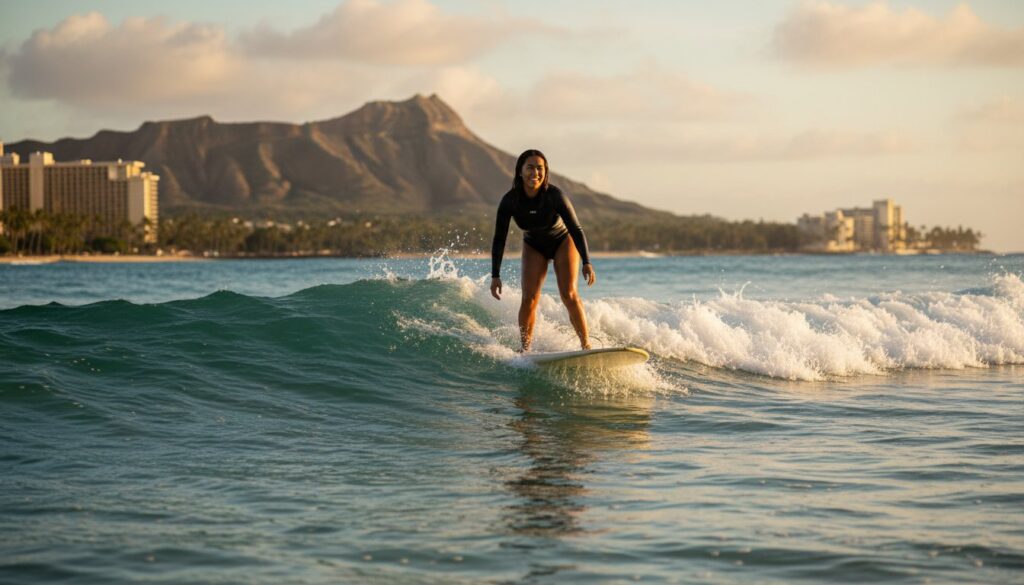
Searching for surf lessons near me is the first step toward one of the most rewarding experiences the ocean has to offer. Whether you are a total beginner, a returning surfer brushing off rust, or a parent signing up a child for their first ride, finding the right local surf school transforms a nervous afternoon into a life-changing moment. This complete guide covers every factor that matters — from certifications and costs to safety protocols, lesson formats, board types, and exactly what happens during that first session in the water. See our beginner surf lessons to find practical first-session tips and booking details.
Surfing is far more accessible than most people assume. However, the quality of your introduction to the sport depends almost entirely on the instructor, the beach, and the structure of the lesson. Spending a few minutes doing your research before booking can save you money, frustration, and — most importantly — help you actually stand up and ride on your very first day.

Beginner surf lessons near me typically start in shallow, calm water with a certified instructor guiding every step. For a deeper walkthrough, see our Surf Lessons in Hawaii: The Complete Guide to Learning to Surf on Every Island.
What Are Surf Lessons Near Me?
Surf lessons near me are structured, instructor-led surfing sessions offered by local surf schools, surf camps, or independently certified coaches at nearby beaches. A proper lesson is not simply paddling out with someone watching from shore — it is a curated, progressive learning experience that includes land-based safety instruction, paddling mechanics, ocean awareness, wave-timing techniques, and hands-on guidance the moment you enter the water. Learn more about beginner surf lessons and what to expect in your first sessions.
Most beginner programs last between 90 minutes and two hours. Reputable schools provide all necessary equipment — typically a soft-top foam surfboard, a leash, and often a rash guard or wetsuit depending on local water temperature. The best schools also limit class sizes to maintain a low student-to-instructor ratio, which directly impacts both safety and learning speed.
Local surf lessons differ fundamentally from generic online tutorials or self-teaching because they provide real-time feedback in real ocean conditions. No video replaces the moment an experienced instructor repositions your foot stance or calls out the exact second to paddle for a wave.
Types of Surf Lessons Available Near You
Understanding your options before searching for surf lessons near me helps you match the right format to your goals, schedule, and budget. Most local schools offer several distinct lesson structures.
Group Surf Lessons
The most common entry point for beginners. Groups typically consist of 4 to 8 students sharing one or two instructors. The social atmosphere is encouraging, costs are lower, and the curriculum covers everything a first-timer needs. Ideal for families, couples, and solo travelers who want a fun, shared experience.
Private Surf Lessons
One instructor, one student. Private lessons accelerate progression because every correction, every encouragement, and every wave is tailored entirely to you. Athletes, goal-focused learners, those with limited time, and anyone returning after a long break benefit most from private instruction.
Semi-Private Lessons
Two to three students share a single instructor. A popular choice for couples or small friend groups who want more personalized attention than a group class without the full cost of private instruction.
Kids and Junior Surf Lessons
Many local schools offer age-specific programs for children as young as 5 or 6. Instructors in these sessions are trained in youth water safety and use smaller, lighter foam boards suited to smaller bodies. Junior surf programs often run as week-long summer camps that combine surfing with beach games and ocean education.
Multi-Day Surf Camps
Residential or day-camp formats that combine multiple daily sessions with accommodation, meals, video analysis, and sometimes yoga or fitness conditioning. Multi-day camps produce the fastest results of any learning format and are increasingly popular with adult beginners who want genuine, lasting skills from a single trip.
Intermediate and Progression Clinics
For surfers who can already stand and ride but want to develop turning, positioning, and wave selection. Local schools offering structured intermediate programs are a significant advantage over schools that only teach beginners.
How to Find and Choose the Best Surf Lessons Near You — Step by Step
Not every surf school is created equal. Knowing what to look for before you book dramatically improves your experience and protects your safety. Follow these six steps to make a fully informed decision and choose the right surf school for your needs.
Step 1 — Confirm your swimming ability. Before booking any surf lesson, be honest about your swimming ability in open water. Most surf schools require students to be comfortable swimming at least 50 to 100 meters unassisted in the ocean — not a pool. This is a non-negotiable safety baseline, not a gatekeeping measure. If you are not there yet, take a few open-water swim sessions first.
Step 2 — Search for certified local surf schools. Use Google Maps, TripAdvisor, Yelp, or your local tourism board to identify surf schools near your destination. Filter specifically for schools whose instructors hold certification from the International Surfing Association (ISA) — the globally recognized governing body for surf instruction — or a nationally accredited equivalent. Certification is not a marketing badge; it means instructors have been formally trained in teaching methodology, water safety, and emergency response.
Step 3 — Read reviews and verify credentials in detail. Check Google Reviews and TripAdvisor carefully and look beyond the star rating. Specifically search for comments about instructor patience, safety protocols, student-to-instructor ratio, communication before and during the lesson, and whether beginners actually stood up and rode waves. Confirm that all instructors hold current first aid and CPR certification — not just the school director.
Step 4 — Evaluate the student-to-instructor ratio. This detail is rarely advertised prominently but is arguably the most important quality indicator. A ratio of 4:1 or better means your instructor can physically assist you, watch your technique, and respond to safety incidents. Anything above 8:1 is too crowded for effective beginner teaching. Ask this question directly before you pay.
Step 5 — Choose between group, semi-private, or private lessons. Group lessons are the most affordable and social option — ideal for first-timers. Private lessons offer faster progression through undivided attention — ideal for returning surfers or those with a specific skill goal. Semi-private lessons balance both. For most absolute beginners, a group lesson is the best starting point both financially and experientially.
Step 6 — Book early and prepare properly. Reserve your spot well in advance, particularly during summer months when quality schools book out days or weeks ahead. At time of booking, ask about cancellation policy, what equipment is provided, wetsuit availability, and the school’s specific beach location. Bring a swimsuit, reef-safe sunscreen, a towel, and a filled water bottle. Everything else — board, leash, and often a wetsuit — is typically provided.
What to Expect During Your First Surf Lesson — A Complete Walkthrough
First-time students are consistently surprised by how structured and land-based the beginning of a lesson is. Here is a realistic, minute-by-minute breakdown of what a well-run beginner surf lesson actually looks like.
The Land Session (20–35 Minutes)
Every quality lesson begins on dry sand. Your instructor will cover ocean awareness (reading wave types, identifying rip currents, understanding tide), surfboard anatomy (nose, tail, rails, fins, leash plug), paddling technique (body position, arm stroke, head position), and the pop-up — the explosive movement from lying prone to standing on the board.
The pop-up is practiced repeatedly on the sand before you ever get wet. This repetition is deliberate — muscle memory developed on land makes the movement more automatic when you are actually moving with the energy of an ocean wave. Instructors will also teach you how to fall safely (away from the board, protecting your head) and how to hold your board in the impact zone.
The Water Session (45–75 Minutes)
Once in the water, your instructor will position you on your foam board in shallow water, typically waist-deep. They will physically guide your board, call the timing of your paddle, and often give you a push to match the wave’s speed. Your only job in those early moments is to execute the pop-up you practiced on land.
The vast majority of beginners successfully stand and ride a wave during their very first in-water session. Foam boards are wide, long, and highly buoyant — they are engineered specifically to make this possible. That first ride, even a short one, is typically described by students as one of the most immediately addictive physical sensations they have ever experienced.
As the session progresses, your instructor will refine your stance, address any technical issues in real time, and gradually reduce hands-on assistance as your confidence builds. Surfing etiquette — right of way rules, priority in the lineup, how to paddle out without interfering with others — is typically introduced during this phase as well.
The Debrief (10–15 Minutes)
The best schools end every lesson with a structured debrief on the beach. Instructors cover what each student did well, what to focus on before the next session, and answer any questions. Some schools use video analysis even at the beginner level — a powerful feedback tool that dramatically accelerates improvement.
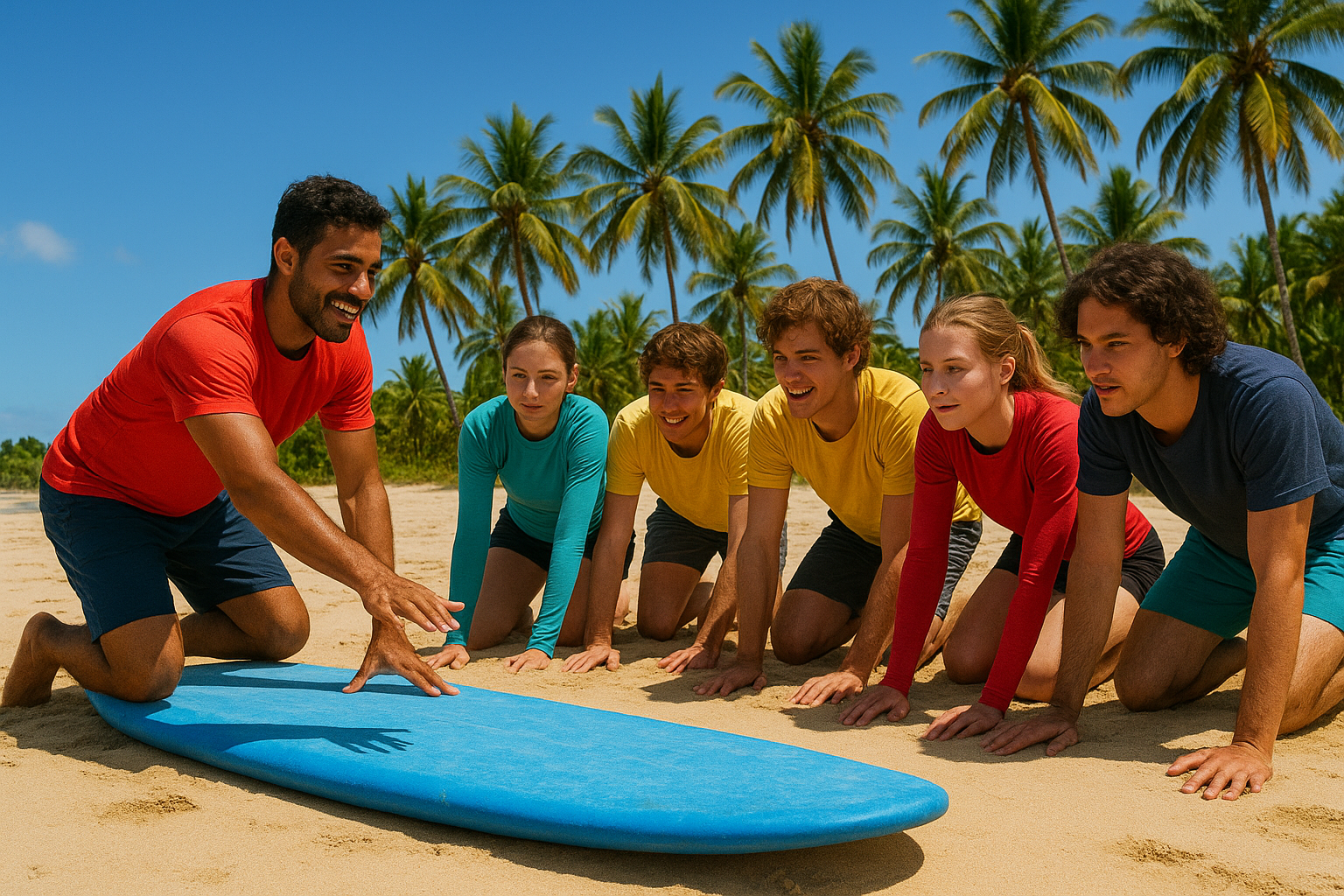
Land-based pop-up drills are a standard part of any quality beginner surf lesson program.
Surf Lesson Costs: What You Should Expect to Pay
Pricing for surf lessons near me varies by region, lesson format, instructor experience, and what equipment is included. The following is a comprehensive breakdown of typical pricing across all lesson formats in most coastal U.S. markets. Compare typical surf lesson prices to find the best value and multi-session savings.
Group Lessons
$50 – $150
Per person per session. Equipment typically included. Best for first-timers and social learners.
Semi-Private (2–3 people)
$75 – $175
Per person per session. More personal attention with a social element. Great for couples and small groups.
Private Lessons
$100 – $250
Per hour, one-on-one. Fastest progression. Ideal for goal-focused learners and returning surfers.
Multi-Day Surf Camp
$300 – $800+
Full package. Often includes multiple daily sessions, equipment, sometimes meals and accommodation.
What drives the price difference? Location is the biggest factor — surf schools at premium beach destinations in Hawaii, Southern California, or the Outer Banks charge more than schools at smaller regional beaches. Instructor experience and certification level, class size limits, and whether video analysis or specific equipment (like wetsuits) is included all affect final pricing as well.
How to get the best value: Look for multi-session packages from a single school. Most reputable schools discount three- or five-session bundles by 15 to 25% compared to single-session rates. These packages also give you the same instructor across sessions, which accelerates your progression significantly.
Ocean Safety: What Every Beginner Must Know Before Getting in the Water
Safety is the foundation of every legitimate surf lesson. A school that skips or rushes safety education to get students into the water faster is a school worth avoiding entirely. Here is what every beginner should understand before their first session.
Understanding Rip Currents
According to the National Weather Service, rip currents account for over 80% of lifeguard rescues in the United States. A rip current is a narrow, fast-moving channel of water flowing away from shore — and panicking swimmers who fight it by swimming directly back to shore quickly exhaust themselves. The correct response is to swim parallel to shore until you exit the current’s narrow channel, then angle back to the beach. Every good surf instructor will cover this scenario on land before the session begins.
Reading Ocean Conditions
Wave height, period (the time between waves), wind direction, and tide all affect how safe and learnable a break is for beginners. Onshore winds (blowing from sea to land) create choppy, messy surf. Offshore winds (blowing from land to sea) groom cleaner, more predictable waves. A rising tide can quickly change a gentle shore break into a powerful shorebreak. Local instructors read these conditions in real time — another irreplaceable advantage of in-person instruction.
Beach and Break Selection
Reputable surf schools teach exclusively at beaches they know intimately. Beginner-appropriate surf breaks share specific characteristics: a sandy bottom (rather than rock or reef), small to moderate wave height (ideally 1 to 3 feet for beginners), and enough distance from rocks, piers, or other hazards to provide a safe working area. Never assume any beach is appropriate for a beginner lesson — local expertise in break selection is itself a safety feature.
Surfing Etiquette and Right of Way
Surfing has a well-established hierarchy in the water that functions as both social courtesy and safety protocol. The surfer closest to the peak of the breaking wave has right of way. Dropping in on another surfer’s wave — taking off in front of someone already riding — is both dangerous and deeply disrespectful. A thorough surf instructor will spend meaningful time on these rules during the land session because understanding them prevents collisions and makes you a welcome participant in any lineup.
Lifeguard Coverage
Always surf at beaches with active lifeguard coverage, especially as a beginner. Reputable schools do not teach at unguarded beaches. Before booking, confirm that your lesson takes place at a patrolled beach with year-round or seasonal lifeguard presence.
Surfboards Used in Lessons: Why Equipment Choice Matters
The board you learn on has an enormous impact on your first experience. This is why equipment selection is a deliberate teaching decision — not just something grabbed from a rack.
Soft-Top Foam Boards (Foamies)
The universal standard for beginner surf lessons. Soft-top boards are typically 8 to 10 feet long and 22 to 25 inches wide, providing a large, stable platform that is far more forgiving than any fiberglass shortboard. The soft foam construction reduces the risk of injury from board contact. Their high volume generates significant buoyancy, which makes paddling easier and wave-catching more frequent — maximizing the number of rides a beginner gets per session.
Longboards for Progression
Once a beginner has mastered the pop-up and can consistently ride whitewash, many instructors transition students to glassed longboards (typically 9 to 10 feet). Longboards reward smooth technique, offer a different and deeply satisfying style of surfing, and are an excellent intermediate stepping stone before downsizing to shorter boards.
Wetsuits and Rash Guards
Water temperature dictates what you wear. In colder waters (below 65°F), a full 3/2mm or 4/3mm wetsuit is essential. In warmer tropical or summer conditions, a rash guard provides sun protection and prevents board rash without adding thermal insulation. Most surf schools provide appropriate thermal protection — but confirm this at booking, especially if you are surfing in spring or fall when water temperatures drop unexpectedly.
Why Local Expertise Is Non-Negotiable When Finding Surf Lessons Near Me
Local surf instructors carry knowledge that no franchise, national chain, or online course can replicate. They know their beaches in intimate, operational detail — the exact sandbar configuration at low tide, which section of the break fills the quickest on a rising swell, where the rip forms on an outgoing tide, and how the morning glass-off compares to the afternoon onshore wind. This is not supplementary information. For beginner surfers who cannot yet read conditions themselves, it is safety-critical intelligence delivered in real time.
Schools like Star Beach Boys exemplify what local expertise combined with structured teaching methodology actually looks like in practice — certified instructors who know their home break in every condition, teaching beginner programs that prioritize safety, progression, and genuine enjoyment. When evaluating schools near you, look for this same combination: deep local knowledge and a formal, consistent teaching structure. Read our choose the right surf school guide for specific selection criteria and questions to ask.
Conversely, be cautious of any school that operates at multiple beaches simultaneously, employs seasonal instructors with no long-term connection to the local break, or cannot tell you specifically why they teach at their chosen beach versus alternatives nearby. These are indicators that local expertise — the most valuable asset a surf school can offer — is absent.
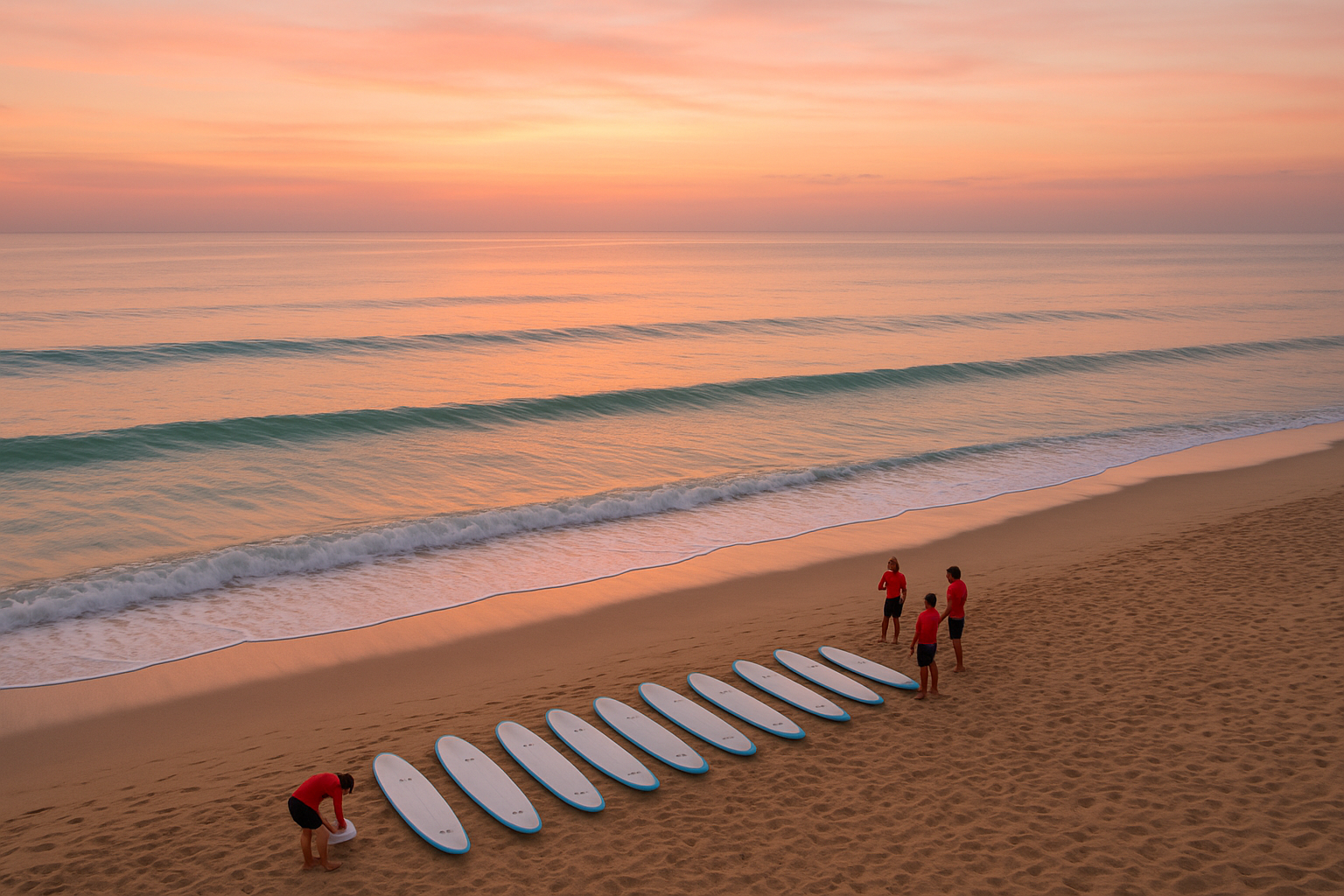
Local surf schools know their beach conditions intimately — a critical advantage for beginner safety and learning speed. For a deeper walkthrough, see our Local Surf Spots Waikiki: Best Breaks Guide.
What Certifications Should Your Surf Instructor Have?
Instructor credentials directly affect your safety and learning outcome. Here is exactly what to look for — and what to be skeptical of — when evaluating a surf school near you.
- ISA Certification (International Surfing Association): The globally recognized standard for surf instruction. ISA-certified instructors have completed a formal curriculum covering surf pedagogy, water safety, emergency procedures, and teaching methodology. This is the credential to prioritize. For a deeper walkthrough, see our Teaching Surfing Techniques: A Complete Guide.
- National Surf Teaching Credentials: Many countries have their own nationally accredited surf instruction programs (such as the SurfingGB award in the UK or Surfing Australia’s coaching pathway). These are equally valid and often aligned with ISA standards.
- First Aid Certification: All instructors should hold current first aid certification. Ocean environments present unique risks — marine stings, lacerations, exhaustion, and near-drowning situations — that require a trained response. “Current” means renewed within the past two years.
- CPR Certification: Separate from first aid but equally essential. Confirm this independently, not just as a blanket “our staff are trained” statement from the school’s website.
- Experience at the Specific Break: Formal certification combined with years of teaching at the same beach is the gold standard. An ISA-certified instructor who has taught 500 lessons at your local break is a fundamentally safer teacher than one who is technically certified but unfamiliar with local conditions.
Best Time of Year to Take Surf Lessons Near You
Timing your first lesson to match favorable conditions significantly improves the experience. Here is a regional breakdown to help you plan.
East Coast (U.S. Atlantic)
Late summer (August–September) offers the most consistent beginner-friendly conditions — warm water, moderate swells, and light morning winds. Early fall can produce excellent mid-sized swells from hurricane activity, which is exciting for intermediate students but less appropriate for absolute beginners. Spring is manageable with a wetsuit.
West Coast (U.S. Pacific)
The Pacific Northwest runs cold year-round; a wetsuit is mandatory in any season. Southern California offers the most beginner-accessible conditions in summer and early fall, with small to moderate swells, offshore morning winds, and water temperatures warm enough for a spring suit or rash guard. Winter brings larger NW swells that are generally not suited to beginners.
Hawaii and Tropical Destinations
surfing lessons in Hawaii, the Caribbean, Central America, and Southeast Asia operate year-round with consistent beginner-friendly conditions at their designated lesson beaches. These destinations experience seasonal swell windows, but schools choose their teaching breaks specifically because those spots remain manageable year-round. A beginner lesson in Waikiki in January is just as accessible as one in July.
General Timing Tip
Regardless of destination, book early morning sessions when possible. Ocean winds are typically calmest in the morning (a condition called “glass-off”), producing cleaner, more predictable wave faces. Afternoon onshore winds chop up the surface and make learning harder. Quality surf schools know this and structure their beginner lessons accordingly — so ask about session timing when you book.
Surf Lessons for Kids: What Parents Need to Know
Children are often the fastest learners in any surf school. Their lower center of gravity, fearlessness, and natural flexibility give them genuine physical advantages in learning to surf. Most quality schools accept children as young as 5 to 7 years old, though this varies by school and the child’s individual comfort level in the ocean.
When searching for kids’ surf lessons near you, look specifically for:
- Smaller student-to-instructor ratios — ideally 3:1 or 4:1 for young children. Physical proximity of the instructor is non-negotiable for child safety.
- Age-appropriate equipment — smaller, lighter foam boards scaled to a child’s height and weight rather than adult-sized boards repurposed for smaller riders.
- Child-specific curriculum — game-based learning, shorter attention-span-adjusted instruction segments, and an emphasis on fun alongside safety fundamentals.
- Background checks for instructors — ask directly. Reputable schools working with children routinely run background checks on all staff who interact with minors.
- Week-long junior camps — an excellent option for school-age children during summer break. The consistency of daily sessions combined with a structured curriculum produces genuine skill development, not just a one-time novelty.
Progressing Beyond Your First Surf Lesson
One lesson is an extraordinary introduction to surfing — but consistent, structured practice is what builds lasting skill. Understanding the progression pathway before you book helps you plan your development rather than starting from zero at each session.
The Beginner-to-Intermediate Progression Arc
Most surfers follow a fairly predictable progression: whitewash riding → unbroken wave takeoffs → consistent pop-up → directional control and basic turns → reading and selecting waves independently. Each stage requires consolidation before the next becomes accessible. Trying to rush from whitewash rides to shortboard performance surfing is the most common mistake self-taught beginners make — and it is why formal instruction at each stage remains valuable well beyond the first lesson.
Between-Session Training
Between lessons, specific off-water habits meaningfully accelerate ocean development:
- Daily pop-up practice on land — 10 repetitions on a yoga mat or marked board outline reinforces muscle memory without any ocean time required.
- Swimming regularly — paddle fitness is the single biggest limiter for beginner surfers. Swimming 3 to 4 times per week between lessons dramatically reduces fatigue in the water.
- Watching experienced surfers — either in person or through quality surf film content. Pattern recognition developed through observation translates directly to better wave selection and positioning instincts.
- Keeping a surf journal — note the conditions, wave size, what felt good, and what broke down. Many advanced surfers credit this practice with faster-than-average progression during their early years.
- Yoga and core training — balance, hip flexibility, and rotational core strength are the physical foundations of surfing movement. Yoga in particular is widely practiced by surfers at every level.
Multi-Session Packages and Progression Programs
Most reputable local surf schools offer multi-session packages — typically three or five lessons bundled at a discount. These packages give you the same instructor across sessions, build on accumulated knowledge each time, and are significantly more cost-effective than booking individual lessons. Ask about intermediate progression clinics and video analysis sessions as you advance — these are indicators of a school with real teaching depth rather than one focused purely on beginner volume.
Red Flags: Surf Schools to Avoid When Searching Near Me
Knowing what to avoid is just as important as knowing what to look for. The following are specific warning signs that a surf school prioritizes revenue over student safety and learning quality.
- No verifiable instructor certification. If the school cannot name the certification body their instructors hold credentials from, walk away. “Experienced surfers” are not the same as trained surf instructors.
- Student-to-instructor ratios above 8:1. Beyond this threshold, individual supervision becomes effectively impossible and safety margins collapse.
- No land-based instruction. Any school that skips the beach safety session and sends beginners directly into the water is cutting corners on exactly the content that protects students from injury.
- No clear cancellation or refund policy. Legitimate schools have transparent policies. Vague or absent cancellation terms are a general sign of unprofessional operation.
- Consistently negative reviews about safety. One negative review is noise. Multiple reviews specifically mentioning feeling unsafe, unsupervised, or misled about conditions are a pattern worth taking seriously.
- Teaching at inappropriate breaks. If a school teaches at a reef break, a heavy shore break, or any surf spot locals would not describe as beginner-friendly — that is a dangerous mismatch between marketing and reality.
Ready to Book Your First Surf Lesson? See guidance on whether surfing is safe for beginners before you book.
Visit Star Beach Boys to explore beginner and intermediate surf programs led by certified local instructors — with deep knowledge of their home break and a structured curriculum built for real progression. — By Star Beach Boys. Updated 2026-06-27. For a deeper walkthrough, see our Surf Rental in Waikiki: The Ultimate Guide to Riding the Waves with Aloha.
Conclusion: How to Find the Best Surf Lessons Near Me
Finding the right surf lessons near me is ultimately about matching your goals, budget, and location to a school that genuinely prioritizes safety, certified instruction, progressive curriculum, and a deeply local understanding of the ocean environment where it operates. The surf lesson format, instructor credential, student-to-instructor ratio, and timing of your session all have measurable impacts on both your safety and your enjoyment.
The ocean rewards patience and consistent effort. One well-structured lesson at a reputable local school will give you more usable skill than a dozen sessions of unsupervised trial and error. Book with a school that has the credentials, the local knowledge, and the teaching structure to make your first session genuinely great — and then come back for more.
Whether you are chasing your first wave on a family vacation, introducing a child to the ocean, or beginning what may become a lifelong pursuit — the right local instructor makes all the difference. Start your search today and get in the water. Author: Star Beach Boys Team. Last updated: 2026-08-11. Author: Star Beach Boys instructors. Last updated: 2026-07-27.
Frequently Asked Questions About Surf Lessons Near Me
How do I find surf lessons near me?
Search Google Maps, TripAdvisor, or Yelp using the phrase “surf lessons near me” combined with your destination city or beach name. Look specifically for ISA-certified schools with recent positive reviews. Local surf shops, visitor centers, and tourism boards are also reliable resources for finding reputable nearby instruction.
How much do surf lessons near me typically cost?
Group lessons generally range from $50 to $150 per person per session. Semi-private lessons for two or three students cost $75 to $175 per person. Private one-on-one lessons run $100 to $250 per hour. Multi-day surf camp packages range from $300 to $800 or more depending on what is included. Equipment is usually provided.
Do I need to know how to swim before taking surf lessons?
Yes, basic swimming ability in open water is required by most surf schools. You should be able to swim at least 50 to 100 meters unassisted in the ocean — not just a pool. This is a safety requirement, not a gatekeeping measure, and exists because students can end up in deeper water during lessons despite instructors’ best efforts.
What age is appropriate to start surf lessons?
Most surf schools accept children as young as 5 to 7 years old, depending on the child’s individual comfort in the ocean. There is no upper age limit — many schools offer programs specifically designed for adults and seniors. The key factors are ocean comfort, basic swimming ability, and physical willingness to try something new.
How long does it take to learn to surf?
Most beginners can stand and ride small whitewash waves after one or two lessons with a certified instructor. Consistent riding of unbroken waves typically develops over three to ten sessions depending on frequency of practice. Becoming a confident intermediate surfer — able to select and ride green waves independently — generally takes several months of regular water time. Consistent instruction significantly compresses this timeline.
What should I bring to my first surf lesson?
Bring a swimsuit or board shorts, a rash guard if you have one, reef-safe sunscreen, a towel, a water bottle, and any required medications. Most schools provide the surfboard, leash, and a wetsuit or rash guard if needed — but confirm equipment details at the time of booking, especially in cooler-water destinations.
Are group or private surf lessons better for beginners?
Group lessons are the best starting point for most beginners — they are affordable, socially encouraging, and cover all core fundamentals effectively. Private lessons offer faster personal progression through undivided instructor attention and are better suited for goal-focused learners, returning surfers, or people with very limited available time. Semi-private lessons for two or three students strike an excellent balance between cost and personal attention.
What is the best time of year to take surf lessons near me?
On the U.S. East Coast, late summer and early fall offer the best beginner conditions. On the West Coast, summer and early fall in Southern California are ideal. In tropical destinations — Hawaii, the Caribbean, Central America — quality beginner conditions exist year-round. Regardless of location, morning sessions offer cleaner wave faces due to lighter wind conditions.
What certifications should a surf instructor have?
Look for ISA (International Surfing Association) certification or a nationally accredited equivalent. All instructors should also hold current first aid and CPR certification — renewed within the past two years. Experienced local knowledge of the specific teaching break is an additional quality indicator that formal credentials alone do not capture.
Is surfing dangerous for beginners?
Beginner surf lessons taught by certified instructors at appropriate beach breaks are designed to minimize risk. Foam boards, sandy-bottom beach breaks, constant instructor supervision, and proper safety education combine to make structured lessons genuinely safe. The most common beginner injuries — minor abrasions and muscle soreness — are not serious. Booking with a school that takes safety protocols seriously is the single most important risk-reduction decision you can make.
What type of surfboard is used in beginner lessons?
Soft-top foam surfboards — commonly called “foamies” — are the universal standard for beginner instruction. They are typically 8 to 10 feet long, wide, and highly buoyant, making paddling easier and wave-catching more frequent. The soft foam construction significantly reduces the risk of injury from board contact compared to hard fiberglass boards.
What is the student-to-instructor ratio I should look for?
A ratio of 4:1 or better is ideal for beginner surf lessons. At this ratio, instructors can maintain visual contact with every student and physically intervene when needed. Ratios above 8:1 compromise both safety supervision and individual teaching quality. Ask this question directly before booking — legitimate schools answer it readily.
Can I take surf lessons if I am not physically fit?
Yes. Surf lessons are designed to be accessible to people of varying fitness levels, and most schools welcome students of all body types and athletic backgrounds. That said, basic upper body and cardiovascular fitness genuinely helps — paddling is more demanding than it looks, and students with better base fitness get more wave-riding time per session. Consider a few weeks of swimming or light paddling before your first lesson if fitness is a concern.