Surf lessons in Hawaii are a bucket-list experience unlike anything else in the world — warm turquoise water, world-class instructors, and gentle beginner waves that make standing up on your first day not just possible, but probable. Whether you’re visiting Oahu for a week or spending a month island-hopping, this guide gives you everything you need to plan the perfect lesson, choose the right school, and make the most of every minute in the water.
Surfing was born in Hawaii. Ancient Polynesian Hawaiians — royalty and commoners alike — rode waves carved from koa wood centuries before the sport spread to the rest of the world. Taking surf lessons in Hawaii means learning this sport in its birthplace, guided by people who grew up in this exact ocean. That combination of cultural depth, ideal conditions, and generational expertise is something no other destination can replicate.
This guide covers every detail — from which beaches are best for beginners on each island, to what happens minute-by-minute during your first lesson, to exactly what to look for when choosing a school. Read it once and you’ll head to your lesson prepared, confident, and ready to ride.

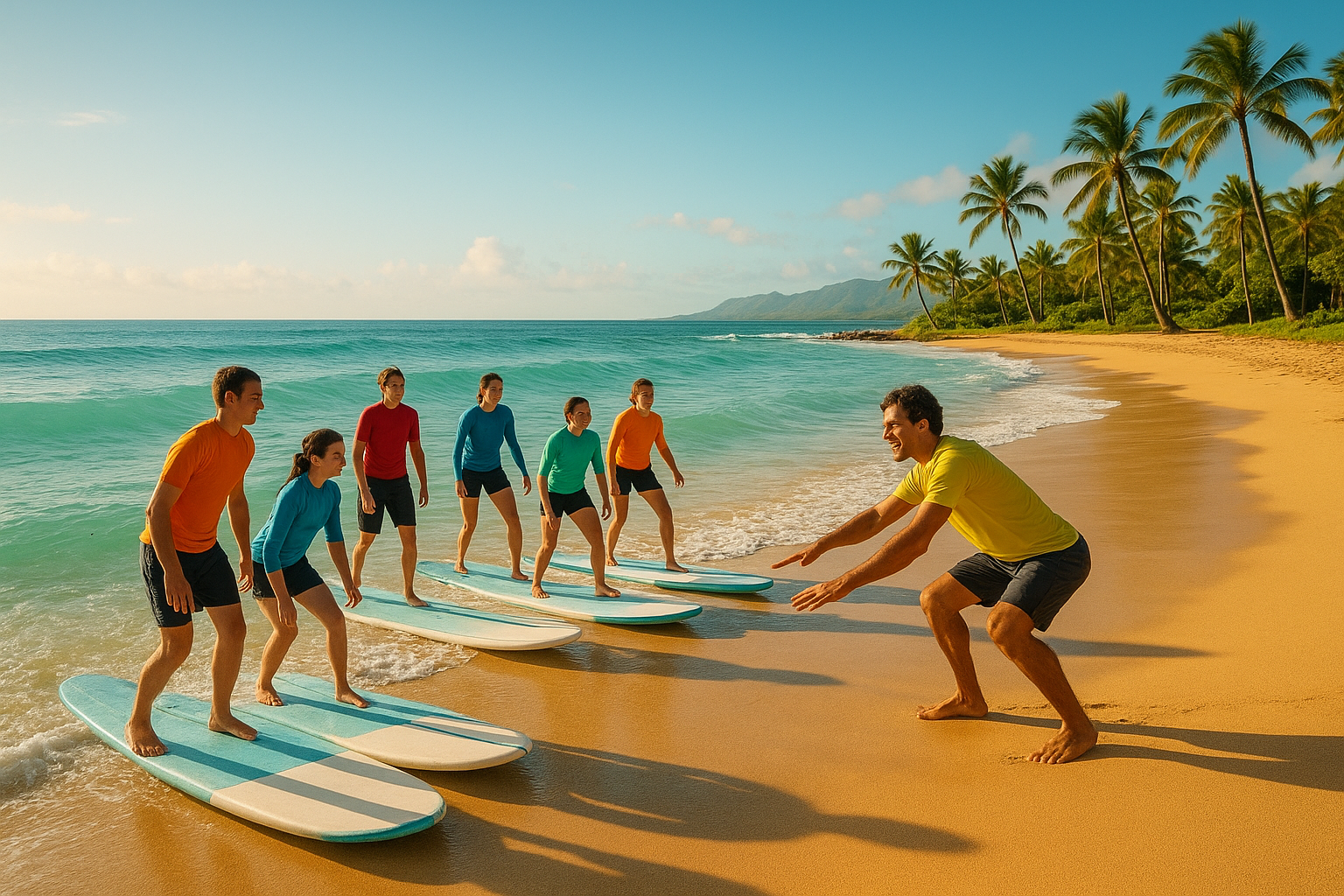
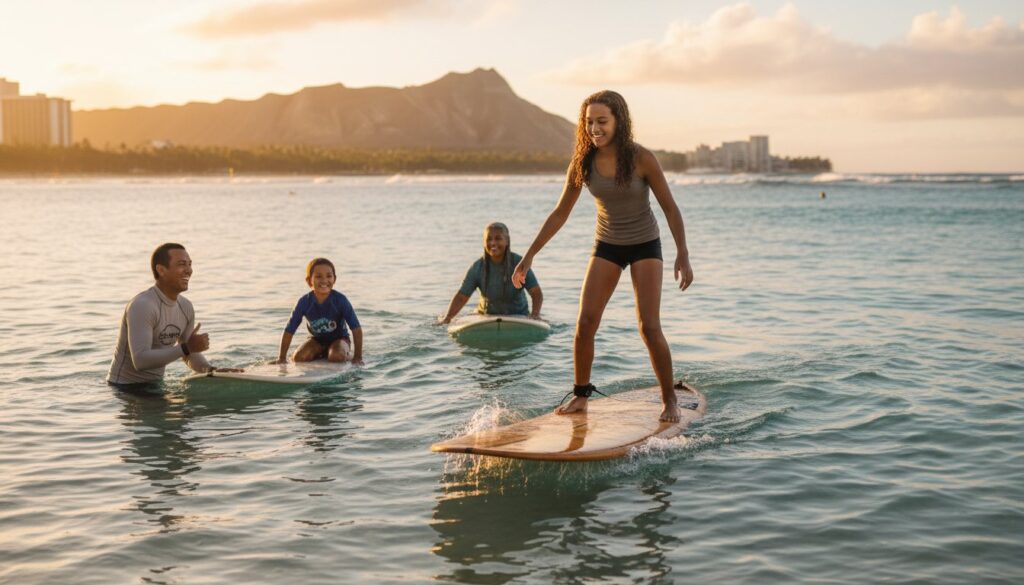
Surf lessons in Hawaii typically begin with on-sand instruction before students enter the water.
Why Hawaii Is the World’s Best Place to Learn to Surf
No other destination on earth combines the cultural significance, natural conditions, and instructor quality that Hawaii offers for learning to surf. Here’s what sets it apart:
- Warm water year-round: Ocean temperatures hover between 75°F and 80°F (24°C–27°C) across all islands and all seasons. You’ll never need a wetsuit, and cold water will never be a distraction from learning proper technique.
- Consistent, beginner-friendly waves: Hawaii’s geography creates sheltered bays and reef-protected beaches that generate slow, rolling waves perfect for beginners — especially at spots like Waikiki, where waves peel predictably across a wide sandy bottom.
- Certified, lifelong instructors: Hawaiian surf instructors often started surfing at age four or five. Many hold certifications from recognized surf safety organizations and have logged thousands of teaching hours. You’re learning from people who live this sport.
- Cultural heritage: Surfing originated in Hawaii. Learning here carries a meaning that no other location can offer — you’re participating in a tradition that spans centuries and connects you to something far larger than sport.
- Options for every skill level: From the mellow rollers of Waikiki to the legendary breaks of Pipeline on the North Shore, Hawaii has a wave for everyone. Beginners thrive here, and so do the world’s best surfers. That range is unique.
Best Beaches for Beginner Surf Lessons on Every Hawaiian Island
Choosing the right beach is just as important as choosing the right school. The wrong beach — even with great instruction — can make learning much harder. Here is a detailed island-by-island breakdown of the best spots for beginner surf lessons in Hawaii.
Oahu — Waikiki Beach (Best Overall for Beginners)
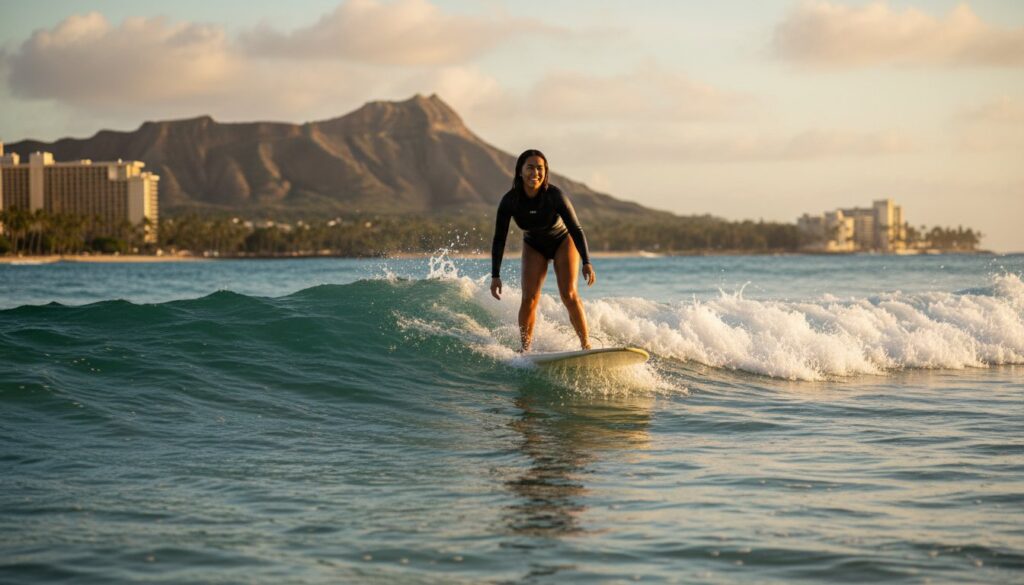
Why it works: Waikiki offers long, slow-rolling waves that break over a forgiving sandy bottom. Wave height for beginners typically ranges from 1 to 3 feet, and the consistent peel gives students plenty of time to execute their pop-up.
Best time to go: Year-round, though summer (April–September) offers the calmest conditions.
What to know: Waikiki is busy, especially on weekends. Book early and opt for morning lessons when crowds are lighter and winds are calmer. Schools like Star Beach Boys operate directly on the beach here and are well regarded for their beginner instruction.
Oahu — Ala Moana and Canoes Break
Just west of Waikiki, the Canoes break is one of the most legendary beginner surf spots on the island. Named for the outrigger canoes that once launched from this spot, it offers long, gentle rides and is a favorite for surf schools operating in the area.
Maui — Lahaina, Kaanapali, and Thousand Peaks
Why it works: Maui’s western shores offer warm, calm water and manageable wave heights. Thousand Peaks near Ukumehame is particularly ideal — it has multiple wave peaks breaking simultaneously, so there’s almost always a gentle ride available for beginners.
What to know: Maui offers a less crowded experience than Waikiki while still maintaining excellent beginner conditions. Schools here are smaller and often provide a more personalized teaching environment.
Kauai — Hanalei Bay and Poipu Beach
Why it works: Hanalei Bay in summer offers some of the most picturesque beginner surfing conditions in all of Hawaii, framed by dramatic green cliffs and calm, translucent water. Poipu Beach on the south shore offers more consistent year-round conditions.
What to know: Hanalei can produce large swells in winter (November–March), making it unsuitable for beginners during those months. Always check conditions before booking.
Big Island — Kohala Coast and Banyans
Why it works: The Big Island’s leeward (western) coast is naturally sheltered from open-ocean swells, producing calm, protected bays ideal for beginners. Banyans near Kona is a popular local spot with reliable small waves. Surf schools on the Big Island are fewer than on Oahu or Maui, but the uncrowded, intimate environment makes learning here especially enjoyable.
What Happens During Your First Surf Lesson — Step by Step
Most first-time students are surprised by how structured, safe, and confidence-building a proper surf lesson actually is. Here is a detailed walkthrough of exactly what to expect from arrival to your first wave.
Step 1 — Choose your beach and book a certified school. Research beginner-friendly beaches on your island and select a school with certified instructors, strong reviews, and small class sizes. Book online at least 3–5 days ahead during peak season (June–August and December–January). Morning slots (7–10am) offer the best wind and crowd conditions.
Step 2 — Arrive 15 minutes early and check in. Most schools ask you to arrive 10–15 minutes before your lesson begins. You’ll sign a waiver, receive your foam board and rash guard, and meet your instructor. Use this time to watch the water and note how the waves are breaking.
Step 3 — Complete the on-beach orientation and warm-up (20–30 minutes). Your instructor will cover ocean safety, wave reading, and surf etiquette. You’ll practice the pop-up movement on dry sand — lying flat on the board, then explosively rising to a balanced stance in one fluid motion. This is the single most important skill you’ll practice, and doing it right on land dramatically improves your performance in the water.
Step 4 — Enter the water and begin paddle practice (10–15 minutes). Your instructor will lead you into waist-deep water and show you proper paddle technique — arms fully extended, pulling through the water in a steady S-stroke rhythm. Efficient paddling is what gets you into waves, so this step is more important than most beginners realize.
Step 5 — Catch your first waves with instructor guidance (30–45 minutes). Your instructor will position you in the lineup and physically push your board into waves, giving you the assist you need to feel the ride. They’ll call “paddle!” and “pop up!” at the right moment, and give real-time verbal feedback between each attempt. Most students stand up within the first 3–5 tries.
Step 6 — Cool-down, debrief, and next steps. After your water session, your instructor will review your performance, highlight what you did well, and identify one or two specific things to work on in your next lesson. This debrief is extremely valuable — take notes if you can. Most schools will offer a package discount if you book your next session on the spot.

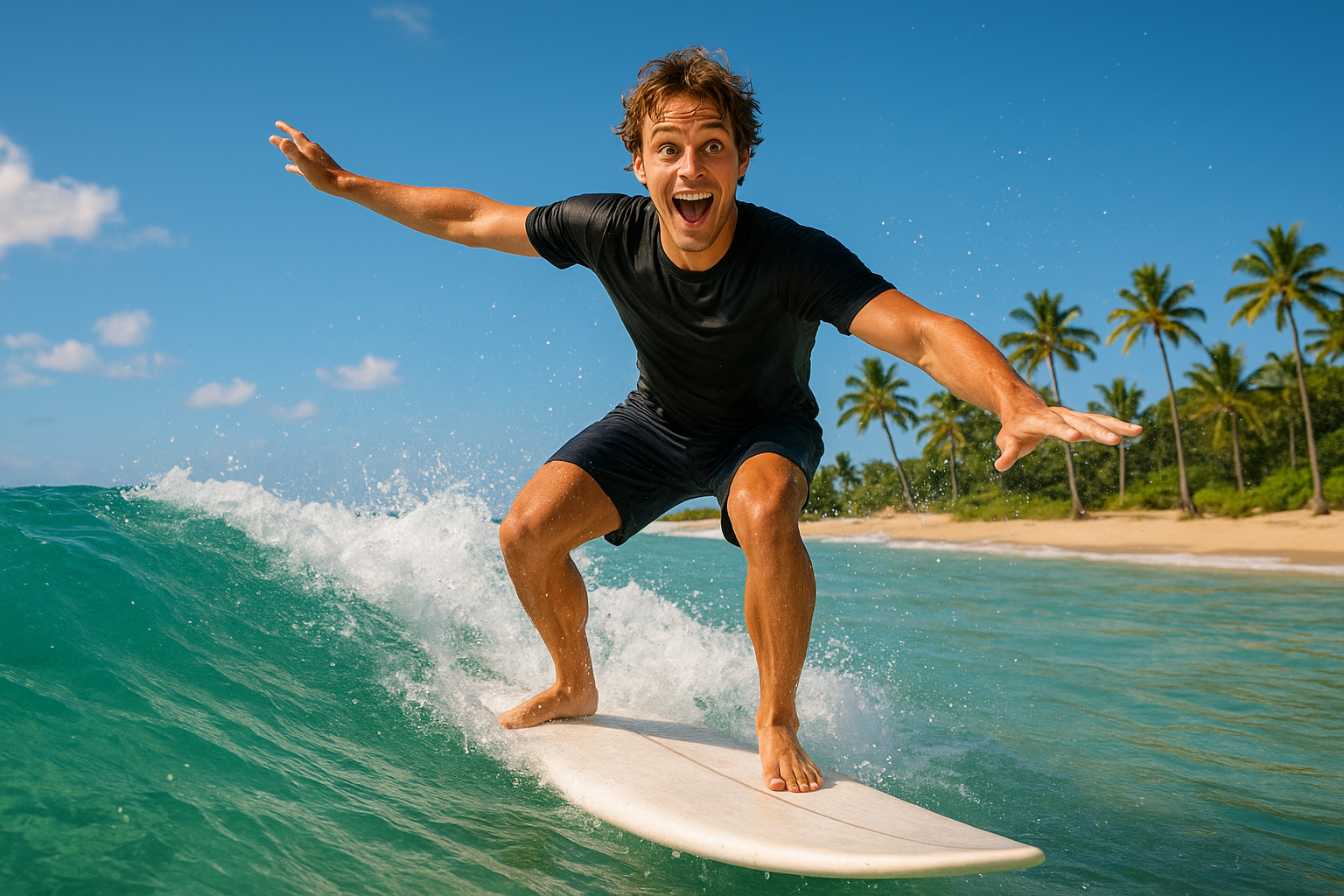
Many beginners successfully stand up and ride a wave during their very first lesson in Hawaii.
How to Choose the Right Surf School in Hawaii
Not all surf schools are created equal, and the quality of your first experience depends heavily on who teaches it. Here are the key criteria to evaluate before you book.
Instructor Certification and Experience
Look for instructors certified by recognized surf safety organizations. Certification ensures your instructor knows how to manage ocean emergencies, handle rip currents, and teach proper technique. Ask the school directly about certifications if the website doesn’t specify them clearly.
Student-to-Instructor Ratio
The ideal group lesson has no more than 4–6 students per instructor. Ratios higher than this significantly reduce the feedback and individual attention you receive. Always ask about class size before booking — especially during peak season when schools run at full capacity.
Equipment Quality
Reputable schools use foam-top (soft-top) surfboards for beginners — typically 8 to 10 feet long. These boards are wider, more stable, and far more forgiving than fiberglass shortboards. If a school wants to put a beginner on a hard board, that’s a red flag. Schools should also provide leashes and rash guards at no additional charge.
Reviews and Reputation
Read recent reviews on Google, TripAdvisor, and Yelp. Look specifically for comments about instructor patience, safety practices, and whether beginners successfully stood up. A strong school will have dozens — or hundreds — of reviews with consistent praise for their teaching approach.
Lesson Packages and Follow-Up Options
A single lesson is a great introduction, but two or three consecutive lessons will accelerate your progress dramatically. Ask whether the school offers multi-day packages, discounts for returning students, or advanced beginner progression programs. The best schools invest in your long-term development, not just a single transaction.
Beach Permit and Legitimacy
All commercial surf instruction on Hawaii’s public beaches requires a state permit. Always confirm that your school operates legally with a proper beach permit. Unlicensed instructors may offer lower prices, but they operate without insurance or regulatory oversight — which creates real risk for you if something goes wrong.
How Much Do Surf Lessons in Hawaii Cost?
Understanding pricing before you book helps you budget accurately and avoid being overcharged. Here’s a realistic breakdown of what surf lessons in Hawaii typically cost across lesson types and islands.
Prices vary by island, season, and school. Oahu generally has more competitive pricing due to higher competition among schools. Maui and Kauai lessons may run slightly higher. Always confirm what’s included — most quality schools include board, leash, and rash guard, but confirm before assuming.
Group Lessons vs. Private Lessons: Which Is Right for You?
One of the most common questions people ask when booking surf lessons in Hawaii is whether to choose a group lesson or go private. Both have genuine advantages — the right choice depends on your goals, budget, and learning style.
Group Lessons — Best For Most Beginners
- More affordable — often 50–60% less than private rates
- Social and energizing — you’ll cheer each other on and share the excitement
- Watching others attempt waves and receive feedback accelerates your own learning
- Ideal for families, friend groups, and travelers who want the communal experience
- Quality group lessons (4–6 students max) still offer substantial personal feedback
Private Lessons — Best for Fast Progression
- 100% of your instructor’s attention means faster skill development
- Your instructor can adapt the session entirely to your pace, body type, and learning style
- Ideal for people who learn best without an audience or who have specific physical considerations
- Worth the extra cost if you plan to continue surfing beyond your Hawaii trip
- Better for intermediate surfers working on technique rather than just catching waves
Bottom line: For most first-timers, a quality group lesson at a reputable school like Star Beach Boys delivers an exceptional experience at a fraction of the private rate. If budget isn’t a concern or you’re serious about progressing quickly, book private.
What to Wear and Bring to Your Surf Lesson
Showing up prepared makes your lesson smoother and safer. Here’s exactly what to bring and what to leave at the hotel.
What to Bring
- Swimsuit or board shorts: Wear something you’re comfortable moving aggressively in. Avoid loose bottoms that might come off in a wipeout.
- Reef-safe sunscreen: Apply 30 minutes before you hit the sand. Hawaii law requires reef-safe formulas (no oxybenzone or octinoxate). Apply liberally to your neck, back of knees, and tops of feet — areas beginners forget.
- Water bottle: You’ll be more physically active than you expect. Stay hydrated before and after your session.
- Towel and dry clothes: For after the lesson. Leave valuables — wallet, phone, car keys — locked in your car or hotel room.
- Rash guard (optional): Most schools provide these, but if you have your own and prefer it, bring it. Long-sleeve rash guards provide better sun and board-rash protection.
What the School Provides
- Foam-top (soft-top) surfboard — typically 8–10 feet long
- Leg leash (keeps board attached to your ankle)
- Rash guard (at most reputable schools)
- All instruction, wax, and on-beach coaching
The Best Time of Year for Surf Lessons in Hawaii
Hawaii offers surfable conditions 365 days a year, but the optimal time for beginner surf lessons varies by island and wave direction. Understanding the seasonal patterns helps you plan the ideal lesson timing.
Summer (April–September) — Best for Beginners Overall
Summer months bring smaller, more consistent swells generated from the southern hemisphere. Waves at beginner spots like Waikiki typically run 1–3 feet — ideal for learning fundamentals. Trade winds are lighter in the morning, giving you the glassiest conditions of the day. This is peak tourist season, so book lessons at least one week ahead.
Winter (October–March) — Manageable for Beginners on South Shores
Winter brings large north swells from the Pacific — this is when the North Shore of Oahu sees the legendary 20–40 foot waves that host the Vans Triple Crown of Surfing. These are absolutely not for beginners. However, south-facing beaches on all islands remain calm in winter because they’re sheltered from north swells. Waikiki faces south, which is why it stays beginner-friendly year-round.
Shoulder Seasons (March–April and September–October)
The shoulder seasons offer the best of both worlds — smaller crowds, better pricing on lessons, and still-excellent wave conditions for beginners. If your travel dates are flexible, late September through early October is arguably the best time to book surf lessons in Hawaii: summer-style waves, fewer tourists, and a very reasonable rate from most schools.
Common Beginner Mistakes — And How to Fix Them Before They Happen
Even with great instruction, most beginners fall into the same predictable patterns. Knowing these mistakes in advance lets you actively avoid them — and makes your instructor’s job much easier.
Mistake 1: Looking Down at the Board
This is the single most common beginner mistake. The moment you pop up, your gaze should lock on the horizon or the beach ahead. Looking down shifts your center of gravity forward, collapses your chest, and causes an almost immediate nose-dive. Practice keeping your chin up during your dry-land rehearsal and the habit will carry into the water.
Mistake 2: A Slow, Hesitant Pop-Up
The pop-up from lying flat to standing must be one explosive, fluid movement — not a slow, step-by-step process. Many beginners try to use their knees as a midpoint, which kills their momentum and balance. Think of it like a burpee: fast, committed, and complete. If you’re hesitating, you’re already falling.
Mistake 3: Wrong Foot Forward
Surfers are either “regular” (left foot forward) or “goofy” (right foot forward). Your instructor will help you determine your natural stance, but if you’re unsure: the foot you instinctively step forward with to catch your balance is your front foot on the board. Getting this wrong makes everything feel awkward and makes turning nearly impossible.
Mistake 4: Paddling Too Early or Too Late
Wave timing is the hardest skill to master, and beginners consistently misjudge it. Starting your paddle too early means the wave passes under you. Starting too late means you get dumped. Your instructor will read the wave and give you the cue — trust it completely, especially on your first few attempts.
Mistake 5: Tensing Up the Upper Body
Fear and excitement both cause beginners to lock up their shoulders and arms. A rigid upper body destroys your balance and makes corrections impossible. Shake your arms out before each wave, take a breath, and actively try to keep your arms loose and extended to your sides for balance — like a tightrope walker.
Mistake 6: Skipping the Warm-Up
Paddling works muscles most people rarely engage — specifically the rotator cuff, lats, and lower back. Skipping a proper shoulder, hip, and back warm-up before entering the water significantly increases your injury risk. Your instructor will often lead a group warm-up, but if yours doesn’t, do five minutes of arm circles, shoulder rolls, and hip stretches on the beach beforehand.

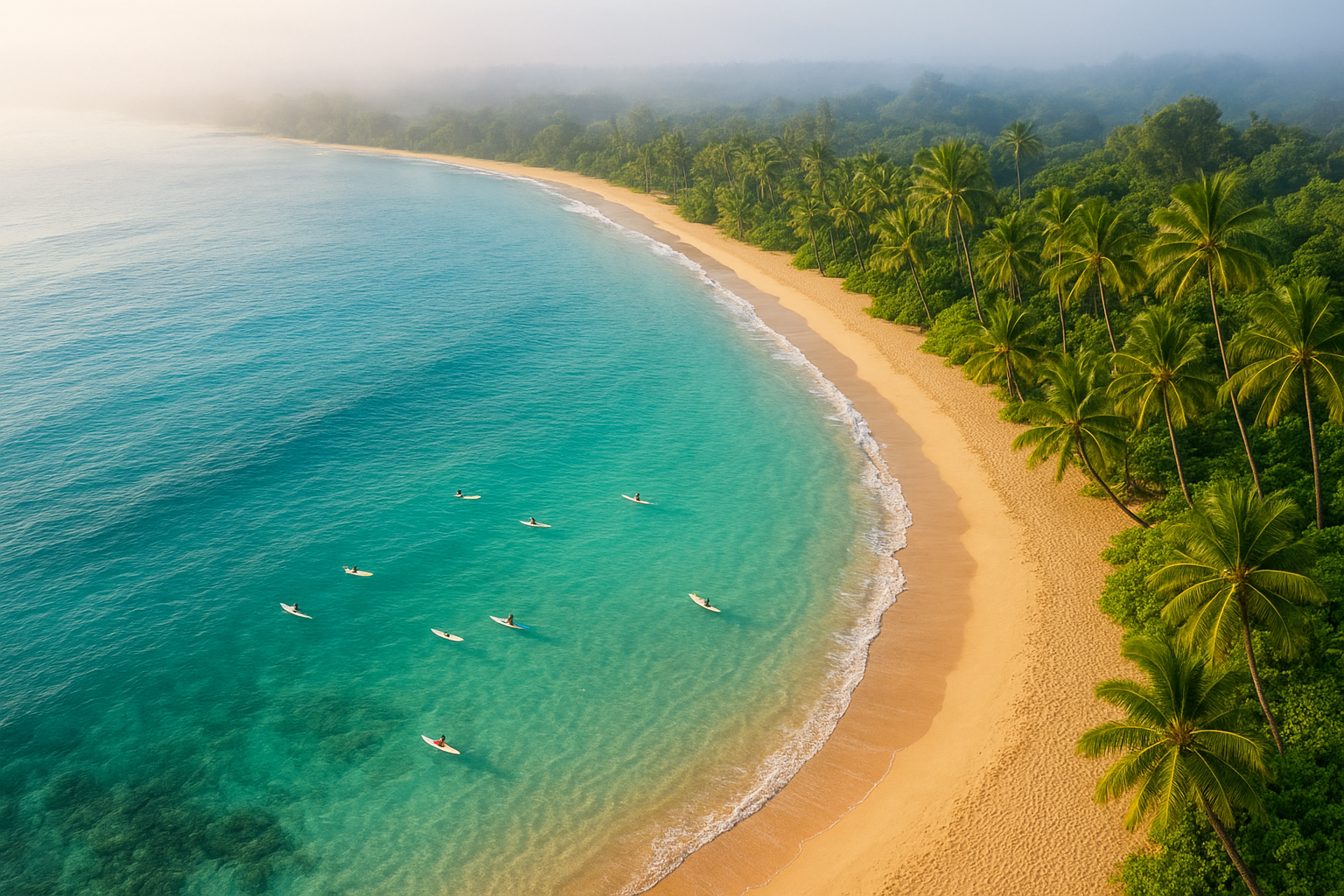
Hawaii’s sheltered bays and warm shallow waters create ideal conditions for beginner surfers year-round.
Surf Lessons in Hawaii for Kids and Families
Surfing is genuinely one of the best family activities in Hawaii — kids as young as 5 or 6 take to the water with remarkable ease, and watching your child ride their first wave is an unforgettable shared experience. Here’s what families need to know.
Minimum Age Requirements
Most surf schools in Hawaii accept children as young as 5 years old for introductory lessons. Many schools also offer youth-specific programs for ages 8–15. There is no upper age limit — surf schools regularly teach students in their 60s, 70s, and beyond. If you’re traveling with mixed ages, ask schools about their family lesson format, which places a parent and children in the water together with one or two instructors.
What Makes Kids Learn Faster
Children have a lower center of gravity and less fear of falling, which makes them natural surfers. Most kids who take surf lessons in Hawaii stand up within 2–3 waves — often before their parents do. The key is choosing a school with instructors who specialize in youth teaching and maintain the patience to keep kids engaged throughout the session.
Safety Considerations for Families
For children under 8, semi-private or private family lessons are strongly recommended over large group sessions. This ensures your child receives constant supervision in the water. Confirm that the school’s instructor-to-student ratio for kids’ lessons is 1:2 or 1:3 at most, and that all instructors are current CPR and first-aid certified.
Ocean Safety: What Every Surf Student in Hawaii Should Know
Good surf schools build ocean safety into their curriculum from the very first minute. But as a student, understanding these fundamentals independently makes you a safer and more confident surfer.
Understanding Rip Currents
Rip currents are the leading cause of ocean rescues in Hawaii. A rip current is a narrow channel of water flowing rapidly away from shore — if you’re caught in one, the critical rule is: do not swim directly against it. Instead, swim parallel to the shore until you’re out of the current, then swim diagonally back to the beach. Your instructor will point out any active rip currents before your session and position lessons away from them entirely.
Surf Etiquette and Right of Way
Surfing has a strict code of conduct in the lineup. The fundamental rule: the surfer closest to the breaking part of the wave has right of way. Dropping in on someone else’s wave is dangerous and deeply disrespectful in surf culture. Your instructor will cover lineup etiquette during the beach session — absorb it carefully, because other surfers take it seriously.
How to Fall Safely
Falling off a surfboard is inevitable and completely safe when done correctly. The key rules: fall flat rather than diving head-first, cover your head with your arms as you surface, and never stand up quickly when you resurface — drag your board back first and look around for incoming waves before rising.
Swimming Ability Requirements
Basic swimming ability is essential before taking surf lessons in Hawaii. You don’t need to be a competitive swimmer, but you should be comfortable in open water and capable of swimming at least 50 meters unassisted. If you’re not a confident swimmer, spend a few days in the hotel pool before your lesson day.
What Happens After Your First Lesson — Continuing Your Surf Journey
After your first lesson, expect a powerful combination of muscle soreness and obsession. Your shoulders and lats will be sore from paddling (it uses muscles most people have never properly engaged), and your mind will replay every wave you rode for the rest of the day. This is completely normal — and it’s the beginning of a lifelong relationship with the ocean.
Book Your Second Lesson Before You Leave the Beach
The progression from lesson one to lesson two is one of the most dramatic jumps in all of surfing. Everything that felt awkward — the pop-up, the paddle, the wave reading — starts to feel familiar. If your trip allows it, book lesson two for the very next day while the muscle memory is fresh. Most schools offer return student discounts.
What to Work On Between Lessons
Between lessons, practice your pop-up on a stable surface — a yoga mat or even the hotel room floor works perfectly. Five minutes of dry-land pop-up practice per day will noticeably improve your speed and consistency in the water. Watch surf instruction videos online to reinforce the technique your instructor demonstrated.
Connecting With the Surf Community
Schools like Star Beach Boys offer ongoing instruction and can connect you with the broader surf community on the island. Whether you’re planning to return to Hawaii regularly or looking to continue surfing at home, these connections accelerate your development and make every future trip more rewarding.
Surfing and Hawaiian Culture: What Every Student Should Understand
Surfing isn’t just a sport in Hawaii — it is woven into the cultural identity of the islands. Understanding this context makes your experience richer and ensures you approach the ocean with the respect it deserves.
Ancient Hawaiians called surfing he’e nalu — literally “wave sliding.” It was practiced by both men and women across all levels of Hawaiian society, and the most skilled surfers were revered figures. Hawaiian ali’i (royalty) rode boards called olo — up to 18 feet long, crafted from koa or wiliwili wood — at breaks that only they were permitted to surf.
When Western contact disrupted Hawaiian culture in the 18th and 19th centuries, surfing nearly disappeared. It was revived in the early 20th century largely through the efforts of Duke Kahanamoku — a Native Hawaiian Olympic swimmer and surfer from Waikiki who introduced surfing to California, Australia, and ultimately the rest of the world. A statue of Duke stands at Waikiki Beach today, arms outstretched toward the ocean he loved.
When you take surf lessons in Hawaii, you are participating in something that spans centuries. Treat the ocean, the locals, and the culture with the same respect you’d show any sacred place — and you’ll receive a warmth and welcome in return that makes Hawaii unlike anywhere else on earth.
Frequently Asked Questions About Surf Lessons in Hawaii
Are surf lessons in Hawaii suitable for complete beginners with no experience?
Yes — surf lessons in Hawaii are specifically designed for all skill levels, including absolute beginners. Most schools use wide, stable foam boards and begin with 20–30 minutes of on-beach instruction before entering the water. No prior surfing experience is required, and most complete beginners successfully stand up during their first session.
How long does a typical surf lesson in Hawaii last?
Most surf lessons in Hawaii last 60 to 90 minutes. This typically includes 20–30 minutes of on-beach instruction covering stance, pop-up technique, and wave reading, followed by 40–60 minutes of in-water practice with direct instructor guidance.
What is the best beach in Hawaii for beginner surf lessons?
Waikiki Beach on Oahu is widely considered the best location for beginner surf lessons in Hawaii. Its long, slow-rolling waves, sandy bottom, and warm water create consistently forgiving conditions. The Canoes break at Waikiki is especially popular with schools for its predictable, gentle waves.
How much do surf lessons in Hawaii cost?
Group surf lessons in Hawaii typically cost $50–$100 per person. Semi-private lessons (two students) run $100–$150 per person, while private 1-on-1 lessons range from $150–$250. Multi-day packages offer the best value, often providing three group lessons for the price of two.
Do I need to know how to swim before taking surf lessons in Hawaii?
Yes — basic swimming ability is required before taking surf lessons in Hawaii. You don’t need to be an expert swimmer, but you should be comfortable in open water and able to swim at least 50 meters unassisted. If you’re not a confident swimmer, practice in a pool before your lesson day.
What should I bring to my surf lesson in Hawaii?
Bring a swimsuit or board shorts, reef-safe sunscreen (Hawaii law requires reef-safe formulas), a towel, a water bottle, and dry clothes for after. Most schools provide the surfboard, leash, and rash guard. Leave valuables — phone, wallet, keys — locked in your vehicle or hotel room.
What age is appropriate for surf lessons in Hawaii?
Most surf schools in Hawaii accept children as young as 5 years old, and there is no upper age limit. Many schools offer dedicated youth programs and family lesson formats where parents and children learn together. Instructors regularly teach students in their 60s and 70s — surfing is truly for all ages.
Is it safe to take surf lessons in Hawaii?
Surf lessons in Hawaii are very safe when conducted by certified instructors at beginner-friendly beaches. Reputable schools use soft-top foam boards, maintain low student-to-instructor ratios, teach ocean safety and rip current awareness, and choose protected beach locations specifically to minimize risk.
What is the best time of year to take surf lessons in Hawaii?
Summer months (April–September) offer the calmest, most beginner-friendly conditions across Hawaii. South-facing beaches like Waikiki remain gentle year-round. The shoulder seasons (late September–October and March–April) offer the best combination of good conditions and reduced crowds.
Are group or private surf lessons better for beginners in Hawaii?
Both options work well. Group lessons (4–6 students max) are more affordable and socially energizing — many beginners thrive in this environment. Private lessons provide 100% instructor attention and faster skill progression. For most first-timers on a budget, a quality group lesson at a reputable school delivers an outstanding experience.
Can I stand up on a surfboard during my first lesson in Hawaii?
Many first-time students successfully stand up during their very first surf lesson in Hawaii. Hawaii’s gentle beginner waves, quality instruction, and stable foam boards significantly increase your chances of riding a wave on day one. Most schools report that the majority of their beginners stand up within the first session.
Do surf schools in Hawaii require a state permit to operate on the beach?
Yes — all commercial surf instruction on Hawaii’s public beaches requires a state-issued permit. Always confirm your chosen school is properly licensed before booking. Permitted schools carry appropriate insurance and operate under state safety guidelines. Unlicensed operators may offer lower prices but create real legal and safety risks.
Ready to Book Your Surf Lesson in Hawaii?
Taking surf lessons in Hawaii is more than a vacation activity — it’s an entry point into a centuries-old culture, a physical challenge that rewards immediately, and a skill you’ll carry for the rest of your life. Whether you ride one wave or spend your entire trip in the water, the experience will stay with you long after the tan fades.
Here’s your action plan: decide which island and beach fits your trip, research schools using the criteria in this guide, read recent reviews, confirm instructor certifications and class size, and book at least one week ahead if you’re traveling between June and August. Morning sessions offer the best conditions — aim for a 7am or 8am slot if available.
The water is warm, the waves are waiting, and skilled instructors are ready to help you succeed from the very first paddle. Don’t let uncertainty or overthinking delay one of the best decisions you’ll make on your Hawaiian trip.
Start with Star Beach Boys — a Waikiki-based school with a long track record of turning complete beginners into confident wave riders. Book your spot, show up with sunscreen and enthusiasm, and let Hawaii do the rest.