Building Surfing Confidence: The Complete Guide to Feeling at Home in the Ocean
By the Star Beach Boys Team | Ocean Skills & Mental Performance. Last updated: 2026-06-27. Author: Star Beach Boys Team — certified surf coaches and mental-performance specialists. — Updated May 18, 2026. See the author bio and instructor credentials below.
Building surfing confidence is the single greatest accelerant for any surfer’s growth — it is what separates a surfer who watches waves from one who commits to them. Whether you are paddling out for the first time surf training for adults, pushing through a frustrating plateau, or recovering after a bad wipeout shook your nerve, confidence is the engine behind every successful ride.
Fear and hesitation are completely natural responses to an unpredictable, dynamic environment like the ocean. But they do not have to define your surfing. With the right equipment, structured instruction, genuine ocean knowledge, physical preparation, and mental tools, you can rewire your relationship with the water — and make every session a step forward rather than a source of dread.
This guide covers everything — from choosing your first board to mastering the mental game — giving you a complete, actionable roadmap for building surfing confidence at every level. For a deeper walkthrough, see our Best Surf School Waikiki: The Complete 2025 Guide to Every Top Option.
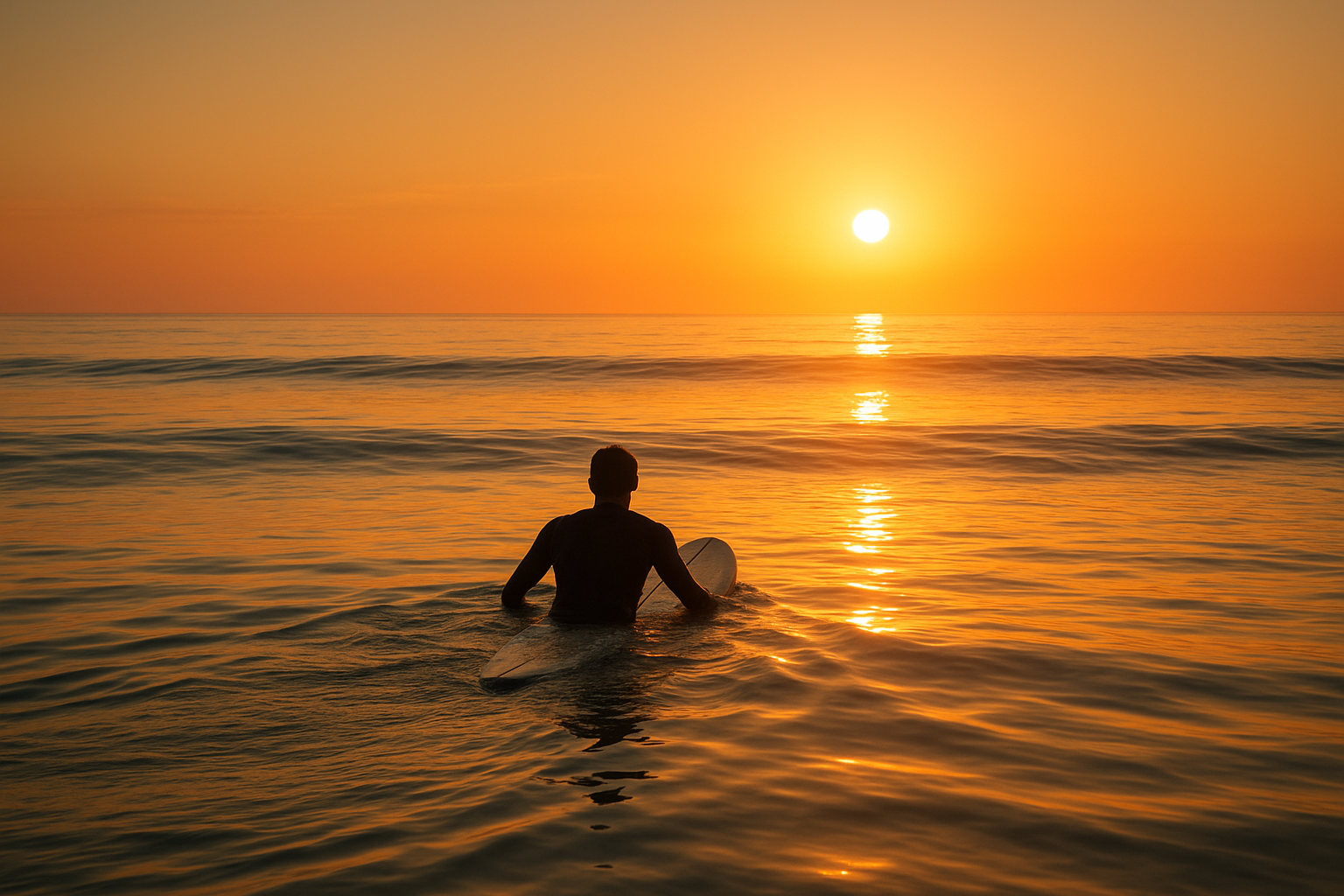
Starting each session with calm focus is one of the most effective ways to build surfing confidence in any conditions.
Why Building Surfing Confidence Matters More Than Raw Talent
Many beginners mistakenly believe that skill level alone determines surfing success. In reality, your mental state is equally — and often more — decisive. A technically capable surfer who hesitates at the critical moment of takeoff will miss the wave every single time. Meanwhile, a less experienced surfer who commits fully will catch it. See our teaching techniques for practical coaching tips.
Sports psychology research on self-efficacy — the belief that you can execute a skill in a specific situation — consistently shows a direct link between confidence and physical performance. When you trust yourself, you paddle harder, position yourself better, and commit to the full movement. When you doubt yourself, your body hesitates, and the wave passes.
What makes this so powerful is the confidence feedback loop: commit to a wave → catch it → brain registers success → next wave feels more manageable → you commit again. Every positive repetition tightens this loop. Investing in your mental game is not a soft extra — it is a core training strategy with measurable returns.
The Two Types of Surfing Fear — and Why They Are Different
Not all surfing fear is the same, and understanding the distinction helps you address it correctly:
- Rational fear — a response to genuine environmental danger, such as large surf beyond your skill level, offshore winds, or unfamiliar reef breaks. This type of fear is your nervous system keeping you safe. Respect it.
- Performance anxiety — self-doubt about whether you will catch the wave, look foolish, or fail in front of others. This fear is a learned mental pattern, not a physical signal. It can be systematically unlearned with the right approach.
The strategies in this guide address both — by building genuine competence so rational fear diminishes, and by developing mental tools so performance anxiety loses its grip.
Step 1 — Choose the Right Board for Your Current Level
One of the fastest, most underestimated ways to undermine your progress is riding a board that does not match your skill level. Equipment mismatch is among the most common reasons beginner surfers plateau — and it silently destroys confidence without anyone realizing why.
What Board Should a Beginner Ride?
For surfers at the beginning stages of building surfing confidence, a foam longboard between 8 and 10 feet is the clear best choice. Here is why each characteristic matters:
- Length — More surface area means more buoyancy, easier paddling, and a larger sweet spot to stand on.
- Width — A wider board (22–24 inches) provides lateral stability, so you wobble less when standing up.
- Foam construction — Soft-top boards are forgiving on impact and reduce injury risk during wipeouts, which reduces fear.
- Volume — High-volume boards paddle into waves earlier, giving you more time to execute your pop-up.
When you catch waves regularly — even small ones — your brain registers success on a repetition-by-repetition basis. That steady stream of successful catches is what builds the deep neurological confidence that carries into more challenging conditions later.
When to Progress to a Shorter Board
Transition to a shorter, lower-volume board only when you can consistently catch unbroken waves, complete a clean pop-up, and control your direction with basic turns. Rushing this transition — often driven by ego or peer pressure — is one of the most common ways surfers stall their development and damage their confidence.
Step 2 — Take Structured Lessons from a Qualified Instructor
Self-teaching in surfing is possible, but it is significantly slower than learning with proper instruction — and it almost always builds habits that are difficult and time-consuming to unlearn. A qualified surf instructor provides something no YouTube video or self-directed session can: real-time, individualized feedback in the actual environment where you need it.
What Good Surf Instruction Actually Delivers
- Technique correction in real time — Bad habits are stopped before they become ingrained. Good habits are reinforced while they are still forming.
- Ocean safety education — Understanding how to manage rip currents, surf break hazards, and right-of-way rules removes fear by replacing ignorance with knowledge.
- Surfing etiquette — Knowing the unwritten rules of the lineup eliminates social anxiety in the water. When you understand where to sit, when to paddle, and how to communicate priority, you feel like you belong — and belonging is its own form of confidence.
- Structured progression — A good instructor calibrates the challenge level to match your ability, keeping you in the optimal growth zone without overwhelming you.
Star Beach Boys offers beginner-friendly surf instruction specifically designed to help new surfers feel safe, supported, and genuinely capable from their very first wave. For a deeper walkthrough, see our Best Surf Instructors in Waikiki.
How Many Lessons Do You Need?
There is no fixed answer, but most beginners benefit significantly from at least 4 to 6 structured lessons before attempting fully independent sessions. After that foundation, periodic check-in lessons as you progress to new skills — turns, trimming the board, reading more complex breaks — keep your technique clean and your confidence growing in the right direction.
Step 3 — Learn to Read the Ocean Before You Paddle Out
A significant portion of surfing fear is not fear of the waves themselves — it is fear of the unknown. The ocean feels chaotic and unpredictable to anyone who does not understand its patterns. The moment you learn to read what the water is doing, it transforms from a threatening environment into a readable, navigable system.
Spend at least 10 minutes on the beach before every session conducting a deliberate pre-surf assessment. This single habit, practiced consistently, is one of the highest-return investments you can make in building surfing confidence.
What to Look For in Your Pre-Surf Assessment
- Wave size and consistency — Are waves breaking cleanly or closing out all at once? Are they spilling gently (better for beginners) or pitching sharply (more challenging)?
- Rip currents — Look for discolored water, choppy surface texture, or foam moving steadily toward the horizon. According to NOAA, rip currents account for the vast majority of lifeguard rescues at surf beaches. Knowing how to identify and escape one (swim parallel to shore until out of the current, then diagonally to the beach) removes one of the most common sources of beginner anxiety.
- Wave sets and intervals — Count how many waves arrive in each set and how long the lulls last. This tells you when to paddle out and when to rest.
- Lineup positioning — Where are other surfers sitting? Where are the waves breaking most consistently? This identifies the take-off zone before you are in the water.
- Hazards — Rocks, shallow sandbars, pier pilings, crowded areas. Identifying these on the beach lets you avoid them in the water without having to think about it.
- Tide direction — Is the tide coming in or going out? Rising tides often improve conditions at many beach breaks; falling tides can expose more hazards.
- Wind — Onshore wind (blowing from sea to land) chops up the water and makes conditions messier. Offshore wind (blowing from land to sea) holds the wave faces up cleanly — generally better for learning.
This knowledge replaces guesswork with strategy — and strategy is the bedrock of calm, decisive action in the water.
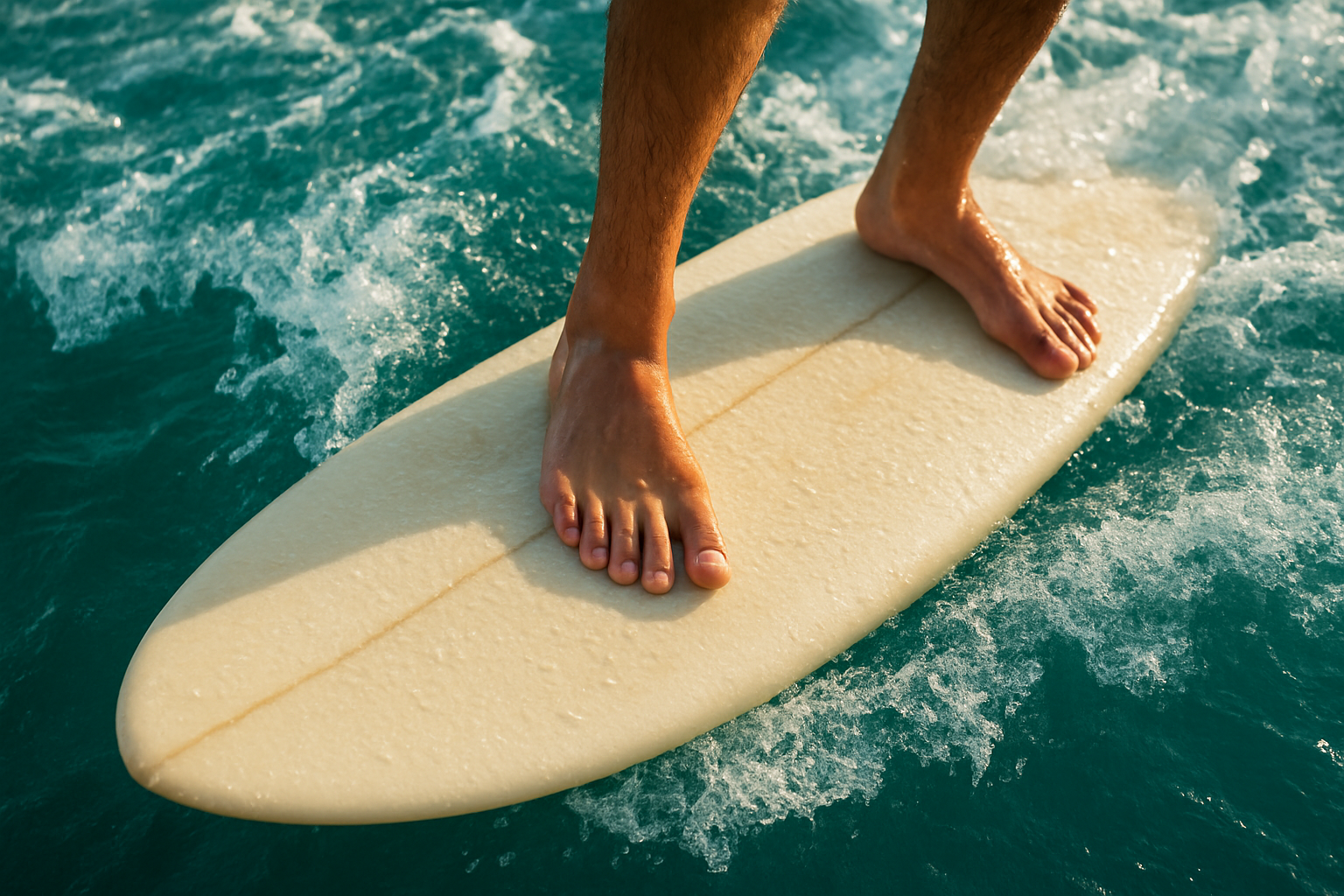
Practicing balance on a stable foam board is an essential early step for anyone building surfing confidence and can help you improve surfing skills.
Step 4 — Master Your Pop-Up on Dry Land First
The pop-up — the explosive movement from lying prone on the board to standing — is the most technically critical moment in surfing. It must happen in under one second, in the middle of a moving, tilting surface, while a wave propels you forward. There is no time to think. It must be automatic.
The only way to make the pop-up automatic is repetition on land, before it ever needs to happen on water. Learn drills to speed up your progress. Neurologically, the brain does not fully distinguish between a real movement and a deeply practiced simulation — so drilling your pop-up on the beach literally pre-loads your body’s response pattern for the real moment.
How to Drill Your Pop-Up Correctly
- Set up on flat ground — Lie on a towel or your board in the same position you use in the water: chest and hips down, hands by your lower chest, toes pointed.
- Execute the movement in one explosive motion — Push up with both hands simultaneously, bring both feet forward in one movement (not a crawl), and land with feet shoulder-width apart and slightly staggered.
- Check your stance immediately — Back foot over the fins or tail, front foot roughly centered on the board. Both feet perpendicular to the stringer, not parallel to it.
- Check your posture — Knees bent, hips low, arms out to the sides for balance. Upright chest, eyes looking forward — not at your feet.
- Repeat 20 times before every session — Not 5 times, not 10. Twenty clean repetitions ingrain the motor pattern at a level that holds up under the pressure and adrenaline of a real wave.
The psychological effect of a solid pop-up is enormous. When you know the movement is there — when it is in your body, not just your head — the anxiety of the takeoff moment decreases significantly. That moment of commitment becomes exciting rather than terrifying.
Step 5 — Start Small and Build Up Progressively
One of the most destructive patterns in beginner surfing is the rush to bigger, more powerful waves before the foundational skills are in place. This is often framed as bravery, but it is actually counterproductive — each wipeout in conditions beyond your current ability chips away at your confidence rather than building it.
The science of skill acquisition is clear: growth happens at the edge of your current ability — not well beyond it. The goal is to be challenged enough to improve, but not so overwhelmed that you are operating in survival mode rather than learning mode.
A Progressive Wave Progression for Beginners
- Stage 1 — Whitewater (broken waves): Practice lying, kneeling, and standing on already-broken whitewater. No timing or reading required. Pure pop-up repetition in a controlled environment. Learn how to learn to ride waves progressively.
- Stage 2 — Tiny unbroken waves (knee-to-hip high): Begin catching unbroken waves and experiencing the full pop-up in a live context. This is where real wave-reading starts.
- Stage 3 — Waist-to-chest high waves: Introduce direction control — basic trimming and weight shifting. Begin working on frontside and backside turns.
- Stage 4 — Overhead waves: Only approach this size when stages 1–3 are genuinely solid. Not when they feel “mostly okay.”
Set Goals Per Session, Not Per Month
Rather than thinking in vague, long-term terms (“get better”), set specific, measurable targets for each session to improve surfing skills. Examples:
- Catch 5 waves cleanly from start to finish.
- Complete a pop-up without looking at my feet on 3 consecutive waves.
- Make one intentional directional shift on a backhand wave.
- Paddle into the lineup through a set without getting caught inside.
Achieving even small, specific goals creates a meaningful, documented record of growth. Keeping a surf journal amplifies this effect — on difficult sessions when the ocean feels overwhelming, reviewing past entries provides concrete evidence of how far you have already come. This is not sentimentality; it is strategic confidence management.
Step 6 — Use Visualization to Prime Your Mind Before Each Session
Visualization is not motivational fluff — it is a rigorously documented mental performance technique used by elite athletes across every sport. Research shows that mentally rehearsing a movement activates the same motor cortex pathways as physically performing it, giving your nervous system an additional set of high-quality repetitions without any physical exertion.
For surfers working on building surfing confidence, this translates into a concrete pre-session practice: This five-minute investment before every session compounds significantly over weeks. Athletes who use structured visualization alongside physical practice consistently outperform those who use physical practice alone. To speed progress, see how to improve your surfing with targeted drills.
A 5-Minute Pre-Session Visualization Routine
- Find a quiet spot on the beach and close your eyes. Take three slow, deep breaths to down-regulate your nervous system from baseline anxiety.
- Visualize the full wave sequence in first-person detail. See the wave approaching from the back of the lineup. Feel your hands in the water as you begin paddling. Feel the acceleration as the wave catches you.
- Rehearse the pop-up perfectly. Feel your hands push down, feet land in exactly the right position, knees bend, arms balance. Make it vivid — include the sound, the sensation, the spray.
- See yourself riding the wave to completion. Not just standing up — riding all the way through, making a trim, stepping off cleanly. End the mental movie with a positive outcome.
- Open your eyes and paddle out with that image still active. Your nervous system is now primed with a successful template.
This five-minute investment before every session compounds significantly over weeks. Athletes who use structured visualization alongside physical practice consistently outperform those who use physical practice alone.
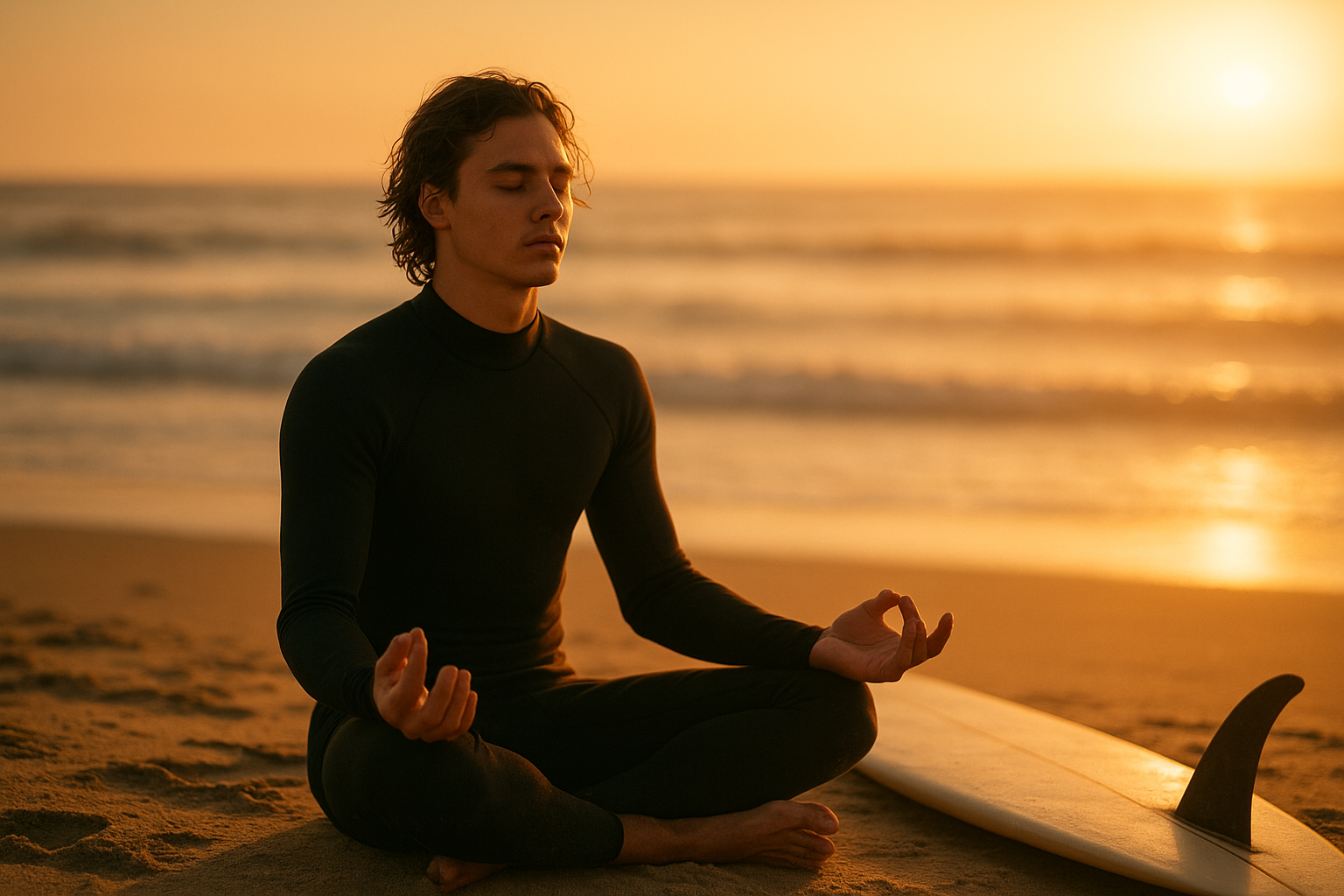
A structured pre-session visualization routine is one of the most underused and high-return tools available for building surfing confidence.
Step 7 — Build Your Physical Fitness Off the Water
Physical conditioning is not a separate goal from building surfing confidence — it is a direct input into it. When you tire quickly in the water, your technique degrades, your decision-making slows, and anxiety fills the space left by fading competence. Being physically fit for surfing means you stay sharp, strong, and clear-headed for the entire session.
Key Physical Capacities for Confident Surfing
- Paddling strength and endurance — Swimming (freestyle) 2–3 times per week is the most direct analogue to surfing paddle fitness. Resistance band exercises targeting the lats, shoulders, and triceps also build paddling power efficiently.
- Core stability — The core manages the constant micro-adjustments that keep you balanced on the board. Yoga, Pilates, or targeted core work (planks, hollow body holds, rotational exercises) builds the kind of deep stability that passive gym training often misses.
- Lower body explosiveness — The pop-up draws heavily on hip flexor power and leg drive. Bodyweight squats, lunges, and hip mobility work translate directly into a faster, cleaner pop-up.
- Cardiovascular endurance — Sessions can last 1–2 hours. Aerobic base fitness from running, cycling, or swimming ensures you are not fatigued after the first 20 minutes.
- Flexibility and mobility — Hip and shoulder mobility in particular affect pop-up speed and board control. Regular stretching or a yoga practice reduces injury risk and keeps movements fluid.
Breath Control — The Most Overlooked Confidence Tool
Breath control deserves its own emphasis. The single event that most often triggers panic in beginner surfers is the hold-down — the moment after a wipeout when a wave keeps you submerged for several seconds. Panic during a hold-down leads to poor decision-making and wastes the oxygen you have.
Practicing breath-hold exercises in a supervised pool environment gradually extends your calm tolerance for being underwater. When you know from repeated experience that you can hold your breath comfortably for 20, 30, or 45 seconds, hold-downs lose most of their terror. That knowledge is pure confidence — earned through preparation, not wishful thinking.
Important: Never practice breath-holds alone, and never practice them in open water. Always use a buddy system in a controlled pool environment.
For structured surf-specific fitness and coaching programs that address both physical and mental performance, Star Beach Boys offers comprehensive coaching designed around the full spectrum of what confident surfing requires. Explore immersive surfing experiences to ride waves confidently.
Step 8 — Reframe Wipeouts as Data, Not Failure
Every surfer wipes out. Every single one — from beginners to world champions. Kelly Slater wipes out. The difference between a confident surfer and an anxious one is not the absence of wipeouts; it is the meaning they assign to them.
Surfers who treat wipeouts as feedback — actionable data about what to adjust on the next wave — recover faster, progress further, and suffer far less psychological damage from bad sessions. Surfers who treat wipeouts as failures or evidence that they do not belong in the water accumulate a debt of self-doubt that becomes increasingly difficult to repay.
The Correct Physical Response to a Wipeout
Having a rehearsed, automatic physical response to wipeouts replaces panic with procedure. Practice this sequence mentally so it executes automatically when needed:
- Go limp on impact. Tensing your body during impact increases injury risk. Relax and let the water take you.
- Cover your head with both arms as you are tumbling underwater. This protects against board impact and shallow reef.
- Do not fight the turbulence. Wait 2–3 seconds for the initial force to pass. Fighting costs oxygen and energy.
- Surface calmly and take a breath. Look toward the horizon immediately to assess the next incoming wave.
- Identify what happened. Was it weight placement? Timing? Hesitation? One analytical question asked immediately after the wipeout turns it from failure into lesson.
The Mental Response: Ask Better Questions
After surfacing, instead of asking “Why can’t I do this?” ask “What specifically can I adjust on the next wave?” The first question triggers rumination. The second triggers problem-solving. Over a full session, this difference in self-talk accumulates into either a confidence-building or a confidence-draining experience — your choice.
“Building surfing confidence is not the absence of fear — it is the decision to paddle anyway, informed by preparation, ocean knowledge, and a growing respect for what you are capable of.”
Step 9 — Build Your Surfing Community Deliberately
The environment you surf in — and especially the people you surf with — has a far greater impact on your confidence than most surfers realize. Human beings are social learners. We calibrate our sense of what is possible by observing and receiving feedback from those around us.
A supportive surf community normalizes mistakes, celebrates incremental progress, and creates a psychological safety net that enables you to try new things without fear of embarrassment. A dismissive or aggressively competitive lineup has the opposite effect — amplifying self-doubt and triggering social anxiety that makes the water feel even more threatening.
How to Build a Supportive Surf Environment
- Join a surf club or group lesson program where encouragement is built into the culture. Many surf schools run social sessions, progress clinics, and beginner-only lineups specifically to create this kind of environment. Consider fun surf experiences that combine learning with low-pressure sessions.
- Surf regularly with someone slightly more experienced than you. Watching their technique, receiving real-time tips, and sharing the water with a skilled surfer accelerates your learning in a way no instructional content can replicate.
- Engage genuinely with the local surf community. Introduce yourself, learn the etiquette of your local break, show respect in the lineup. Belonging to a local community transforms the ocean from a solo challenge into a shared space — a powerful shift for building confidence.
- Use online communities wisely. Forums and social groups can be sources of encouragement and knowledge — but be selective. Communities focused on learning and mutual support are far more useful than those focused on performance comparison.
- Do not surf alone as a beginner. Beyond the safety risk, surfing with a buddy provides immediate support, accountability, and shared motivation — all of which are confidence-building assets.
Step 10 — Develop Consistent Surf Habits and Routines
Confidence is not built in a single breakthrough session — it is constructed gradually through the accumulation of consistent, deliberate practice. Irregular, sporadic surfing produces slow progress and long gaps in which skills and nerve regress between sessions. A consistent routine prevents this regression and keeps the positive feedback loop running.
Habits That Accelerate Surfing Confidence
- Surf at minimum 2–3 times per week during your active learning phase. Frequency matters more than session duration when building skill.
- Pre-session ritual: Beach observation → land pop-up drills → visualization → paddle out. Doing the same ritual every session reduces pre-surf anxiety by making the transition from land to water feel familiar and controlled.
- Post-session review: Spend 5 minutes after each session noting what worked, what didn’t, and one specific thing to focus on next time. This transforms sessions from isolated events into a connected, progressive journey.
- Check surf forecasts the night before. Knowing what conditions to expect removes the surprise element that amplifies pre-session anxiety. Apps like Surfline or Magicseaweed provide detailed wave and wind forecasts.
- Choose surf times strategically. Dawn patrol (early morning) sessions often offer calmer winds, smaller crowds, and cleaner conditions — ideal for building skills without the pressure of a crowded lineup.
Common Confidence-Killing Mistakes to Avoid
Understanding what erodes building surfing confidence is just as important as knowing what builds it. These are the most damaging patterns to recognize and eliminate:
- Comparing yourself to more advanced surfers. This is perhaps the single most destructive habit. You are not competing with them — you are measuring your current chapter against their final chapter. It is not a valid comparison, and it consistently produces discouragement.
- Surfing waves that are too big too soon. This is not courage — it is impatience. The result is wipeouts that damage confidence faster than small waves could ever build it.
- Using the wrong board. Riding a shortboard before you are ready is like learning to drive in a Formula 1 car. It produces failure regardless of your actual potential.
- Skipping the pre-surf assessment. Paddling out without reading the conditions means encountering surprises that erode composure and confidence.
- Ignoring technique. Bad habits solidify with repetition. Once ingrained, they become confidence-limiting ceilings that are difficult to break through without sustained, focused unlearning.
- Negative self-talk after wipeouts. The internal narrative after a failed wave has an outsized effect on the rest of the session. Practice replacing “I can’t do this” with “I’m adjusting for the next one.”
Surfing Confidence at Different Skill Levels
Building surfing confidence is not a once-and-done achievement — it is an ongoing practice that evolves with your skill level. Each stage of the surfing journey brings new challenges that require updated confidence-building strategies.
Beginner (0–30 sessions)
Primary focus: equipment choice, lesson quality, basic ocean reading, pop-up automaticity, and celebrating every successful wave catch. The goal at this stage is consistent positive repetition, not ambition.
Intermediate (30–100 sessions)
Primary focus: reading and timing unbroken waves, developing basic turns (frontside and backside), beginning to navigate a real lineup independently. Confidence challenges at this stage often revolve around the social dynamics of the lineup and the complexity of reading more varied conditions.
Advanced (100+ sessions)
Primary focus: pushing into new conditions, larger surf, and performance maneuvers. Confidence challenges here are often about committing to critical sections and managing the psychological pressure of surf that genuinely demands respect. Breath work, mental coaching, and exposure-based progression remain essential.
Conclusion — A Complete Commitment to Building Surfing Confidence
Truly building surfing confidence requires more than a single tip or a single session — it requires a holistic, sustained commitment to developing every dimension of your competence in the water. The right board. Quality instruction. Genuine ocean knowledge. Physical preparation. Mental tools. A supportive community. And a growth-oriented response to every challenge the ocean presents.
None of these elements works in isolation. Together, they compound into something powerful: a surfer who is not just technically capable, but genuinely at home in the water — calm under pressure, decisive at the moment of commitment, and resilient after every wipeout.
Progress will not always be linear. Some sessions will feel like breakthroughs; others will feel like setbacks. Both are part of the process. The ocean will always be bigger than you — and that is exactly why building your confidence within it is one of the most genuinely rewarding things you can pursue.
Trust the process. Stay consistent. Show up — and the confidence you are building will carry you through every wave you face.
Frequently Asked Questions About Building Surfing Confidence
How long does it take to build surfing confidence?
Most beginner surfers notice meaningful improvement in their confidence within 10 to 20 consistent sessions. However, the timeline varies significantly based on session frequency, lesson quality, wave conditions, and individual comfort with the ocean. Surfing 2–3 times per week produces faster results than occasional once-a-month outings. Read more about how long to learn to surf.
What is the best way to start building surfing confidence as a complete beginner?
Start on small, gentle whitewater waves with a large foam board and take structured lessons from a qualified instructor. Mastering the pop-up on land before each session, reading conditions from the beach before paddling out, and setting small achievable goals for each session creates the foundation of genuine, lasting surfing confidence.
Why do experienced surfers still feel nervous, even after years of surfing?
Because the ocean is genuinely unpredictable. New breaks, larger swells, unfamiliar conditions, and high-performance demands all introduce new challenges that can trigger nervousness even in expert surfers. This is normal and healthy — experienced surfers have learned to use that alertness productively rather than letting it become debilitating anxiety.
Does board choice really affect surfing confidence?
Significantly. A longer, wider, high-volume foam board gives beginners the stability, buoyancy, and easy paddling needed to catch waves consistently. Consistent wave-catching creates repetitive success — and repetitive success is the most direct way to build durable surfing confidence. Using a board that is too small or too thin for your level does the opposite.
How does learning to read ocean conditions help with building surfing confidence?
Ocean knowledge replaces fear of the unknown with informed awareness. When you can identify rip currents, read wave sets, understand wind direction, and select a safe entry point, you are making decisions rather than reacting to chaos. Decision-making feels empowering; chaotic reaction feels frightening. The beach observation habit is one of the highest-return investments in building surfing confidence.
Can visualization exercises genuinely improve surfing performance and confidence?
Yes — this is well-supported by sports psychology research. Mentally rehearsing a successful wave ride activates the same motor pathways as physical practice, reinforcing muscle memory and reducing anxiety. A structured 5-minute pre-session visualization routine before paddling out consistently improves both performance and confidence over time.
What should I do when I wipe out so I do not lose my confidence?
Cover your head with your arms, relax your body, wait for the turbulence to pass, and surface calmly. Immediately identify one specific thing to adjust on the next wave. Treating every wipeout as actionable feedback — not as evidence of failure — prevents confidence damage and keeps your learning momentum intact.
How important is physical fitness for building surfing confidence?
Very important. When you fatigue quickly, your technique degrades and anxiety fills the gap. Building paddling strength through swimming, core stability through yoga or Pilates, and cardiovascular endurance through aerobic training means you remain sharp, controlled, and capable throughout each session — all of which translate directly into greater confidence in the water.
How does breath control help with surfing confidence during wipeouts?
Knowing from practiced experience that you can calmly hold your breath for 20–45 seconds removes most of the terror from hold-downs. Practicing supervised breath-hold exercises in a pool builds this tolerance safely. The result is a surfer who surfaces from a wipeout composed and ready rather than panicked and rattled.
What are the biggest mistakes that destroy surfing confidence in beginners?
The most damaging mistakes are: surfing waves that are too big too soon, using the wrong (too small) board, skipping structured lessons, comparing yourself to more advanced surfers, ignoring technique, and using negative self-talk after wipeouts. Each of these creates a confidence drain that compounds over time if left unaddressed.
Is surfing with more advanced surfers good for building confidence?
It can be, depending on the environment. Surfing with a supportive, slightly more experienced surfer who offers encouragement and tips in real time is excellent for growth. However, paddling into a competitive, crowded, or dismissive lineup before you are ready can amplify anxiety. Choose your surf partners and environments as deliberately as you choose your waves.
Should beginners ever surf alone when trying to build independence and confidence?
No — not until you have well-established ocean awareness, reliable skills, and clear self-rescue capabilities. Surfing solo as a beginner removes the safety net without adding meaningful independence benefits. Surf with a buddy or in a supervised area, and build independence gradually as your skills and ocean knowledge genuinely develop.