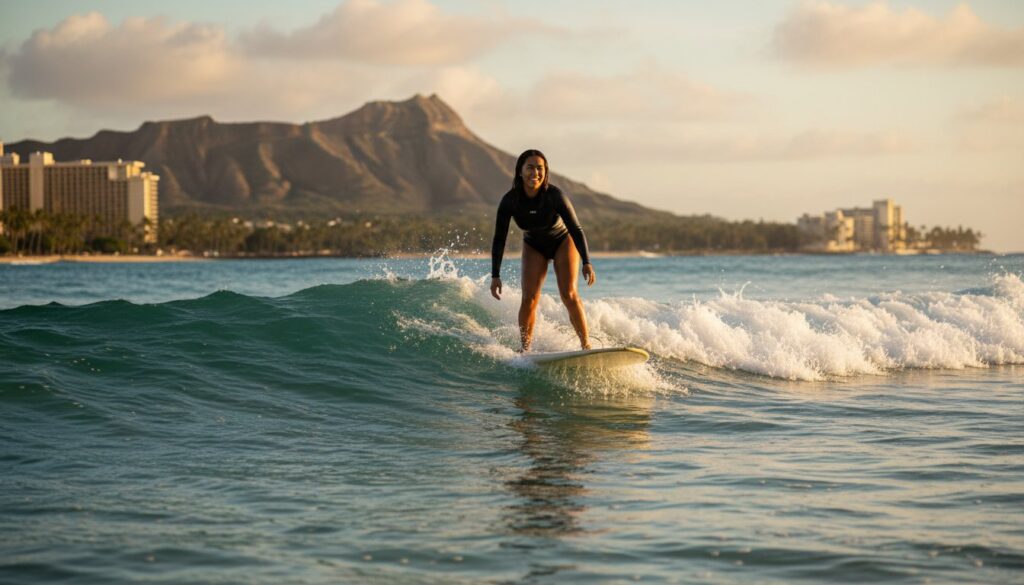
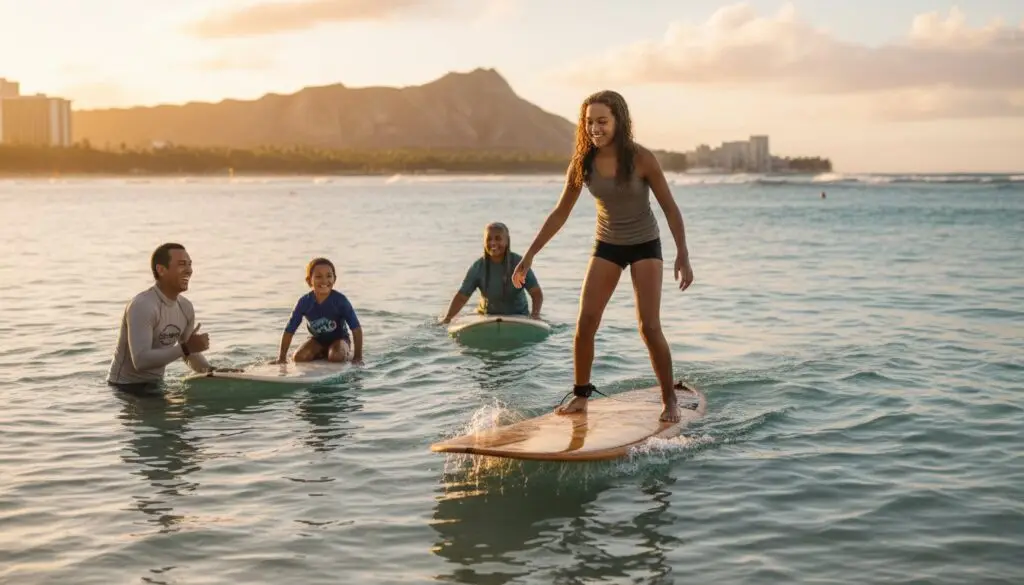
Surfing lessons in Hawaii cost $75 to $250 per person for most visitors, depending on lesson format, island, and school. Surfing lessons in Hawaii are structured beginner-to-intermediate surf instruction sessions offered by certified coaches on Hawaii’s beaches — covering safety, paddling, pop-up technique, and wave riding in the Pacific Ocean. This guide covers every price tier, every island, and everything you need to know before you book. See our average cost guide for a focused pricing breakdown.
Whether you’re a complete first-timer stepping onto a foam board for the very first time or an intermediate surfer looking to sharpen technique, Hawaii’s surf schools offer structured instruction for every level. However, prices, quality, and what’s included vary significantly — and knowing the difference can save you money and frustration. Last updated: 2026-08-11.
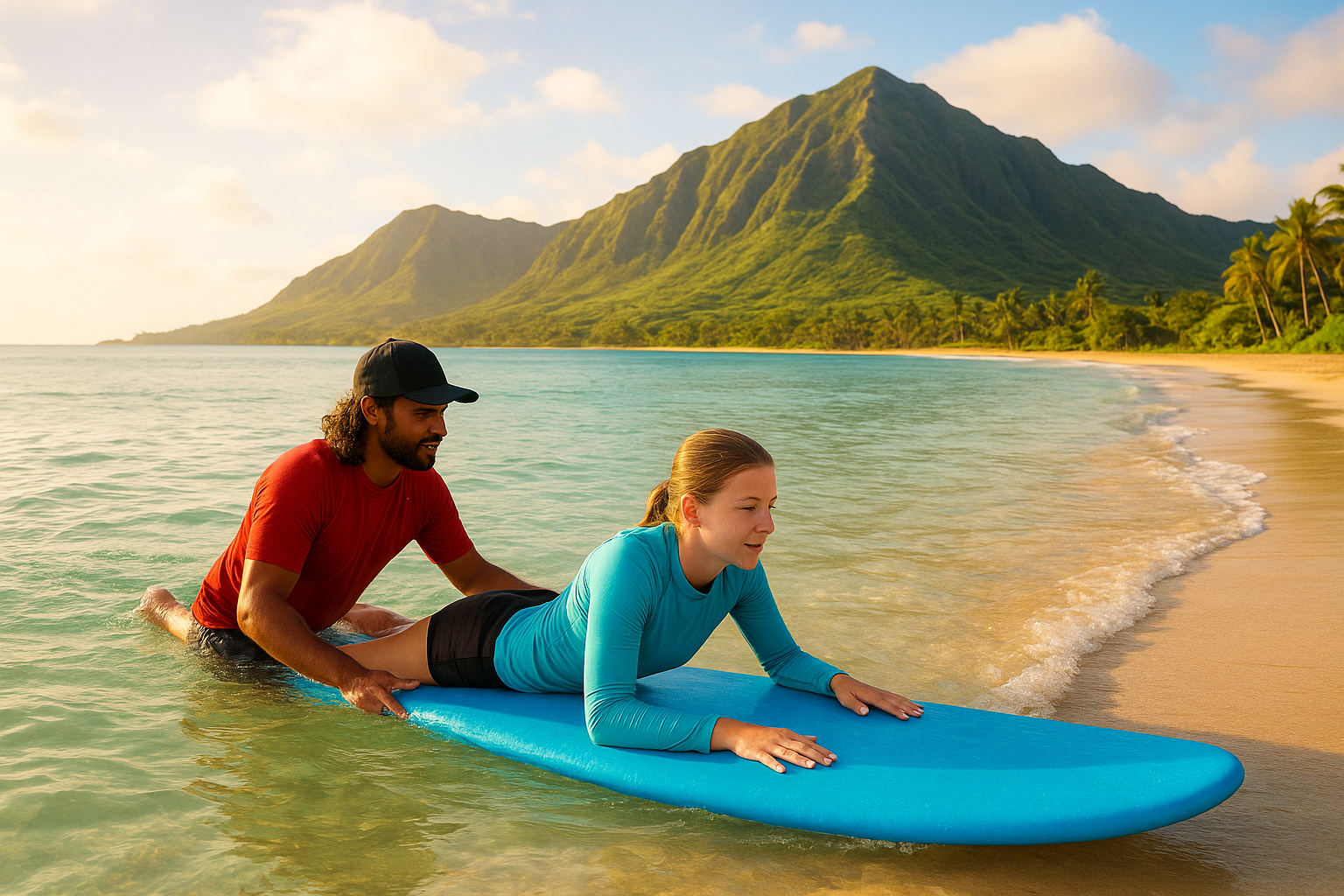
A certified surf instructor guides a first-timer through the basics on a calm Hawaiian shoreline — the kind of experience that makes surfing lessons in Hawaii unforgettable.
What Are Surfing Lessons in Hawaii — and What Do They Actually Include?
Surfing lessons in Hawaii are professionally guided sessions that teach ocean safety, board handling, paddling mechanics, the pop-up (standing up on the board), and basic wave-riding in real Pacific Ocean conditions. They are not simply board rentals — they involve direct, hands-on coaching from a qualified instructor, typically on the beach first and then in the water.
Most reputable Hawaii surf schools bundle the following into the lesson fee:
- Foam longboard — soft-top boards designed specifically for beginners, far more forgiving than hard fiberglass boards
- Rash guard — a lycra or neoprene top that protects against sun, saltwater rash, and board abrasion
- Land instruction — a 20–30 minute on-beach session covering pop-up mechanics, paddling form, and ocean safety rules
- In-water coaching — 60–90 minutes of active surf instruction with your instructor in the water beside you
- Post-session photos or video — offered by many premium schools as an optional or included bonus
However, not every operator includes all of the above. Some budget schools charge separately for rash guards or board upgrades. Therefore, always confirm exactly what’s included before paying a deposit.
Lesson Formats: Group, Semi-Private, and Private
Hawaii surf schools typically offer three lesson formats. Each serves a different skill level and budget:
- Group lessons — typically 4 to 8 students per instructor. These are the most popular and most affordable option, particularly for first-timers.
- Semi-private lessons — two students sharing one instructor. A strong middle-ground option for couples or friends who want more feedback without paying private rates.
- Private lessons — one student, one instructor, fully personalized coaching throughout. Ideal for faster progression, kids, or anyone with specific technique goals.
- Multi-day packages — three or more lessons bundled together, usually at a 15–25% discount. Best for visitors staying five or more days.
- Kids’ lessons — offered by most schools for children aged 5 and up, often priced similarly to adult group rates with smaller board sizes and closer supervision.
- Intermediate/advanced clinics — specialty sessions focused on specific skills like reading waves, bottom turns, cutbacks, or duck-diving through whitewater.
Surfing Lessons in Hawaii: Full Price Breakdown
The cost of surfing lessons in Hawaii ranges from $75 for a basic group session to $400+ for a multi-day private package. In general, the format of the lesson is the single biggest pricing factor — even more than which island you visit. See our 2024 price guide for current package examples and promo tips.
Hawaii Surf Lesson Price Reference Table
| Lesson Type | Price Range | Duration | Best For |
|---|---|---|---|
| Group Lesson | $75 – $120/person | 1.5 – 2 hrs | First-timers, budget travelers |
| Semi-Private (2 students) | $120 – $175/person | 1.5 – 2 hrs | Couples, friends |
| Private Lesson | $150 – $250/person | 1.5 – 2 hrs | Faster progress, kids, intermediates |
| Multi-Day Package (3+ lessons) | $200 – $400/person | Varies | Extended stays, dedicated learners |
| Kids’ Group Lesson | $75 – $110/child | 1.5 hrs | Ages 5–14 |
| Intermediate/Advanced Clinic | $130 – $200/person | 2 hrs | Surfers improving specific skills |
What Drives Prices Up or Down?
Several factors push surf lesson prices higher or lower. Understanding them helps you make a smarter booking decision:
- Lesson format — private instruction costs roughly 2–3x more than a group session at the same school
- Island — Oahu (Waikiki) offers the most competitive pricing; Kauai and the Big Island tend to be more expensive due to fewer operators
- Beach location — lessons at less-crowded, premium breaks often command a location premium
- Instructor certification — ISA (International Surfing Association) certified instructors sometimes charge more, but their credential quality is higher
- School reputation — well-reviewed, established schools charge more than pop-up operations, and the extra cost is usually justified
- Season — peak tourist season (June–August and December–January) can see prices rise 10–20% at popular schools
- Package add-ons — professional surf photography, video analysis, or gear upgrades all add to the base price
Island-by-Island Guide to Surfing Lessons in Hawaii
Each Hawaiian island offers a different surf lesson experience. Therefore, the best island for your lesson depends on your skill level, travel itinerary, and budget. Here is a detailed breakdown of what to expect on each island.
Oahu: Best for Beginners and Budget Travelers
Waikiki Beach on Oahu is widely regarded as the world’s greatest beginner surf destination. Its gently breaking, long-rolling waves — created by a shallow reef that slows and softens incoming swells — give beginners an unusually forgiving environment to learn in. Consequently, the vast majority of Hawaii’s surf schools are clustered along Waikiki’s two-mile stretch. Learn where to book local lessons on our Waikiki lessons guide.
This density of operators creates genuine price competition. Group lessons on Waikiki typically start at $75 to $85 per person, making it the most affordable surf lesson destination in all of Hawaii. In addition, Oahu’s North Shore offers lessons for intermediate and advanced surfers during summer (April–September) when swells are smaller and more manageable.
Oahu at a Glance: Group lessons $75–$115 · Private lessons $150–$230 · Best beginner beach: Waikiki · Peak season: June–August
Maui: Best for a More Intimate Surf Experience
Maui surf schools, particularly those based in Lahaina, Kaanapali, and Kihei, offer a notably less-crowded experience than Waikiki. As a result, group sessions here feel more personal even though you’re technically in a group setting. Prices are slightly higher — group sessions typically run $90 to $130 per person — reflecting the premium beach environment.
Maui’s west-facing beaches catch consistent swells throughout the year, making it a reliable choice regardless of season. Furthermore, several Maui schools specialize in intermediate clinics covering wave selection, positioning in the lineup, and turning fundamentals — topics that most Waikiki schools don’t address at all.
Maui at a Glance: Group lessons $90–$130 · Private lessons $175–$250 · Best beginner beach: Lahaina · Specialty: Intermediate clinics
Kauai: Best for Uncrowded Waves and Nature Immersion
Kauai has far fewer surf schools than Oahu or Maui. Consequently, operators here charge a small premium — group lessons typically run $95 to $135 per person. However, what you gain in exchange is remarkable: smaller class sizes, emptier lineups, and an experience set against some of the most visually stunning coastlines in the Pacific.
Hanalei Bay on Kauai’s north shore is one of the most beautiful beginner surf breaks in all of Hawaii, though it’s best suited to summer months when swells are calmer. In contrast, Poipu Beach on the south shore offers year-round gentle conditions ideal for beginners of any age.
Kauai at a Glance: Group lessons $95–$135 · Private lessons $180–$260 · Best beginner beaches: Hanalei Bay, Poipu Beach · Class sizes: Typically 3–5 students
The Big Island: Best for an Off-the-Beaten-Path Surf Experience
Hawaii Island (the Big Island) is not traditionally a first-choice destination for surf lessons, primarily because its coastline is more rugged and its wave conditions less consistent for beginners. Nevertheless, operators in Kona on the island’s west coast offer solid beginner instruction at prices comparable to Kauai — roughly $90 to $130 for group sessions.
The Big Island specifically suits travelers who want surf lessons as one component of a broader adventure itinerary — volcano tours, snorkeling, stargazing — rather than as the primary purpose of their trip. Bays Beach Parks in Kohala are particularly suitable for beginners during calm summer conditions.
Big Island at a Glance: Big Island lessons $90–$130 · Private lessons $160–$240 · Best beginner area: Kona/Kohala Coast · Best for: Adventure travelers combining activities
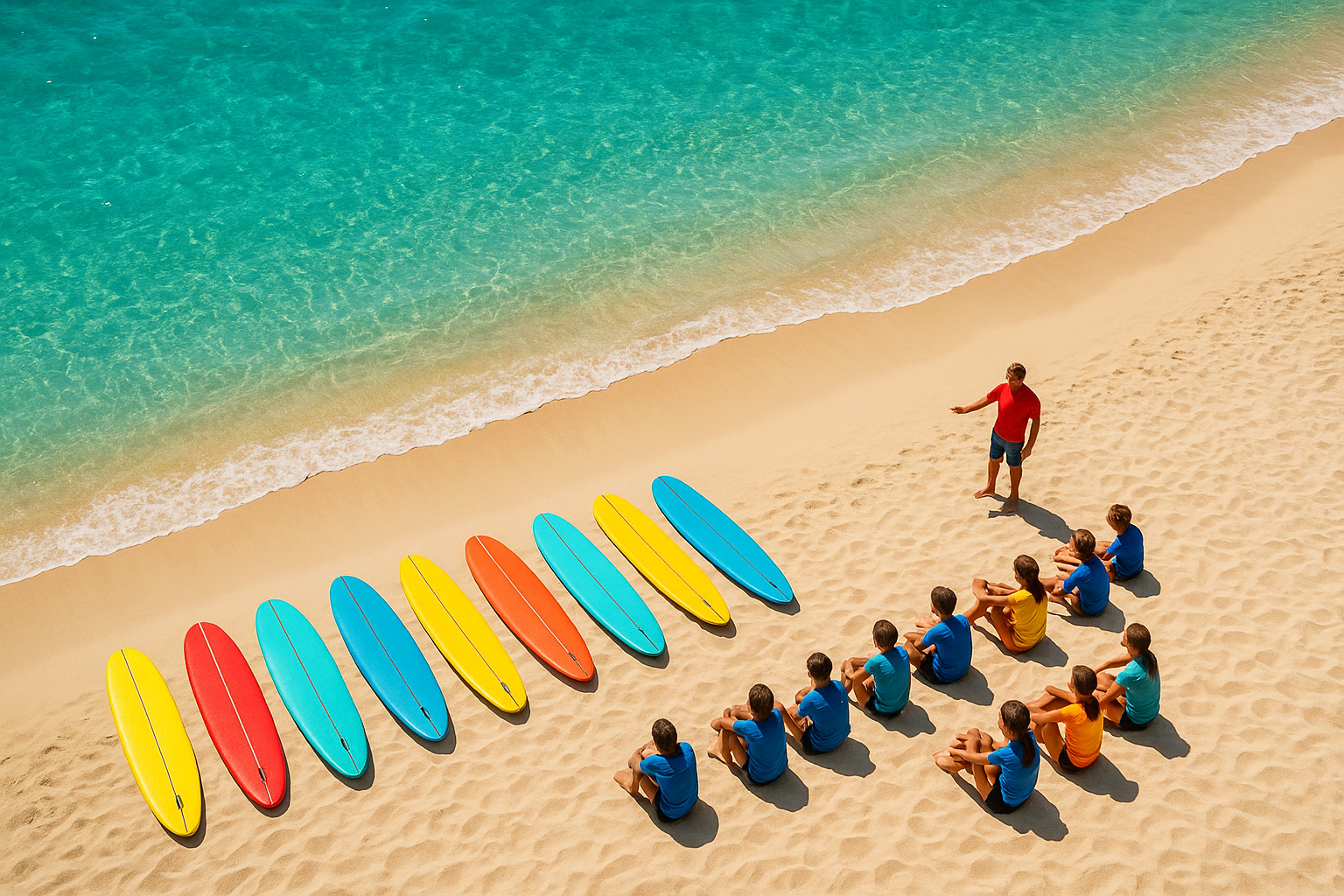
Surf schools across Hawaii’s islands offer a range of lesson formats and price points to suit every traveler’s budget and experience level.
Choosing the Right Surf Instructor and School in Hawaii
Not all surf instructors are equally qualified. In Hawaii, the best instructors hold certifications from recognized bodies such as the ISA (International Surfing Association) or the National Surf Schools and Instructors Association (NSSIA). These credentials confirm that the instructor has completed formal training in surf pedagogy, ocean safety, and first aid.
In addition to instructor credentials, look for these qualities when evaluating a surf school:
- Current lifeguard certification — every water-based instructor should hold an active lifeguard certificate, not just a surf credential
- Liability insurance — reputable schools carry insurance; don’t be afraid to ask
- Student-to-instructor ratio — the lower, the better; a ratio above 8:1 in beginner group lessons is a red flag
- Equipment quality — foam soft-top boards should be well-maintained with no major dings or delamination; rash guards should be clean and fitted
- Transparent pricing — schools that clearly list what’s included (and what isn’t) are far more trustworthy than vague “starting from” quotes
- Recent online reviews — check Google, TripAdvisor, and Yelp for recent reviews, specifically noting mentions of instructor quality and safety practices
- Local knowledge — instructors who have surfed Hawaii’s waters for years understand seasonal wave patterns, rip currents, and hazard-specific safety protocols that mainland-trained instructors may not
Well-established operators like Star Beach Boys are widely regarded as trustworthy options, with experienced local instructors who combine genuine surfing expertise with deep knowledge of Waikiki’s unique conditions.
Red Flags: When to Walk Away from a Surf School
Some operators cut corners in ways that directly compromise your safety or experience. Specifically, be cautious of any school that:
- Advertises lessons under $50 without a clear explanation of what’s included
- Puts 10 or more beginners with a single instructor in open water
- Cannot confirm instructor certification or lifeguard status when asked directly
- Has no online presence, no recent reviews, or responds defensively to questions about safety
- Uses damaged boards or does not provide rash guards for beginners
- Skips the land-based safety briefing and takes students directly into the water
Best Time of Year for Surfing Lessons in Hawaii
Timing your surf lessons around Hawaii’s seasonal wave patterns dramatically affects your experience — especially as a beginner. Hawaii’s surf seasons are largely driven by trade winds and swell direction, which vary between summer and winter.
Summer (May – September): Ideal for Beginners
Summer is the best season for beginner surf lessons across all Hawaiian islands. During these months, south swells arrive from the Southern Hemisphere and produce gentle, rolling waves — typically 2 to 4 feet — on Oahu’s south shore and Maui’s west coast. These conditions are ideal for first-timers learning to paddle, pop up, and balance on a board.
Furthermore, summer water temperatures in Hawaii hover between 78°F and 82°F (26–28°C), meaning you won’t need a wetsuit and the environment is maximally comfortable. The shoulder periods — specifically April through early June and September through October — combine beginner-friendly waves with slightly smaller crowds and occasionally lower prices.
Winter (November – March): Best Left to Advanced Surfers
Winter brings large north swells that can produce waves of 15 to 30 feet or more on Oahu’s North Shore — the same swells that power the famous Banzai Pipeline and Eddie Aikau big-wave contest. These conditions are entirely unsuitable for beginner surf lessons.
However, winter is not a complete write-off for beginners. South-facing beaches on Oahu (like Waikiki) and the west coast of Maui remain relatively sheltered from north swells and continue to offer manageable beginner conditions year-round. Consequently, reputable schools continue to offer lessons throughout winter — they simply adjust their teaching location based on daily conditions.
⚑ Seasonal Planning Tip
April through early June is arguably the ideal time to book surfing lessons in Hawaii — summer south swells have begun, crowds are lighter than peak July–August, and some schools offer lower rates to fill early-season bookings. October is similarly underrated.
Matching Surfing Lessons in Hawaii to Your Skill Level
Choosing the right lesson type for your current ability level is just as important as choosing the right school or island. Specifically, beginners who book intermediate clinics waste money — and intermediate surfers who sign up for beginner group lessons waste their time.
Complete Beginners (Never Surfed Before)
If you’ve never surfed, a group lesson at Waikiki or a Maui west-coast beach is the perfect starting point. The curriculum focuses on three fundamentals: the pop-up (jumping from lying down to standing in one fluid motion), paddling technique, and basic ocean safety. Most first-timers successfully stand on a wave within their first 90-minute session — particularly at Waikiki, where the waves are unusually forgiving.
For beginners, the most important variable is wave quality, not instructor seniority. As a result, Waikiki’s consistent, mellow breaks are actually a more important factor than choosing a premium private instructor.
Intermediate Surfers (Can Stand Up, Wants to Improve)
If you can already stand up and ride whitewater but want to progress to green (unbroken) waves, a semi-private or private lesson is a significantly better investment than a group session. Private instruction delivers personalized feedback that directly targets your specific weaknesses — whether that’s timing your pop-up, reading wave lines, or executing a basic bottom turn.
Intermediate surfers often plateau without this kind of targeted coaching. Furthermore, many Hawaii surf schools offer video analysis as an add-on to private lessons — your instructor records your session and reviews it with you frame by frame. This technique is enormously effective for fixing ingrained habits that are hard to feel in real-time.
Families and Children (Ages 5 and Up)
Most Hawaii surf schools accept children as young as 5 or 6 years old. Kids’ lessons are typically structured similarly to adult group lessons but with closer water supervision and age-appropriate instruction. Many schools also offer family package discounts — for example, two adults and two children booking together may save 15–20% compared to individual rates.
Foam soft-top boards are standard for young learners. They are buoyant, wide, and far less intimidating than hard boards. Additionally, because the boards are soft, accidental contact is much less likely to cause injury — an important safety consideration for younger students.
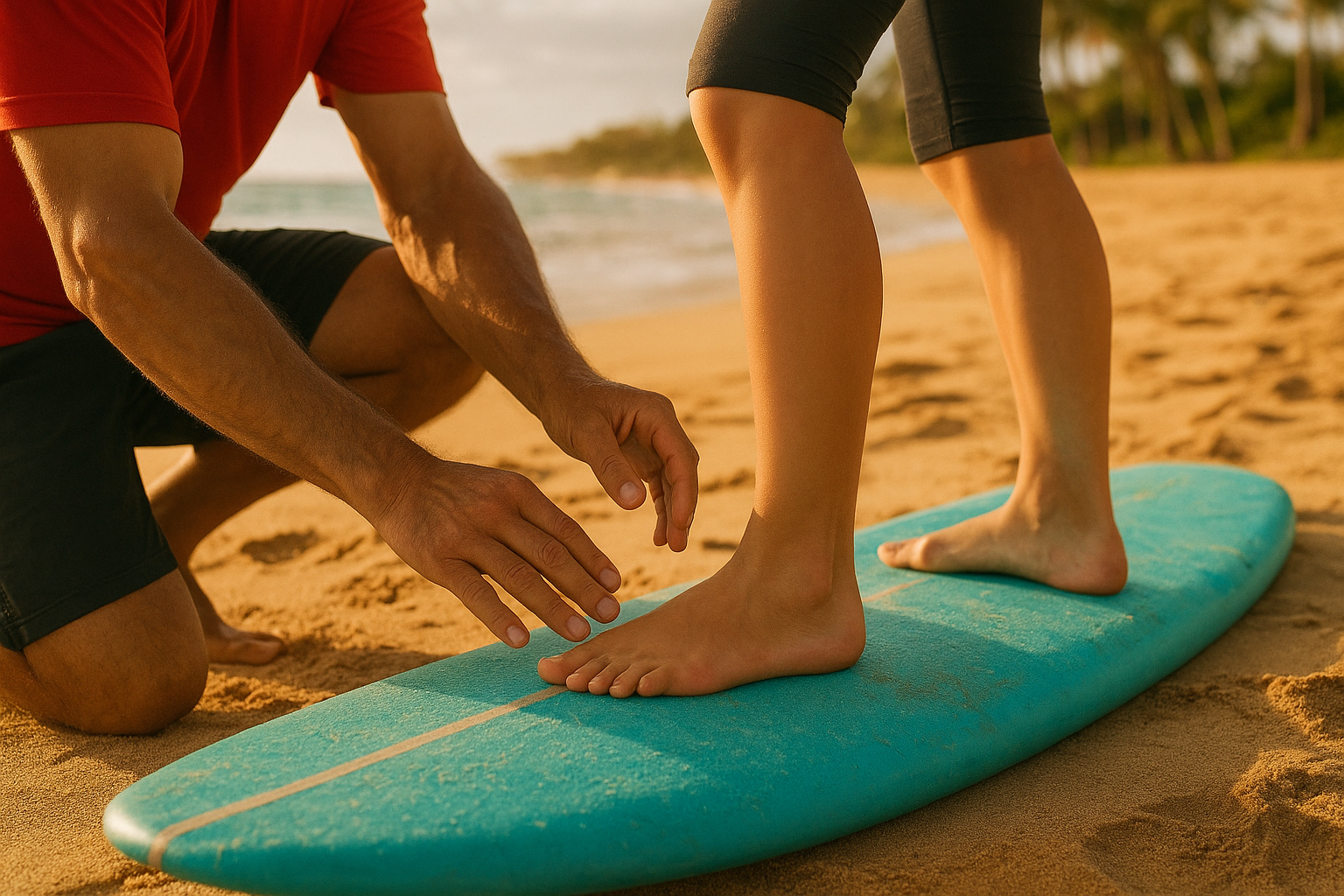
Certified instructors provide hands-on corrections that help beginners develop safe and effective technique from the very first session.
What to Expect on the Day of Your Hawaii Surf Lesson
Knowing exactly what happens during your lesson eliminates anxiety and helps you get the most from every minute in the water. Here is a step-by-step breakdown of a typical surf lesson day.
- Arrive 15–20 minutes early. Complete any waivers, get fitted for your rash guard, and receive your board assignment. Use this time to ask your instructor about wave conditions and any specific hazards at the day’s teaching location.
- Land-based instruction (20–30 minutes). Your instructor demonstrates paddling mechanics, the pop-up technique, and proper foot positioning on the board — all on the sand before you enter the water. Pay close attention: this session directly determines how quickly you progress in the water.
- Ocean safety briefing (10 minutes). Your instructor covers the specific hazards at today’s beach — rip currents (strong channels of water flowing away from shore), right-of-way rules in the surf lineup, and how to fall safely to avoid injury.
- Enter the water (60–90 minutes). You’ll paddle out together to the teaching zone, typically in shallow water where waves are soft and manageable. Your instructor pushes your board into waves and coaches your timing, stance, and balance in real-time throughout the session.
- Post-session debrief (10–15 minutes). Back on the beach, your instructor reviews your progress, identifies your strongest improvements, and recommends what to work on next. This debrief is especially valuable if you’re planning multiple lessons.
☀ What to Bring to Your Lesson
Pack a swimsuit, reef-safe sunscreen (required by Hawaii state law — products containing oxybenzone or octinoxate are banned statewide to protect coral reefs), a water bottle, a towel, and a change of clothes. Leave valuables, wallets, and electronics secured at your hotel — most beach lesson locations have no secure storage on-site.
How to Save Money on Surfing Lessons in Hawaii
Hawaii is one of the world’s most premium travel destinations, and surf lessons reflect that. However, several practical strategies can meaningfully reduce what you pay without compromising the quality of your instruction.
- Book a multi-day package. Three or more lessons bundled together typically cost 15–25% less than the same number of individual sessions. If your trip is five or more days, a package is almost always the better financial choice.
- Travel in the shoulder season. April through early June and September through October combine beginner-friendly waves with off-peak pricing. Some schools reduce group lesson prices by $15–20 per person during these periods.
- Ask your hotel concierge. Many Oahu and Maui hotels maintain formal partnerships with local surf schools and offer exclusive guest discounts — sometimes 10–20% off published rates. Always ask before booking independently.
- Choose group over private for your first lesson. If you’ve never surfed, a group lesson genuinely serves your needs. Reserve private instruction for lesson two or three, once you have a foundation and can articulate specific technique goals.
- Book directly with the school. Third-party booking platforms and activity desks frequently add a 10–20% markup. Booking directly through a school’s website or by calling them directly usually secures a better price.
- Look for early-morning sessions. Some schools offer discounted dawn patrol lessons — typically the first session of the day — because conditions are calmer and crowds are minimal. These sessions are often $10–20 cheaper than midday bookings.
Hawaii Surf Lesson Safety: What Every Student Should Know
Ocean safety is the most underrated aspect of surf lessons — and the area where the gap between good and bad schools is most consequential. A reputable school treats safety as non-negotiable, not an afterthought.
Swimming Requirements
All reputable Hawaii surf schools require students to be comfortable swimming at least 25 to 50 meters unassisted. This requirement exists because even beginner surf zones involve open ocean conditions. In the event of a wipeout — falling off the board unexpectedly — students must be capable of swimming back to shallow water independently.
Strong swimming ability also reduces panic in the water, which in turn improves your surfing. Conversely, poor swimmers tend to tense up when waves pass over them, making the pop-up motion much more difficult to execute effectively.
Understanding Rip Currents
Rip currents — narrow, fast-moving channels of water flowing from the shore out to sea — are the leading cause of ocean rescues in Hawaii. However, they are manageable once understood. Your instructor will point out any rip channels at the day’s teaching location and explain how to identify and escape them: by paddling parallel to the shore (not directly against the current) until you exit the channel, then angling back in.
In practice, beginner teaching zones at well-run Hawaii surf schools are specifically selected to minimize rip current exposure. Nevertheless, understanding the concept before entering the water is a core component of every legitimate lesson.
Reef and Hazard Awareness
Many of Hawaii’s surf breaks sit directly above shallow reef structures — coral formations that create the distinctive wave shapes the islands are famous for. Consequently, falls at reef breaks carry a higher injury risk than sandy-bottom breaks. Reputable surf schools match teaching locations to student ability levels: beginners are always taught above sandy bottoms, not reef.
Your instructor will specifically address the bottom composition at the day’s teaching spot. If a school plans to teach beginners directly above shallow reef without explicitly acknowledging this, consider it a serious red flag.
How Many Surfing Lessons Do You Need in Hawaii?
Progress in surfing is non-linear. Most beginners improve rapidly in their first one to three lessons, plateau briefly, then make another jump in the fourth through seventh sessions once muscle memory begins to solidify. Here is a realistic progression timeline:
| Lessons Completed | Expected Milestone |
|---|---|
| Lesson 1 | First successful pop-up, riding whitewater to shore |
| Lessons 2–3 | Consistent pop-up, basic direction control on wave |
| Lessons 4–6 | Catching unbroken green waves, basic bottom turn |
| Lessons 7–10 | Paddling out independently, reading wave selection |
| 10+ Lessons | Surfing independently at beginner-level breaks |
Therefore, if your trip to Hawaii is only 3–5 days, one or two lessons combined with additional practice time (self-supervised board rentals cost $15–$30/hour at most Waikiki rental shops) will deliver the most value. In contrast, if you’re staying 7–14 days, a three-to-five lesson package followed by daily independent practice will produce genuinely transformative results.
Frequently Asked Questions About Surfing Lessons in Hawaii
How much are surfing lessons in Hawaii on average?
Surfing lessons in Hawaii typically cost between $75 and $250 per person. Group sessions average $75 to $120, semi-private lessons run $120 to $175, and private lessons range from $150 to $250. Location, instructor experience, and package inclusions all influence the final price.
Are surfing lessons in Hawaii worth it for beginners?
Yes. Hawaii — particularly Waikiki — offers some of the best learning conditions in the world for beginners, with gentle, consistent waves, warm water, and an abundance of experienced instructors. Most first-timers successfully stand up on a wave within their very first session.
What is included in a typical Hawaii surf lesson?
Most Hawaii surf lessons include a foam surfboard, rash guard, land-based safety instruction, and in-water coaching from a certified instructor. Some schools additionally offer post-session photos or video analysis. Always confirm the full list of inclusions before paying.
Which Hawaiian island has the best surf lessons for beginners?
Oahu — specifically Waikiki — is the best island for beginner surf lessons. Its gentle, consistent waves, high density of certified schools, and competitive pricing (group lessons from $75) make it the top choice for first-timers. Maui is an excellent second option for a more intimate experience.
How long does a beginner surf lesson in Hawaii last?
Most beginner surf lessons last 1.5 to 2 hours total — approximately 20–30 minutes of land instruction followed by 60–90 minutes of in-water coaching. Some schools add a 10–15 minute post-session debrief at no extra charge.
Do I need to know how to swim to take surf lessons in Hawaii?
Yes. All reputable Hawaii surf schools require students to be able to swim at least 25–50 meters unassisted. This ensures you can return to shore independently after a wipeout. Strong swimming ability also reduces anxiety in the water, which directly improves how quickly you progress.
What is the best time of year for surfing lessons in Hawaii?
Summer (May–September) is the best season for beginners, with gentle south swells producing 2–4 foot waves ideal for learning. April–early June and September–October are particularly good shoulder-season windows — smaller crowds, manageable waves, and occasionally lower prices.
Are private surf lessons in Hawaii worth the extra cost?
Private lessons are worth it for anyone who wants faster progression, personalized technique feedback, or an experience tailored to specific goals. They’re also the best choice for children, adults with physical limitations, and intermediate surfers who have plateaued in group settings.
Can kids take surfing lessons in Hawaii?
Yes. Most Hawaii surf schools accept children as young as 5 or 6 years old. Kids’ lessons use soft-top foam boards, include closer in-water supervision, and are priced similarly to adult group rates. Many schools offer family package discounts of 15–20% when booking multiple participants together.
How do I choose a reputable surf school in Hawaii?
Look for ISA or NSSIA certified instructors, current lifeguard certification, a student-to-instructor ratio no higher than 8:1, transparent pricing, and strong recent reviews on Google and TripAdvisor. Established operators with clear safety policies and local knowledge are always the safest choice.
Is surfboard rental included in the lesson price?
In most cases, yes. The majority of Hawaii surf schools include a foam beginner board and rash guard in the lesson fee. However, a minority of budget operators charge separately — always confirm what’s included when booking to avoid unexpected charges at the beach.
What should I bring to a surfing lesson in Hawaii?
Bring a swimsuit, reef-safe sunscreen (Hawaii state law bans oxybenzone and octinoxate), a water bottle, and a towel. Most equipment is supplied by the school. Leave valuables at your hotel — secure beach storage is not available at most lesson sites.
How many surf lessons does it take to learn to surf in Hawaii?
Most beginners stand up and ride small waves after just one or two lessons. Consistent technique and real confidence in the water typically takes 5–10 sessions. Combining lessons with daily independent board rentals ($15–$30/hour at Waikiki) is the fastest path to genuine competency.
What certifications should a Hawaii surf instructor have?
Look for instructors certified by the ISA (International Surfing Association) or NSSIA (National Surf Schools and Instructors Association), plus a current lifeguard certification from the American Red Cross or equivalent body. First aid and CPR certification is also a standard requirement at reputable schools.
What is the difference between Waikiki surf lessons and North Shore surf lessons?
Waikiki lessons use gentle, rolling waves on a sandy bottom — ideal for beginners year-round. North Shore lessons use significantly more powerful waves and are only appropriate for intermediate-to-advanced surfers during summer months (April–September) when swells are smaller. Beginners should always start at Waikiki or an equivalent mellow south-shore break.
Conclusion: Are Surfing Lessons in Hawaii Worth It?
Surfing lessons in Hawaii represent one of the most genuinely rewarding experiences available to any visitor to the islands. The combination of warm Pacific water, remarkably beginner-friendly waves at breaks like Waikiki, and a rich surf culture that dates back centuries creates a learning environment found nowhere else on Earth.
Whether you invest $75 in a group session on Oahu or $250 in a private lesson on a quiet Maui beach, the fundamentals of a great experience are the same: a certified instructor, a well-matched lesson format, the right beach for your skill level, and the right season. In addition, by booking directly with reputable schools, traveling during the shoulder season, and taking advantage of multi-lesson packages, you can significantly reduce costs without sacrificing quality.
Above all, the investment is almost always worth it. Surfing lessons in Hawaii don’t just teach you to stand on a board — they give you access to one of the most joyful physical experiences imaginable, guided by instructors who have spent their lives in these waters. That kind of expertise, in that kind of setting, is genuinely priceless.