Best Surf School Waikiki: The Complete 2025 Guide to Every Top Option
Finding the best Waikiki surf lessons can be the difference between a magical first wave and a frustrating, forgettable afternoon in the water. Waikiki Beach is the birthplace of modern surfing — a living, breathing classroom where warm turquoise water, long rolling swells, and over a century of surf culture converge to create the most beginner-friendly conditions on earth. But with dozens of schools operating along this iconic stretch of sand, knowing exactly who to trust with your first paddle-out takes more than a quick Google search.
This guide covers every top-rated surf school currently operating on Waikiki Beach, breaks down lesson formats and pricing, explains what certified instruction actually looks like, and tells you exactly what to expect from your first session — so you can book with total confidence. Last updated: 2026-07-12. Author: Star Beach Boys.
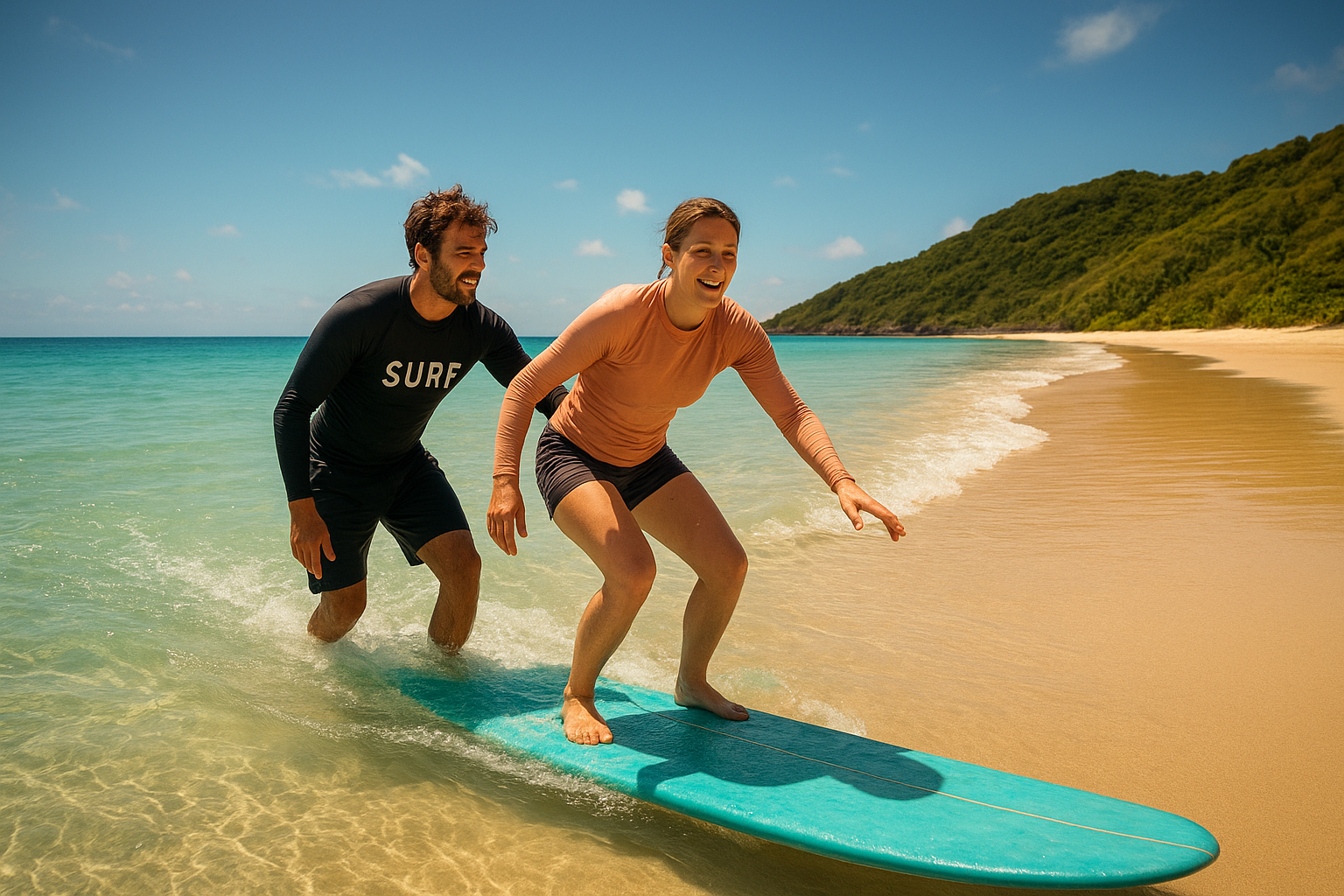
A certified instructor guides a first-time surfer through the gentle shore break at Waikiki — one of the world’s most beginner-friendly surf spots.
Why Waikiki Is the World’s Greatest Place to Learn Surfing
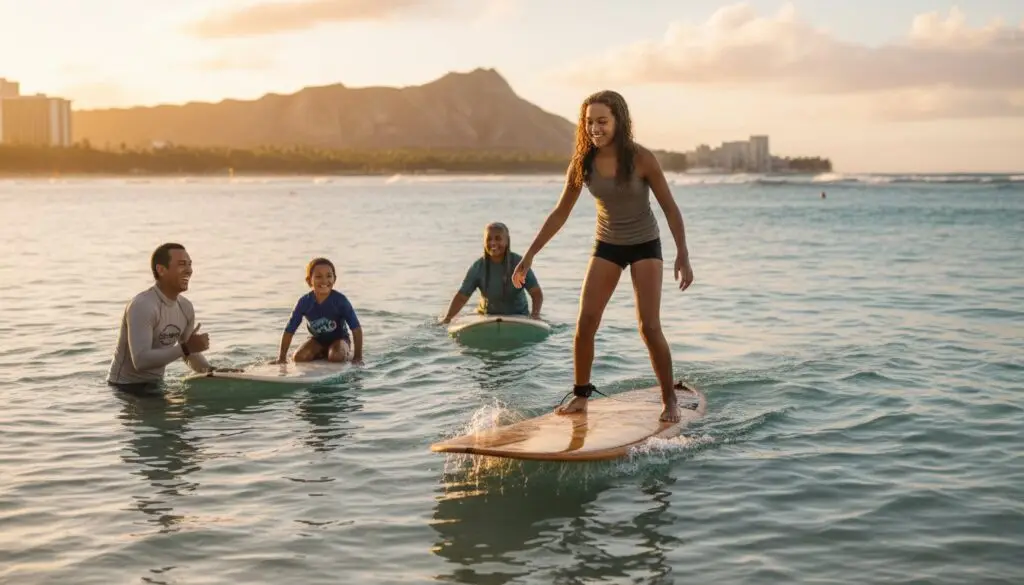
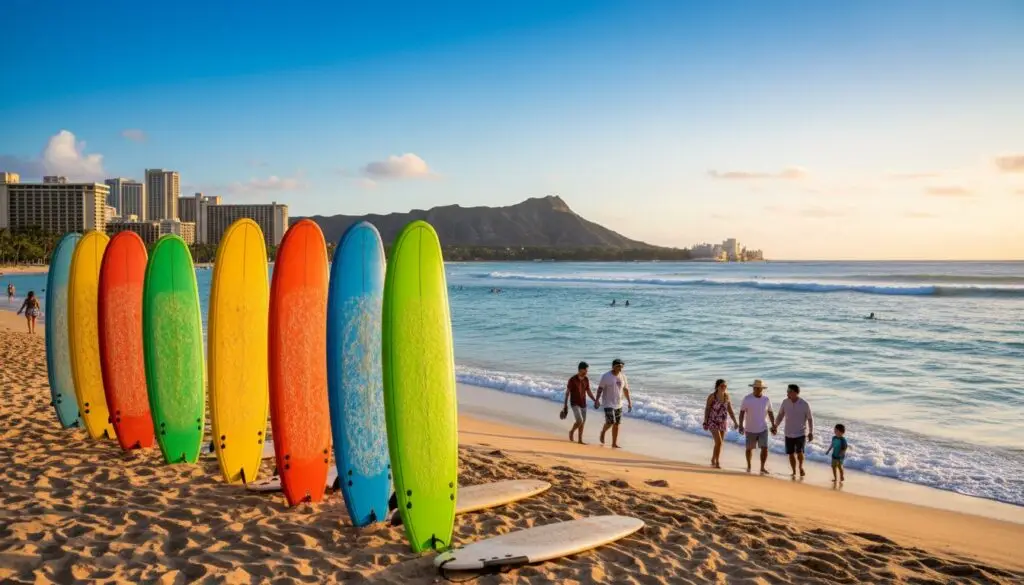
Waikiki sits on the south shore of Oahu, sheltered by a shallow offshore reef that slows incoming swells to an ideal, forgiving pace. The result is a wave that breaks gently, holds its shape long enough for a beginner to pop up, and rolls toward shore over warm, chest-deep water. Unlike beach breaks in California or cold Atlantic shores, Waikiki delivers consistent, learnable waves every single day of the year. Learn which specific beaches in Waikiki are best for lessons.
The water temperature hovers around 78°F year-round, meaning no wetsuits, no cold shock, and no barrier between you and the pure joy of catching your first wave. For families, that alone is a game-changer. Children as young as five can comfortably participate alongside adults and seniors in their seventies.
There is also the cultural weight of the place. Duke Kahanamoku — Olympic swimmer and father of modern surfing — learned and taught surfing right here on this beach. Learning to surf at Waikiki is not just a vacation activity; it is a direct connection to the oldest continuous surf culture in the world. No other destination offers that combination of ideal conditions and living history.
What Makes Waikiki’s Waves Uniquely Beginner-Friendly
- Slow-breaking swell: Waves from the south travel across deep ocean, arrive with long intervals, and break gradually — giving beginners 3–5 full seconds to complete their pop-up.
- Shallow, sandy bottom: The inshore area where lessons are held is sandy and shallow, dramatically reducing risk of injury from wipeouts.
- Consistent conditions: Unlike seasonal or weather-dependent surf spots, Waikiki produces learnable waves 365 days a year. For a deeper walkthrough, see our Family Surf Lessons: Get Everyone Riding Waves Together.
- Zero wetsuit requirement: Warm water year-round means younger students, older adults, and anyone sensitive to cold can participate without discomfort.
- Designated surf zones: The City and County of Honolulu designates specific areas of the break for surf schools, keeping lessons safe and organized. For a deeper walkthrough, see our Which Surf Schools Offer the Best Ocean Experiences?.
What Separates the Best Surf Schools in Waikiki from the Rest
Dozens of operators line the beach. Some are polished, professional, and safety-first. Others are informal, overcrowded, and light on credentials. Here is exactly what to look for before you hand over your credit card:
Instructor Certification and Lifeguard Training
The single most important quality indicator is whether instructors hold current CPR/First Aid certification and an active lifeguard credential. Waikiki is generally safe, but ocean environments are inherently unpredictable. A certified instructor can respond appropriately if a student struggles, swallows water, or a sudden set wave arrives. Always ask before booking — any reputable school will answer this question immediately and proudly.
Instructor-to-Student Ratio
The ideal ratio for a beginner group lesson is no more than 4 students per instructor. Beyond that, individual attention becomes impossible, and safety in the water is compromised. Some budget operators pack 8–12 students with a single instructor — avoid those arrangements entirely. Semi-private lessons (2:1) and private lessons (1:1) deliver the fastest skill progression and the highest safety margin.
State and County Beach Permits
All legitimate surf instruction businesses on Waikiki Beach must hold valid permits from both the State of Hawaii and the City and County of Honolulu. These permits are not trivial — they require proof of insurance, background checks, and demonstrated compliance with safety standards. Unlicensed operators sometimes approach tourists on the beach offering cheap informal lessons; avoid them entirely.
Board Quality and Equipment Standards
The best schools use soft-top foam longboards (typically 8–10 feet) for all beginner instruction. Foam boards are buoyant, stable, and forgiving on impact — critical for novices who will wipe out and land on the board repeatedly. Schools that hand beginners hard fiberglass shortboards are cutting corners on safety. Also verify that rash guards are provided — prolonged sun exposure on the water without one causes painful burns within minutes at Hawaiian latitude.
Quick Answer: The best surf school in Waikiki pairs you with a certified, lifeguard-trained instructor in a group of four or fewer students, uses proper foam longboards, holds all required State and County permits, and conducts lessons in the designated beginner zone of the break. Schools like Star Beach Boys have built strong multi-year reputations by meeting every one of these standards consistently.
Top-Rated Surf Schools in Waikiki — Best Surf School Waikiki Picks
The following recommended surf schools have earned consistently strong reputations through verified reviews, professional operations, and long-standing community presence on Waikiki Beach. Each is evaluated across the key criteria above.
⭐ Star Beach Boys — Best Overall for Beginners
Star Beach Boys is a locally owned and deeply community-rooted surf school operating directly on Waikiki Beach. Their instructors are known for patience, warmth, and a genuine spirit of aloha that makes first-timers feel welcome and capable from the moment they arrive. Every session is capped to ensure strong individual attention, and lessons are held in the calm, protected inside break — the most forgiving section of the water for beginners.
They offer group lessons, semi-private lessons for couples or friends, and private one-on-one sessions. Families with children receive specially tailored instruction, and the school’s instructors are experienced at reading which section of the break suits each student’s confidence level on any given day.
- Best for: First-timers, families, solo travelers, and anyone who wants a genuinely local Waikiki experience
- Group size: Small, capped groups with strong instructor ratio
- Standout quality: Authentic aloha culture, experienced local instructors, consistent five-star reviews
Hans Hedemann Surf School — Best for Coaching Methodology
Founded by Hans Hedemann, a four-time world professional surf champion, this school brings a structured, technically rigorous approach to instruction that is rare on the beginner end of the market. Instructors are trained in a coaching system developed through decades of professional competition experience, which means technique feedback is precise, actionable, and effective.
In addition to standard beginner lessons on Waikiki, Hans Hedemann offers multi-day surf camps, intermediate clinics, and advanced performance sessions — making it the top choice for visitors who want to continue developing after the initial lesson and potentially return each year with measurable progress.
- Best for: Motivated learners, intermediate surfers, and multi-day camp participants For a deeper walkthrough, see our best surfing schools in Oahu.
- Standout quality: Professional coaching methodology, multi-day program structure
- Unique offering: Intermediate and advanced clinics not offered by most Waikiki schools For a deeper walkthrough, see our Best Surf Schools for Beginners in Waikiki: Complete 2024 Guide.
Faith Surf School — Best for Families and Ocean Safety
Faith Surf School has built a strong reputation specifically among kids surf lessons and younger learners, largely because of how thoroughly they integrate ocean safety education into every lesson. Students don’t just learn to pop up on a board — they leave understanding rip currents, wave sets, surf etiquette, and how to stay safe as an independent ocean user.
Class sizes are kept deliberately small, and instructors are chosen as much for their communication skills with children as for their surf ability. Parent-child lesson packages allow families to experience the entire progression together in the same session.
- Best for: Families, children ages 5+, parents who want comprehensive safety instruction
- Standout quality: Deep focus on ocean safety education alongside surfing technique For a deeper walkthrough, see our Building Surfing Confidence: The Complete Guide to Feeling at Home in the Ocean.
- Unique offering: Parent-child joint lessons and family packages
Aloha Beach Services — Best for Walk-In Availability
Aloha Beach Services operates a long-established beachside stand near the center of Waikiki and offers one of the most accessible entry points to surfing on the island. While advance booking is always recommended, they maintain a larger staff that allows same-day and walk-in lesson availability more reliably than most competitors — a practical advantage for travelers whose schedules change on the fly.
- Best for: Spontaneous bookers, visitors with unpredictable itineraries
- Standout quality: Same-day availability, central beach location
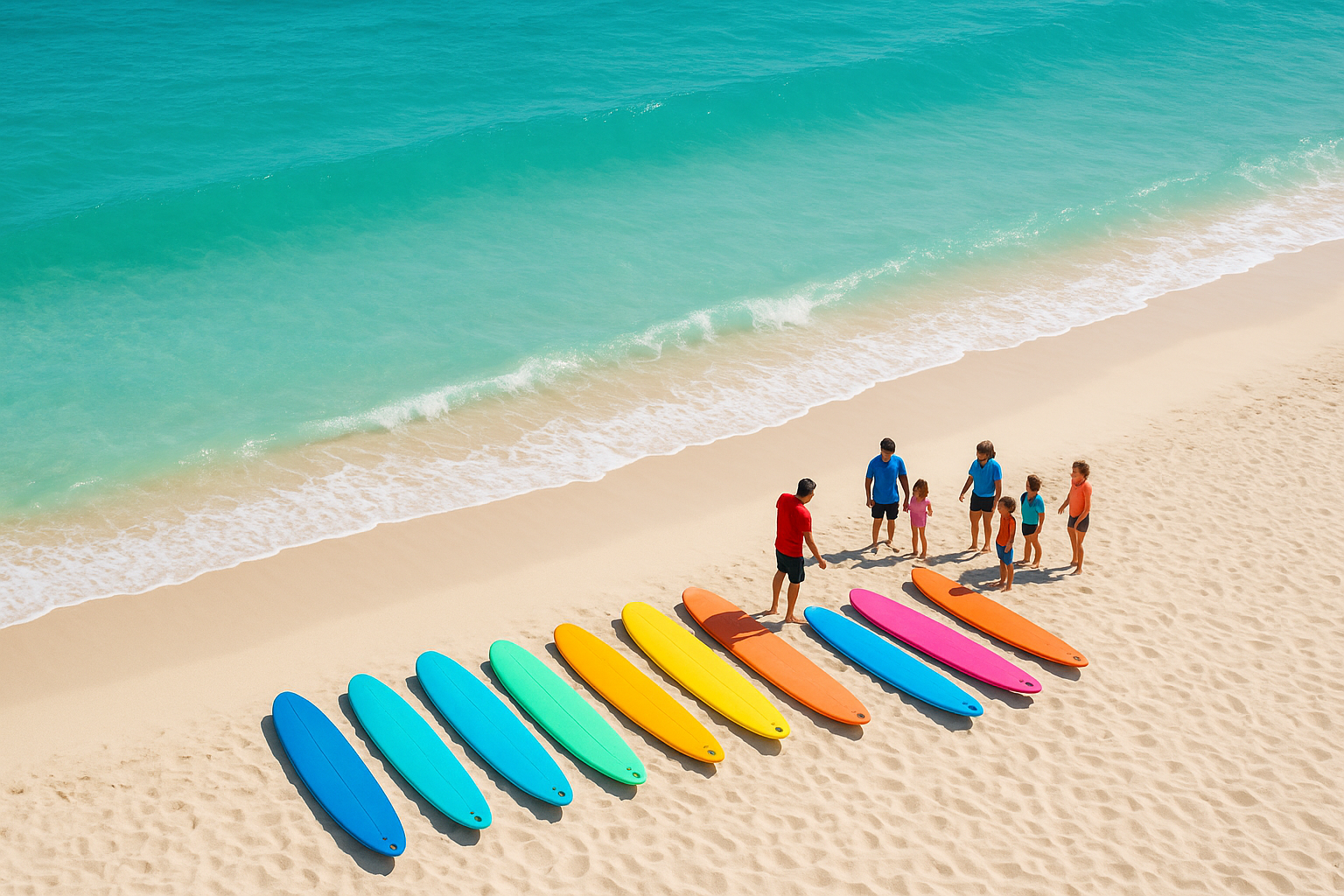
Foam boards lined up and ready for a group lesson — the standard setup at every reputable Waikiki surf school.
For a deeper walkthrough, see our Family Surf Lessons Waikiki.
How to Choose Between Group, Semi-Private, and Private Lessons
Every surf school in Waikiki offers multiple lesson formats. The right choice depends on your budget, learning style, and how quickly you want to progress. Here is a complete breakdown:
Are Private Lessons Worth the Extra Cost?
For absolute beginners, a group lesson with a good school delivers excellent value — the social energy helps, the instructor can demonstrate for the whole group efficiently, and Waikiki’s forgiving waves do a significant portion of the teaching on their own. However, for anyone who has already had one or two lessons and wants to progress beyond standing up and riding straight to the beach, Waikiki surf lessons private sessions accelerate that curve dramatically. Instructors can focus entirely on your specific weaknesses — foot position, weight distribution, trim angle — rather than managing a group.
What Happens During a Waikiki Surf Lesson: Step-by-Step
Knowing exactly what to expect transforms first-day nerves into excitement. Here is the precise structure of a standard 60–75 minute beginner surf lesson at a top Waikiki surf lessons: For a deeper walkthrough, see our What Are Some Tips for Choosing the Right Surf School?.
- Arrival and gear setup (5–10 minutes): Check in with your instructor, sign any required waivers, receive your foam board and rash guard, and apply sunscreen before heading to the sand. Most schools ask you to arrive 10–15 minutes before your session start time.
- Land briefing and sand practice (15–20 minutes): Your instructor walks through ocean safety rules, surf etiquette (right of way, paddling out protocol), and demonstrates the paddling position and pop-up technique on dry sand. You will practice popping up on your board multiple times before you ever enter the water — this muscle memory makes your first in-water attempts dramatically more successful.
- Paddling warm-up in shallow water (10 minutes): You enter the water in the knee-to-waist-deep zone and practice lying on the board, paddling forward, and shifting your weight without attempting to stand. This builds comfort and confidence with the board before waves are introduced.
- First wave catches with instructor assist (25–35 minutes): Your instructor positions you on the board, reads the incoming waves, and pushes you into the break at precisely the right moment — calling out when to paddle, when to stop, and when to pop up. Most students stand successfully within the first two to four attempts at Waikiki due to the ideal wave conditions. The instructor provides real-time coaching adjustments between waves.
- Independent attempts (10–15 minutes, skill-dependent): As your technique develops, the instructor transitions you to paddling into waves independently while providing guidance from nearby. This builds the self-sufficiency needed to continue surfing after the lesson ends.
- Post-session debrief (5–10 minutes): Back on the sand, your instructor provides personalized feedback on what went well, what to focus on next time, and specific tips for your body type and learning style. Top schools also recommend next steps — whether a second lesson the following day, a rental session for practice, or a specific intermediate skill to work on.
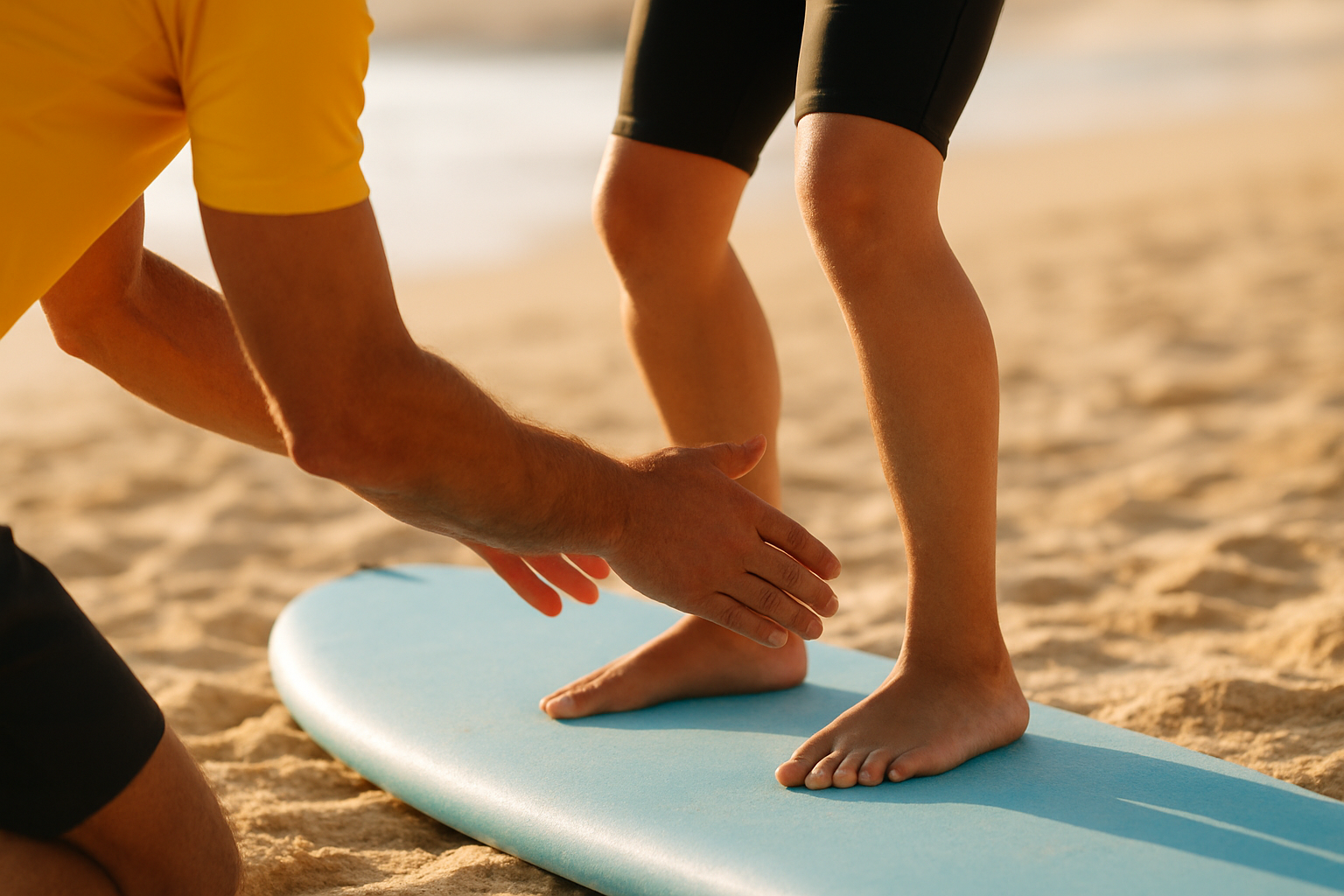
Hands-on technique coaching during the land portion of a lesson — a hallmark of the best surf schools in Waikiki.
For a deeper walkthrough, see our Best Surf Instructors in Waikiki.
Surf Lesson Pricing in Waikiki: What’s Included and What to Watch For
Price variation across Waikiki surf schools is significant. A $50 group lesson and a $200 private lesson are not simply different quantities of the same thing — they often reflect fundamentally different instructor quality, equipment, and class size. Here is what you should expect each price tier to include:
What Should Always Be Included (Any Reputable School)
- Foam surfboard for the duration of the session
- Rash guard (UV protection top)
- Full land briefing and safety instruction
- In-water instruction and wave push-ins
- Post-session feedback
Red Flags That Signal a Lower-Quality Operation
- Groups of 8 or more students with a single instructor
- Hard fiberglass boards provided to beginners
- No rash guard provided (sun protection matters)
- Instructors unable to answer questions about their certifications
- No land briefing — students sent directly into the water
- Cash-only, no booking confirmation, no cancellation policy
- Operators who cannot produce permit documentation upon request
Common Booking Mistakes to Avoid
Even well-intentioned travelers frequently make avoidable errors when booking surf lessons in Waikiki. These mistakes range from minor inconveniences to genuine safety risks: For a deeper walkthrough, see our Family Surf Lessons in Waikiki, Oahu: The Ultimate 2026 Ohana Guide.
- Choosing solely on price: The cheapest lesson is often cheap for a reason. An oversized class with an uncertified instructor is not a bargain — it is a liability. Focus on reviews and credentials first, then compare prices among qualified schools.
- Booking too late: Early morning slots (7–9 AM) — when conditions are calmest and the beach is least crowded — sell out 2–4 days in advance during peak tourist season (June–August, December–January). Book as soon as your travel dates are confirmed.
- Ignoring the instructor-to-student ratio: Always ask how many students will be in your group before confirming. Anything above 4:1 is a red flag.
- Not reading recent reviews: Schools change over time — instructors leave, ownership changes, standards slip or improve. Check reviews from within the past three to six months specifically, not overall lifetime ratings alone.
- Skipping the land briefing: Some budget operators minimize or eliminate the sand portion of the lesson to maximize in-water time. This is counterproductive. The land briefing is where technique is established, and it directly determines how quickly you stand up in the water.
- Not disclosing health conditions: Inform your school of any relevant health considerations — prior shoulder injuries, swimming ability, heart conditions — before the session. Good schools use this information to adjust positioning and expectations appropriately.
How to Get the Most Out of Every Waikiki Surf Lesson
The school and instructor determine the ceiling of your experience. These practical steps determine how close to that ceiling you actually get:
Before Your Lesson
- Schedule early morning sessions (7–9 AM). Trade winds build through the day and roughen the surface of the water. Early morning produces the cleanest, glassiest conditions for learning.
- Eat lightly beforehand. A heavy meal before paddling causes discomfort in the water. Have a light snack 1–2 hours before your lesson and save the big breakfast for after.
- Apply reef-safe sunscreen 20–30 minutes before entering the water. This gives it time to bind to skin before swimming washes it away. Chemical sunscreens are banned in Hawaii — use only certified reef-safe mineral formulas.
- Arrive 10–15 minutes early. Rushing to your lesson causes anxiety and means missing part of the all-important land briefing.
During Your Lesson
- Look at the horizon, not your feet. The single most common beginner mistake. Looking down shifts your weight forward, causes the nose to pearldive, and kills momentum. Fix your gaze forward immediately.
- Commit fully to each pop-up. Hesitation — half-standing, then sitting back down — is more likely to cause a wipeout than a fully committed stand. Trust your practice.
- Ask your instructor specific questions. Tell them what felt wrong on each wave — foot slipping, losing balance left vs. right, difficulty paddling into the wave. The more specific your feedback to them, the more targeted their coaching will be.
- Rest between waves rather than paddling frantically. Conserve energy. Exhausted upper body muscles lead to sloppy pop-ups in the second half of the lesson.
After Your First Lesson
- Book a second lesson the following day if possible. Muscle memory consolidates during sleep. Students who surf on back-to-back days progress twice as fast as those who wait a week between lessons.
- Rent a board for an independent session. Even 30–45 minutes of unsupervised paddling and wave-catching after your lesson cements what you learned under instruction. Most schools offer rental boards at reasonable hourly rates.
- Hydrate aggressively. Saltwater and sun cause significant dehydration even in a short session. Drink at least 16–24 oz of water within one hour of finishing.
Surfboard Rentals vs. Lessons in Waikiki: Which Should You Book First?
Many visitors wonder whether they can simply rent a board and teach themselves, particularly if they have some experience in other board sports (skateboarding, snowboarding, wakeboarding). Here is an honest assessment:
For true beginners with no ocean experience: Always take a lesson before renting independently. Waikiki is forgiving, but understanding right-of-way rules, how to fall safely, and how to navigate the channel back to the lineup without being dragged along the reef are essential knowledge that a lesson provides in 15 minutes and independent experimentation may never fully resolve.
For those with some prior surfing experience: Renting a board for an independent session can be a great complement to a lesson, particularly for practicing specific techniques like paddling endurance, reading wave selection, or trimming across the face. Many Waikiki operators rent foam longboards by the hour for approximately $15–$30, making supplemental practice very accessible.
The recommended approach: Take one lesson on day one. Rent a board for independent practice on day two. Take a second (private) lesson on day three. This three-step structure produces more progress in a short vacation window than any other sequence. For broader logistics and statewide context, see surf lessons in Hawaii.
Best Time of Year for Surf Lessons at Waikiki Beach
Waikiki is one of the few surf destinations in the world that delivers beginner-appropriate conditions every month of the year. That said, there are meaningful seasonal differences that affect lesson quality:
Summer (May–September)
South swells produce the calmest, most consistent beginner waves. Best overall period for first-timers. Peak tourist season means higher demand — book early.
Fall (October–November)
Transitional period with slightly more variable swell. Still excellent for beginners. Lower tourist volume means easier booking and more instructor attention.
Winter (December–February)
North shore swells can push larger surf to the south side on occasional days. Instructors always evaluate conditions before each session. Holiday demand makes early December and January very busy — book ahead.
Spring (March–April)
Excellent, often overlooked period. South swells begin building, conditions are clean, and tourist volume is lower than summer peak. Great value window for surf lessons.
Ocean Safety: What Every Waikiki Surf Student Should Know
The best surf schools in Waikiki treat ocean safety as a non-negotiable foundation of every lesson — not an afterthought. Even in Waikiki’s gentle conditions, knowing how to handle unexpected situations is essential knowledge:
Surf Etiquette — The Unwritten Rules of the Lineup
- Right of way: The surfer closest to the peak (the highest breaking point of the wave) has right of way. Never drop in on a surfer who is already riding — it is the most dangerous and disrespectful violation in surfing.
- Paddling out: When paddling back to the lineup, move through the channel (the non-breaking section of water) rather than through the path of surfers riding waves. If caught in the impact zone, hold onto your board and paddle over or through the white water.
- Don’t ditch your board: Your foam surfboard is your most important safety device. In a wipeout, maintain contact with or stay close to your board at all times.
- Communicate: If you are not sure whether it is your turn on a wave, make eye contact with nearby surfers and yield. In Waikiki’s busy beginner zone, a quick smile and a wave go a long way.
What to Do If You Get Caught in a Rip Current
Rip currents are uncommon in Waikiki’s designated surf lesson areas, but knowing how to respond is important regardless. Never swim directly against a rip current toward shore — this exhausts you quickly. Instead, swim parallel to the shoreline until you exit the current’s flow, then swim diagonally back to shore. Alternatively, stay calm, float on your board, and signal for help. Every certified Waikiki instructor is trained to identify and respond to rip currents immediately.
Conclusion: How to Choose the Best Surf School in Waikiki for Your Trip
The best surf school Waikiki offers is ultimately the one that matches your specific goals, learning style, and budget — while meeting every baseline standard for safety, certification, and class size. Whether you choose the community-rooted warmth of Star Beach Boys, the coaching rigor of Hans Hedemann Surf School, the family-focused safety instruction at Faith Surf School, or the walk-in accessibility of Aloha Beach Services, you are entering the water at one of the most extraordinary surfing locations on the planet.
Prioritize these factors in order: certified instructors with lifeguard credentials → small class sizes (4:1 or better) → proper State and County permits → verified recent reviews → lesson format that matches your goals. Get those five right, and Waikiki’s perfect beginner waves will handle the rest.
Ready to Book?
Book your lesson at least 2–3 days in advance to secure an early morning slot. Check that your chosen school is fully permitted, uses foam boards, and caps group sizes; find surf lessons and compare options. Then show up rested, sunscreened, and ready — your first wave at Waikiki is waiting.
Frequently Asked Questions: Best Surf School Waikiki
What is the best surf school in Waikiki for beginners?
The best surf school Waikiki offers beginners is one with certified, lifeguard-trained instructors, a maximum of four students per instructor, foam longboards, and lessons held in the designated beginner zone of the break. Star Beach Boys consistently receives top marks for all of these criteria and is widely regarded as the best overall option for first-timers on Waikiki Beach.
How much do surf lessons cost in Waikiki?
Group surf lessons in Waikiki typically cost $50–$80 per person. Semi-private lessons for two students run $120–$150 per pair. Private one-on-one lessons range from $100–$200 per hour. Multi-day surf camp programs are available from approximately $300–$600 depending on duration and school. Most reputable schools include the board and rash guard in the lesson fee — confirm this before you book a surf lesson.
How long does a typical Waikiki surf lesson last?
Most Waikiki surf lessons last 60–90 minutes total, including a 15–20 minute land briefing on safety and technique followed by 45–60 minutes of in-water instruction. Some schools offer two-hour extended sessions for students who want additional water time, and multi-day camp programs run several hours per day over multiple consecutive days.
Do I need any experience to take a surf lesson at Waikiki?
No prior surfing experience is required. Waikiki’s gentle, slow-breaking waves make it the most beginner-friendly surf destination in the world, and all reputable schools are specifically designed and equipped to work with complete novices. Basic swimming ability is recommended — being comfortable in chest-deep ocean water makes the experience more enjoyable and safe.
Is Waikiki Beach actually a good place to learn to surf?
Yes — Waikiki is universally considered one of the best places in the world to learn to surf. The combination of warm water (78°F year-round), slow-breaking long-interval swells, sandy bottom, consistent daily conditions, and a century-long culture of surf instruction makes it genuinely exceptional. Beginners of all ages and fitness levels can stand up on their first lesson here more reliably than at almost any other surf break on earth.
What should I bring to a Waikiki surf lesson?
Bring a swimsuit or board shorts, reef-safe mineral sunscreen (chemical sunscreen is banned in Hawaii), a towel, water for hydration, and a light snack for before or after. Most schools provide the foam surfboard and rash guard — confirm this when booking. Wearing contact lenses in the surf is not recommended; if possible, swim without them or use prescription goggles.
Are private surf lessons worth it in Waikiki?
Private lessons are worth the extra cost for anyone who wants to progress quickly beyond the basics, has specific technical issues to address, prefers learning without other students around, or has previously attempted surfing and wants targeted coaching. Group lessons remain excellent value for true beginners who are comfortable in social learning environments — Waikiki’s easy waves mean most people stand up in a group setting on their first attempt regardless.
What age is suitable for surf lessons in Waikiki?
Most Waikiki surf schools accept students as young as 5 or 6 years old, and there is no upper age limit — students in their 70s and 80s regularly take lessons successfully. Many schools offer family packages where parents and children learn together in the same session, which is an especially popular option for vacationing families. Children under 8 should be enrolled in the school’s specific children’s program where available.
How do I verify that a Waikiki surf school is legitimate?
Ask the school directly whether their instructors hold current CPR/First Aid and lifeguard certifications and whether the business holds valid State of Hawaii and City and County of Honolulu beach permits. Reputable schools will answer these questions immediately. Additionally, check Google Reviews and TripAdvisor for reviews from the past three to six months — look for consistent mentions of instructor quality, class size, and safety standards, not just overall star ratings.
What is the best time of year to take surf lessons in Waikiki?
Waikiki is suitable for surf lessons every month of the year. Summer (May–September) offers the calmest south swells and is ideal for absolute beginners. Spring (March–April) is an excellent, often overlooked window with building south swells, clean conditions, and lower tourist volume. Winter months are busier and occasionally see larger south-side surf from north swells, but lessons remain safe and available daily — instructors assess conditions before every session.
Can I rent a surfboard in Waikiki without taking a lesson first?
Yes, surfboard rentals (typically foam longboards at $15–$30 per hour) are widely available from beachside operators. However, first-time surfers are strongly encouraged to take at least one lesson before paddling out independently — not because the water is dangerous, but because a 15-minute land briefing on right-of-way rules, paddling technique, and safe wipeout practices produces a dramatically better and safer independent experience.
How many surf lessons does it take to stand up at Waikiki?
Most beginners stand up on a surfboard during their very first Waikiki lesson — the slow, forgiving waves make it genuinely achievable within the first few attempts for the vast majority of students. Building consistent technique, smooth wave selection, and the ability to ride independently without instructor assistance typically requires two to five lessons spread across several days.
Does Hans Hedemann Surf School offer multi-day programs?
Yes. Hans Hedemann Surf School offers structured multi-day surf camps in addition to standard beginner lessons. These programs run across 3–5 days and include progressive instruction from fundamentals through intermediate technique. They are particularly well suited for dedicated learners who want to make meaningful skill gains within a single vacation. Hans Hedemann also offers intermediate and advanced clinics that most other Waikiki schools do not provide.