Surfing terms are the backbone of the sport — the shared language that connects beginners to instructors, surfers to the ocean, and newcomers to a culture that spans centuries. According to the Surfrider Foundation, millions of people attempt surfing for the first time every year. Those who arrive knowing even a handful of key surfing terms learn faster, stay safer, and enjoy the water more. This guide gives you everything — from board anatomy and wave vocabulary to surf slang, etiquette language, and advanced technique terms — so you never feel lost in the lineup. This guide was written by the Star Beach Boys editorial team and was last updated 2026-07-27 to keep safety and technique advice current.
Whether you are booking your first beginner lesson, studying for an upcoming surf trip, or simply curious about surf culture, consider this your complete, plain-language reference for every essential surfing term — and dozens the other guides leave out. For step-by-step help, see our surfing tips for beginners.
What Are Surfing Terms?
Surfing terms are the specialized words, phrases, and slang surfers use to describe the ocean, equipment, wave conditions, riding techniques, and cultural attitudes. This vocabulary has evolved over many decades, shaped primarily by Hawaiian, Californian, and Australian surf traditions, and is used daily by everyone from absolute beginners to world champions.
Knowing these terms allows you to follow instructor directions precisely, read surf reports, understand lineup rules, and communicate confidently with fellow surfers. Surfing has its own dialect — and learning it is one of the first and most rewarding steps on your journey. For a deeper look at the Hawaiian roots of surf language, explore our guide to Waikiki surf lingo and Hawaiian traditions.
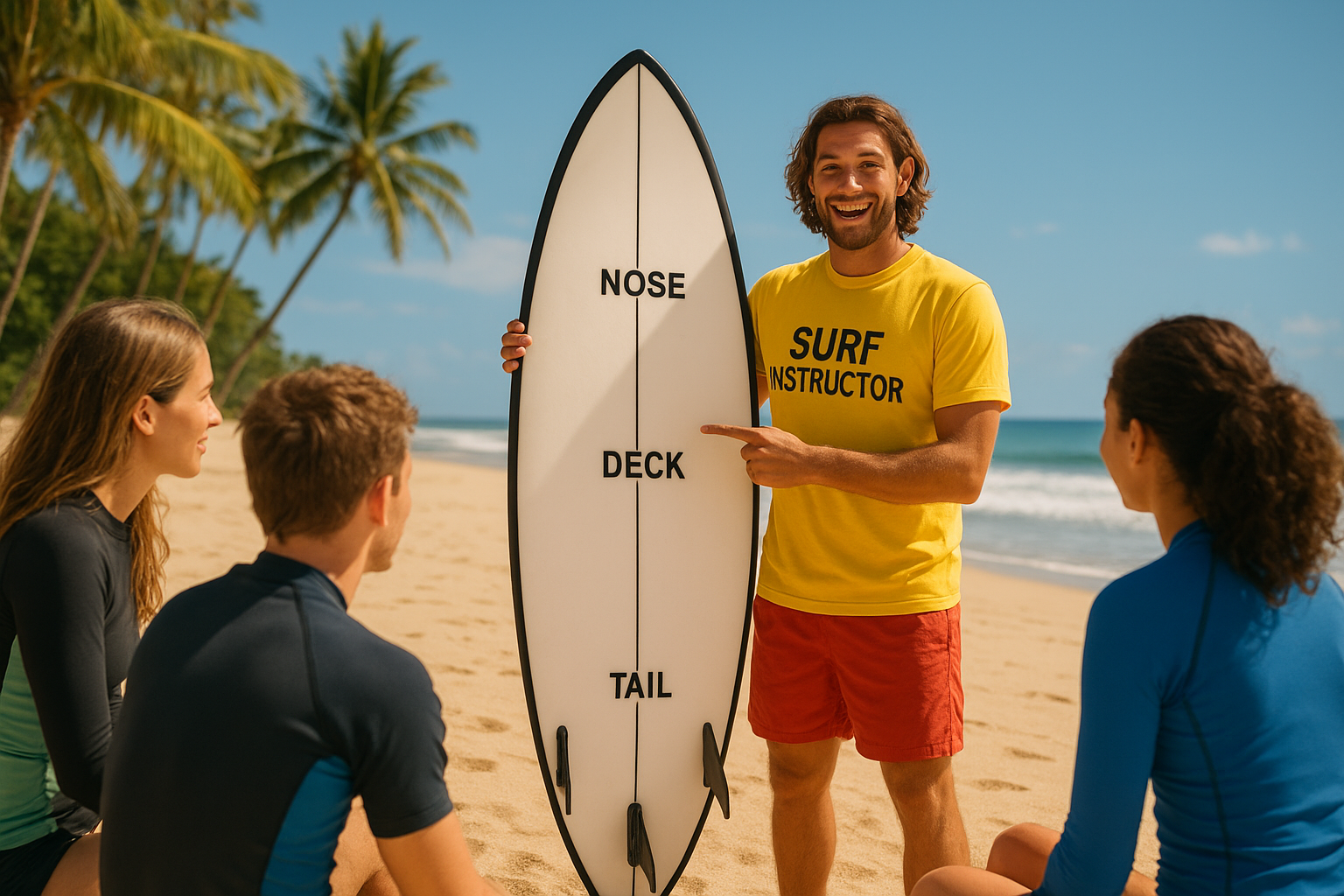
Learning surfing terms on the beach before entering the water gives beginners a critical confidence advantage from the very first lesson.
Surfboard Anatomy: Every Part Explained
Your instructor will reference surfboard parts constantly during lessons. Knowing each one before you hit the water means zero confusion and faster progress. Here is a complete breakdown of surfboard anatomy:
- Nose: The front tip of the board. A rounded nose (common on longboards) is more forgiving; a pointed nose (on shortboards) improves speed through the water.
- Tail: The rear end of the board, which directly influences how it pivots and turns. Common tail shapes include the squash, pin, swallow, and round tail — each handling differently in the water.
- Rails: The edges running along both sides of the board from nose to tail. Hard rails provide bite and control; soft rails offer smoother transitions through turns.
- Deck: The top surface of the board where the surfer stands. Covered in wax or a traction pad for grip.
- Bottom: The underside of the board, shaped with contours (concaves, channels, vee) that affect speed and water flow.
- Fins: Blade-like structures on the underside near the tail that provide directional stability and turning control. Common setups include single fin, twin fin, thruster (three fins), and quad (four fins).
- Fin box (fin plug): The slot or housing on the board’s underside that holds the fins in place. Removable fin systems include FCS and Futures.
- Leash plug: A small anchor point near the tail where the leash is attached.
- Leash: A coiled cord connecting the board to the surfer’s ankle or calf, preventing it from drifting away after a wipeout. This is essential safety equipment for all surfers.
- Stringer: A thin strip of wood running down the center of the board that adds strength and stiffness.
- Rocker: The curvature of the board from nose to tail when viewed from the side. More rocker means greater maneuverability in steep waves; less rocker means more speed in flatter conditions.
- Wax: Applied to the deck to create grip so your feet don’t slip. Different wax formulas exist for water temperature — cool water wax, warm water wax, and basecoat.
- Traction pad (deck grip): A foam non-slip pad adhered to the tail area of the deck as an alternative or complement to wax, especially popular on shortboards.
Board Types: Matching the Right Board to the Right Surfer
The type of board you ride affects every aspect of your surfing experience. Understanding these categories is a core part of your surfing terms vocabulary: Learn which board is best for beginners.
- Longboard: Typically 9 feet or longer, wide, and thick. Extremely stable and ideal for beginners, small waves, and a relaxed style of surfing. Longboards allow classic moves like cross-stepping and hanging ten.
- Shortboard: Usually 5’6″ to 6’4″, narrow, and with significant rocker. Designed for powerful, aggressive surfing in larger waves. Requires advanced skill and balance — not recommended for beginners.
- Funboard (Malibu / Mini Mal): A mid-length board between 7 and 9 feet that bridges the gap between longboard stability and shortboard performance. Popular with intermediate surfers and beginner adults.
- Fish: A short, wide board with a swallow tail, typically around 5’4″ to 6’2″. Very fast and playful in small, mushy waves. A great step-up option after mastering the basics.
- Gun: A long, narrow board designed specifically for big-wave surfing. Built for speed and control in heavy, powerful surf of 10 feet or more.
- Foamie (Soft-top): A foam-topped surfboard with soft, rounded rails. The safest option for complete beginners and the board of choice in most beginner surf schools, including those at starbeachboys.com.
- SUP (Stand-Up Paddleboard): A large, buoyant board ridden while standing and propelled by a long paddle. Often used in calm conditions and for fitness, though it can be surfed on waves.
Ocean and Wave Terminology: Reading the Water
The ocean has its own vocabulary. Understanding these wave-related surfing terms helps you read conditions, stay safe, position yourself correctly, and make the most of every session.
Types of Surf Breaks
- Beach break: Waves breaking over a sandy seabed. The most forgiving type of break and ideal for beginners. The sandbar shifts with tides and swells, so conditions change regularly.
- Reef break: Waves breaking over a coral or rock reef. Can produce powerful, hollow, high-quality waves but is generally more dangerous due to the hard surface below.
- Point break: Waves that wrap around a headland or point of land and break in a consistent, predictable direction along the coastline. Often produce long, peeling waves ideal for skilled surfers.
- Shore break: Waves that break very close to or directly on the beach. Can be powerful and dangerous, especially for beginners, as there is little water depth to cushion a wipeout.
Wave Structure and Behavior
- Swell: A series of waves generated by distant storms or wind systems far out at sea. A good swell means quality surf is incoming. Swell is measured in height, period (seconds between waves), and direction.
- Swell period: The time in seconds between successive wave crests. A longer period (12+ seconds) generally means more powerful, better-organized waves. Short-period swells tend to be choppy and disorganized.
- Set: A group of waves that arrive together, typically larger and more powerful than the lulls (calm periods) in between. Experienced surfers are always watching for the next set on the horizon.
- Lull: The calm period between sets when the ocean temporarily quiets. The best time for beginners to paddle out past the break.
- Wave face: The forward-facing surface of a wave — the part the surfer rides. A clean, steep wave face is ideal for performing maneuvers.
- Lip: The top edge of the wave as it pitches forward to break. Advanced maneuvers like lip bashes and aerial tricks take place at or above the lip.
- Pocket (power zone): The steepest, most powerful part of the wave, just below and in front of the breaking lip. Riding in the pocket generates maximum speed and allows for the most dynamic surfing.
- Shoulder: The unbroken, sloping section of the wave away from the peak. Less powerful than the pocket but useful for generating speed on longer rides.
- Peak: The highest point of the wave where it first starts to break. This is the optimal takeoff spot — surfers paddle to the peak to catch waves at their most rideable point.
- Barrel (Tube): The hollow, cylindrical tunnel formed when the lip of a wave pitches over the wave face, creating an enclosed space inside. Riding inside a barrel — called getting tubed or getting barreled — is widely considered surfing’s ultimate experience.
- Closeout: A wave that breaks simultaneously across its entire length, leaving no rideable open face. Closeouts cannot be surfed laterally and are generally undesirable — though they can still be fun for beginners practicing pop-ups.
- Double-up: Two waves that combine into a single, extra-powerful wave. Can create exceptional surfing conditions but also dramatically increased danger.
Zones of the Surf Lineup
- Lineup: The area beyond the breaking waves where surfers sit on their boards and wait for incoming sets. Understanding the lineup is essential for safety, etiquette, and wave selection.
- Impact zone: The area directly in front of where waves are breaking. This is the most dangerous spot in the water — waves break with maximum force here, and surfers who fall in the impact zone can be held underwater.
- Channel: A deeper water pathway to the side of the breaking waves, where currents flow back out to sea. Paddling out through the channel is far easier and safer than paddling directly through the impact zone.
- Inside: The area between the shore and the lineup, where smaller, broken whitewater waves exist. Beginners typically learn in the inside.
- Outside: The area beyond the lineup, further out to sea. A shout of “outside!” from another surfer warns that a large set is approaching — everyone needs to paddle further out immediately.
Wind and Conditions Vocabulary
- Offshore wind: Wind blowing from the land toward the sea. Offshore conditions hold the wave face up, producing cleaner, more defined, longer-lasting waves. This is the most desirable wind direction for surfing.
- Onshore wind: Wind blowing from the sea toward the land. Onshore conditions push waves over prematurely, creating choppy, disorganized, difficult-to-ride surf.
- Cross-shore wind: Wind blowing parallel to the coastline, from the side. Conditions vary — cross-shore winds can be acceptable or disruptive depending on direction and strength.
- Glassy: Perfectly smooth, mirror-like ocean surface with no wind at all. Glassy conditions are considered ideal — waves hold their form beautifully and the water is visually stunning.
- Choppy: Rough, uneven water surface caused by strong onshore winds or conflicting currents. Choppy conditions make wave faces bumpy and harder to ride.
- Firing / Pumping: Slang describing exceptionally good surf conditions — “the waves are firing today” means excellent surf quality with consistent sets.
- Flat: No waves whatsoever. A flat ocean means no surfing is possible.
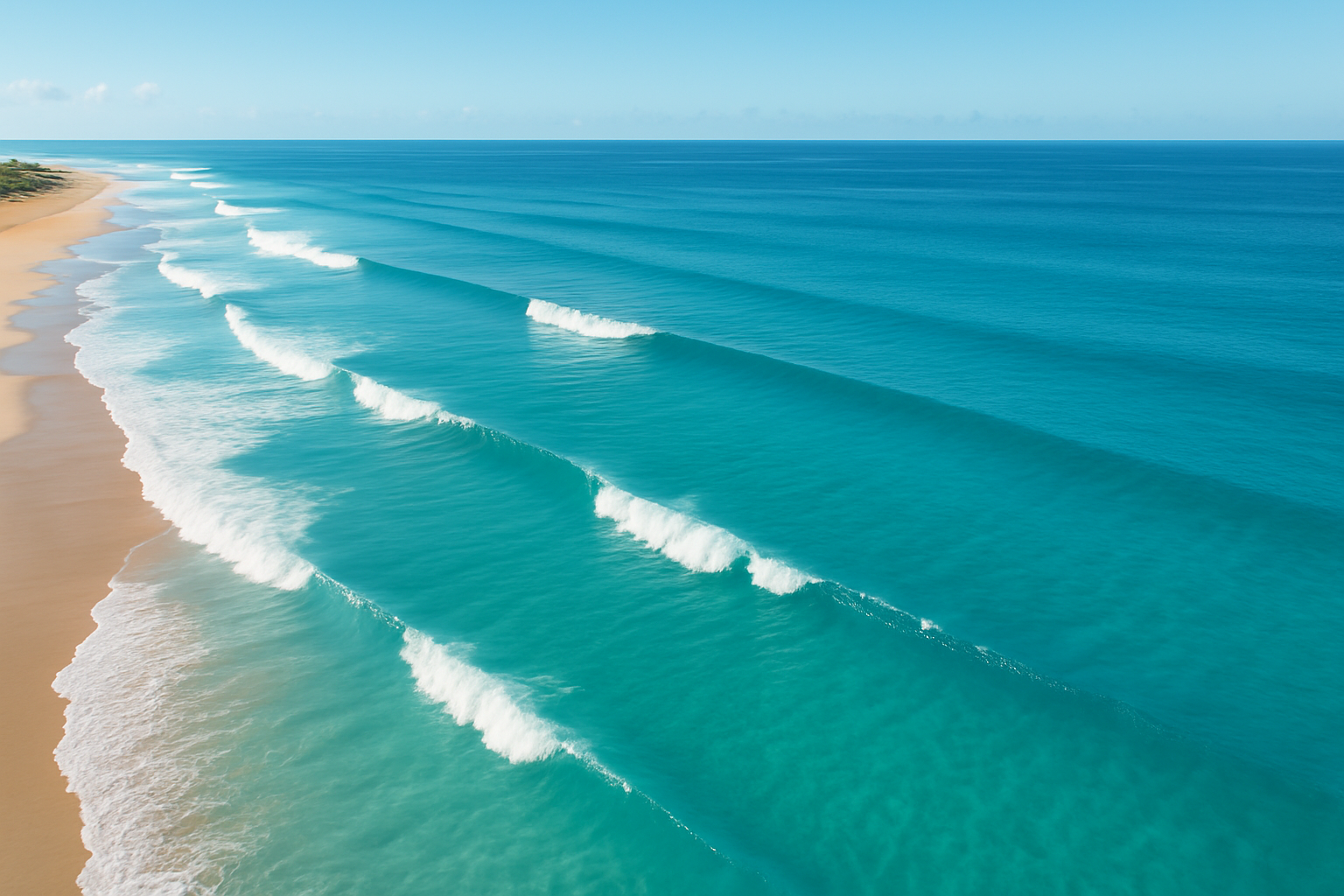
Recognizing the lineup, impact zone, channel, and sets from above illustrates how much surf vocabulary maps directly to real-world ocean geography.
Stance, Paddling, and Movement: The Complete Technique Glossary
Once you are on the board, technique terms become your daily vocabulary. Every physical motion in surfing has a name — and knowing them lets you absorb instructions instantly, fix mistakes faster, and communicate clearly with your instructor.
Stance and Foot Position
- Regular (Natural) foot: Surfing with the left foot forward and the right foot back, toward the tail. The most common stance globally.
- Goofy foot: Surfing with the right foot forward. Completely normal — approximately one-third of surfers are goofy-footed. Neither stance is superior.
- Stance width: The distance between your front and back feet on the board. A stance roughly shoulder-width apart provides the best balance and control.
- Front foot / back foot: The front foot controls direction and generates drive; the back foot controls speed and turning force. Understanding their independent roles is crucial to progression.
- Toeside: The side of the board facing your toes. Turning on your toeside requires leaning forward over your toes.
- Heelside: The side of the board facing your heels. Turning heelside requires dropping your weight through your heels.
- Switch stance: Deliberately surfing with your non-natural foot forward — regular-footed surfers riding goofy or vice versa. An advanced skill used for style or specific wave features.
Fundamental Movements and Techniques
- Paddle: The act of lying prone on the board and using your arms to move through the water. Strong, efficient paddling is foundational to catching waves and navigating the ocean safely.
- Pop-up: The rapid, explosive motion of transitioning from lying flat on the board to standing upright in one fluid, explosive movement. This is typically the first technique taught in any beginner lesson. Speed and commitment are essential — hesitation leads to missed waves.
- Prone paddling position: The flat, streamlined lying-down position used while paddling. The board nose should sit slightly out of the water — too far forward and you pearl; too far back and you slow down.
- Pearling: When the nose of the board dips underwater as you take off on a wave, causing an abrupt stop or forward ejection. Caused by lying too far forward on the board or poor wave timing.
- Takeoff: The moment a surfer begins to catch and ride a wave, transitioning from paddling to standing. Proper takeoff timing — not too early, not too late — is one of surfing’s most essential skills.
- Trim: Adjusting your position on the board to maintain optimal speed and balance as you travel along the wave face. Trimming is a constant, subtle process throughout every ride.
- Cutback: A foundational turning maneuver where the surfer arcs back toward the breaking part of the wave (the power zone) after riding too far down the shoulder. Essential for maintaining wave energy and generating speed.
- Bottom turn: The first turn a surfer makes at the base of the wave after dropping down the wave face on takeoff. The bottom turn is widely considered the most important maneuver in surfing — it sets up every subsequent move.
- Top turn: A turn performed at or near the top of the wave face, redirecting the surfer back down the wave. The foundation of high-performance surfing.
- Snap: A sharp, aggressive top turn at the lip of the wave. One of surfing’s most visually dynamic maneuvers.
- Floater: A maneuver where the surfer rides over the breaking, falling section of the wave, gliding across the foam as it collapses beneath them.
- Re-entry: Turning off the lip of the wave and redirecting back down the wave face. One of the most versatile maneuvers in performance surfing.
- Aerial (Air): An advanced maneuver where the surfer launches off the wave lip into the air and attempts to land back on the wave. Requires precise timing, speed, and athletic ability.
- Hang ten: A classic longboard maneuver where the surfer walks all the way to the nose of the board and hangs all ten toes off the front edge. A hallmark of traditional longboard style.
- Hang five: A variation of hang ten where only one foot (five toes) hangs off the nose of the board.
- Cross-stepping: Walking up and down the deck of a longboard using a graceful, deliberate crossover foot pattern. An art form associated with traditional longboarding.
- Wipeout: When a surfer loses balance and falls off the board. Wipeouts happen to surfers of all levels and are a completely normal part of progression — learning to fall safely is itself an important skill.
Paddling Out: Getting Through the Waves
- Paddle out: The process of paddling from the shore out past the breaking waves to the lineup. Knowing the right technique — using the channel, timing sets, managing energy — is a skill in itself.
- Duck dive: A technique used on shorter boards to push the nose of the board underwater and glide beneath an oncoming wave while paddling out. Requires practice and timing to execute correctly.
- Turtle roll (Eskimo roll): The beginner-friendly alternative to the duck dive, used on longboards and larger boards that are too buoyant to duck dive. The surfer grabs the rails and flips the board upside down, letting the wave roll over them and the board.
- Kick through: Pushing the board forcefully through the base of a smaller wave rather than going under it. Often used by beginners on whitewater sections close to shore.
- Caught inside: The challenging situation where a surfer is trapped between the shore and the impact zone when a large set arrives. Being caught inside means repeatedly getting pushed back toward shore by breaking waves and requires patience and physical effort to escape.
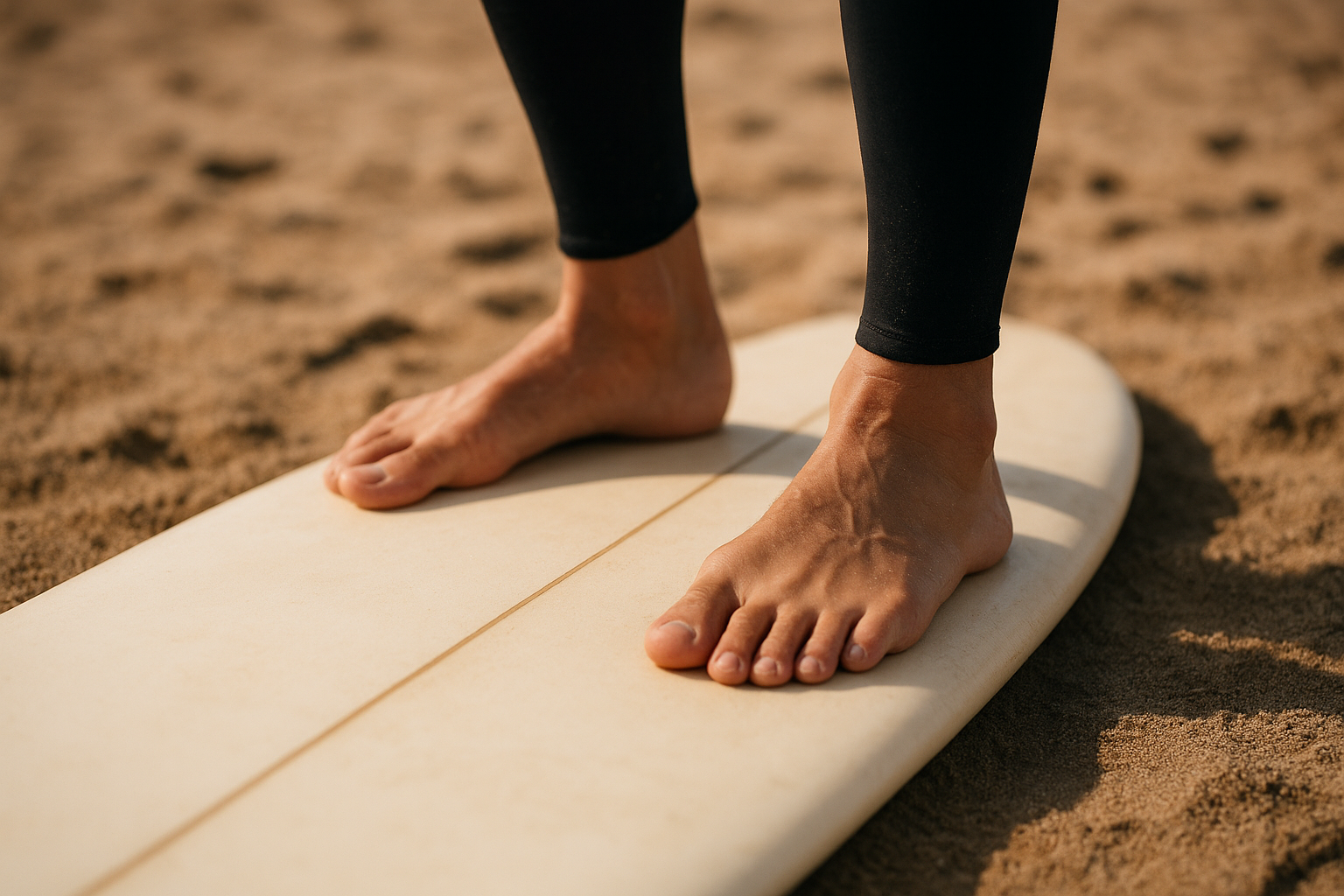
Practicing the pop-up on dry land helps beginners connect surfing terms to real physical movements before entering the water for the first time.
Surf Etiquette: The Unwritten Rules and Their Vocabulary
Surf etiquette is the unwritten code of conduct that governs behavior in the water. Violating it is dangerous, disrespectful, and guaranteed to make enemies in the lineup. Learning etiquette terms before your first session is not optional — it is a safety requirement. For a comprehensive breakdown, explore our full resource on surf etiquette.
- Right of way: The surfer closest to the peak (breaking part) of the wave has absolute priority. Everyone else must yield immediately. Violating right of way is the most serious etiquette offense in surfing.
- Drop in (burning someone): Paddling into and riding a wave that another surfer is already riding and has right of way on. This is a major breach of etiquette that can cause serious collisions. “Don’t drop in” is one of the first rules every beginner learns.
- Snake: Repeatedly paddling around another surfer — maneuvering to steal their position — in order to illegitimately claim right of way. Considered extremely poor form.
- Priority: The formal right to catch the next wave, earned either through position (closest to peak) or, in competition, by official scoring systems. In casual surfing, priority means respecting who has been waiting the longest.
- Locals: Surfers who regularly surf a specific break and often hold informal priority there. Respecting locals — by being courteous, not over-surfing, and acknowledging unspoken hierarchies — makes you welcome at any break worldwide.
- Kook: Informal slang for a beginner who is unaware of etiquette, technique, or proper behavior in the water. Not a permanent label — every expert was once a kook. The fastest way to stop being called a kook is to learn and follow the rules.
- Aggro: Short for “aggressive.” An aggro surfer is overly confrontational, territorial, or hostile in the lineup — often intimidating beginners or less experienced surfers.
- Call it out: Verbally communicating on a wave — shouting “left!” or “right!” to let other surfers know which direction you plan to ride. This prevents collisions in crowded conditions.
- Giving way: Actively moving your board and body to allow another surfer with right of way to ride their wave without obstruction.
- Paddle wide: The etiquette practice of paddling around the surf zone rather than directly through it, to avoid disrupting surfers already riding waves.
Surf Slang and Culture: The Colorful Language of the Lineup
Beyond technical vocabulary, surf culture has developed a rich, expressive slang that adds personality to the sport. These expressions are used casually among surfers worldwide and give the culture much of its distinctive flavor.
Essential Surf Slang Terms
- Stoked: Overwhelmingly excited, happy, or enthusiastic. Arguably the single most iconic word in surf culture — “I am so stoked to surf today.”
- Shred: To surf with aggressive, high-performance skill — carving turns, snapping off the lip, generating speed. “She absolutely shredded that wave.”
- Shaka: The hand gesture — thumb and pinky extended, other fingers curled — that is a universal sign of aloha, relaxation, and goodwill in surf and Hawaiian culture.
- Dude / Brah / Bro: Casual terms of address used freely between surfers regardless of gender. Part of the laid-back social register of surf culture.
- Dawn patrol: The practice of surfing at first light — immediately after sunrise — to score uncrowded waves and glassy conditions before the winds pick up and the crowds arrive.
- Glass off: The afternoon phenomenon when onshore winds die down and the ocean surface becomes smooth and glassy — often producing the best conditions of the day.
- Session: A single surf outing from paddling out to coming back in. “That was an incredible morning session.”
- Scoring waves: Successfully catching good quality waves. “We scored great waves all morning.”
- Log: Slang for a longboard. Affectionate and widely used among longboarders.
- Quiver: A surfer’s personal collection of surfboards for different wave conditions. A “well-rounded quiver” might include a longboard, a fish, and a shortboard.
- Barney: Another term for a beginner or inexperienced surfer, used similarly to “kook” in some surf communities — particularly in Australia.
- Grommie (Grom): A young surfer, typically a child or teenager, who is actively learning and progressing. Groms are often the most energetic and fearless people in the water.
- Hodad: Old-school slang for a non-surfer who hangs around surf culture without actually surfing. Less commonly used today.
- Mushy: Describes soft, slow, crumbling waves without much power or face. Mushy waves are forgiving for beginners but offer limited performance potential.
- Hollow: Describes a steep, powerful wave with a thick, pitching lip that forms a tube or barrel. The opposite of mushy.
- Heavy: Used to describe a powerful, dangerous, or challenging wave or surf spot. “Pipeline is a heavy wave — not for beginners.”
- Wedge: A wave that forms when two wave peaks collide or refract off a structure, creating a single, extra-steep, triangular peak. Can produce excellent — and very powerful — surfing.
Hawaiian Surfing Terms and Cultural Vocabulary
Surfing was born in Hawai’i, and the Hawaiian language has left an enduring mark on surf culture worldwide. Understanding these terms connects you to the sport’s deepest roots and shows respect for its heritage.
- Aloha: The most important word in Hawaiian culture — meaning love, peace, compassion, and grace. In surfing, aloha represents the spirit of welcoming, respect, and joy that should define every experience in the water.
- Mahalo: Thank you. Expressing mahalo to locals, instructors, and fellow surfers is always appropriate and appreciated.
- He’e nalu: The Hawaiian term for surfing — literally translating as “wave sliding.” This is the ancient practice from which all modern surfing descends.
- Da hui: Hawaiian for “the group” or “the crew.” Refers to a close-knit group of surfers, often associated with a particular break or community.
- Nalu: The Hawaiian word for wave. Used in place names and surf culture references throughout Hawaii.
- Kai: The Hawaiian word for ocean or sea. A common name in surf culture and widely used in Hawaiian surfing vocabulary.
- Hana hou: Hawaiian for “do it again” — often shouted in appreciation after a great wave or performance. The equivalent of an encore.
For a deeper exploration of these roots, visit our dedicated surf lingo resources, and learn more about the cultural history of surfing through the International Surfing Association.
Surf Forecast and Report Terms: Decoding the Surf Report
Surf reports are how surfers plan their sessions — and they are written entirely in surfing terms. Being able to read a surf forecast accurately is a genuinely useful skill that changes how you experience the sport.
- Surf forecast: A prediction of incoming wave conditions based on weather patterns, swell models, wind data, and tidal information. Services like Surfline and Magic Seaweed (MSW) produce detailed forecasts.
- Wave height: The measured height of a wave, typically described in feet or meters. Different surf communities measure differently — Hawaiian scale measures the back of the wave (conservative), while face scale measures the front (more intuitive for beginners).
- Swell direction: The compass direction from which a swell is traveling. Different breaks respond better to different swell directions depending on their orientation to the coastline.
- Swell period: The number of seconds between successive waves. Period is one of the most important forecast variables — longer period means more organized, more powerful surf.
- Tide: The rise and fall of sea level driven by gravitational forces. Many surf breaks change dramatically with the tide — some work best at high tide, others at low, and some only at a very specific tide level.
- High tide / Low tide: The highest and lowest points of the tidal cycle. Understanding tidal timing at your local break is essential for maximizing good surf windows.
- Wind speed and direction: Wind data tells you whether conditions will be clean (offshore) or messy (onshore) and how strong any chop will be.
- Star rating: Many surf forecast services rate each time window with stars (typically 1–5 or 1–3) indicating overall surf quality. A 5-star forecast means exceptional conditions; 1 star means poor conditions.
Safety and Ocean Hazard Terms Every Surfer Must Know
Surf safety vocabulary can save your life. These surfing terms describe real ocean hazards that every surfer — regardless of level — must understand before entering the water. Read our safety checklist for beginners.
- Rip current (rip): A powerful, narrow channel of water flowing rapidly away from shore, created when water pushed in by breaking waves finds a path back out to sea. Rip currents are the leading cause of beach rescues worldwide. If caught in a rip, do not fight it — paddle parallel to shore to escape its pull.
- Ding: A crack, dent, or puncture in the surfboard’s outer shell (usually fiberglass or foam). Even small dings must be repaired promptly — water intrusion degrades the board and makes it waterlogged and heavy.
- Held down: Being held underwater after a wipeout by the force of the breaking wave. In larger surf, hold-downs can last multiple wave cycles and can be frightening. Remaining calm and curling into a protective ball are standard responses.
- Two-wave hold-down: Being held underwater through the impact of two consecutive breaking waves — a scenario encountered in powerful, heavy surf. Requires calm, breath control, and experience to survive safely.
- Wax up: The act of applying fresh surf wax to the deck before a session. Neglecting to wax up means slipping off on every wave.
- Board check: Inspecting your board for dings, delamination, or fin damage before entering the water. A critical safety and equipment maintenance habit.
- Helmet: Protective headgear used in big-wave surfing or reef-break environments where head injuries are a real risk. Increasingly common in advanced surfing. For a deeper walkthrough, see our Where to Find Surfing Lessons in Waikiki: The Complete Guide.
- Reef rash: Abrasions caused by contact with a coral reef during a wipeout. Reef rash is painful and can become infected — appropriate board shorts and rash guards reduce the risk.
- Rash guard: A lightweight, quick-drying athletic shirt worn under or instead of a wetsuit to protect the skin from sun, rash from the board deck, and minor abrasions.
- Wetsuit: A neoprene suit worn to retain body heat in cold water. Wetsuit thicknesses are measured in millimeters — a 3/2mm suit is standard for temperate waters, while a 5/4mm or thicker suit is used in cold climates.
How to Learn Surfing Terms Before Your First Lesson
Learning surfing vocabulary is straightforward when approached step by step. Follow this process before your first session and you will arrive in the water confident, prepared, and already thinking like a surfer.
- Start with board anatomy and equipment terms. Learn the names of every board part — nose, tail, rails, fins, rocker, stringer, leash, and deck — so you can follow instructor directions without hesitation. Being able to identify your fins from your rails instantly means faster progress in lessons. For equipment setup and riding basics, see Learn to Ride Waves.
- Learn ocean and wave vocabulary. Familiarize yourself with lineup, break types (beach, reef, point), set, swell, barrel, impact zone, channel, and closeout. This vocabulary enables you to read surf reports, understand conditions before paddling out, and follow safety instructions clearly. For additional planning tips and trip advice, check is surfing safe for beginners.
- Master stance and movement terms. Study pop-up, paddle, takeoff, regular and goofy foot, bottom turn, cutback, trim, duck dive, and turtle roll. When your instructor calls a technique by name, you should be able to execute it without needing a verbal definition first. Practice these moves with our step-by-step beginner guide learn to ride waves.
- Commit surf etiquette language to memory. Understand right of way, drop in, snake, locals, priority, and calling it out. Knowing these rules before you paddle out makes you a safe, welcome presence in the lineup from day one.
- Learn safety and hazard terms. Understand rip currents, impact zone, held down, caught inside, and basic wipeout protocol. This knowledge is not optional — ocean conditions can change rapidly and your safety depends on understanding what is happening around you. For practical guidance, review our surfing safety tips resource.
- Practice with a qualified surf instructor. Book a beginner lesson with a certified instructor who can reinforce these terms in real ocean conditions and correct your technique in the moment. If you are not sure whether a lesson is worth it, read our guide on whether a surfing lesson on vacation is worthwhile. For more beginner resources, explore our how long to learn to surf guide.
Competitive Surfing Terms
If you watch competitive surfing or aspire to compete, these additional surfing terms from the contest world are worth knowing.
- Heat: A timed contest period — typically 20 to 35 minutes — during which two to four surfers compete for the best waves and highest scores.
- Heat score: The combined total of a surfer’s two best wave scores in a competitive heat. Maximum possible is 20 points (two 10-point rides).
- Excellent: A wave score in the 8.0–10.0 range in contest judging — indicating outstanding surfing with exceptional technique, difficulty, and wave selection.
- Priority vest: A colored vest worn in competition to indicate which surfer has the legal right to catch the next wave.
- Interference: A penalty in competitive surfing awarded when a surfer without priority drops in or disrupts a competitor’s ride.
- CT (Championship Tour): The WSL’s elite professional tour, formerly called the World Tour — the highest level of competitive surfing in the world.
- WSL (World Surf League): The governing body of professional surfing globally, responsible for organizing competitions, rankings, and rule-making.
Frequently Asked Questions About Surfing Terms
What are the most important surfing terms for beginners to learn first?
The most critical surfing terms for beginners are pop-up, paddle out, lineup, break, set, barrel, wipeout, right of way, drop in, regular foot, goofy foot, leash, and rip current. Mastering these terms before your first lesson allows you to follow instructions, respect other surfers, and stay safe in the ocean.
What does “pop-up” mean in surfing terms?
The pop-up is the rapid, explosive motion of going from lying flat on the surfboard to standing upright in one fluid movement as a wave lifts the board. It is the single most practiced skill for beginners and is taught in every surf lesson from day one.
What is the difference between regular and goofy stance in surfing?
Regular stance means surfing with the left foot forward and right foot back. Goofy stance means surfing with the right foot forward. Neither is better or more advanced — it is purely a matter of which feels natural. Approximately two-thirds of surfers are regular-footed and one-third are goofy-footed.
What does “lineup” mean in surfing?
The lineup is the area beyond the breaking waves where surfers sit on their boards and wait for incoming wave sets. It is the social and strategic hub of every surf session — understanding where to sit in the lineup and how to behave there is essential for safety and etiquette.
What is a barrel in surfing?
A barrel, also called a tube, is the hollow cylindrical tunnel formed when the lip of a powerful wave pitches forward and over the wave face, enclosing a space of air inside. Riding inside a barrel — getting tubed — is considered the pinnacle of the surfing experience by most surfers worldwide.
What does “dropping in” mean in surfing?
Dropping in means paddling into and riding a wave that another surfer already has right of way on — meaning they were already up and riding or in a superior position at the peak. It is one of the most serious violations of surf etiquette and can cause dangerous collisions. Learning to identify who has priority is essential.
What is the difference between a longboard and a shortboard?
A longboard is typically 9 feet or longer, wide, and very buoyant — excellent for beginners, smaller waves, and classic style surfing. A shortboard is usually between 5’6″ and 6’4″, narrow, with significant rocker, designed for high-performance surfing in powerful waves. Beginners almost always start on longboards or foamies before progressing to shorter boards.
What does “kook” mean in surf culture?
A kook is informal surf slang for someone who is new to surfing or consistently behaves in ways that show ignorance of technique, etiquette, or ocean awareness. The word is not permanent or malicious — every expert surfer was once a kook. Learning the rules and showing respect eliminates the label quickly.
What is a rip current and why do surfers need to know about it?
A rip current is a powerful, narrow channel of water flowing rapidly away from shore. It is the leading cause of beach rescues worldwide and can quickly pull swimmers and surfers out to sea. If caught in a rip, do not fight it by paddling directly toward shore — paddle parallel to the beach to exit the current’s pull, then return to shore at an angle.
What does “offshore wind” mean and why is it good for surfing?
Offshore wind blows from the land out toward the ocean, which holds up the front face of breaking waves and makes them cleaner, more defined, and longer-lasting. Surfers worldwide prefer offshore conditions because waves peel more predictably and maintain their shape for longer rides.
What does “stoked” mean in surfing?
Stoked is one of the most iconic words in all of surfing and broader beach culture. It means extremely excited, happy, or enthusiastic — particularly about surfing or surf conditions. Being stoked is the natural emotional state of a surfer who just had a great session.
What is a duck dive?
A duck dive is a technique used to paddle through an oncoming breaking wave by pressing the nose of the surfboard underwater and using body weight to dive beneath the wave, emerging on the other side. It is primarily used on shortboards and smaller boards — larger, more buoyant boards require the turtle roll instead.
How long does it take to learn basic surfing terms?
Most people can absorb the foundational surfing terms vocabulary in a single focused reading session or during their first beginner surf lesson. The terms deepen in meaning with time in the water — within a few sessions, most surfers use them instinctively without conscious effort. Learn how long it typically takes to learn to surf.
What is surf etiquette and why does it matter?
Surf etiquette is the unwritten code of behavior in the water that keeps all surfers safe, respected, and welcome. Core rules include not dropping in, not snaking, respecting right of way, giving way to locals, and paddling wide when returning to the lineup. Following these rules prevents dangerous collisions and builds a positive reputation at any surf break worldwide.
Conclusion: Why Mastering Surfing Terms Is Your Best Head Start
Mastering surfing terms is far more than memorizing jargon — it is the foundation of becoming a safe, capable, and respected surfer. When you understand what your instructor means by “pop-up,” “outside,” “right of way,” or “caught inside,” you can focus entirely on the physical experience rather than decoding language under pressure. You respond faster, stay safer, and progress at a noticeably quicker pace. Learn more about how long to learn to surf.
The vocabulary in this guide covers every dimension of surfing — board anatomy, wave science, technique, etiquette, safety, slang, culture, forecasting, and competition. No matter where you surf in the world, these terms travel with you and give you a common language with every other surfer in the water.
Above all, surfing is about joy, continuous learning, and a deep connection with the ocean. The team at starbeachboys.com is here to guide you through every step — from your very first surfing terms to your very first real ride. According to Wikipedia’s overview of surfing, the sport continues to grow globally — and the best time to start speaking its language is right now. By the Star Beachboys editorial team. Last updated: 2026-07-12. This guide was written by the Star Beach Boys editorial team. Last updated: 2026-06-27.