Star Surfing: The Complete Guide to Riding Waves Under the Night Sky
Updated for surfers seeking the most immersive night ocean experience possible. Star Surfing blends astronomy with wave riding to create a uniquely meditative ocean session.
Star surfing means riding ocean waves at night on coastlines free from artificial light, where the Milky Way arches overhead and bioluminescent waves glow beneath your board. In short, star surfing is the intentional combination of wave riding and astronomical immersion — a pursuit that transforms a surf session into a cosmic experience. It is both an athletic discipline and a meditative practice, and this guide covers everything you need to know to do it safely, skillfully, and unforgettably. See our Fun surf experiences for related session ideas.
For many surfers, the ocean is already a spiritual place. However, when you strip away the crowds, the sunscreen, and the glare of afternoon sun, something extraordinary shifts. The water turns dark and alive. Stars multiply overhead. Furthermore, every wave carries a new kind of weight — one measured not in feet, but in feeling.
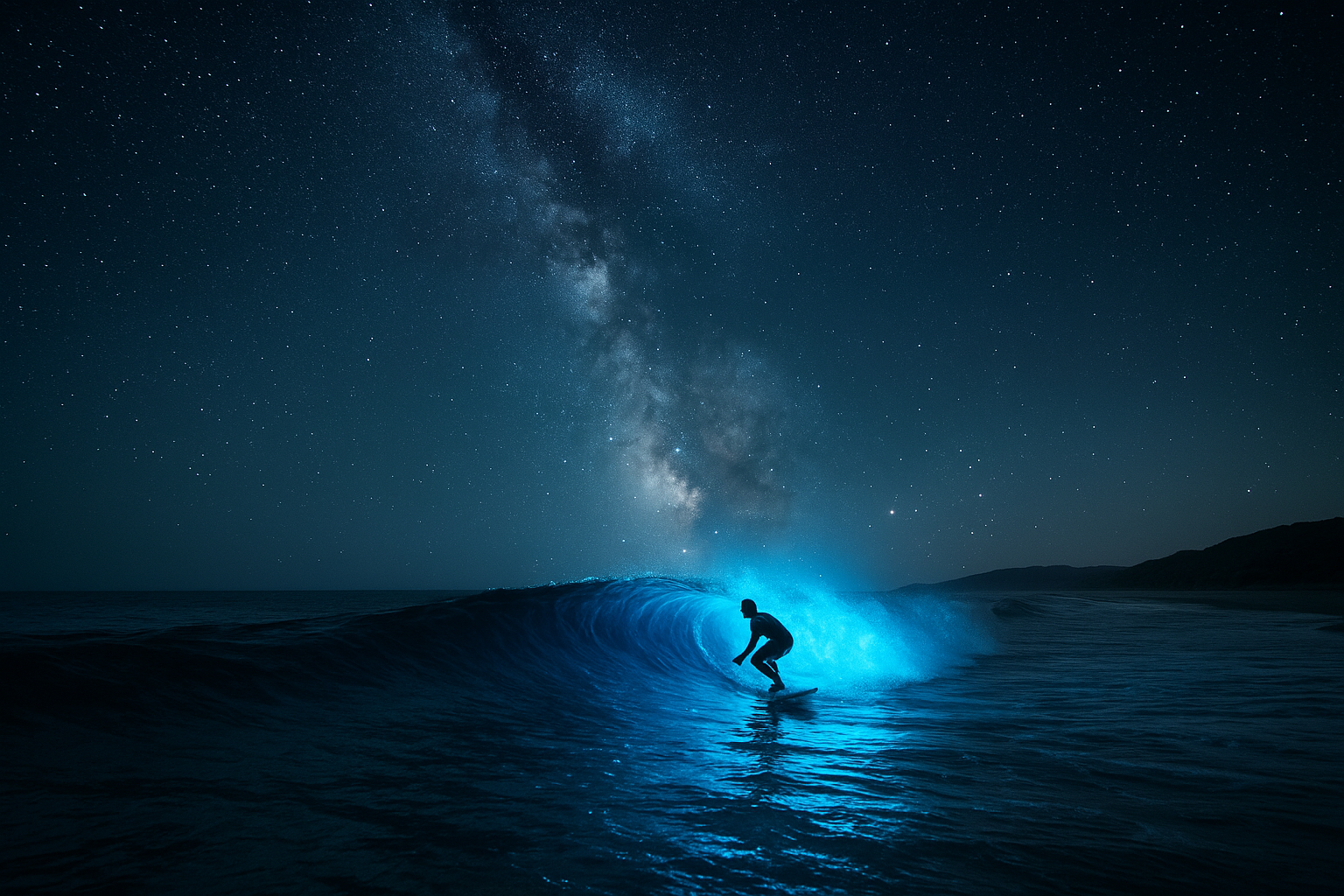
Star surfing transforms an ordinary surf session into a journey beneath the Milky Way — especially when bioluminescent waves light the way.
What Is Star Surfing? A Clear Definition
Star surfing is defined by its intentional pursuit of darkness. Unlike standard night surfing — which often takes place under floodlit beach breaks — star surfing seeks out remote, light-pollution-free coastlines where the sky performs as nature intended. In practice, this means carefully selecting locations away from city glow, timing sessions around moon phases, and treating the stars as active participants rather than passive background scenery.
The difference is also deeply philosophical. Because darkness demands more attention, every sense sharpens dramatically. You hear the wave before you see it. You feel the water’s temperature shift as a set approaches. As a result, star surfers consistently describe these sessions as more meditative and more immersive than anything experienced under daylight conditions.
How Star Surfing Differs From Regular Night Surfing
Regular night surfing typically happens under artificial floodlights at popular, well-mapped breaks. Star surfing, in contrast, intentionally avoids all artificial light. The goal is full sensory immersion in the natural environment — ocean, atmosphere, and cosmos together. Consequently, the philosophy, location, equipment mindset, and atmosphere are entirely different pursuits, even if both involve a surfboard after dark.
Moreover, star surfing incorporates genuine astronomical awareness. Before paddling out, experienced practitioners study moon phases, identify which constellations will arc overhead, and check for bioluminescence conditions. Therefore, the preparation alone distinguishes it from a casual dusk session at the local break.
The Science Behind the Magic of Star Surfing
Two natural phenomena make star surfing particularly spectacular. First, on moonless nights far from urban glow, the Milky Way — our home galaxy, visible as a dense river of hundreds of billions of stars — becomes clearly visible arching across the full sky. This requires a Bortle Class 3 or lower dark-sky rating at your chosen coastline, meaning light pollution is minimal enough for the galactic core to appear with the naked eye.
Second, in certain warm coastal waters, microscopic single-celled organisms called dinoflagellates produce bioluminescence — a cold blue-green chemical light triggered by mechanical disturbance in the water. Specifically, when a wave breaks or a surfboard cuts through the water, these organisms flash in response, painting every wave face and every paddle stroke with living, glowing light.
Why Bioluminescence and Starlight Together Are Extraordinary
Above, a canopy of ancient light billions of years old. Below, waves that ignite with living fire triggered by your own movement. For surfers who have experienced both simultaneously, the session is frequently described as the single most memorable ride of their lives. Furthermore, bioluminescence intensity varies by season — late summer through early autumn typically produces the strongest displays in the Northern Hemisphere, as warm water temperatures concentrate dinoflagellate populations near the coast.
Understanding Dark Adaptation and Night Vision
Human eyes take approximately 20 to 30 minutes to fully dark-adapt after leaving artificial light. During this process, rod cells in the retina — which are far more sensitive to low light than cone cells — gradually become active. Consequently, rushing from a lit car park directly into the water eliminates this advantage. Instead, allow at least 15 to 20 minutes of full darkness on the beach before paddling out. Your ability to read waves, spot incoming sets, and perceive the bioluminescent glow will improve significantly as a result.
How to Plan Your First Star Surfing Session: Step-by-Step
Planning is what separates a magical night from a dangerous one. Therefore, follow these steps carefully before your first session.
- Choose a dark-sky coastal location you already know. Research coastlines with minimal light pollution using tools like the Light Pollution Map or the Clear Dark Sky atlas. Additionally, choose a surf break you have paddled many times in daylight — so underwater topography, rip locations, and channel exits hold no surprises after dark. If you’re visiting, check our surf experiences for vacationers for curated options and booking tips.
- Check the moon phase, tide, and swell forecast together. A new moon delivers the darkest skies for maximum star and Milky Way visibility. A crescent moon, in contrast, provides gentle ambient light that helps beginners read oncoming waves. Furthermore, align your session with a manageable swell — 2 to 4 feet is ideal for first-timers — and check tide charts to avoid paddling out against a strong outgoing current.
- Assemble your night surfing safety kit. Pack an LED leash light, a waterproof headlamp with red-light mode, a well-fitting full wetsuit rated to the water temperature, and a waterproof phone case with GPS enabled. Most importantly, always bring a buddy or ensure a spotter remains on shore throughout the session. Tell someone on land your exact location, expected duration, and planned exit point.
- Study the stars before you paddle out. Use a free stargazing app such as Stellarium or SkySafari to identify which constellations will arc overhead during your session. Specifically, note the position of the Milky Way core and any planets visible. This preparation transforms your session from a simple night surf into a genuine star surfing experience with intentional cosmic awareness.
- Sit on the beach for at least 15 minutes before entering. Watch and listen. Identify the rhythm of sets, the sound of the break, and the pattern of foam trails in the darkness. Allow your eyes to fully dark-adapt. As a result, your first paddle-out will feel far more intuitive than you expect.
- Paddle out, ride the waves, and let the sky absorb you. Enter the water calmly, use foam reflections and moonlight shimmer to time your rides, and between sets, simply float on your back. Look up. Let the silence and the stars do what no daytime session ever can.
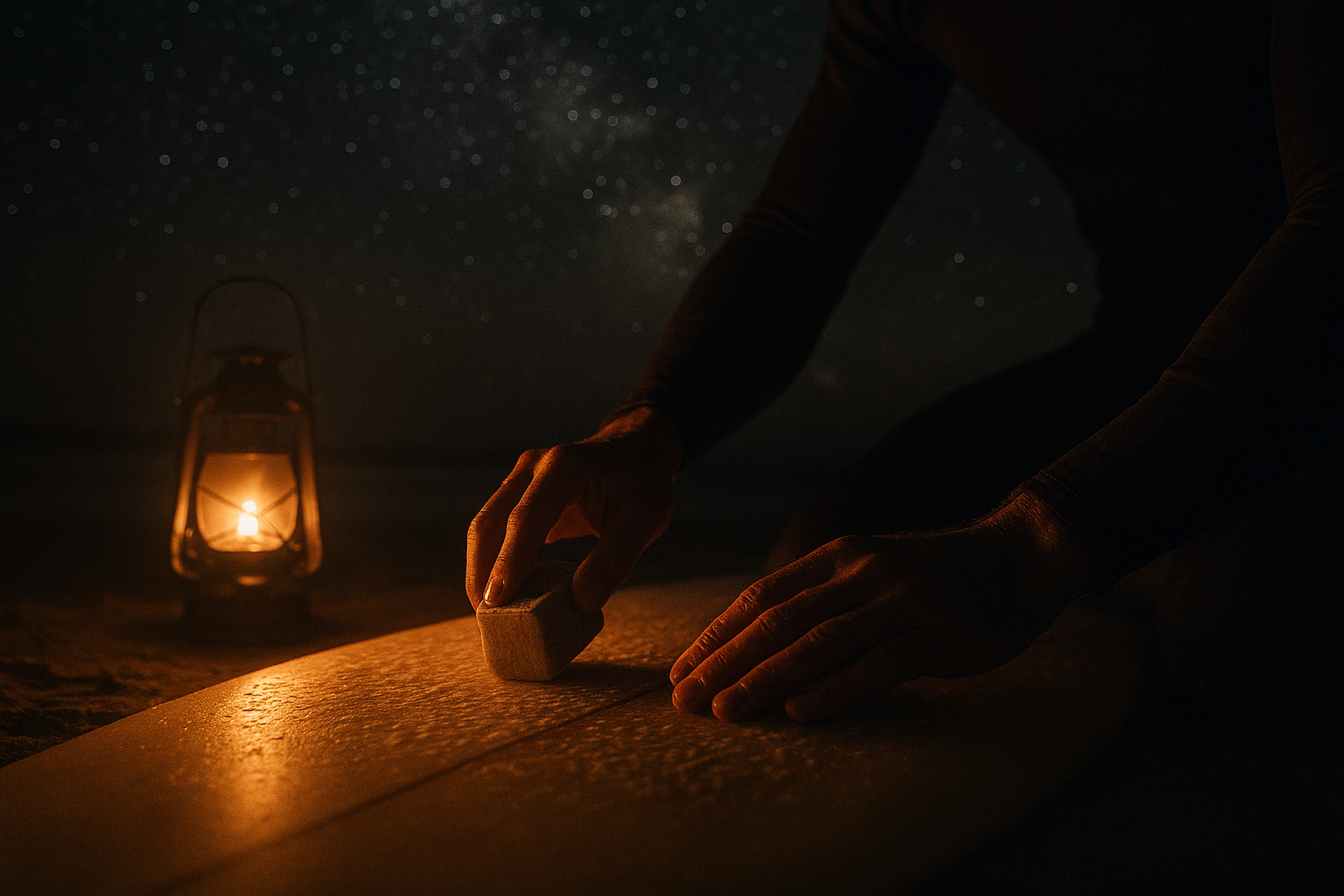
Preparation is everything — the right safety kit and a board you trust are the foundation of every great star surfing session.
Essential Gear for a Safe Star Surfing Session
Safety gear for star surfing goes well beyond the standard leash and wetsuit. Each item below serves a specific purpose — and omitting any one of them increases risk meaningfully.
Core Safety Equipment
- LED surf leash light: Clips directly onto your leash and makes you visible to other water users, boat traffic, and your shore-based spotter. This is non-negotiable for any open-water night session.
- Waterproof headlamp with red-light mode: Red light (wavelength ~650nm) preserves dark-adapted night vision while still allowing you to check conditions. White light, in contrast, destroys night vision in seconds — avoid it entirely once you are session-ready.
- Full wetsuit rated to water temperature: Water temperatures drop measurably after sunset. A suit that felt sufficient in the afternoon may be inadequate at midnight. Furthermore, cold water increases the risk of cold water shock — a dangerous physiological response to sudden immersion.
- Waterproof phone case with GPS: Store your phone in a sealed case attached to your body. Specifically, ensure GPS location sharing is active so a shore contact can track your position if needed.
- Shore spotter or buddy: This is as important as any piece of hardware. A person on shore with a torch and a phone, who knows your plan and your expected return time, is your primary safety net.
Optional Enhancements That Improve the Experience
- Glow-in-the-dark surf wax: Applied to the deck of your board, it creates a subtle luminous surface that helps you locate your board quickly if separated in dark water.
- Flexible LED rail strips: Thin waterproof LED strips attached to the board rails make the board visible in the water and add dramatic visual atmosphere to bioluminescent sessions.
- Stargazing app pre-loaded offline: Apps like Stellarium allow offline constellation maps — useful if you are at a remote coastal location with no mobile signal.
- Longer, more stable board: A longboard or mid-length is recommended for beginners specifically because reduced visual reference points make balance more challenging at night.
In contrast, heavy waterproof flashlights should be avoided entirely. They destroy night vision, disrupt the dark-sky atmosphere, and offer no advantage over a properly fitted headlamp on red-light mode.
Best Star Surfing Destinations Around the World
The ideal star surfing destination combines reliable surf, minimal light pollution, and ideally bioluminescent potential. Below are the world’s top locations, ranked by the overall quality of the combined ocean and sky experience.
Hawaii — Big Island
The Big Island of Hawaii offers consistently warm water, dark volcanic coastlines free from reflective sand glare, and excellent surf at breaks like Honolii and Banyans. Furthermore, Hawaii sits at a latitude that places the galactic core of the Milky Way high overhead during summer months. Bioluminescent activity is reliably present in bays on the Kona Coast. For star surfing, it is arguably the single best all-round destination on the planet.
Maldives
The Maldives is one of the most bioluminescence-rich regions in the world. Specifically, Vaadhoo Island’s beach — sometimes called the “Sea of Stars” — produces extraordinary nightly bioluminescent displays. The waves here are mellow and consistent, making it suitable for intermediate surfers who want to prioritise the astronomical experience over powerful surf.
Algarve, Portugal
The Algarve delivers powerful Atlantic swells beneath skies that are remarkably clear by European standards. Moreover, sea cliffs and rocky headlands shield many breaks from terrestrial light scatter, creating naturally darker conditions. Autumn sessions here combine large swells with high atmospheric clarity — an ideal combination for advanced star surfers.
Byron Bay, Australia
Byron Bay is renowned among Southern Hemisphere surfers for its mellow point breaks, warm water, and genuinely dark coastal skies. In addition, the Southern Cross and Magellanic Clouds — features of the southern sky invisible to Northern Hemisphere surfers — are spectacular from Byron’s beaches. For surfers who want the Milky Way’s core at its most vertical and dramatic, Australia’s east coast delivers year-round.
Outer Banks, North Carolina, USA
The Outer Banks combines accessible surf with genuinely dark coastal skies, particularly during off-season months when tourist crowds thin and coastal light pollution diminishes. Cape Hatteras National Seashore is a designated dark sky park — one of very few on the US East Coast — making it exceptional for star surfing within driving distance of major population centres.
Puerto Rico
Puerto Rico’s Mosquito Bay on Vieques Island is officially recognized as the brightest bioluminescent bay in the world. Combined with consistent tropical surf and warm water year-round, Puerto Rico is the top destination for surfers who specifically want the bioluminescence experience alongside the night sky.
San Diego, California, USA
San Diego experiences well-documented bioluminescent blooms — particularly dramatic red tide events that produce intense blue bioluminescence — during spring and early summer. Additionally, breaks like Black’s Beach sit beneath coastal cliffs that naturally block city glow. For US-based surfers, San Diego is the most accessible premier star surfing location.
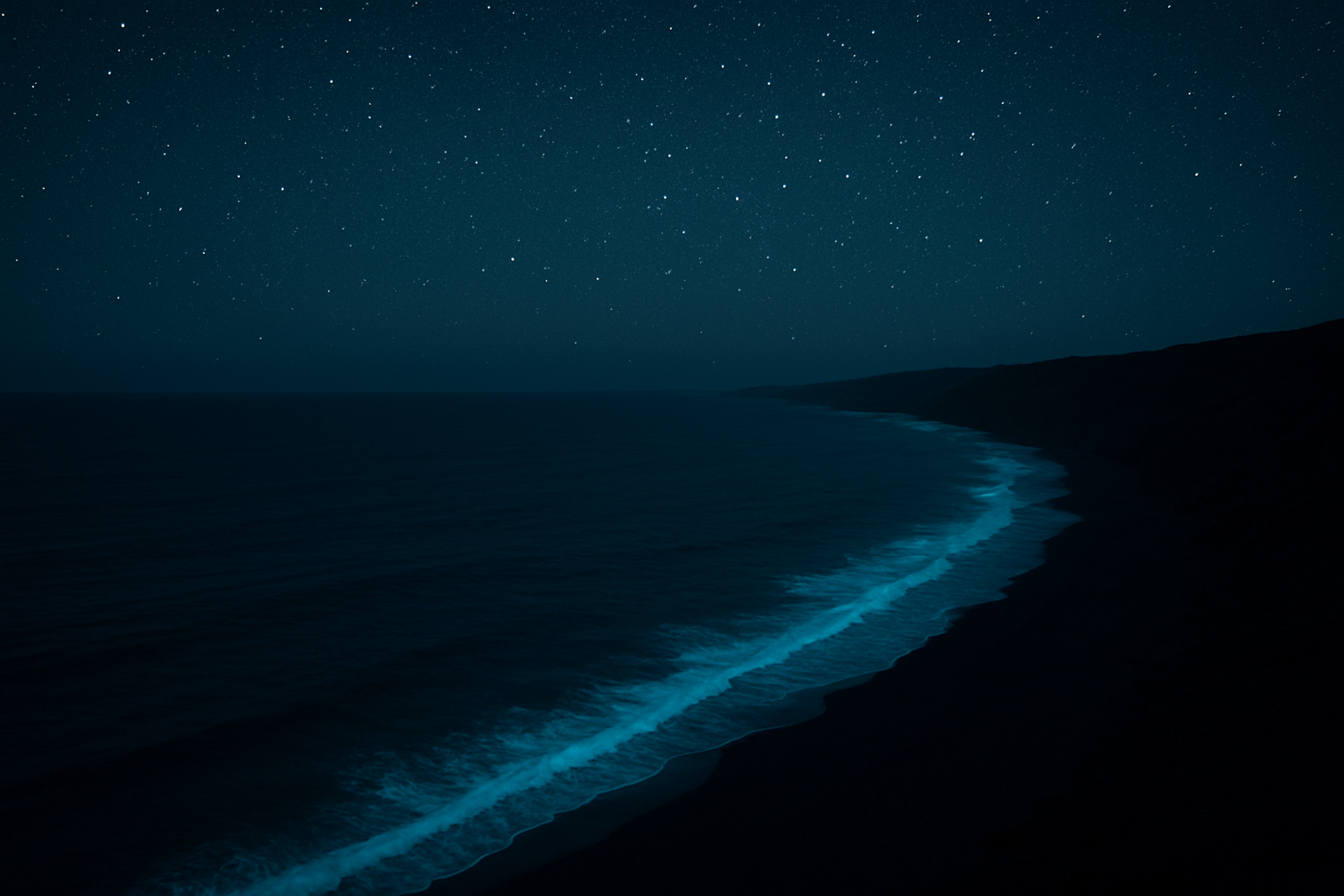
Remote coastlines with minimal light pollution offer the most immersive conditions for a true star surfing experience. For a deeper walkthrough, see our Star Beachboys Waikiki: The Ultimate Ocean Experience.
Reading Waves After Dark: Techniques That Work
One of the most common challenges beginners face is reading wave sets without daylight’s visual cues. However, with practice and targeted surfing techniques, the ocean communicates just as clearly at night — through sound, pressure, and texture.
Sound-Based Wave Reading
The deep rumble of a breaking set travels through the water and the air before the wave becomes visible. Specifically, an approaching set produces a low-frequency vibration you can feel through your board before you hear it clearly. Therefore, practise remaining still between sets and listening actively — experienced star surfers can identify set intervals of 8 to 12 seconds by ear alone.
Using Moonlight and Bioluminescence as Visual Cues
Even a crescent moon casts enough reflected light to create a shimmer on a rising wave lip. Additionally, in bioluminescent waters, the disturbance of an oncoming wave produces a faint but visible glow along the wave’s face several seconds before it reaches you. Consequently, experienced star surfers in bioluminescent waters actually gain a visual cue that daytime surfers never have — a glowing advance warning system built into the ocean itself.
Pre-Session Beach Observation
Experienced star surfers consistently recommend spending at least 15 minutes sitting on the beach before entering the water. This serves two purposes. First, it allows full dark adaptation of your eyes. Second, it lets you calibrate your ears to the specific rhythm and period of the break. As a result, your first paddle-out feels far more intuitive — and far safer — than immediately entering unfamiliar dark water.
The Best Seasons and Moon Phases for Star Surfing
Timing matters enormously. Unlike daytime surfing — where swell and wind are the only forecasting variables — star surfing requires you to coordinate three additional factors: moon phase, seasonal sky conditions, and bioluminescence cycles.
Moon Phase Guide
- New Moon: Darkest skies. The Milky Way core is visible with the naked eye from a Bortle 3 or lower location. Best for experienced surfers prioritising astronomical immersion. However, wave reading requires more reliance on sound and feel.
- Crescent Moon (1–5 days after new moon): A good compromise. Enough ambient light to read waves comfortably while the Milky Way remains highly visible. This is the recommended phase for first-time star surfers.
- Quarter Moon: Wave visibility is good, but the Milky Way core begins to wash out. Still beautiful — particularly for viewing bright constellations and planets — but less ideal for deep-sky immersion.
- Full Moon: The ocean is illuminated almost like low-level daylight, making wave reading easy. However, stars are largely washed out. Full-moon sessions are therefore better categorized as night surfing rather than true star surfing.
Best Seasons by Hemisphere
- Northern Hemisphere — Summer (June–September): Warmer water, longer nights, and the Milky Way galactic core at peak visibility high in the southern sky. Additionally, late summer brings the strongest bioluminescent blooms. This is the most popular star surfing season.
- Northern Hemisphere — Winter (December–March): Colder water requires a thicker wetsuit, but the winter sky offers Orion, Gemini, Taurus, and the Pleiades at their most brilliant. Clear winter nights can be exceptionally dark with very low humidity.
- Southern Hemisphere — Year-round: Australia, New Zealand, and South Africa offer outstanding dark-sky coastal conditions year-round. Furthermore, the southern Milky Way — including the galactic centre — sits higher in the southern sky than it does from northern latitudes, making it even more dramatic.
Constellations to Look For While Star Surfing
One of the most rewarding dimensions of star surfing is learning which sky objects will arc overhead during your session. Depending on season and hemisphere, several constellations and deep-sky objects become reliable companions on the water.
- Orion (Northern winter / Southern summer): One of the most recognisable constellations globally. The three-star belt and the Orion Nebula visible below it are extraordinary from dark coastal locations.
- Scorpius (Northern summer / Southern winter): A large, bright constellation that follows the curve of the Milky Way. Particularly dramatic from southern latitudes, where it rises high overhead.
- The Milky Way Galactic Core (June–September from Northern Hemisphere): The densest, brightest portion of our galaxy’s disc — a river of stars, nebulae, and dust stretching from horizon to horizon on moonless nights.
- Southern Cross / Crux (Southern Hemisphere): A compact, brilliant constellation visible only south of approximately 25°N latitude. For surfers in Australia, South Africa, or South America, it is the defining star surfing sky marker.
- Cassiopeia and Perseus (Northern autumn / winter): Situated in a rich section of the Milky Way, these constellations are excellent for meteor watching — particularly during the Perseid meteor shower in August and the Geminid shower in December.
Use a stargazing app before your session to identify exactly which objects will be overhead at your surf time. Specifically, apps like Stellarium and SkySafari allow you to simulate the sky at a future date and time, so you arrive at the water already knowing what to look for.
Common Mistakes to Avoid in Star Surfing
Even experienced surfers make avoidable errors on their first star surfing sessions. Therefore, understanding these mistakes in advance makes the difference between a transcendent night and a dangerous one.
- Surfing an unfamiliar break: Visual reference points are severely limited in darkness. Consequently, surfing an unknown reef or sandbar dramatically increases the risk of collision with hazards. Always begin at a break you know intimately from multiple daylight sessions.
- Going alone: Even experienced ocean swimmers should never surf at night without a buddy or a shore-based spotter. This is the single most important safety rule in star surfing — no exceptions.
- Underestimating cold water: Water temperatures drop measurably after sunset. A wetsuit that felt adequate in the afternoon may be dangerously insufficient at midnight. Specifically, cold water shock — an involuntary gasp reflex triggered by sudden cold immersion — can cause drowning in even strong swimmers. Err on the side of a thicker suit.
- Using white light immediately before entering the water: Checking your phone, using a white torch, or walking under car headlights resets your dark adaptation to zero. Instead, switch exclusively to red-light mode at least 20 minutes before paddling out.
- Choosing a full moon expecting dark skies: A common beginner misunderstanding. The full moon is bright enough to cast shadows and washes out most stars completely. Similarly, overcast skies negate the entire premise of the experience — always check weather and cloud cover forecasts alongside swell data.
- Ignoring the tide: Nighttime currents and tides are the same physical forces as during the day, but harder to observe visually. Therefore, always check tide tables and ensure you are surfing an incoming or neutral tide, not an outgoing one that could pull you away from shore.
Building a Star Surfing Community
Star surfing is growing steadily as more surfers seek experiences beyond the crowded daytime lineup. In particular, the crossover between surf culture and amateur astronomy is producing a new generation of practitioners who bring tide charts and star charts to the same session.
Online communities, local surf shops, and dedicated platforms like Immersive surfing experiences are excellent places to find fellow enthusiasts, share location tips, and organise group sessions.
The community dimension of star surfing is, for many practitioners, its greatest reward. There is a particular bond formed between people who have floated together in dark water beneath a sky full of stars, waiting for the next wave to arrive out of the blackness. Moreover, group sessions significantly improve safety — more eyes on the water, more hands on shore, and more collective experience to draw from.
Star surfing is, at its core, a reminder that the ocean and the cosmos are not separate worlds. They are two expressions of the same vast, indifferent, breathtaking universe — and you are riding the border between them.
Frequently Asked Questions About Star Surfing
What is star surfing?
Star surfing is the practice of riding ocean waves at night on dark, light-pollution-free coastlines where the stars, Milky Way, and natural bioluminescent sea light guide the experience. It combines athletic wave riding with intentional astronomical observation, creating a meditative and visually extraordinary session unlike anything in daylight surfing.
Is star surfing safe for beginners?
Star surfing carries more risk than daytime surfing due to reduced visibility and the added challenge of reading waves in darkness. Beginners should always surf with an experienced guide, choose a calm break they already know from daytime sessions, use a full safety kit including LED leash lights, and ensure a spotter remains on shore. However, with proper preparation, it is accessible to confident intermediate surfers. Beginners may also find our Surfing tips for beginners useful for foundational skills.
What gear do I need for a star surfing session?
Essential items include an LED surf leash light, a waterproof headlamp with red-light mode, a well-fitting wetsuit rated to the water temperature, and a waterproof phone case with GPS. A buddy or shore spotter is equally important as any piece of equipment. Optional additions include glow-in-the-dark wax, LED rail strips, and an offline stargazing app pre-loaded on your phone.
What moon phase is best for star surfing?
A new moon creates the darkest skies and the most vivid Milky Way visibility — ideal for experienced surfers. A crescent moon (1–5 days after new moon) is the best compromise for beginners, offering just enough ambient light to read waves while keeping the stars highly visible. A full moon is too bright for true star surfing and is better categorised as standard night surfing.
Can I see bioluminescence while star surfing at night?
Yes — in warm coastal waters rich in dinoflagellates, bioluminescent plankton makes every wave glow blue or green, dramatically enhancing the experience. Mosquito Bay in Puerto Rico, Vaadhoo Island in the Maldives, San Diego in California, and the Big Island of Hawaii are among the most reliable locations globally for bioluminescent star surfing sessions.
Where are the best star surfing destinations?
Top destinations include the Big Island of Hawaii, Puerto Rico’s Vieques Island, the Maldives, Byron Bay in Australia, the Algarve coast of Portugal, Cape Hatteras in North Carolina, and San Diego in California. Each combines reliable surf with minimal light pollution, and several also offer exceptional bioluminescent activity.
How do I read waves at night while star surfing?
Focus on sound (the deep rumble of breaking sets), tactile feedback (pressure and texture changes beneath your board), moonlight shimmer on rising wave lips, and bioluminescent glow on approaching wave faces. Spend at least 15 minutes on the beach before entering to fully dark-adapt your eyes and calibrate your hearing to the break’s rhythm.
What constellations can I see while star surfing?
Depending on season and hemisphere: Orion and the Pleiades (winter, northern), Scorpius and the galactic core (summer, northern), the Southern Cross and Magellanic Clouds (southern hemisphere year-round), and brilliant shower events like the Perseids (August) and Geminids (December). A stargazing app used before your session helps you plan exactly which objects will be overhead.
How is star surfing different from regular night surfing?
Regular night surfing typically occurs under artificial floodlights at popular breaks. Star surfing, in contrast, intentionally seeks out remote, light-pollution-free coastlines to combine wave riding with genuine astronomical immersion. The philosophy, location selection, gear requirements, and overall atmosphere are entirely different — star surfing is as much a stargazing practice as it is a surf session.
What time of year is best for star surfing?
In the Northern Hemisphere, late summer (July–September) offers warm water, the Milky Way galactic core at peak visibility, and strong bioluminescent blooms — making it the most popular season. However, winter sessions under crystal-clear skies reveal Orion, Gemini, and the Pleiades at their most brilliant, and the colder, clearer air often produces exceptional atmospheric transparency for deep-sky viewing.
Do I need a special surfboard for star surfing?
No special board is required, but a longer, more stable board is recommended for beginners specifically because reduced visibility makes balance more challenging. A 7’6″ or longer mid-length or longboard provides stability and a larger surface for applying glow-in-the-dark wax or LED strips. Advanced surfers can use their standard shortboards at familiar, well-mapped breaks.
How do I find a star surfing community?
Online surf forums, local surf shops, astronomy clubs near coastlines, and dedicated platforms like starbeachboys.com are all excellent starting points. Many coastal astronomy clubs now organise joint stargazing and night surf events. Additionally, social media groups focused on night surfing and dark sky photography are growing rapidly and frequently announce group sessions.
What is the Bortle Scale and why does it matter for star surfing?
The Bortle Scale is a nine-level numerical scale (1 = darkest, 9 = brightest) used to measure the darkness of the night sky at any given location. For star surfing, a Bortle Class 3 or lower rating at your chosen coastline means the Milky Way will be clearly visible with the naked eye. Light pollution maps available online allow you to check any coastal location’s Bortle rating before you travel.
Conclusion: Why Star Surfing Is Worth Pursuing
Star surfing is ultimately about presence — the kind that arrives only when you strip away artificial light and let the universe fill the space it left behind. Whether you are chasing bioluminescent waves in the tropics, floating beneath Orion on a clear winter night, or simply sitting on a dark beach listening to sets roll in while the Milky Way arches overhead, the experience rewards patience, preparation, and a genuine sense of wonder. Therefore, start with a familiar break, assemble the right gear, connect with a community, and let the stars do what they have always done — illuminate everything. In every sense, star surfing offers something no daylight session ever can: a reminder that the ocean and the cosmos are not separate worlds, but two expressions of the same breathtaking universe, and you are riding the border between them.