Family Surf Lessons: The Complete Guide to Getting Every Age Riding Waves Together
Everything your family needs to know — from choosing the right school to catching your first wave safely.
Family surf lessons are structured, instructor-led ocean sessions where parents and children learn to ride waves together — and they are widely considered one of the most memorable activities a family can share on a beach vacation. In short, family surf lessons are beginner-friendly programs that guide every family member, from toddler age through adults, through ocean safety, paddling, and standing up on a surfboard for the very first time.
Surfing is often seen as a solo pursuit. In reality, however, it brings people together in a uniquely powerful way. Because everyone starts from the same place — flat on a board, paddling toward a wave — the experience naturally levels the playing field between adults and children. As a result, families consistently report that surf lessons create shared memories that outlast any resort pool or theme park visit.
Furthermore, the surf lesson format is specifically designed to be accessible. No prior ocean experience is required. Certified instructors break the process into small, manageable steps so that nervous beginners and excited kids alike can find their footing — literally — within a single session.

Family surf lessons give parents and kids the chance to experience the ocean together from the very first wave. For a deeper walkthrough, see our Family Surf Lessons in Waikiki, Oahu: The Ultimate 2026 Ohana Guide.
What Are Family Surf Lessons — and What Actually Happens?
A typical family surf lesson follows a clear, beginner-friendly structure. First, the instructor gathers everyone on the beach for a safety briefing. This briefing covers ocean awareness, rip current basics, and how to handle a surfboard around other people. This portion usually lasts 15 to 20 minutes. It sets the tone for a confident, calm session in the water.
Phase 1: Beach Safety Briefing
The beach safety briefing is more than a formality. Instructors explain how to identify a rip current (a fast-moving channel of water pulling away from shore), what to do if caught in one, and how to read wave patterns. For children especially, this knowledge builds confidence before they even touch the water. Specifically, instructors teach kids to always surf with a buddy and to keep their board between themselves and incoming waves.
Phase 2: Land-Based Pop-Up Drills
Next, families move to land-based drills. The instructor demonstrates the pop-up technique — the motion of going from lying flat on the board to standing upright in one fluid movement. Everyone practices this on the sand. Although it might seem simple, this phase is where most of the real learning happens. Therefore, instructors spend considerable time here before anyone enters the water. Repetition on the sand directly translates into faster success in the surf.
Phase 3: In-Water Wave Riding
Finally, the family wades into the beginner break zone. The instructor positions each person on their board and gives them a guided push into gentle, rolling waves. Most participants stand up on their first or second attempt. Consequently, this generates an immediate burst of excitement that keeps everyone motivated throughout the session. The instructor remains in the water the entire time, providing real-time feedback and corrections.
Choosing the Right Age to Start Family Surf Lessons
Many parents wonder when their children are ready to try surfing. Most surf schools accept children from age 5 or 6 onward. However, the sweet spot is generally between 7 and 10 years old. At that age, kids have developed enough coordination, body awareness, and attention span to follow instructor directions effectively in a dynamic ocean environment.
Age-by-Age Surf Readiness Guide
- Ages 5–6: Ready with close supervision. Short attention spans mean sessions should stay brief and playful. Choose a school with very small ratios.
- Ages 7–10: The ideal starting window. Strong coordination, growing fearlessness, and the ability to follow multi-step instructions.
- Ages 11–15 (Teens): Often the fastest learners. Greater strength and balance accelerate pop-up success. Teens frequently outpace adults within a single session.
- Adults: Tend to overthink the pop-up. However, adults who commit fully and trust the instructor’s cues progress quickly. Prior fitness helps, but is not required.
Teenagers often progress faster than younger children because of their greater strength and balance. In contrast, younger kids frequently show more fearlessness in the water, which can actually be an advantage in the early stages. Adults, meanwhile, tend to overthink the pop-up — so instructors often remind them to trust their instincts and commit to the movement without hesitation.
According to Wikipedia’s overview of surfing, the sport has been practiced for centuries and is accessible to a wide range of ages and physical abilities — making it a genuinely inclusive family activity that spans generations.
Group vs. Private Family Surf Lessons: Which Is Right for You?
One of the most important decisions when booking family surf lessons is choosing between a group session and a private one. Both formats offer genuine advantages. The right choice depends on your family’s size, budget, learning goals, and the ages of your children.
Group Lessons
- More affordable — typically $50–$100 per person
- Social and energetic atmosphere that motivates kids
- Great for families who enjoy meeting other travelers
- Instructor attention is shared across participants
- Best for ages 7 and up with no special needs
Private Lessons
- Dedicated instructor for your family only
- Ideal for children under 7 or nervous beginners
- Faster skill progression with personalized feedback
- Flexible pacing — sessions move at your family’s speed
- Worth the extra cost for mixed-age or special-needs groups
For most families on a beach vacation, a group lesson is a fantastic starting point. However, if you have a child under 7 or a family member with specific physical needs, a private lesson is worth the additional investment. Specifically, private lessons allow instructors to adjust the session in real time — slowing down for nervous children or advancing quickly with confident teens.
Some schools also offer semi-private lessons for two to three people. This middle-ground option delivers more personal attention than a group lesson at a lower cost than a fully private booking. It is particularly well-suited for parents with one or two children who all share a similar skill level.
How to Prepare Your Family for Surf Lessons: A Step-by-Step Guide
A little preparation goes a long way toward making your surf lesson a success. Follow these steps before your session to ensure everyone is comfortable, safe, and ready to have fun in the water.
- Choose a certified surf school. Look for instructors with lifeguard certification or recognized surf coaching credentials. Schools affiliated with established programs — such as Star Beach Boys — prioritize safety and family-friendly instruction. Verify certifications before booking.
- Book your lesson in advance. During peak summer season, popular time slots fill up quickly. Therefore, book at least one to two weeks ahead to secure your preferred day and morning time slot.
- Apply reef-safe sunscreen before arriving. Ocean-safe sunscreen (meaning mineral-based formulas without oxybenzone or octinoxate) protects both your family and the marine environment. Additionally, pack water, towels, and dry clothes for after the session.
- Arrive 10 to 15 minutes early. Early arrival lets your family settle in, meet the instructor, and ask any questions before the safety briefing begins. Rushing to the start creates unnecessary stress, especially for younger children.
- Take the land drill seriously. During the pop-up practice on the sand, focus and repeat the movement until it feels natural. Solid repetition translates directly into better performance in the water. Specifically, practice with your arms in the right position and your gaze fixed forward.
- Commit fully when you enter the water. Follow the instructor’s positioning cues, keep your eyes on the horizon, and commit to the pop-up without hesitating. Trust the process — most families catch a wave on their very first attempt when they follow instructions precisely.
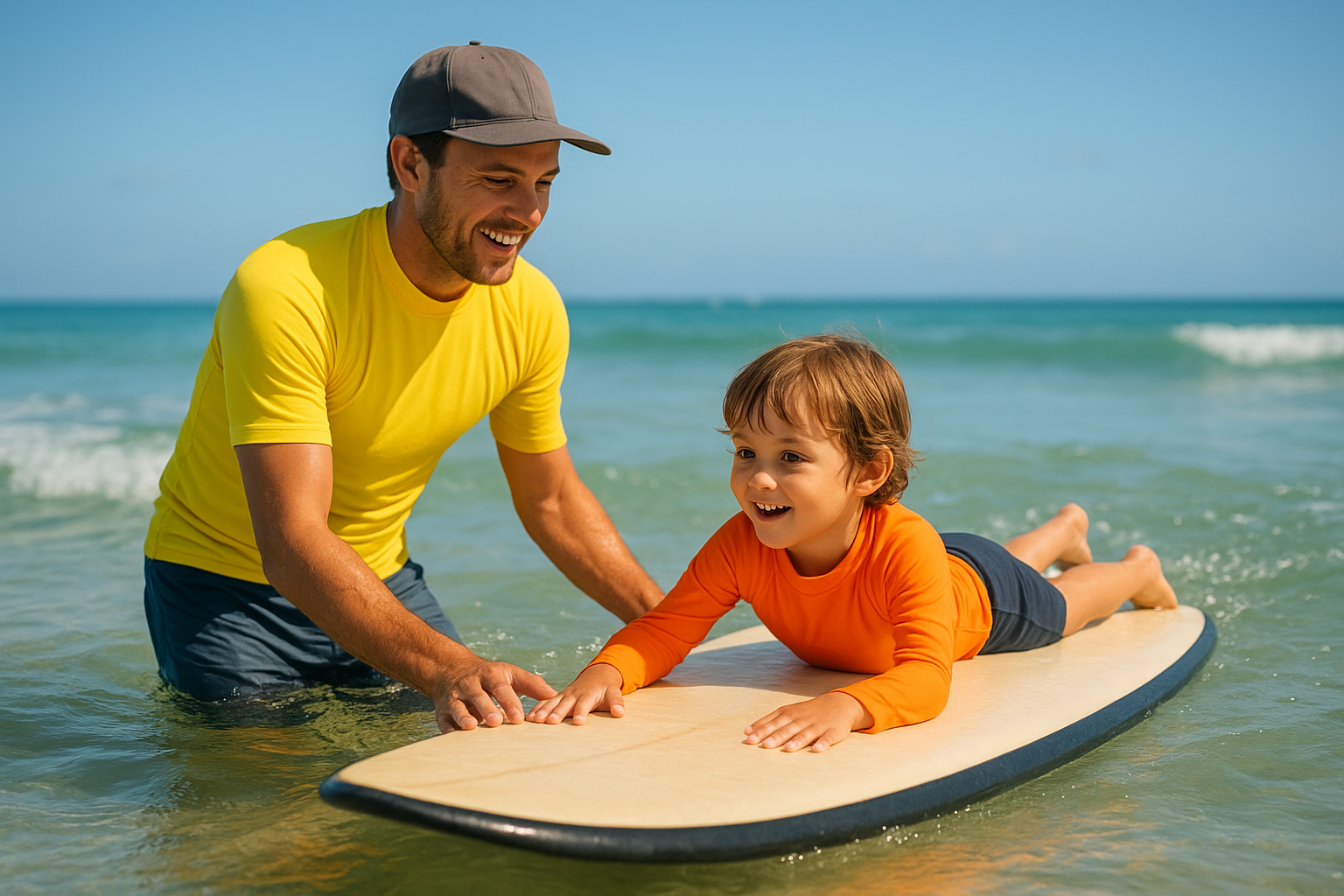
Certified instructors work one-on-one with younger children to build confidence before catching their first wave.
What to Look for in a Quality Family Surf School
Not all surf schools offer the same quality of instruction or safety standards. When evaluating options for your family surf lessons, consider the following criteria carefully to ensure your family is in truly capable hands.
Certified and Experienced Instructors
First, look for instructors with documented water safety training, including CPR certification and lifeguard qualifications. Specifically, ask whether instructors have experience teaching children — not just adults. Teaching a nervous 6-year-old requires a very different skill set than teaching a confident teenager.
Appropriate Student-to-Instructor Ratios
Check the student-to-instructor ratio carefully. Ideally, no more than 4 to 6 students per instructor for beginner lessons. Similarly, for lessons involving children under 8, a ratio closer to 2 or 3 to 1 is significantly safer. A crowded lesson means less individual attention and a higher risk of collisions in the water.
Soft-Top Boards and Proper Safety Equipment
Confirm that the school uses soft-top surfboards (also called foam boards) for all beginners. Soft-top boards are significantly safer than hard fiberglass boards in shallow water because they reduce the impact force of any accidental contact. Additionally, all participants should be equipped with a surf leash — a cord that tethers the board to the surfer’s ankle, preventing the board from drifting away after a wipeout.
Genuine Family-Friendly Culture
Read recent reviews from other families and specifically look for mentions of patience with young children. Providers like Star Beach Boys exemplify surf schools built around family-friendly beach experiences. A genuinely family-focused school will have smaller class sizes, encouraging instructors, and a welcoming atmosphere that puts nervous parents and kids at ease from the moment they arrive.
Quick Surf School Checklist
- ✅ Certified instructors with lifeguard or water safety credentials
- ✅ Ratio of 4–6 students max per instructor (lower for young kids)
- ✅ Soft-top foam boards for all beginner surfers
- ✅ Surf leashes included for every participant
- ✅ Rash guards or wetsuits provided or available
- ✅ Positive reviews from other families with young children
- ✅ Lessons conducted in designated beginner break zones
Common Mistakes Beginners Make During Family Surf Lessons
Even with great instruction, beginners tend to repeat a handful of predictable errors. Knowing these in advance helps families correct them faster and enjoy more successful waves throughout the session.
Looking Down at the Board
Looking down at the board is the single most common mistake in family surf lessons. Instead, surfers should fix their gaze on the horizon. This small adjustment naturally improves balance because your body aligns with where your eyes are pointed. In contrast, looking down shifts your weight forward and almost always results in a wipeout.
Standing With Feet Too Close Together
Similarly, placing feet too close together makes the board wobble side to side. A shoulder-width stance, with your front foot angled slightly toward the nose of the board, provides far more stability. Specifically, your back foot should sit just behind the center fin for maximum control during the ride.
Paddling With Bent Arms
Paddling with bent arms reduces power significantly. Straight, deep paddle strokes alongside the board’s rail generate the momentum needed to match the wave’s speed. Consequently, beginners who paddle correctly catch more waves with less effort. Cup your hands slightly as they enter the water to maximise each stroke’s pull.
Hesitating During the Pop-Up
Finally, hesitating during the pop-up causes most beginners to miss the wave entirely. The pop-up must be one fluid, committed movement. Half-standing while the wave passes underneath you is the quickest route to frustration. Therefore, commit fully and move quickly — every time. The land drill exists precisely to make this movement automatic under pressure.
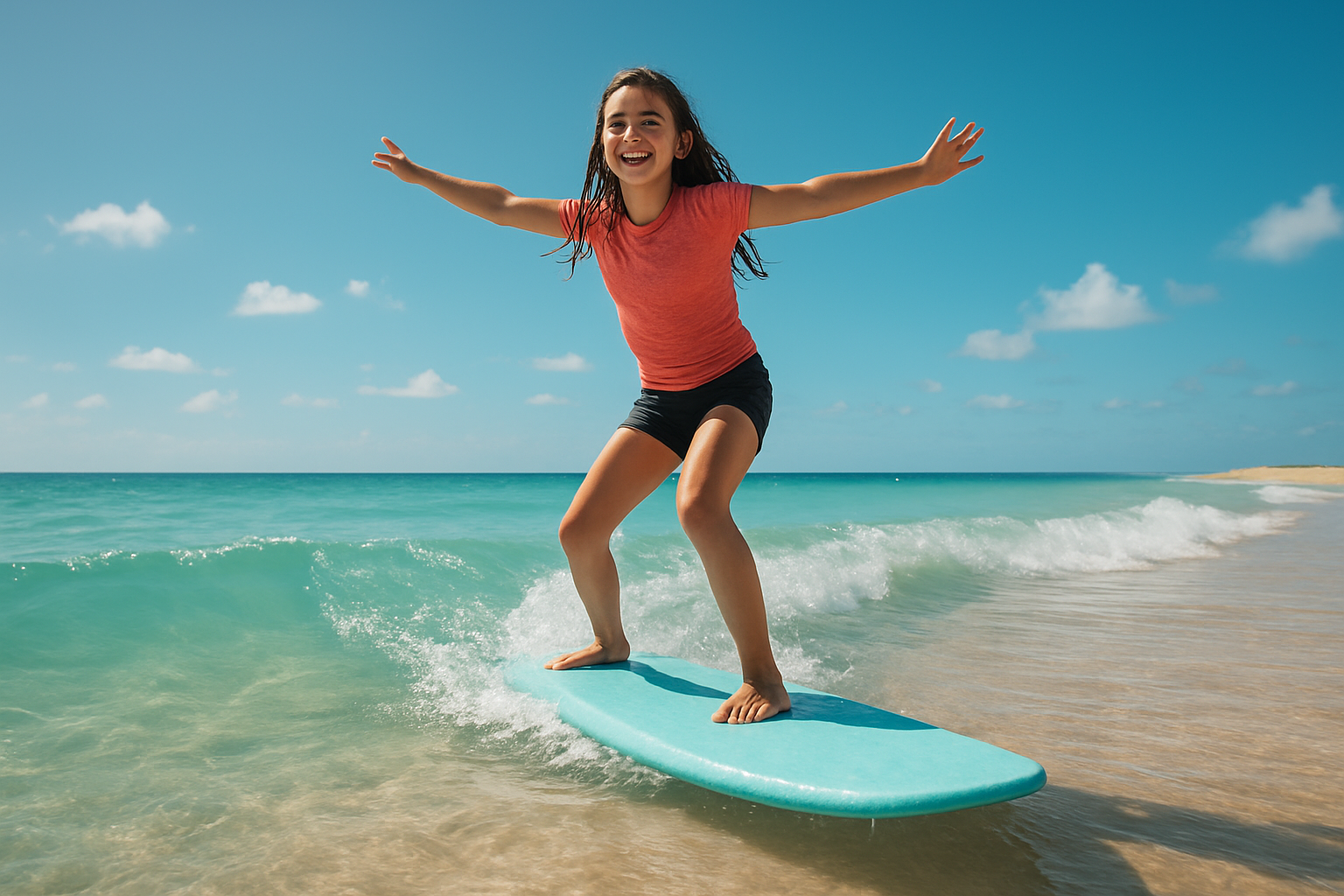
Standing up on a surfboard for the first time is an unforgettable milestone for surfers of any age.
Ocean Safety During Family Surf Lessons
Ocean safety is the foundation of every quality family surf lesson. Understanding the basics before you enter the water gives every family member — especially younger children — the confidence to enjoy the experience without unnecessary fear.
Understanding Rip Currents
A rip current is a narrow, fast-moving channel of water flowing away from the shore. It is the leading cause of beach rescues worldwide. However, rip currents are easy to escape once you understand them. The key is to swim parallel to the shoreline — not against the current — until you are out of the channel, then swim back to shore at an angle. Qualified surf instructors always cover this during the safety briefing.
Designated Beginner Zones
Reputable surf schools conduct family lessons in designated beginner zones — areas of the beach where waves are consistently small, the bottom is sandy (not rocky or reefed), and there is minimal boat traffic. These zones are specifically chosen to minimise risk for first-time surfers of all ages. Consequently, parents can focus on learning rather than worrying about environmental hazards.
What to Do If You Wipe Out
Wiping out is completely normal — and it is part of the fun. However, knowing how to fall safely reduces the risk of injury. Specifically, when falling, cover your head with both arms as you enter the water. This protects against the surfboard, which may be nearby. Additionally, never dive headfirst off the board in shallow water. Your instructor will demonstrate a safe falling technique during the land briefing.
How Many Surf Lessons Does Your Family Need?
One of the most common questions families ask before booking is how many lessons they will need before becoming comfortable surfers. The honest answer depends on age, fitness, and how frequently you practice. However, there are useful general benchmarks.
Typical Learning Progression
- Lesson 1: Most beginners stand up at least once. You learn pop-up mechanics, paddling basics, and ocean awareness.
- Lessons 2–3: Consistency improves. You begin to read waves and time your paddle-in more accurately.
- Lessons 4–6: Confident, repeatable wave riding. You start to control your direction on the board and experiment with turning.
- Beyond Lesson 6: Intermediate progression — cross-stepping, trimming the board, and reading larger surf.
For families visiting a beach destination on a one-week trip, booking two or three lessons across the week is ideal. This spacing gives your body time to rest and your mind time to process what you have learned. Furthermore, returning to the water after a break almost always results in noticeable improvement — a phenomenon instructors call the “sleep consolidation effect.”
Why Surfing Is One of the Best Activities for Family Bonding
Beyond the physical thrill, surfing offers a unique emotional dimension that few beach activities can match. Because the ocean is unpredictable, every family member faces the same challenge simultaneously. That shared vulnerability creates genuine connection. Parents who struggle alongside their kids — rather than watching from the shore — build a different kind of trust and mutual respect.
Furthermore, surfing teaches patience, resilience, and how to read natural environments — skills that extend well beyond the beach. Children who take surf lessons often carry a deeper appreciation for the ocean and a greater sense of physical confidence into their everyday lives. As a result, many families return year after year, progressing from beginners to intermediate surfers together as a unit.
Additionally, unlike competitive sports, surfing has no scoreboard, no winning team, and no pressure to outperform anyone. Every wave is its own small victory. Consequently, this non-competitive format is particularly healthy for children who struggle with performance anxiety in traditional sports environments.
What to Wear and What to Bring to Your Family Surf Lesson
Packing the right items makes the day significantly more comfortable for everyone. Here is a practical breakdown of what every family member should bring.
What to Wear
- Fitted swimsuit or board shorts — avoid loose clothing that catches water
- Rash guard (UPF 50+ sun protection) — usually provided by the school
- Wetsuit if water temperature is below 68°F / 20°C — confirm with your school
What to Bring
- Reef-safe mineral sunscreen applied at least 15 minutes before arriving
- Water bottles — surfing is more physically demanding than it looks
- Towels and a complete change of dry clothes for after the session
- Light snacks for younger children to maintain energy
- Waterproof bag to keep belongings dry on the beach
- Camera or waterproof action camera for capturing memories
Best Time of Year and Time of Day to Book Family Surf Lessons
Timing your family surf lessons well makes a meaningful difference to the quality of the experience. There are two dimensions to consider: the time of year and the time of day.
Best Time of Year
Summer months offer the warmest water and the most consistent beginner-friendly wave conditions at most destinations. However, spring and early autumn are also excellent choices — often with smaller crowds and calmer surf that is ideal for first-timers. In contrast, winter surf at many Atlantic and Pacific locations is more powerful and less predictable, making it less suitable for family beginners.
Best Time of Day
Morning sessions — typically between 7am and 10am — are generally best for beginners. Offshore winds (winds blowing from land toward the sea) tend to smooth the wave face in the early hours, creating cleaner, more manageable conditions. Additionally, the sun is less intense, which is an important consideration for children with sensitive skin. By midday, onshore winds frequently chop up the surf and make learning harder.
Booking Your First Family Surf Lesson: Final Tips
When you are ready to book, a few final considerations will help you choose the right school and set the right expectations for the day.
First, always prioritise morning bookings for the reasons above. Second, choose smaller waves over impressive surf — beginners learn far faster on small, consistent waves than on large, unpredictable ones. Third, set realistic expectations and focus on enjoying the process rather than measuring performance. Even if someone in your family does not stand up on the first day, they are learning ocean awareness, paddling strength, and wave timing — all of which compound into skill over subsequent sessions.
Furthermore, do not underestimate the value of the post-session debrief. After the lesson, ask your instructor what each family member did well and what to focus on next time. This feedback accelerates improvement significantly between sessions.
Above all, remember that family surf lessons are ultimately about the shared experience. The waves are the backdrop. The connection between your family members — paddling together, cheering each other on, laughing through wipeouts — is the real reward.
Ready to book your family surf lessons? Last updated: 2026-06-27. Written by the Star Beach Boys instructors.
Look for a certified, family-friendly surf school with experienced instructors, soft-top boards, small class sizes, and a genuine passion for sharing the ocean with families of all ages. For a deeper walkthrough, see our Best Surf School Waikiki: The Complete 2025 Guide to Every Top Option.
Frequently Asked Questions About Family Surf Lessons
What are family surf lessons?
Family surf lessons are structured surfing sessions designed for parents and children to learn together under the guidance of a certified instructor. They cover ocean safety, paddling technique, and how to stand up on a surfboard — all in a fun, supportive environment suitable for complete beginners of all ages.
What is the minimum age for kids to take surf lessons?
Most surf schools accept children as young as 5 or 6 years old. However, the ideal starting age is typically 7 to 9, when children have developed enough coordination and focus to follow instructor directions safely in the ocean. Learn how to choose a surf school that fits your family.
Do parents need surfing experience to join a family lesson?
No prior experience is needed. Family surf lessons are designed for complete beginners of all ages. Parents and children start from the same foundation and progress together through the session under instructor guidance.
How long does a typical family surf lesson last?
Most beginner family surf lessons run between 90 minutes and 2 hours. This includes a beach safety briefing, land-based pop-up practice, and time in the water riding waves with instructor support the entire time.
Is surfing safe for young children?
Yes — when taught by qualified instructors in beginner-friendly conditions, surfing is very safe for children. Instructors select gentle, shallow break areas with sandy bottoms and provide soft-top foam boards to significantly reduce the risk of injury.
What equipment is provided during surf lessons?
Reputable surf schools provide soft-top surfboards, surf leashes, and rash guards or wetsuits depending on water temperature. Families generally do not need to bring any specialized gear of their own — just reef-safe sunscreen and a swimsuit.
How much do family surf lessons typically cost?
Group family lessons typically range from $50 to $100 per person for a 90-minute to 2-hour session, depending on location and school. Private family lessons cost more but provide personalized attention that significantly accelerates skill development.
What is the difference between a group lesson and a private family lesson?
Group lessons are more affordable and place your family alongside other learners, while private lessons dedicate an instructor exclusively to your family. Private lessons are ideal for very young children or family members who need additional one-on-one support. Some schools also offer semi-private lessons as a middle-ground option.
What should families wear and bring to a surf lesson?
Wear a fitted swimsuit or board shorts and apply reef-safe sunscreen before arriving. Bring water bottles, a towel, dry clothes, and light snacks for younger children. Confirm in advance whether your school supplies rash guards and wetsuits.
Can non-swimmers participate in surf lessons?
Non-swimmers should inform the instructor before the lesson. Sessions for non-swimmers typically stay in very shallow water with extra instructor support. However, basic swimming ability is strongly recommended for safety in an ocean environment.
How many lessons does it take to stand up on a surfboard?
Many beginners stand up on their very first lesson with good instruction and suitable conditions. Consistent, confident wave riding typically develops over 3 to 5 sessions as balance, timing, and paddling strength improve together.
What common mistakes should families avoid during surf lessons?
The most common mistakes include looking down at the board, standing with feet too close together, paddling with bent arms, and hesitating during the pop-up. A qualified instructor will identify and correct these habits early before they become ingrained patterns.
What is the best time of year to book family surf lessons?
Summer offers the warmest water and most consistent beginner conditions. However, spring and early autumn are also excellent — typically with smaller crowds and calmer surf ideal for first-timers. Morning sessions between 7am and 10am deliver the best wave conditions at most beaches.
What is a rip current and how should children handle one?
A rip current is a fast-moving channel of water pulling away from shore. If caught in one, the key is to swim parallel to the beach — not against the current — until free of the channel, then angle back to shore. Your instructor will always cover this during the pre-lesson safety briefing.
How do I find the best family surf lessons near me?
Search for certified surf schools with strong family-specific reviews. Look for schools that list instructor certifications, clearly state their student-to-instructor ratios, provide soft-top boards, and have experience teaching children of varying ages. Booking directly with an established local school — rather than through a third-party booking platform — often yields better personalised service.
Conclusion: Why Family Surf Lessons Are Worth Every Wave
Family surf lessons offer something rare: an activity where age, experience, and physical ability become almost irrelevant. Everyone starts as a beginner. Everyone faces the same unpredictable ocean. And everyone — parent and child alike — gets to experience the pure joy of riding their first wave. In addition to being deeply fun, surfing builds confidence, resilience, and a lasting connection to the natural world. Whether you are planning a single session on your next beach vacation or embarking on a multi-lesson journey together, family surf lessons deliver memories — and skills — that your family will carry far beyond the shoreline.