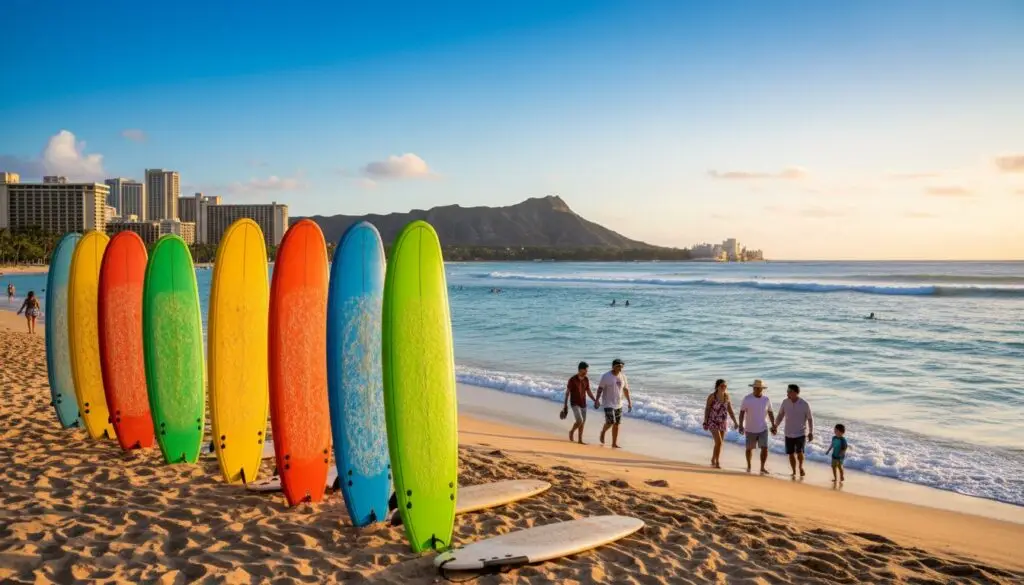
Searching for beginner surf lessons near me is the smartest first move you can make before hitting the water. Quality surf instruction is available at nearly every coastal destination in the United States — from the Atlantic shores of the Outer Banks to the Pacific swells of San Diego. This comprehensive guide covers everything you need to find a great local surf school, what to expect on day one, how much it costs, how to stay safe, and exactly how to keep improving after your first session. Written by Star Beach Boys surf coaches. Last updated: 2026-06-27.
What Are Beginner Surf Lessons?
Beginner surf lessons are structured, instructor-led sessions held at the beach where a certified coach teaches you ocean safety, paddling mechanics, surf etiquette, and the pop-up technique. Unlike self-teaching — which often builds bad habits — a proper lesson gives you a safe, tested progression framework from the very first moment you step onto the sand.
Lessons are deliberately held in shallow, mellow-break zones known as the whitewater zone, where broken waves roll in consistently and predictably. This controlled environment lets you focus entirely on technique without worrying about powerful open-ocean conditions. Most beginner sessions run between 90 minutes and 2 hours and include all equipment — surfboard, leash, and wetsuit where needed.
A typical lesson unfolds in three phases: a land-based safety and technique briefing, shallow-water paddle and positioning drills, and then guided pop-up attempts on real waves. By the end of most first sessions, the large majority of beginners successfully stand up and ride at least one wave to shore.

A certified instructor walks beginners through the pop-up technique on the sand — a non-negotiable part of every quality beginner surf lesson.
Who Are Beginner Surf Lessons For?
One of the most common misconceptions about surfing is that it requires youth, athletic ability, or prior ocean experience. In reality, beginner surf lessons are designed for anyone who wants to try surfing for the first time, regardless of fitness level, age, or background.
- Children (ages 6–12): Many surf schools run dedicated kids’ programs with age-appropriate instruction, smaller boards, and extra safety measures. Children often progress fastest of all age groups.
- Teenagers: Teen surf camps and group lessons are popular summer activities. Social group formats work especially well for this age group.
- Adults of any age: There is genuinely no upper age limit. Adults in their 50s, 60s, and beyond regularly take and enjoy beginner surf lessons. Instructors adapt the pace to each student.
- Non-swimmers with limited ocean experience: Basic swimming ability — comfortable over at least 100 meters unassisted — is strongly recommended, but you do not need to be a strong swimmer to begin.
- Travelers on surf trips: Booking a local beginner lesson when visiting a surf destination is one of the best ways to experience a new beach safely and memorably.
How to Find the Best Beginner Surf Lessons Near You
Typing “beginner surf lessons near me” into a search engine or Google Maps will surface a list of local options, but the real work is in evaluating them properly. Here is a step-by-step process that ensures you choose a school that is safe, qualified, and right for your goals.
Step 1 — Search Google Maps and Review Platforms
Open Google Maps and search “surf lessons near me” or “beginner surf school [your city].” Sort by rating and read at least five recent reviews for each result. Prioritize consistent praise for instructor patience, safety briefings, small group sizes, and equipment quality. TripAdvisor and Yelp offer additional review data worth cross-referencing.
Step 2 — Verify Instructor Certification
The most important credentialing body in surf instruction is the International Surfing Association (ISA). ISA-certified instructors complete formal training in surf pedagogy, open-water safety, and emergency protocols. Some schools also hold certifications from the National Surf Schools and Instructors Association (NSSIA) or regional equivalents. A reputable school will list its credentials openly on its website — if it does not, ask directly before booking.
Step 3 — Evaluate Student-to-Instructor Ratios
A lower ratio means more individualized attention and greater safety in the water. The best beginner surf schools maintain a ratio of 4 to 6 students per instructor. Be cautious of schools that run groups of 10 or more with a single instructor — this compromises both learning quality and safety oversight.
Step 4 — Compare Lesson Formats and Pricing
Most schools offer three main lesson formats:
- Group lessons: $50–$100 per person. Ideal entry point for social learners and those on a budget. Typically 4–8 students sharing one instructor.
- Private lessons: $100–$200 per hour. Instructor attention is focused entirely on you, which accelerates skill development significantly. Recommended if you want fast progress or have specific anxiety about the ocean.
- Multi-lesson packages: Many schools offer 3- to 5-lesson bundles at a 15–25% discount. These are the best value and provide the consistency needed for real improvement.
- Surf camps: Immersive multi-day programs (often 3–5 days) that combine lessons, beach time, and coaching. Excellent for rapid progression and travelers.
Step 5 — Review the School’s Safety Protocols
Ask whether instructors hold current CPR and first aid certifications in addition to surf coaching credentials. Confirm that lessons take place in designated surfing zones at lifeguard-patrolled beaches. A safety-first school will have a formal pre-water briefing covering rip currents, fall technique, right-of-way rules, and board handling — and will not rush this section regardless of conditions.
Step 6 — Book, Confirm, and Prepare
Most reputable schools offer secure online booking. Before confirming, verify: what equipment is included, the exact meeting point at the beach, the cancellation and rescheduling policy (weather cancellations should always be free), and any prepare for your lesson requirements. Arrive at least 15 minutes early to get fitted for gear and attend the full briefing.
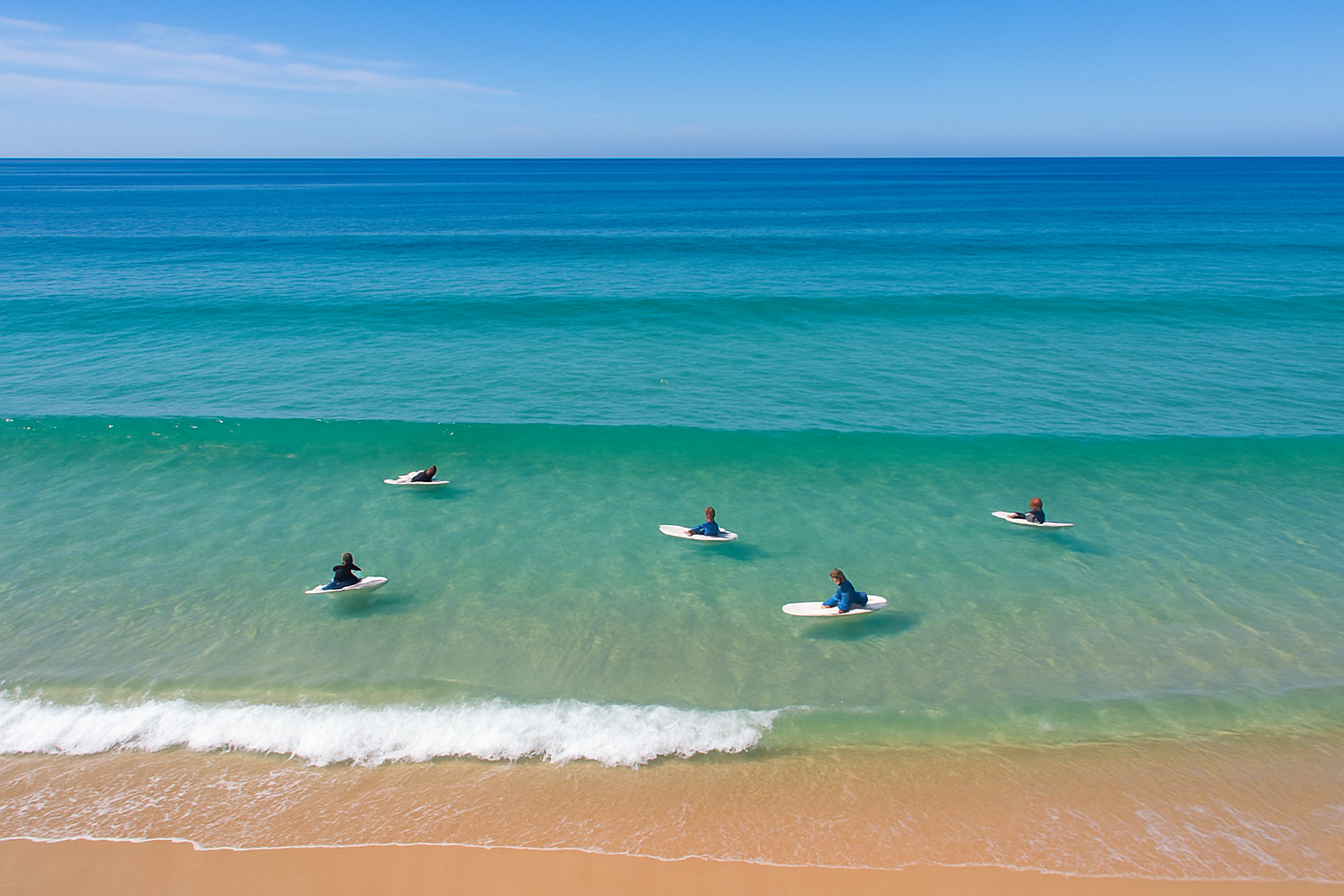
Calm, shallow beach breaks like this are the ideal environment for beginner surf lessons — manageable waves and clear sightlines for instructors. For a deeper walkthrough, see our Best Surf Instructors in Waikiki.
What to Expect During Your First Beginner Surf Lesson
First-time surfers almost always ask: “What is actually going to happen during the lesson?” Here is an honest, detailed what to expect of how a standard beginner surf lesson unfolds from arrival to departure.
Phase 1 — Arrival and Equipment Fitting (15 minutes)
You will meet your instructor at the designated beach location. They will check you in, fit you with a wetsuit if the water temperature requires one, and select an appropriate foam board for your height and weight. This is also a good moment to ask any questions before the formal briefing begins.
Phase 2 — Land-Based Safety Briefing (20–30 minutes)
On the sand, your instructor will cover: rip current identification and escape technique, surf zone etiquette (right-of-way rules, spatial awareness), how to carry and control your board, how to fall safely to avoid injury, and the pop-up technique itself. You will practice the pop-up repeatedly on dry land before ever entering the water. This phase is not optional — it is where most of your safety knowledge comes from, so pay close attention.
Phase 3 — Shallow-Water Paddle Drills (15–20 minutes)
You will wade into the whitewater zone and practice paddling your board, lying in the correct position (centered, weight slightly back, chin up). This phase builds the muscle memory needed to generate speed before attempting to stand. Your instructor will provide corrections on paddle stroke technique and board positioning.
Phase 4 — Guided Wave Riding Attempts (30–40 minutes)
This is the main event. Your instructor will position you on the board, help you catch the wave’s momentum, and call out the cue to pop up. They will often physically guide the board on early attempts. You will make multiple attempts and receive real-time feedback after each one. Most beginners manage at least one successful stand during this phase. See our Oahu surf lessons guide for local technique tips and common instructor cues.
Phase 5 — Debrief and Next Steps (10 minutes)
After returning to the beach, your instructor will give you individual feedback on what you did well and what to focus on in your next session. This is the ideal moment to ask about multi-lesson packages, what to practice at home, and how soon to book your follow-up lesson.
Quick Answer
Beginner surf lessons near me are certified, instructor-led ocean sessions teaching paddling, ocean safety, and the pop-up technique to first-time surfers. Group lessons typically cost $50–$100 and last 90 minutes, with all equipment included. Search Google Maps for ISA-certified surf schools in your nearest coastal town to find the best local option.
Equipment Used in Beginner Surf Lessons
You do not need to own any equipment for your first beginner surf lesson — reputable schools provide everything. Here is what you will be using and why each piece matters.
Foam Surfboards (Soft-Tops)
Virtually all beginner surf schools use foam longboards, commonly called soft-tops or foamies, measuring 8 to 10 feet in length. These boards are significantly wider and thicker than performance fiberglass boards, which gives them exceptional buoyancy and stability. If you fall, the foam construction dramatically reduces the risk of impact injury compared to hard boards. Brands like Wavestorm and BIC are widely used in lesson programs.
Surf Leash
A surf leash is a urethane cord that attaches to your rear ankle and to the tail of the surfboard. If you fall off the board, the leash keeps the board within arm’s reach rather than letting it wash to shore — which would leave you swimming without floatation support. Beginners should always use a leash, and schools will have them pre-attached to lesson boards.
Wetsuits and Rash Guards
Whether you need a wetsuit depends entirely on water temperature:
- Below 60°F (15°C): A 4/3mm full wetsuit is standard — this covers chest, legs, and arms to retain body heat.
- 60–68°F (15–20°C): A 3/2mm shorty or full wetsuit is typical, common in California, the UK, and the Pacific Northwest even in summer.
- Above 72°F (22°C): A rash guard (a lightweight sun-protective shirt) is usually sufficient. Common in Hawaii, Florida, and the Caribbean.
Most beginner surf schools include wetsuit or rash guard rental in the lesson price. If yours does not, ask in advance — arriving in the wrong gear makes for a miserable first session.
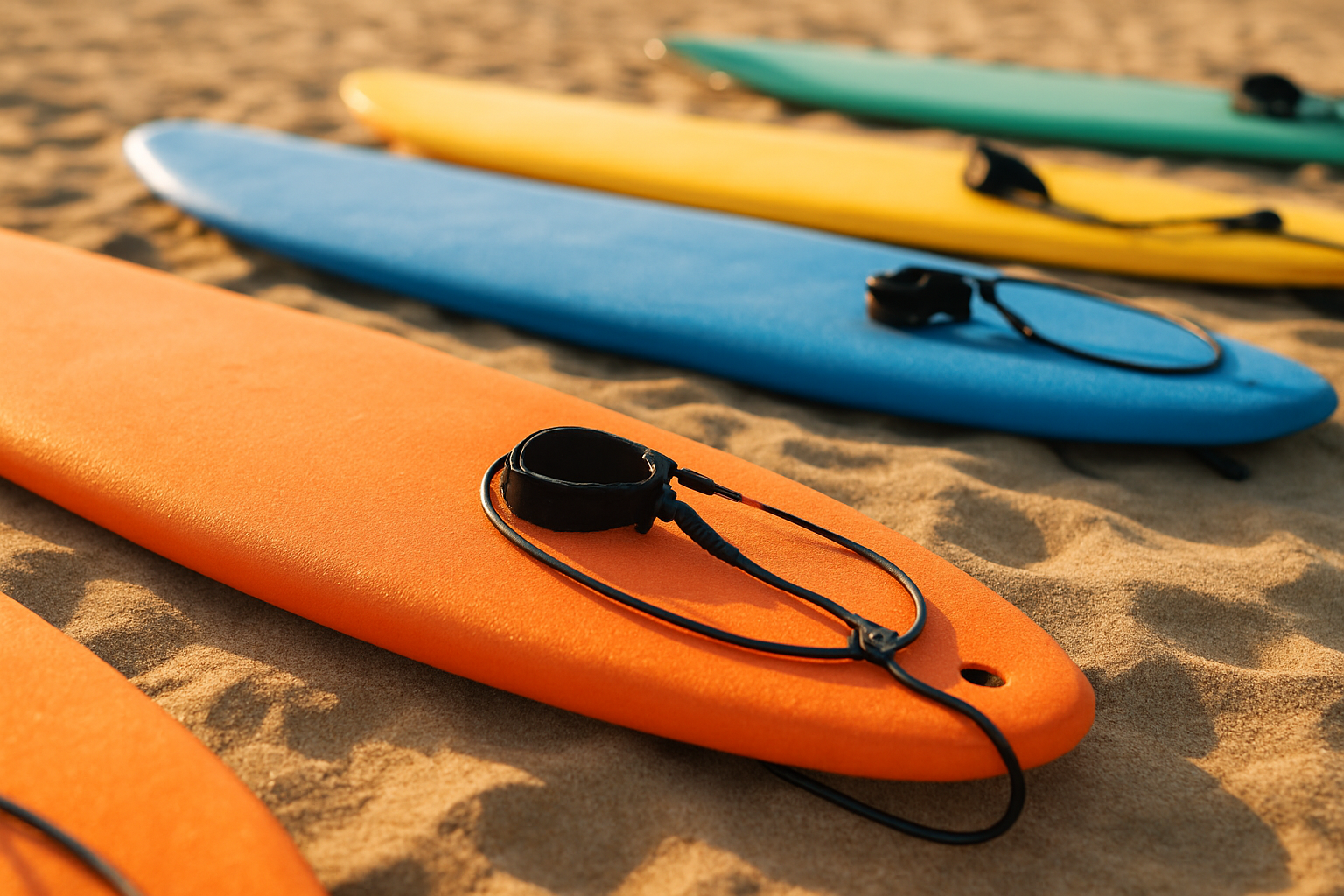
Foam surfboards are the universal standard for beginner surf lessons — stable, buoyant, and far safer than fiberglass alternatives.
What to Bring to Your First Surf Lesson
Knowing what to pack prevents the common mistake of showing up underprepared. Here is the complete checklist:
- Swimsuit or board shorts: Something you can move freely in and that will not slip off during active paddling.
- Water-resistant sunscreen (SPF 50+): Apply generously 20–30 minutes before your session. Ocean water, wind, and sun exposure create intense UV conditions. Reef-safe mineral sunscreen is preferable at many beach locations.
- Water bottle: Surfing is more physically demanding than it looks. Staying hydrated before and after is important.
- Towel and a change of clothes: You will be wet after your session. Having dry clothing to change into makes the post-lesson experience far more comfortable.
- Light meal 1–2 hours before: Surfing on an empty stomach is uncomfortable; surfing on a full stomach is worse. A light snack or meal in the right window gives you energy without the risk of nausea.
- Secure bag or locker for valuables: Many beaches have lockers. Leaving phones, wallets, and keys in a locked facility is far better than leaving them on the sand.
- Hair tie (if applicable): Long hair in your face during a pop-up is a real distraction. A simple hair tie solves it entirely.
Ocean Safety: What Every Beginner Must Know
Safety is the foundation of every legitimate beginner surf lesson program. Before you ever touch the water, your instructor will teach you the core safety knowledge that reduces risk dramatically. This is not a formality — it is the most important part of your lesson.
Understanding Rip Currents
According to the United States Lifesaving Association (USLA), rip currents are responsible for the overwhelming majority of lifeguard rescues at surf beaches in the United States. A rip current is a narrow, fast-moving channel of water flowing away from shore. It will not pull you under — but it will pull you away from the beach.
How to identify a rip current: Look for a discolored, choppy, or foamy strip of water running perpendicular to shore, with calmer water on either side. How to escape: Do not swim directly back toward shore against the current — you will exhaust yourself. Instead, swim parallel to shore until you exit the rip channel, then angle back in. Your instructor will demonstrate this on the sand before you enter the water.
How to Fall Safely
Falling is a normal, inevitable part of learning to surf — and doing it correctly prevents injury. The two key principles: fall flat and wide (spread your body across the water’s surface rather than diving in feet-first, which risks hitting the bottom in shallow water), and cover your head as you surface (put your arms over your head before breaking the surface to protect yourself from the board coming back on the leash or other boards nearby).
Right-of-Way and Surf Etiquette
Even as a beginner in the whitewater zone, basic surf etiquette matters. The fundamental rule is: the surfer closest to the peak of the wave has right of way. Do not paddle in front of someone already riding a wave. Do not leave your board to drift freely toward other people. These rules protect everyone in the water and are part of the pre-session briefing at every legitimate surf school.
Staying Within Your Ability Level
Beginner lessons take place in the whitewater zone close to shore for a specific reason — the conditions there are manageable and your instructor can reach you quickly. Never paddle into unpatrolled water, past the designated lesson area, or into sections of the break where larger, more powerful waves are breaking. Always surf at lifeguard-patrolled beaches and check conditions before entering the water independently.
Common Mistakes First-Time Surfers Make (And How to Fix Them)
Understanding the most common beginner errors before your lesson means you can actively work against them rather than falling into them automatically.
Looking Down at the Board
This is the single most universal beginner mistake. The natural instinct is to look down and confirm your foot position, but this immediately throws off your balance and direction. Fix: Lock your gaze on the shoreline or a fixed point on the horizon. Your body will naturally follow your eyes — keep your eyes forward and balance improves almost instantly.
Popping Up Too Early or Too Late
Timing is everything. Popping up before the wave has caught you means standing on a stationary board — you will stop immediately. Waiting too long means the wave has already passed its momentum peak. Fix: Wait until you feel the wave’s push accelerate the board forward clearly before committing to the pop-up. Your instructor will give you a verbal cue — trust it.
Placing Feet Too Close Together
A narrow stance greatly reduces stability. Many beginners stand with feet hip-width or narrower, which makes the board wobble aggressively. Fix: Your feet should be roughly shoulder-width apart, perpendicular to the stringer (the center line of the board), with your front foot over the board’s mid-point and your back foot near the tail.
Tensing the Upper Body
Rigid arms and locked shoulders make you react slowly to the board’s movement beneath you. Fix: Keep your arms slightly out to the sides (think airplane wings) for lateral balance, and consciously relax your shoulders. Bend your knees slightly — this lowers your center of gravity and makes staying upright significantly easier.
Trying to Ride Waves That Are Too Big
The excitement of the ocean can tempt beginners to paddle for bigger, more powerful waves. This is a mistake. Fix: Stick to small, rolling whitewater waves during your first several sessions. They are easier to catch, more forgiving of timing errors, and much safer. Progression into green (unbroken) waves comes naturally once your pop-up is consistent.
Best Surf Destinations for Beginner Lessons in the United States
While beginner surf lessons near you depend entirely on your location, certain U.S. destinations are particularly well-regarded for their beginner-friendly conditions, density of quality surf schools, and overall surf culture infrastructure.
Waikiki, Hawaii
Waikiki Beach in Honolulu is often described as the birthplace of modern surfing and remains one of the most welcoming beginner surf destinations in the world. The shallow reef produces long, slow, rolling waves that are ideal for learning, the water is warm year-round (no wetsuit needed), and dozens of certified surf schools operate on the beach daily. See Surf lessons in Hawaii for destination-specific tips and school recommendations.
San Diego, California
Beaches like Pacific Beach, Mission Beach, and Ocean Beach offer consistent, manageable surf conditions for beginners. San Diego has one of the highest concentrations of ISA-certified surf schools in the United States, with year-round lessons available. A 3/2mm wetsuit is typical for most of the year.
Cocoa Beach, Florida
Florida’s Space Coast produces smaller, slower Atlantic waves that are forgiving and predictable — ideal for beginners. The water is warm from late spring through fall, and the area has a strong local surf school community with certified instructors.
Virginia Beach, Virginia
One of the East Coast’s most beginner-friendly surf cities, Virginia Beach has calm, rolling summer surf and a well-established surf school infrastructure. The town hosts an annual surf festival and has a deep surf culture history for a non-traditional surf destination.
Santa Cruz, California
While Santa Cruz hosts some challenging breaks for advanced surfers, Cowell’s Beach specifically is a famous beginner-friendly spot with gentle, long-rolling waves and a busy network of local surf schools. Multiple certified providers offer beginner programs here daily.
How to Choose Between Group and Private Surf Lessons
This is one of the most common questions beginners ask, and the honest answer is: it depends on your learning style, budget, and goals.
Group Lessons
- Lower cost ($50–$100 per person)
- Social, fun atmosphere
- Good for casual learners and travelers
- Less one-on-one feedback per attempt
- Ideal for ages 10+ who enjoy group energy
Private Lessons
- Higher cost ($100–$200 per hour)
- Faster skill development
- Instructor adapts to your specific weaknesses
- Better for anxious learners or those with specific goals
- Recommended for adults who want efficient progression
The hybrid approach: A popular strategy is to start with a group lesson to understand the fundamentals in a social setting, then follow up with one or two private sessions to accelerate past the plateau point that most beginners hit after their second or third group class.
Surf Camps vs. Individual Lessons: Which Is Right for You?
For beginners who want an immersive, accelerated learning experience, surf camps offer a compelling alternative to booking individual lessons one at a time.
Surf camps are typically multi-day programs (3–7 days) that combine morning and afternoon surf sessions with video analysis, theoretical coaching on wave reading, ocean science basics, and sometimes yoga or fitness components. Many surf camps are designed specifically for adult beginners and operate at beginner-friendly surf destinations.
Who benefits most from surf camps: Travelers visiting a surf destination for a week, people who learn best with total immersion, those who want to reach intermediate level as quickly as possible, and solo travelers looking for a social experience alongside structured learning.
Cost: Surf camps range from $300 to $1,500+ depending on duration, location, and whether accommodation is included. Day camps (lessons only, no lodging) are significantly less expensive.
How to Progress After Your First Beginner Surf Lesson
Your first lesson will almost certainly leave you wanting more — and that momentum is worth capitalizing on immediately. Here is a structured progression roadmap that takes you from first-timer to confident beginner surfer. See our fun surf experiences for more ideas.
Immediately After Your First Lesson
- Book your second lesson before you leave the beach. The longer the gap between sessions, the more muscle memory you lose.
- Ask your instructor for specific feedback on one thing to focus on at home.
- Stretch — surfing engages muscles you rarely use, and soreness is real. Hip flexors, shoulders, and lower back especially.
Between Lessons: Home Practice
- Pop-up drills on a yoga mat: Place a yoga mat or towel on the floor and practice the pop-up movement from the lying paddle position to standing 10–15 times per day. This builds the explosive, coordinated movement that wave timing demands.
- Balance board training: A balance board or Indo Board simulates the lateral motion of a surfboard and dramatically improves core stability.
- Swimming and ocean time: Body surfing, boogie boarding, or simply swimming through waves builds wave-reading instincts and ocean comfort that translate directly to surfing.
- Watch instructional videos: YouTube has extensive beginner surf coaching content from ISA-certified coaches. Watching pop-up technique from multiple angles reinforces what you are practicing physically.
Lessons 2–5: Building Consistency
Your second and third lessons should focus on making your pop-up automatic — something you execute without thinking — and on beginning to read which waves are worth paddling for. By lessons four and five with a consistent instructor, most beginners are transitioning from purely catching whitewater to occasionally catching the green (unbroken) face of a wave. Complement this with our surf training for adults program to accelerate progression.
Lessons 6–10: Toward Intermediate
At this stage, you will work on wave selection, paddling efficiency, trimming along the wave face, and basic turning. Multi-lesson packages offered by schools like Star Beach Boys are specifically designed to take students through this beginner-to-intermediate progression in a structured, measurable way.
Best Time of Year to Book Beginner Surf Lessons
Seasonality affects wave size, water temperature, crowd levels, and school availability — all of which matter for a beginner’s experience.
- Summer (June–August): The most popular time for beginner lessons. Water is warmest, waves tend to be smaller and more consistent on most U.S. coasts, and schools are fully staffed. Downside: higher prices and more crowded lesson lineups.
- Early Fall (September–October): An underrated window. Water is still warm from summer, crowds thin out, and wave quality is often excellent. Many schools offer discounted rates in this period.
- Late Spring (April–May): Water is beginning to warm, schools are reopening after winter, and prices are lower. Good conditions in Florida, Hawaii, and Southern California.
- Winter: Not ideal for most beginners due to cold water and larger, more powerful swells. However, in Hawaii, Florida, and other warm-water destinations, year-round lessons are perfectly viable with appropriate gear.
Frequently Asked Questions About Beginner Surf Lessons Near Me
What are beginner surf lessons near me?
Beginner surf lessons near me are structured, instructor-led sessions at a local beach where a certified surf coach teaches you ocean safety, paddling technique, and how to stand on a surfboard for the first time. Most lessons last 90 minutes to 2 hours and include all equipment.
How much do beginner surf lessons cost near me?
Group beginner surf lessons typically cost $50–$100 per person. Private lessons range from $100–$200 per hour. Multi-lesson packages and surf camp programs offer the best per-session value, often discounting 15–25% from individual session prices.
Do I need to know how to swim before taking surf lessons?
Yes, basic swimming ability is strongly recommended. You should be comfortable swimming at least 100 meters unassisted in open water before your first surf lesson. Most reputable schools ask about swimming ability during the booking process.
What should I bring to my first surf lesson?
Bring a swimsuit or board shorts, water-resistant SPF 50+ sunscreen applied before leaving home, a water bottle, a towel, a change of clothes, and a light meal eaten 1–2 hours beforehand. Most schools provide the surfboard, leash, and wetsuit or rash guard as part of the lesson price.
How long does it take to learn to surf?
Most beginners stand up and ride a wave within their first 1–3 lessons. Building consistent wave-catching ability and basic maneuvering typically takes 10–20 sessions spread over several months. Daily ocean exposure between lessons significantly accelerates the timeline.
What is the best age to start beginner surf lessons?
Children as young as 6 or 7 can start beginner surf lessons, and there is genuinely no upper age limit. Many schools offer age-specific programs for kids, teens, and adults. Adults in their 50s and 60s regularly begin surfing through certified beginner lesson programs.
Are group or private surf lessons better for beginners?
Both work well for different reasons. Private lessons offer faster progression because the instructor focuses entirely on you. Group lessons are more affordable and socially enjoyable. A hybrid approach — one group lesson followed by private sessions — is popular for adults who want efficient skill development.
What type of surfboard is used in beginner lessons?
Beginner lessons universally use foam longboards — also called soft-tops or foamies — typically 8 to 10 feet long. Their wide, thick profile provides exceptional stability and buoyancy, and the foam construction significantly reduces injury risk compared to fiberglass boards.
What should I look for when choosing a surf school near me?
Prioritize ISA-certified instructors, a student-to-instructor ratio of 4–6:1 or better, CPR and first aid certification, clear safety protocols, positive recent reviews, and transparent pricing. Reputable schools list their qualifications openly and will answer your questions about credentials without hesitation.
Is surfing dangerous for beginners?
Surfing carries inherent risk, but beginner lessons are specifically designed to minimize danger through safe beach selection, foam board use, structured instruction, and mandatory safety briefings. Following your instructor’s guidance and staying within the designated lesson area greatly reduces the risk of injury.
What is the best time of year to take beginner surf lessons?
Summer and early fall are ideal for most U.S. locations — water is warmest, waves are smaller, and schools are fully staffed. Early fall is particularly underrated, as crowds thin and prices drop while conditions remain excellent. In Hawaii and Florida, beginner surf lessons are available and enjoyable year-round.
How many students are in a typical beginner group surf lesson?
The best beginner group surf lessons have 4–6 students per instructor. Schools with 10 or more students per instructor compromise both learning quality and safety supervision. Always ask about the ratio before booking. For a deeper walkthrough, see our Best Surf Lessons in Waikiki: How to Find the Right School and Instructor.
What is a surf camp and is it better than individual lessons?
A surf camp is a multi-day immersive program combining multiple surf sessions per day with video analysis, coaching, and sometimes fitness or yoga components. For beginners who want to progress quickly or who are visiting a surf destination for a week, surf camps offer significantly faster improvement than standalone individual lessons.
Do I need to buy a surfboard before taking beginner lessons?
No. All equipment is provided by the surf school for beginner lessons — surfboard, leash, and wetsuit or rash guard as needed. There is no reason to purchase any gear until after you have completed several lessons and confirmed that surfing is something you want to pursue seriously.
Ready to Book Your First Beginner Surf Lesson?
Finding the best beginner surf lessons near me is entirely achievable once you know what to look for. Focus on ISA-certified instructors, a student-to-instructor ratio of no more than 6:1, clear safety protocols, and transparent pricing. Read recent reviews, ask direct questions about qualifications, and do not hesitate to pay slightly more for a school that ticks every box — the quality of your instruction directly affects how quickly you progress and how safe your experience is.
The ocean is one of the most exhilarating environments on earth — and your first properly guided surf lesson is the safest, most effective way to begin your relationship with it. Book your session, show up prepared, and trust the process. Your first wave is closer than you think. Last updated: 2026-07-12. Author: Star Beach Boys surfing team. Author: Star Beach Boys. Last updated: 2026-07-27.