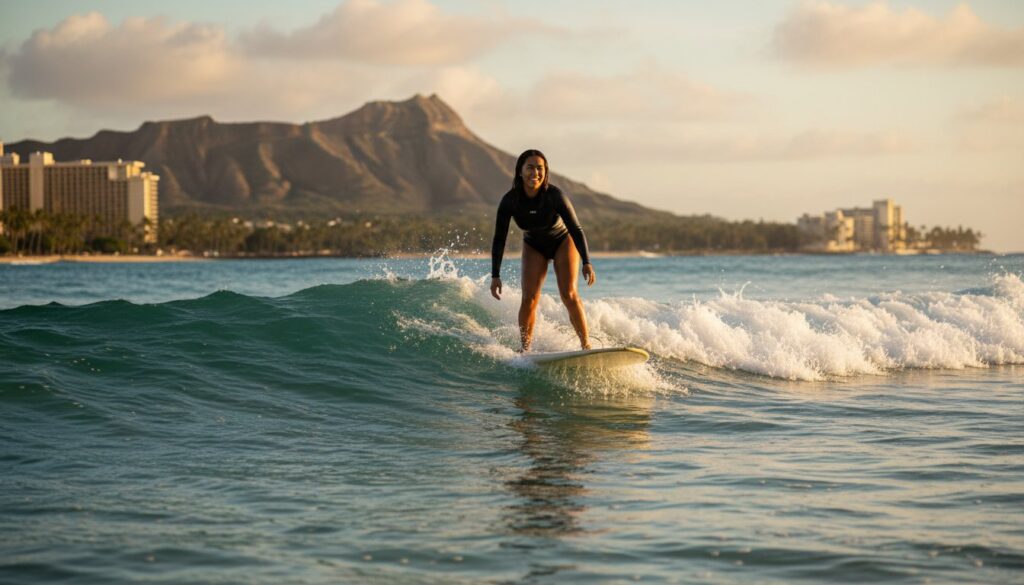
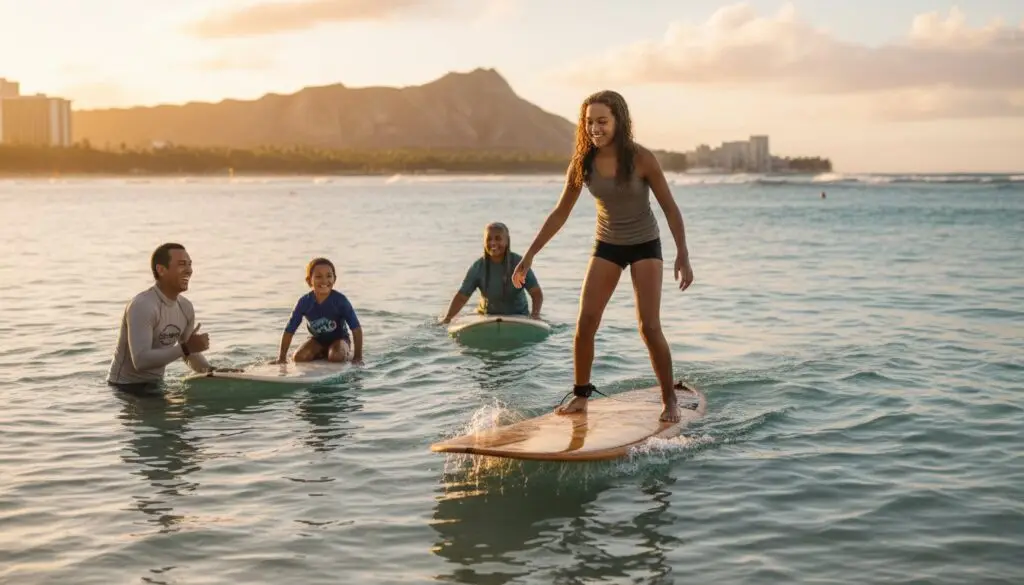
Waikiki Surf Guide
Waikiki Surfboard Rental: The Complete Local Guide to Boards, Breaks & Beach Boy Wisdom
Aloha! What if the board you rent could make or break your entire Waikiki trip? It’s a bigger deal than most people think — and it can be the difference between a great memory and a frustrating one. This guide gives you everything a first-timer or returning surfer needs to rent smart, surf safely, and experience the true spirit of these legendary Hawaiian shores. For a deeper walkthrough, see our Waikiki Surf Lessons: A 2026 Guide to an Authentic Experience.
Key Takeaways
- Waikiki’s gentle, rolling waves require a longboard 9 feet or longer — the right board makes catching waves dramatically easier.
- Flying with your own board can cost $300–$400 in airline fees alone, making a local rental the smarter financial and logistical choice.
- Waikiki has five distinct surf breaks — each with its own personality, ideal skill level, and local etiquette you need to know before paddling out.
- The best surf conditions occur between 7:00 AM and 10:00 AM, before trade winds arrive and crowds build.
- Renting from a Native Hawaiian-operated beach stand connects you to over 100 years of surf culture — not just a transaction.
- Our 2-hour soft-top rentals start at $25 and include a leash, safety briefing, and unlimited board-swapping freedom.
Why a Waikiki Surfboard Rental Is Your Key to the Islands
Choosing a Waikiki surfboard rental isn’t just a practical decision — it’s your first act of connection with a place that invented modern surfing. Before you can paddle out with Diamond Head watching over your shoulder, you need to understand why renting locally isn’t a compromise. It’s the superior choice, full stop.
Flying with your own board to Honolulu means paying upwards of $150–$200 each way on major carriers like Hawaiian Airlines and United Airlines — a potential $400 round-trip fee before you even touch the water. Then there’s the stress: baggage handlers, ding risks, cramming a 9-foot stick into a compact rental car, and finding somewhere to store it in your 325-square-foot Waikiki hotel room. That’s not a vacation. That’s a logistics operation.
A great local surfboard rental in Waikiki solves all of that. You get a board that’s perfectly matched to today’s conditions, expert local advice, essential safety gear, and you’re in the water in under two minutes — not two hours of setup. This is the smart play every time.
The Birthplace of Surfing Culture — and Why That Matters
This isn’t just any beach. Waikiki is the global birthplace of recreational surfing. The spirit of Duke Kahanamoku — the Olympic swimmer and father of modern surfing — still echoes in every wave that rolls over this reef. He shared the gift of heʻe nalu (wave sliding) with the world right from this shore, a pivotal moment documented in the history of modern surfing.
That legacy was carried forward by the original Waikiki Beach Boys of the 1920s — a brotherhood of Native Hawaiian watermen who embodied the Aloha spirit and taught the world how to surf with joy and respect. Renting from a shop that directly descends from this lineage means you’re not just getting a board. You’re joining the Ohana. That is a warm welcome, not a cold transaction.
Beachfront Convenience: Steps from the Sand, Not Blocks Away
Location matters enormously. Our beach stand at Kuhio Beach sits just 50 feet from the water’s edge. You will not be doing the dreaded “Waikiki walk” — navigating three blocks of Kalakaua Avenue traffic balancing a 20-pound longboard over your head. Grab your board, walk a few steps, and you’re paddling out. The entire check-out process takes less than five minutes.
We offer flexible rental options to fit every vacation rhythm:
- 2-Hour Rentals — Perfect for a quick morning session before breakfast. Starting at $25.
- Half-Day Rentals — Ideal for those who want a solid surf without committing the whole day. For a deeper walkthrough, see our Surf & SUP Rentals.
- Full-Day Rentals — For those who want to surf from sunrise to sunset. Best value for single-day surfers.
- Multi-Day & Weekly Packages — Save 15% on 3+ consecutive days, or 25% on a full week. The best value for extended stays.
How to Choose the Right Board for Waikiki Waves
Forget what you’ve seen in pro surfing films. The waves at Waikiki are an entirely different animal — long, gentle, rolling swells that peel slowly over a flat, friendly reef. These are what surfers call “mellow logs,” and they demand a very specific kind of equipment. The wrong board here isn’t just inefficient; it will make surfing feel impossibly hard and ruin your day.
The two non-negotiable qualities for a Waikiki surfboard rental are volume and stability. Volume lets you float high and paddle easily into soft waves. Stability keeps you balanced through slow, rolling sections. Without both, you’ll spend all your time missing waves and none of it actually riding them.
The Waikiki Rule of Thumb: On typical 1- to 3-foot days — which describe most days at Waikiki — a board of 9 feet or longer is your gold standard. More length equals more glide, meaning you paddle into waves with two or three strokes instead of ten frantic ones.
Soft-Top Foam Boards: The Best Choice for Beginners
If this is your first or second time surfing, a high-volume soft-top foam board is your perfect match. These boards carry 80+ liters of volume, making them feel less like a surfboard and more like a personal floating dock. They are incredibly stable, easy to paddle, and forgiving when you fall — which you will, and that’s part of the fun.
Their soft foam construction also makes Waikiki’s busy surf zone safer for everyone around you. At popular beginner breaks like Canoes, where dozens of learners share the lineup, a soft board is the considerate and responsible choice. Our soft-tops range from 9’0″ to 11’0″ to match your height and weight.
Performance Longboards: Step Up Your Game
Ready for more? If you can confidently catch waves and are working on your turns, it’s time for a hard-top fiberglass performance longboard. These are lighter, more responsive boards that reward technique. You can start cross-stepping toward the nose, feeling the wave’s energy in a completely new way. The increased sensitivity makes every ride feel more connected and intentional.
Funboards & Mid-Lengths: The Versatile Middle Ground
On days when the swell bumps up slightly — say, 3 to 5 feet — or if you’re an intermediate surfer who wants more maneuverability, a hybrid funboard or mid-length board between 7’0″ and 8’6″ can be the perfect call. These boards give up a little paddle power in exchange for quicker, more dynamic turns. They’re also ideal for surfers who’ve been on longboards for a while and want to start progressing toward more performance-oriented surfing.
Quick Board-Selection Reference Guide
| Skill Level | Board Type | Size Range | Best Break |
|---|---|---|---|
| First-timer | Soft-top foam longboard | 9’0″–11’0″ | Canoes |
| Beginner (a few sessions) | Soft-top or fiberglass longboard | 9’0″–10’0″ | Canoes, Publics |
| Intermediate | Performance longboard | 9’0″–10’0″ | Queens, Threes |
| Intermediate (bigger swell) | Funboard / mid-length | 7’0″–8’6″ | Queens, Pops |
| Advanced | Performance longboard or shortboard | 6’0″–9’6″ | Pops, Outside breaks |
Our crew lives and breathes these waves every single day. When you arrive at the stand, just tell us your experience level and what you’re hoping to get out of the session. We’ll handle the rest — matching you with the perfect board, fin setup, and break for the day’s conditions. That expert guidance is part of every surfboard rental in Waikiki with us. It’s not an upsell. It’s just how we do things.
Renting vs. Bringing Your Own Board: The Full Cost Breakdown
This is the question every traveling surfer wrestles with. We’re surfers too — we love our boards. But when the math is laid out honestly, renting locally wins almost every time for a Waikiki trip. Let’s walk through the full picture.
The Real Cost of Flying with Your Surfboard to Hawaii
- Airline fees: By 2026, most major carriers charge $150–$200 each way for oversized sporting equipment. That’s $300–$400 round trip — before you’ve even arrived.
- Rental car issues: Fitting a 9-foot longboard bag into a compact rental car (the standard in Waikiki) is frequently impossible without a roof rack, which adds another $15–$25/day.
- Hotel storage: The average Waikiki hotel room is roughly 325 square feet. A board bag takes up a significant portion of that limited space.
- Ding and damage risk: Baggage handlers are not surfboard specialists. The reef at Waikiki — real and shallow — can easily damage your prized board. For a deeper walkthrough, see our Surf Board Hire Waikiki: Your Complete Rental Guide.
- UV delamination risk: Hawaii’s UV index regularly hits 11+ — powerful enough to delaminate an unprotected board in just a few hours of direct sun exposure.
- Total extra cost estimate for a 7-day trip: $350–$500+ in fees and ancillary expenses, plus the stress of managing it all.
Why a Local Waikiki Surfboard Rental Wins on Flexibility
Waikiki’s conditions can shift quickly. The morning’s glassy longboard session can turn into a perfect stand-up paddleboard afternoon when the trade winds pick up. With a rental, you can swap your board on the fly — no penalty, no hassle. That kind of flexibility is simply impossible when you’ve flown one board across the Pacific.
You also get peace of mind. Our boards are inspected and maintained daily by people who surf them. A quality leash and rash guard access are included. And if you want to experiment — try a new shape, test a mid-length, ride a fish — a Waikiki surfboard rental is the perfect low-stakes testing ground. Waikiki’s waves have been the proving ground for board shapes for over 100 years, as documented in the historical record of Waikiki Beach’s surf culture. Be part of that tradition of experimentation.
💡 The Bottom Line
For a typical 7-day Waikiki trip, renting a board daily costs roughly $175–$225 total (or less with our multi-day discount). Compare that to $300–$500 in airline fees and logistics costs, plus the risk of damaging a board you love. Renting saves you money, saves you stress, and gives you better, fresher equipment every single day.
Where to Surf: Every Waikiki Break Explained
Waikiki isn’t a single wave — it’s a string of legendary surf breaks, each with its own character, ideal conditions, and appropriate skill level. Knowing which break to paddle out to is just as important as having the right board. Before you enter the water, understand Kuleana — the Hawaiian concept of responsibility. It is your duty to the ocean, to the people sharing the lineup, and to yourself to surf with awareness, respect, and Aloha.
Always check the tide charts for Honolulu Harbor (Station ID: 1612340) before paddling out. The turquoise water looks inviting, but the reef below can be just 2 to 4 feet deep at low tide. Knowing the tide state is not optional — it’s essential safety knowledge.
Canoes — The World’s Greatest Beginner Wave
Skill level: Complete beginner to intermediate | Best board: 9’+ soft-top or longboard For a deeper walkthrough, see our Which Beaches in Waikiki Are Best for Surfing Lessons?.
Canoes is arguably the most famous beginner surf break on Earth. Located directly in front of our Beach Boy stand, this wave rolls in slowly and gently over a sandy bottom, giving you plenty of time to pop up and find your balance. Rides here can stretch for 50 to 100 yards on a good day — an extraordinary amount of wave time for a learner. This is where countless thousands of first-timers have caught their maiden wave, and where we proudly point every new surfer in our Ohana.
Queens — World-Class Longboarding
Skill level: Intermediate to advanced | Best board: 9’–10′ performance longboard
Just past Canoes, Queens offers a faster, more hollow wave that peels perfectly to the right. It’s a world-class longboarding right-hander and a piece of living surf history. If you’ve mastered the basics and want to start working on your cross-stepping, nose riding, or stylish trimming, Queens is your stage. The wave is more consistent and more powerful than Canoes, so be sure you’re comfortable in the lineup before paddling out here.
Pops (Populars) — Long Rides with Room to Breathe
Skill level: Intermediate to advanced | Best board: Longboard or funboard
Pops is a deep-water break located further out from shore, offering long, beautiful rides in a slightly less crowded environment. Because it sits further outside, it’s more exposed to swell and can get larger and more powerful. If you want space to experiment and find your rhythm without the busiest crowd, Pops is a great choice for confident intermediate surfers.
Publics — A Friendly Alternative Near the Zoo
Skill level: Beginner to intermediate | Best board: Soft-top or longboard
Situated near the Honolulu Zoo end of Waikiki Beach, Publics gives you more elbow room when the main breaks are packed. The wave is similar in character to Canoes — gentle, long, and forgiving — but with a fraction of the crowd. If you arrive to find Canoes wall-to-wall with learners, Publics is an excellent alternative to consider.
Threes — The Local’s Fun Zone
Skill level: Intermediate | Best board: Longboard or funboard
Threes is a slightly faster, more playful wave further along the Waikiki lineup. It’s a local favorite for its consistency and for offering a slightly different shape than the more easterly breaks. Intermediate surfers who want to add a touch more speed to their rides will enjoy what Threes has to offer.
Surf Etiquette & Safety: Surfing with Aloha
The Aloha spirit isn’t a marketing slogan. It’s a real code of conduct that governs behavior in Hawaiian surf lineups. Following these principles makes the water safer, more enjoyable, and ensures you leave with friendships instead of confrontations. Our Beach Boys have been enforcing — and embodying — these values for generations.
The Core Rules of Waikiki Lineup Etiquette
- One surfer per wave: The golden rule. The surfer closest to the breaking part of the wave — closest to the peak — has the right of way. Period.
- Never drop in: “Dropping in” means taking off on a wave that another surfer is already riding. It is disrespectful, dangerous, and will not be tolerated. Watch how the lineup flows before you paddle for your first wave.
- Paddle around, not through: When paddling back out after a ride, always go around the breaking zone — not through the path of incoming surfers. If you can’t avoid a surfer on a wave, fall off your board and dive deep.
- Hold your board: In Waikiki’s busy beginner breaks, a loose board is a dangerous projectile. Always keep a hand on your leash when the water gets shallow or choppy.
- Respect the uncles and aunties: Many long-time local surfers have been riding these specific waves since childhood. They are the guardians of this place. A smile, a nod, and genuine respect for their priority in the lineup is non-negotiable.
- The shaka is your best friend: A shaka wave — thumb and pinky extended — communicates aloha, apology, thanks, and acknowledgment all at once. Use it liberally. It will smooth over any awkward moments.
Our P.A.S.S. Safety Protocol
Every surfer who rents from us gets a quick safety briefing built around our P.A.S.S. framework:
- Paddle — Know your paddle strength and stay within your comfort zone. Never paddle to a spot you can’t paddle back from.
- Assess — Before paddling out, watch the water for five minutes. Identify the impact zone, the channel, the rip currents (if any), and where other surfers are sitting.
- Signal — Make eye contact and communicate with other surfers. Raise your hand to acknowledge right-of-way. Signal to beach staff if you need assistance.
- Stay — Stay with your board. It is your biggest flotation device. If you wipe out, fall flat to avoid the reef, protect your head, and hold onto your leash.
What to Expect When You Rent from Star Beachboys
Since 1972, Star Beachboys hasn’t just operated a business on Waikiki Beach — we are part of its living history. We are the direct descendants of the original Waikiki Beach Boys, and we carry that legacy forward every single day. You won’t find our stand in a strip mall two blocks from the shore. Look for our iconic red-and-yellow stand right on the sand at Kuhio Beach — 50 feet from the gentle peelers at Canoes. We’ve always been exactly here, because this is exactly where we belong.
Who Greets You at the Stand
You won’t be greeted by a seasonal worker who learned to surf last month. You’ll be welcomed by Native Hawaiian instructors whose families have surfed these waters for generations. They can read the swell with a single glance. They can tell you a story about Duke Kahanamoku while waxing your board. They know every mood of every break on this reef. This is their home, and they are genuinely honored to share it with you. That’s the legacy of Waikiki’s Legendary Beach Boys — and it’s alive and well at Star Beachboys.
Step-by-Step: Your Rental Process from Arrival to Surf
- Arrive at our stand at Kuhio Beach — Look for the red-and-yellow Star Beachboys stand right on the sand. We’re open daily from sunrise to sunset.
- Talk to a Beach Boy — Tell them your experience level, how long you want to surf, and any questions you have. They’ll recommend the perfect board for today’s conditions.
- Check out your gear — You’ll receive your board, a leash, wax, and a quick P.A.S.S. safety briefing. The entire process takes under five minutes.
- Store your valuables — Leave your phone, wallet, keys, and sandals in our complimentary cubbies behind the desk. Our staff is always on-site.
- Paddle out — Walk 50 feet to the water. You’re surfing Waikiki.
- Swap if needed — Want to try an SUP in the afternoon? Feeling like a different board shape? Just paddle back in and we’ll swap it out, no charge.
Beyond the Rental: Lessons with an Original Beach Boy
Every rental comes with a quick orientation tip from our crew. If you want to go deeper — to truly learn to surf with confidence — you can easily add a full surf lesson with one of our world-class instructors. Private and group lessons are available for all skill levels. Learning from someone whose family has been teaching on this exact beach since 1959 is an experience you will not find anywhere else on Earth.
Waikiki Surfboard Rental Pricing & What’s Included
Transparent pricing is part of the Aloha spirit. Here’s everything you need to know about what your Waikiki surfboard rental costs and what comes with it — no hidden fees, no surprise charges.
| Rental Type | Duration | 2026 Rate (Starting) | Notes |
|---|---|---|---|
| Soft-top rental | 2 hours | $25 | Leash included |
| Longboard rental | Full day | Ask at stand | Leash included |
| Multi-day package | 3+ consecutive days | 15% discount | Book at stand |
| Weekly package | Full week (7 days) | 25% discount | Best value for extended stays |
| Rash guard add-on | Per day | $5 | Highly recommended for sun protection |
Everything included with every rental: A high-quality leash, a P.A.S.S. safety briefing from a Beach Boy, complimentary cubby storage for your valuables while you surf, and the freedom to swap your board for a different shape or an SUP at any point during your rental period. No hidden fees. No surprise charges for leashes. No nonsense.
Our 2026 rates are locked in and available for online booking in under three minutes, guaranteeing your board is waiting when you arrive.
Best Time to Rent & Surf in Waikiki
Timing your Waikiki surfboard rental right can mean the difference between a perfect glassy session and a choppy, crowded battle. Here’s how to maximize your time on the water.
Best Time of Day: Early Morning Every Time
The golden window is 7:00 AM to 10:00 AM. During these hours, the ocean is typically glassy and smooth — the trade winds that characterize Hawaiian afternoons haven’t started blowing yet. The surface is calm, the light is magical, and the lineup has a fraction of the midday crowd. This is the time when experienced locals paddle out, and for good reason. You’ll catch more waves, with more confidence, in a more peaceful environment.
By 11:00 AM, trade winds typically pick up, chopping the surface and making it harder for beginners to paddle. By 1:00 PM in high season, the beach and lineup can feel crowded. If you can only surf once during your trip, make it an early morning session.
Best Season to Visit for Surfing Waikiki
- April through October (Summer): The calmest, most consistent conditions for beginners. South swells deliver gentle, rolling waves perfect for longboarding. Water temperature hovers around 80°F. This is peak Waikiki season.
- November through March (Winter): North swells can push more powerful waves through. While still manageable by intermediate surfers, conditions can change rapidly. Beginners should stick to Canoes and Publics and seek our team’s daily guidance.
- Year-round consistency: On any given day, Waikiki sees surf in the 1- to 4-foot range, making it one of the most reliably surfable beaches on the planet regardless of season.
Beginner Tips: How to Make the Most of Your First Waikiki Surf Session
Waikiki is genuinely one of the safest, most welcoming places on Earth to learn to surf. The waves at Canoes break over a mostly sandy bottom in waist-to-chest-deep water for hundreds of yards. But “safe” doesn’t mean “effortless.” Here are the tips our Beach Boys give every first-timer before they paddle out.
- Stretch before you paddle. Surfing uses muscles — shoulders, lower back, hip flexors — that most people don’t use in daily life. Five minutes of light stretching prevents the muscle fatigue that will otherwise cut your session short.
- Spend 10 minutes watching before paddling out. Observe how waves break, where other surfers are sitting, and which direction the current is running. This intelligence makes your first 20 minutes in the water dramatically more productive.
- Practice your pop-up on the sand first. Your Beach Boy will demonstrate this. The motion from lying flat to standing in one fluid movement feels awkward the first time. Get it wired on dry land before the ocean’s motion is added to the equation.
- Paddle straight, take off straight. For your first waves, point your board directly toward the beach. Angled takeoffs come later. Straight equals stable. Stable equals a successful first ride.
- Look where you want to go. Surfers go where they look. Eyes up, eyes ahead. Looking down at your board is the single most common reason beginners fall.
- Celebrate every ride, no matter how short. Even a two-second ride on a Waikiki wave puts you in the same lineage as Duke Kahanamoku. The joy is in the attempt and the progress, not in immediate perfection.
Waikiki is calling. The waves are waiting.
Don’t just visit the beach. Experience it with the family that knows it best.
What to bring for your rental day:
- High-SPF, reef-safe sunscreen (required to protect Hawaii’s coral)
- A towel for after your session
- A reusable water bottle — the Hawaiian sun is intense, and hydration matters
- Comfortable boardshorts or a swimsuit
- Your biggest smile and an open heart
Waikiki Surfboard Rental FAQ
Do I need to book my Waikiki surfboard rental in advance?
No advance booking is required for individuals or groups under 8 people. We maintain a fleet of over 150 boards — soft-tops, longboards, funboards, and SUPs — ready to go every day. Just walk up to our stand. If you’re bringing a large group of 8 or more, calling ahead by a day helps us prepare the right mix of equipment for your whole crew. Aloha!
What is included with a Waikiki surfboard rental from Star Beachboys?
Every rental includes a high-quality leash, a P.A.S.S. safety briefing from a Beach Boy, and complimentary cubby storage for your valuables while you surf. You can also swap your board for a different shape or a stand-up paddleboard at any point during your rental period at no extra charge. Rash guards are available as a $5 add-on per day. There are no hidden fees or surprise charges — what you see is what you pay.
How much does a Waikiki surfboard rental cost?
Our 2026 rates start at $25 for a 2-hour soft-top rental. We offer a 15% discount for 3 or more consecutive days, and a 25% discount on weekly packages — making extended surf stays significantly more affordable. All rates are locked in for 2026 and can be confirmed via online booking in under three minutes.
Can I swap my surfboard for a stand-up paddleboard during the day?
Absolutely. Waikiki’s conditions change throughout the day, and we want you to have the best experience possible. Paddle your board back to our stand at any point and we’ll swap it for a different shape or an SUP — no questions, no extra cost. Our goal is to share the stoke, whether you’re riding waves or paddling along the coast.
Is Waikiki safe for a first-time surfer renting a board without a lesson?
Waikiki — especially the Canoes break — is one of the safest places on Earth for a first-timer. Waves break gently over a predominantly sandy bottom in waist-to-chest-deep water for hundreds of yards. Our Beach Boys will brief you on safety, point you to the right spot for the day’s conditions, and keep an eye on the lineup. That said, taking even a short lesson before renting solo will dramatically improve your experience and your safety. We recommend it for absolute beginners.
What happens if I damage the rental board on the reef?
First, don’t panic — accidents happen, especially when learning. We have a straightforward, transparent damage policy. A small ding or scratch from the reef is typically a $25–$40 charge. More significant damage, such as a broken fin box, is around $75. Our experienced Beach Boys assess the board with you fairly and openly when you return it. We just want to get it fixed and back in the water. No drama, no surprises.
Where can I leave my belongings while surfing?
Leave your valuables — keys, wallet, phone, sandals — in our complimentary cubbies right behind the desk at our beach stand. Our staff is present at the stand at all times during operating hours. Your belongings are safe with us. Just focus on the waves.
What is the best time of day to rent a surfboard in Waikiki?
Early morning, between 7:00 AM and 10:00 AM, is definitively the best time. The water is glassy and calm before the trade winds pick up around 11:00 AM, the crowd is thinner, and the light on the water is spectacular. Afternoon sessions are still enjoyable, but morning is when Waikiki shows you its best face.
Do you offer surfboard rentals for large groups or families?
Yes! We love welcoming families and large groups into the ohana. With over 150 boards in our fleet, we can accommodate groups of all sizes. For groups of 8 or more, we recommend calling ahead by a day so we can ensure the right mix of board sizes, skill-level-appropriate shapes, and enough gear for everyone. Combined with group surf lessons from our instructors, a family surf day with Star Beachboys makes for an unforgettable vacation memory.
What is the best type of surfboard to rent in Waikiki as a beginner?
For beginners, a high-volume soft-top foam longboard of 9 feet or longer is unequivocally the best choice. The extra length and volume make paddling and wave-catching dramatically easier on Waikiki’s gentle, rolling swells. Soft-top boards are also safer for the busy beginner lineups at Canoes and Publics. Do not rent a shortboard or a small thruster for your first session in Waikiki — it will make learning exponentially harder and significantly reduce your enjoyment.
Mahalo for letting us share our home with you.
Star Beachboys • Kuhio Beach, Waikiki • Native Hawaiian-owned and operated since 1972
Book Your Waikiki Surfboard Rental →
2-hour soft-top rentals from $25 · Leash included · Board swaps always free