Private surf clinics for small groups combine the personal attention of one-on-one coaching with the social energy of learning alongside friends or family, making them one of the most effective ways to ride waves quickly and safely. Unlike a crowded public class, a small-group clinic is booked exclusively for your party, so the instructor’s focus never has to stretch across dozens of strangers. As a result, feedback comes faster, mistakes get corrected sooner, and everyone in the group moves through the learning curve together.
Quick answer: Private surf clinics for small groups are coached sessions reserved for just a handful of surfers, usually two to six, so instruction stays personalized while still allowing friends or family to learn together on the same waves.
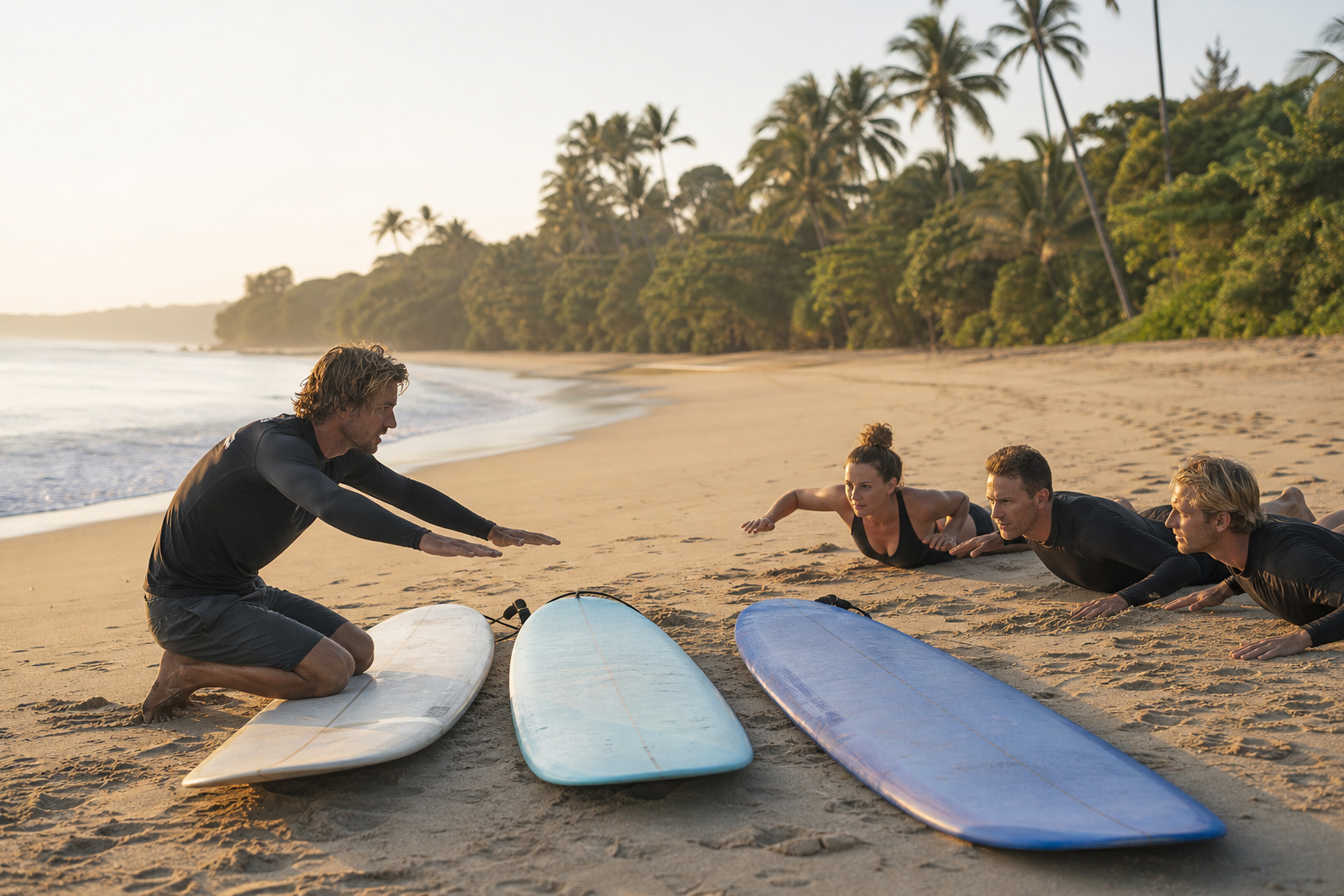
A hands-on briefing is often the first step in private surf clinics for small groups.
What Are Private Surf Clinics for Small Groups?
Private surf clinics for small groups are coaching sessions booked privately by one party rather than filled with unrelated students. In practice, this means two to six people share an instructor, board recommendations, and wave-by-wave feedback that is shaped around their collective goals. Because the group already knows each other, the atmosphere tends to feel relaxed, which often helps nervous first-timers get comfortable faster.
In contrast to a public lesson, where a single coach might be managing ten or more strangers, a small-group format keeps the ratio tight enough for genuine coaching rather than crowd supervision. Specifically, that lower ratio allows an instructor to watch each surfer’s paddle technique, pop-up timing, and board positioning on nearly every attempt, rather than only occasionally.
Why Choose Small-Group Surf Coaching Over a Standard Class
Standard group surf lessons are often built around volume, with schools fitting as many students into a session as safety rules allow. Small-group surf coaching flips that model, prioritizing depth of instruction over headcount. Therefore, participants usually catch more waves per hour and receive specific corrections instead of generic tips shouted from the beach.
Families and groups of friends also tend to prefer this format because it removes the awkwardness of being coached in front of strangers. In addition, instructors can adapt the session on the fly; for example, slowing down for a nervous beginner while giving an intermediate surfer in the same group a harder drill. For a closer look at how this compares to other formats, this guide on the core differences between group and private surf lessons breaks down the trade-offs in more detail.
Private Clinics vs Other Lesson Formats
The table below summarizes how the three most common surf lesson formats compare on group size, attention level, and pace of progress.
| Format | Typical Group Size | Instructor Attention | Learning Pace |
|---|---|---|---|
| Standard group class | 8 to 15+ | Shared, limited | Slower, generalized |
| Private surf clinic for small groups | 2 to 6 | High, per person | Faster, personalized |
| Solo private lesson | 1 | Exclusive | Fastest, individual |
How Private Surf Lessons for Small Groups Work, Step by Step
Most private surf lessons for small groups follow a predictable structure, whether the session runs 90 minutes or a full morning. Understanding the flow ahead of time helps groups arrive prepared and get more out of every wave. The steps below outline a typical clinic from booking through the final debrief.
- Book the clinic and share skill levels: Contact the surf school and reserve a time slot, letting them know the size of your group and the rough experience level of each participant so coaching can be planned in advance.
- Attend the land briefing: Arrive early for a short on-sand briefing covering board handling, paddling technique, ocean safety, and surf etiquette before anyone enters the water together.
- Paddle out as a coached group: Follow the instructor out to a beginner-friendly break where the whole group stays close together while the coach monitors wave conditions and timing for everyone.
- Receive individual feedback between waves: After each attempt, listen for specific correction on stance, timing, or paddle technique, since the small group size allows the instructor to address each surfer personally.
- Debrief and plan the next session: Wrap up with a short recap of what each person did well and what to focus on next time, helping the whole group track progress across future clinics.
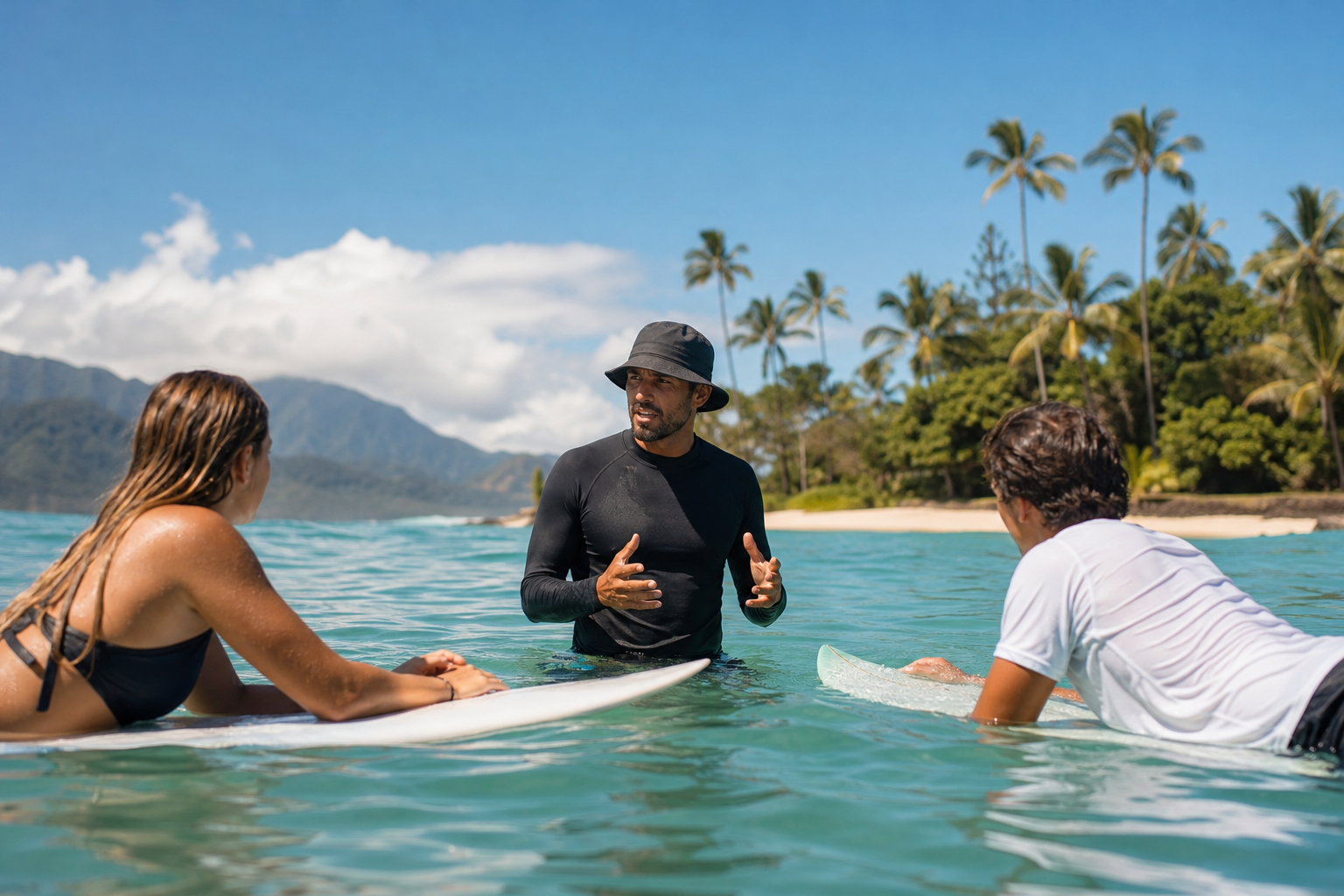
Real-time feedback in the water is a hallmark of small-group surf coaching.
Benefits of Personalized Surf Instruction in Small Groups
Personalized surf instruction in a small-group setting offers several advantages that are difficult to replicate in a large class. Above all, students simply catch more waves, since fewer people are rotating through the same lineup with one coach. Consequently, muscle memory for paddling and popping up tends to build faster when repetitions happen more frequently within a single session.
Safety also improves in smaller groups, because an instructor can keep visual contact with every surfer rather than losing track of students at the back of a crowd. This matters given how serious ocean hazards can be: the National Oceanic and Atmospheric Administration notes that rip currents are responsible for the majority of beach rescues performed by lifeguards each year, which underscores why close supervision matters for newer surfers. For those weighing their options, this breakdown of whether private lessons tend to be more effective explores the data-backed reasoning further.
Finally, personalized coaching tends to build confidence faster. When a surfer receives a specific correction right after a wipeout, instead of a generic tip, the next attempt usually improves noticeably. Over a single clinic, that compounding feedback loop can take someone from shaky pop-ups to riding consistent whitewater.
Private Surf Clinics vs Group Lessons: What’s the Real Difference?
On the surface, private surf clinics and group lessons look similar: both happen in the ocean, both involve an instructor, and both teach the same fundamentals of paddling, timing, and standing up. However, the experience underneath that surface is quite different. In a public group class, the instructor is often responsible for everyone on the beach, which naturally limits how closely any single student is watched.
By comparison, a private clinic reserved for a small group means the coach’s full attention belongs to that party for the entire session. As a result, drills can be adjusted mid-lesson, pacing can slow down or speed up based on how the group is doing, and quieter participants are less likely to get overlooked. For a side-by-side look at outcomes, whether private lessons beat group lessons is worth reading before you book.
Who Should Book a Small-Group Surf Session?
Small-group clinics suit a wide range of surfers. Families traveling together often choose this format so parents and kids can learn side by side, even if their skill levels differ. Likewise, groups of friends on vacation frequently prefer it over solo lessons because it keeps the experience social while still delivering real coaching. Meanwhile, local residents looking to refine technique sometimes book small clinics with a friend or two to split the cost of focused coaching time.
In short, if your group wants more than a generic crash course but doesn’t need the full exclusivity of a solo lesson, a small-group clinic usually hits the right balance. Programs built around personalized surf instruction designed to fast-track your progress are typically structured with exactly this kind of flexibility in mind.
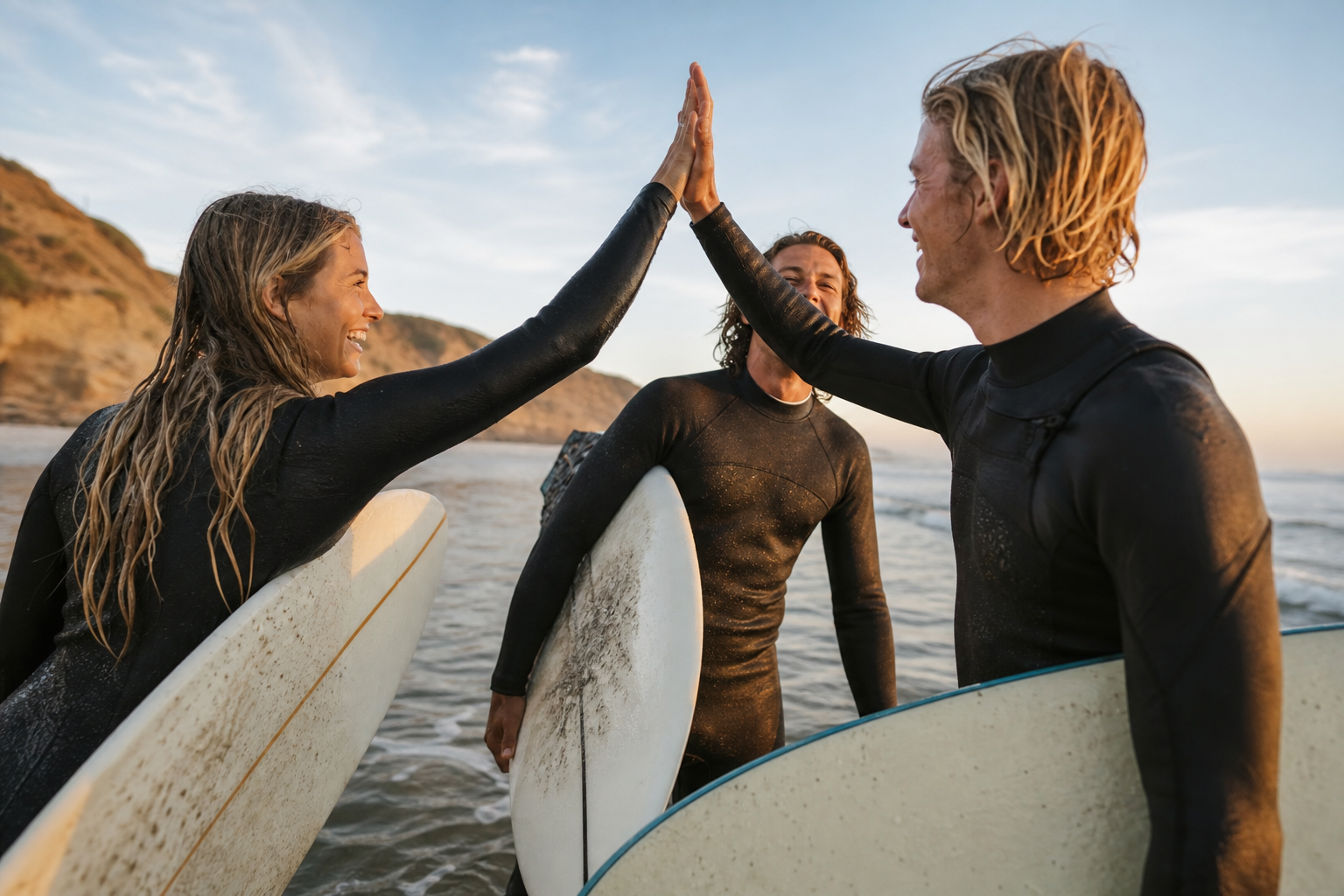
Shared progress is part of what makes small-group surf coaching enjoyable.
What to Expect During Your Private Surf Clinic
On the day of your session, expect to arrive a little before the scheduled start time for fitting boards and discussing conditions. Your instructor will typically check ocean conditions, explain the day’s plan, and set expectations for the group based on experience level. Specifically, beginners usually start on larger, more stable boards in whitewater, while intermediate surfers in the same group may be guided toward catching unbroken waves further out.
Throughout the session, coaching tends to rotate between brief group demonstrations and individual correction in the water. According to general guidance from the International Surfing Association, structured progression through fundamentals like paddling, positioning, and pop-up technique is key to building safe, competent surfers, which is exactly the kind of structure a dedicated instructor can provide more easily in a small group. If you want to compare local options, small group surf lessons in Waikiki is a useful starting point for understanding what’s available in that specific area.
You can learn more about the overall sport, its history, and its techniques through the general Wikipedia entry on surfing, which provides useful background before your first clinic. For current scheduling and instructor availability, the Star Beach Boys website lists session times and group options directly.
Frequently Asked Questions About Private Surf Clinics for Small Groups
What are private surf clinics for small groups?
Private surf clinics for small groups are coached surf sessions booked exclusively for a small party of friends, family, or coworkers rather than a public class. An instructor splits attention only among that group, giving everyone more wave time and more individual feedback.
How many people can join a private surf clinic for small groups?
Most private surf clinics for small groups work best with two to six participants, which keeps the instructor-to-student ratio low enough for real coaching. Larger parties can usually be accommodated by adding a second instructor.
How do private surf clinics for small groups differ from standard group lessons?
Standard group lessons often mix strangers of different skill levels into one large class, while a private clinic is reserved just for your group. This means the pace, drills, and coaching cues can be tailored to the specific people in the water.
Why choose private surf clinics for small groups over a solo private lesson?
A solo private lesson offers one-on-one attention, but a small-group clinic lets friends or family learn together while still getting individualized correction. Many people also find it more fun and less intimidating to progress alongside people they know.
How much do private surf clinics for small groups typically cost?
Pricing varies by location, session length, and group size, but private clinics generally cost more per person than a large public class and less per person than fully solo coaching. Many schools offer tiered group rates, so cost per surfer drops as the group grows.
How long does a typical private surf clinic session last?
Most sessions run between 90 minutes and two hours, which includes a land briefing, paddle-out time, and water coaching. Longer multi-hour or multi-day clinics are also available for groups wanting a structured progression.
What skill level is needed to join a small-group surf clinic?
No prior experience is required, since instructors adapt drills for complete beginners through intermediate surfers. Mixed-ability groups are common, and coaches simply give each person tasks suited to where they currently are.
What should I bring to a private surf clinic for small groups?
Bring swimwear, a towel, reef-safe sunscreen, water, and a rash guard if you have one. Boards, leashes, and often wetsuits are supplied by the surf school as part of the clinic.
What common mistakes do beginners make during small-group surf clinics?
Beginners often stand up too early, paddle too slowly into the wave, or position the board incorrectly on the face of the wave. A coach watching a small group can spot these patterns immediately and correct them before they become habits.
What safety measures are used during private surf clinics?
Reputable schools brief participants on currents, etiquette, and equipment use before anyone enters the water, and instructors stay close by in the lineup. Keeping the group small makes it easier for a coach to monitor everyone’s position and fatigue level at once.
Can families book private surf clinics for small groups together?
Yes, family bookings are one of the most common uses for this format, since parents and kids of different abilities can be coached at the same time. Instructors adjust pacing so younger or newer surfers get extra support while others work on technique.
How soon will I be able to stand up and ride a wave?
Many first-time surfers stand up and ride a small whitewater wave within their first session when coached closely. Consistently riding green, unbroken waves usually takes several sessions of practice.
Do I need to book a private surf clinic in advance?
Advance booking is strongly recommended, especially during peak season or for popular time slots like early morning. Booking ahead also lets the school match instructor availability and equipment to your group’s size and skill mix.
What makes Star Beach Boys a good choice for private surf clinics for small groups?
Star Beach Boys pairs small groups with experienced instructors who structure each clinic around the group’s actual skill levels rather than a one-size-fits-all script. The school serves tourists, families, and locals alike in a coastal setting known for favorable learning conditions.
Final Thoughts on Booking a Small-Group Surf Clinic
Choosing between formats ultimately comes down to what your group values most: pure exclusivity, pure budget, or a balance of both. Private surf clinics for small groups tend to hit that balance well, delivering closer coaching than a crowded class while keeping the experience social and shareable. Whether you are traveling with family, bringing a group of friends on vacation, or simply want focused practice with a partner, this format gives an instructor room to actually watch, correct, and encourage every person in the water. In the end, that level of attention is often what separates a forgettable first attempt at surfing from a session people talk about for years.