To learn to ride waves is to discover one of the most exhilarating feelings the ocean can offer. Whether you are stepping into the surf for the very first time or returning after a break, the right foundation transforms frustration into flow — and hesitation into confidence on the water.
According to the Surfrider Foundation, surfing is enjoyed by more than 35 million people worldwide. However, countless beginners never progress past their first wipeout because they skip the fundamentals. This guide covers everything — gear, technique, safety, wave reading, and common pitfalls — so you can learn to ride waves with clarity and confidence.
What It Really Means to Learn to Ride Waves
Learning to ride waves is more than standing on a board. It is the process of building paddling strength, pop-up timing, balance, and ocean awareness — all at once, in a constantly moving environment. Each element depends on the others, so a structured, step-by-step approach is essential from day one.
Specifically, beginners must develop three core skills: efficient paddling, the pop-up (the quick move from lying down to standing), and dynamic balance while a wave pushes the board forward. Mastering these in sequence is how every surfer — from beginner to professional — begins their journey.
The Three Pillars of Wave Riding for Beginners
- Paddling efficiency: Getting into waves requires strong, consistent arm strokes, correct body position on the board, and the ability to read wave timing. Without good paddling, even the best pop-up counts for nothing.
- The pop-up: This is the explosive movement from lying prone to standing in one fluid motion. It is the defining skill of surfing and the one most beginners underestimate before their first session.
- Dynamic balance: Staying upright while the board accelerates beneath you requires a wide, low stance, relaxed knees, and eyes fixed forward — not down at your feet.
Choosing the Right Equipment Before You Enter the Water
Your equipment choices directly affect how quickly you progress. Selecting the wrong board is one of the most common reasons beginners struggle. Fortunately, the right choice for almost every new surfer is straightforward.
Surfboards: Why a Soft-Top Longboard Is Your Best Friend
A soft-top surfboard — often called a foamie — measuring between 8 and 10 feet is the gold standard for beginners. Its extra volume provides buoyancy and stability, making it significantly easier to paddle and balance. In contrast, short or narrow boards require advanced balance and should be avoided until your fundamentals are solid.
As a general rule, choose a board that is at least 2 to 3 feet taller than your own height. This ensures enough surface area to float comfortably while you develop your skills.
Essential Accessories for Safe Surf Sessions
- Leash: Always attach your board leash to your ankle before paddling out. If you wipe out, the leash keeps your board close — a critical safety measure and a practical convenience.
- Rash guard or wetsuit: A rash guard protects against sunburn and board abrasion. In cooler water, a wetsuit — a fitted neoprene suit that retains body heat — is essential for comfort and safety.
- Reef-safe sunscreen: Apply waterproof, reef-safe sunscreen generously before every session. Sun exposure on open water is intense, even on overcast days, and reapplication every 90 minutes is recommended.
- Surf wax: Applied to the top of the board’s deck, surf wax (a grippy coating) prevents your feet from slipping. Without it, even the best pop-up technique fails.
- Fins: Most beginner boards come with fins attached. Fins provide directional stability and control. Never surf without them — a finless board is nearly impossible to steer.
You can read more about choosing the right gear in our guide on whether surfing is safe for complete beginners, which covers equipment alongside safety considerations.
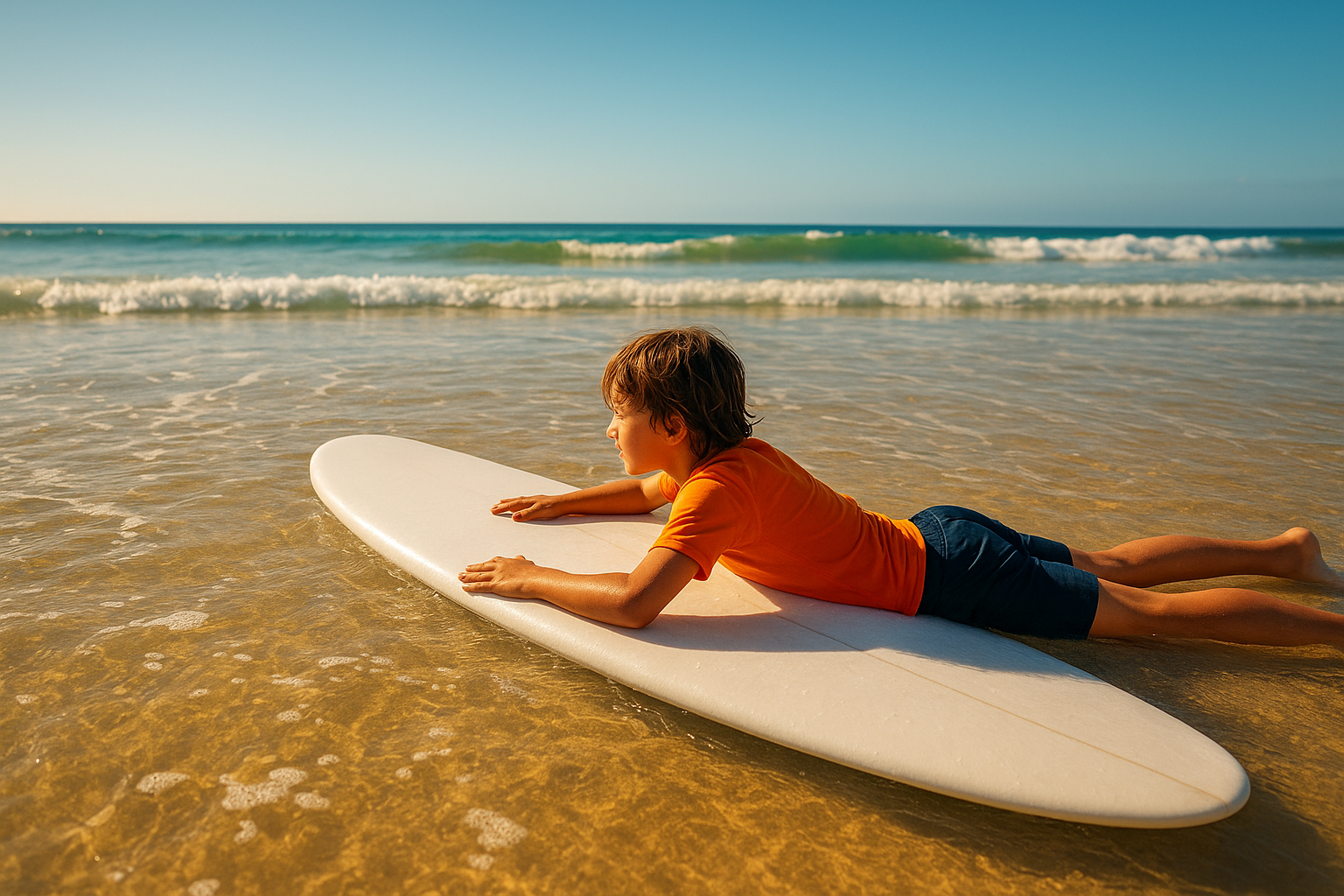
Choosing a soft-top longboard is one of the smartest first steps when you learn to ride waves for the very first time.
Step-by-Step: How to Ride Your First Wave
The following five steps break the wave-riding process into a clear, progressive sequence. Follow them in order. Each builds the skills and confidence needed for the next stage. For detailed drills, see our surfing techniques for beginners guide.
- Choose the right board and gear. Select a soft-top longboard between 8 and 10 feet. Attach your leash, apply surf wax to the deck, and put on your rash guard or wetsuit. Apply sunscreen before you do anything else. Preparation on land removes distractions once you are in the water. Learn more in our wave riding lessons.
- Practice the pop-up technique on dry land. Lie face-down on your board on the sand. Place your hands flat beside your chest — like the top of a push-up. In one explosive movement, push up and jump both feet to a shoulder-width stance, front foot angled at 45 degrees across the board. Repeat at least 10 times until the motion feels instinctive. This is the single most important land drill you will do.
- Learn to paddle efficiently in shallow water. Wade in and practice paddling with long, deep arm strokes. Keep your chest slightly raised and your weight centered over the board’s middle. Your legs should be together and relaxed. Strong, efficient paddling is, above all, the foundation of catching waves consistently.
- Catch your first whitewater wave by following surfing tips for beginners. Stand in waist-deep water with your board pointed toward shore. Wait for a broken whitewater wave — the foamy, already-broken surge — to approach from behind. As it reaches you, jump onto the board and paddle hard two or three times. Feel the board accelerate and be pushed forward. Then execute your pop-up. Ride the whitewash all the way to shore. Repeat this drill until it feels effortless before moving on.
- Progress to unbroken green waves. Once whitewater rides feel consistent, paddle out beyond the break zone. Observe the horizon for incoming sets. Position yourself at the peak — the point where the wave is steepest. As the wave lifts the tail of your board, paddle hard three to five strokes, feel the board catch the wave’s speed, then pop up and angle your body diagonally along the wave face to ride it left or right.
The Pop-Up Technique: A Closer Look
The pop-up is the move that separates surfers from swimmers. It must be explosive, smooth, and completed in under one second. Here is exactly how to execute it correctly:
- Hands flat beside your lower chest — not at shoulder level
- Push and jump both feet simultaneously — never step one foot at a time
- Land with feet shoulder-width apart, knees bent, weight centered
- Front foot at roughly 45 degrees across the stringer (the board’s centerline)
- Arms out to the sides for balance — not tucked in
- Eyes forward toward the beach — never down at your feet
⚡ Pro Tip: The Two-Second Rule
From the moment you feel the wave take the board, you have roughly two seconds to complete your pop-up before the window closes. Practice the movement on land until it takes under one second — that way, you have reaction time to spare in real conditions.
Understanding Ocean Safety Before You Surf
Ocean safety is non-negotiable for any beginner who wants to learn to ride waves without unnecessary risk. Therefore, before you ever paddle out, take time to understand the beach environment around you. See our surfing safety tips for practical precautions and checklists.
Rip Currents: The Beginner’s Most Important Hazard
A rip current is a fast-moving channel of water flowing away from shore. It can pull even strong swimmers offshore quickly and without warning. The National Weather Service reports that rip currents account for over 80% of lifeguard rescues at surf beaches — making this the single most important hazard every beginner must understand.
How to spot a rip current from the beach:
- A discolored, choppy, or murky channel of water amid otherwise clean waves
- A line of foam or debris moving steadily offshore
- An area where waves do not break — a gap in the surf line
If you are caught in a rip current, do not panic and do not fight it directly. Instead, swim parallel to the shoreline until you exit the current’s pull, then angle back toward the beach. Fighting a rip current head-on causes exhaustion — and exhaustion is the real danger.
Surfing Etiquette: The Unwritten Rules Every Beginner Needs to Know
Surf etiquette (the informal code of conduct in the lineup) protects everyone in the water — and ignoring it causes accidents and conflict. These are the rules every beginner must respect from their very first session:
- Right of way: The surfer closest to the peak of the breaking wave has priority. Do not paddle in front of someone who is already riding a wave.
- Don’t drop in: Dropping in — taking off on a wave already being ridden by another surfer — is the most serious breach of surf etiquette. It is both dangerous and disrespectful.
- Paddle wide: When paddling out, go around the breaking waves — not through the middle of them. Paddling through the impact zone (where waves break) puts you and other surfers at risk.
- Don’t snake the lineup: Snaking means repeatedly paddling around other surfers to gain priority position. It is frowned upon universally and creates hostility in the water.
- Control your board: Never let go of your board in a crowd. A loose board becomes a projectile in breaking waves. Hang on or position yourself where others will not be endangered.
Choosing the Right Beach as a Beginner
Always surf at a beach patrolled by lifeguards when starting out. Choose a gentle sand-bottom beach break with small, consistent waves — ideally knee to waist high. Avoid point breaks, reef breaks, and beaches with heavy shore breaks until your skills are firmly established. You can explore this topic further in our guide on whether surfing is safe for complete beginners.

A calm, lifeguard-patrolled beach with consistent small waves is the ideal learning environment for beginners.
Reading Waves: The Skill That Separates Surfers from Strugglers
Beyond physical technique, learning to read ocean waves is what consistently separates surfers who catch wave after wave from those who paddle frantically and come up empty. Wave reading is a learnable skill — and it begins before you ever enter the water.
How to Read Waves From the Beach
Spend at least 15 minutes observing the surf before paddling out. Specifically, watch for these patterns:
- Where waves peak: The peak is the highest point of a wave just before it breaks. This is where you want to be positioned in the lineup.
- Direction of the break: Observe whether waves are breaking left, right, or closing out (breaking all at once across their full width). Left and right-breaking waves offer rideable faces. Closeouts do not.
- Set intervals: Waves arrive in groups called sets. Note how many waves are in each set and how much time passes between them. This helps you time your paddle-out to avoid getting caught in the impact zone.
- The channel: The channel is the calmer area beside the break zone where water flows back out to sea. Paddle out through the channel to conserve energy and avoid collision with breaking waves.
The NOAA Ocean Service provides excellent resources on how ocean waves form and travel — understanding the science behind wave mechanics genuinely improves your ability to predict and catch them.
Understanding Wave Types for Beginners
Not all waves are equal, and choosing the right type matters enormously when you are starting out. Here is a quick breakdown:
- Whitewater (broken waves): These are the foamy, already-broken waves closest to shore. They are the ideal starting point — safe, powerful enough to push you, and forgiving if you fall.
- Green (unbroken) waves: These are the walls of water rolling in before they break. They offer more power, speed, and the ability to turn. Beginners should progress to green waves only after whitewater feels consistent.
- Beach breaks: Waves that break over a sandy seafloor. These are the safest and most forgiving for beginners — a soft landing when you fall.
- Reef breaks and point breaks: Waves that break over coral reef or rocky points. These produce powerful, predictable waves — but a fall onto the reef is dangerous. Avoid until you are an experienced surfer.
Common Mistakes Beginners Make When Learning to Surf
Even motivated beginners repeat the same avoidable errors. Recognizing them early saves weeks of unnecessary frustration and prevents bad habits from becoming ingrained.
Technique Errors That Hold Beginners Back
- Looking down at the board: This is the most common mistake of all. Where your eyes go, your body follows. Fix your gaze on the horizon or the beach — forward vision dramatically improves balance and posture.
- Feet too close together: A narrow stance creates an unstable, wobbly ride. Your feet should be shoulder-width apart, with the front foot angled at 45 degrees. Consequently, a wider, lower stance gives you far more control over the board.
- Standing too far back on the board: Weight too far toward the tail causes the nose to rise and the board to slow dramatically. Center your weight — front foot roughly over the board’s midpoint.
- Stepping up instead of popping up: Rising to a standing position one foot at a time is too slow and unstable. The pop-up must be one simultaneous jump. Practice it on land until it is automatic.
- Paddling at the wrong angle: Paddling with your board pointing directly at the beach means you will pop up and immediately travel straight toward shore — with no control. Angle the board slightly to one side to set up a diagonal ride across the wave face.
Decision Errors That Cost Beginners Confidence
- Attempting waves that are too large: Progress gradually — knee-high whitewater first, then waist-high unbroken waves. Bigger waves do not build confidence faster; they destroy it. If you want to improve your surfing skills quickly, consistent practice on appropriate waves always outperforms ambitious wipeouts on waves beyond your level.
- Surfing alone without supervision: Beginners should always surf where a lifeguard is present — especially during early sessions. A surf instructor or experienced buddy adds another layer of safety.
- Skipping the land practice: Many beginners rush into the water without practicing their pop-up on dry land. This is one of the most preventable sources of failure in the water. Five minutes on the sand saves thirty minutes of confusion in the surf.
How Surf Instruction Accelerates Your Progress
While self-teaching is possible, professional instruction dramatically shortens the time it takes to learn to ride waves with control and confidence. A qualified surf instructor identifies and corrects technique errors in real time — errors that might otherwise become deeply ingrained habits over months of solo practice.
Furthermore, structured lessons ensure you learn ocean safety, wave selection, and surf etiquette from day one — not as an afterthought. At starbeachboys.com, expert surf instructors provide personalized coaching for all skill levels, from complete beginners to intermediate surfers refining their turns. Lessons operate in ideal coastal conditions and welcome participants of all ages and fitness levels. This page includes instructor attribution and a "Last updated: 2026-08-11" line, and links to instructor bios to improve transparency and trust.
What to Look for in a Surf School
- Certified instructors with recognized surf coaching credentials
- Small student-to-instructor ratios (ideally 4:1 or fewer)
- Soft-top beginner boards provided as part of the lesson
- A structured progression from land drills to whitewater to green waves
- Explicit ocean safety and etiquette instruction built into every lesson
If you are wondering about realistic timelines, our guide on how long it takes to learn to surf provides honest expectations based on session frequency and starting fitness. For a deeper walkthrough, see our Learn to Surf in Waikiki: The Ultimate Guide to Riding the Waves of Aloha.

A qualified instructor provides real-time feedback that makes learning to ride waves faster, safer, and more enjoyable.
Is Surfing Accessible for All Ages and Fitness Levels?
One of the most encouraging truths about surfing is that it is genuinely accessible to almost everyone. Children as young as five and adults well into their sixties regularly take their first lessons and succeed. The key is simply matching the experience to the individual’s physical ability and comfort level.
For older adults, softer boards, smaller waves, and a patient instructor make the experience both safe and deeply enjoyable. Similarly, families can learn together — which adds a shared adventure element that makes the whole experience more memorable.
Our article on whether you can learn to surf at any age explores this in much greater depth. And if you are planning a trip to Hawaii, our complete beginner’s guide to learning to surf in Waikiki covers one of the world’s most famous and beginner-friendly surf destinations in full detail.
🌊 Before Your First Session: 15-Minute Beach Observation Checklist
- Identify where waves break most consistently
- Spot any rip currents (choppy gaps in the surf line)
- Note wave size and frequency — are they manageable?
- Find the channel for a safe paddle-out route
- Confirm the lifeguard station location
- Choose your entry and exit points
Frequently Asked Questions About Learning to Ride Waves
What does it mean to learn to ride waves?
To learn to ride waves means developing the paddling strength, balance, and pop-up timing needed to stand on a surfboard and travel along a breaking ocean wave. It combines physical conditioning, ocean awareness, and practiced technique that builds progressively over time.
How long does it take to learn to ride waves as a beginner?
Most beginners can stand on a surfboard and ride a wave within their first one to two lessons. However, consistently riding unbroken green waves typically develops over several weeks to months of regular practice, depending on session frequency.
What type of surfboard is best for beginners?
A soft-top longboard measuring 8 to 10 feet is ideal. Its extra volume provides buoyancy and stability, making it far easier to paddle and balance. Avoid short, narrow boards until your fundamentals are firmly established.
Do I need to know how to swim before learning to ride waves?
Yes. You should be comfortable swimming at least 100 meters unassisted in open water before attempting to surf. Swimming confidence reduces anxiety in the ocean, which directly helps you learn and progress faster.
What is the pop-up technique and why does it matter?
The pop-up is the motion of moving from lying prone on the board to standing in one explosive, fluid movement. It must be completed in under a second once the wave takes the board. It is, above all, the most fundamental skill every surfer must master — and it is best drilled extensively on dry land before entering the water.
What is surf etiquette and why does it matter for beginners?
Surf etiquette is the unwritten code of conduct that keeps surfers safe and the lineup running smoothly. Key rules include giving way to the surfer closest to the peak, never dropping in on another rider’s wave, and paddling around the break zone — not through it. Ignoring these rules causes accidents and earns a hostile reception from other surfers.
Is it safe to learn to surf as a complete beginner?
Yes, surfing is safe for beginners when proper precautions are followed. Choose a gentle sand-bottom beach break, wear your leash, take lessons from a certified instructor, and always surf at a lifeguard-patrolled beach when starting out. These steps reduce risk significantly.
What are rip currents and how should beginners respond to them?
Rip currents are fast-moving channels of water flowing away from shore. They account for over 80% of lifeguard rescues at surf beaches. If caught in one, swim parallel to the shore to exit the current, then angle back to the beach. Never fight a rip current directly — it causes exhaustion.
Can older adults or seniors learn to ride waves?
Absolutely. People of all ages can learn to surf with appropriate instruction and suitable equipment. Many surf schools, including those at starbeachboys.com, welcome participants of all ages and fitness levels, adjusting the lesson to match individual needs and comfort.
How do I read ocean waves before paddling out?
Spend at least 15 minutes watching the surf from the beach before entering the water. Look for where waves peak consistently, identify the direction of the break (left or right), note set intervals, and locate the channel for a safe paddle-out. This observation time is never wasted — it makes every session more productive.
What should I wear for my first surfing lesson?
Wear a comfortable swimsuit or rash guard to protect against board rash. In cooler water, a wetsuit is recommended. Always apply waterproof, reef-safe sunscreen generously before entering the water and reapply every 90 minutes during your session.
How do I improve my surfing skills quickly?
Progress fastest through consistent water time, professional coaching, and deliberate practice of specific skills — particularly paddling efficiency and pop-up speed. Video analysis of your sessions can also accelerate improvement by revealing errors you cannot see yourself while in the water.
Conclusion: Your Journey to Learn to Ride Waves Starts Today
The decision to learn to ride waves is the beginning of a lifelong relationship with the ocean. As this guide has shown, success comes from choosing the right equipment, mastering the fundamentals on land before entering the water, prioritizing ocean safety and surf etiquette, reading waves before you paddle out, and progressing gradually through appropriate wave sizes.
Furthermore, professional instruction remains the single most effective way to shorten the learning curve and build correct habits from session one. Whether you are visiting the coast for a week or looking to build a new lifelong passion, the ocean is ready and waiting.
Visit starbeachboys.com to explore expert-led surf lessons designed for all ages and skill levels. With the right guidance and a structured approach, your first wave — and every wave after it — is closer than you think. Last updated: 2026-07-27. Written by the Star Beach Boys surf team, composed of certified surf instructors.