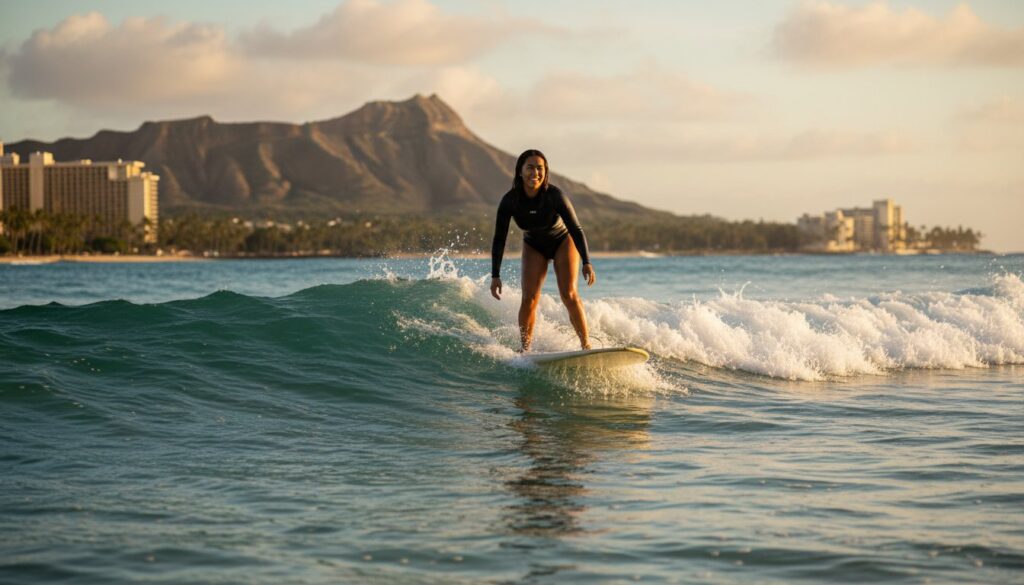
Ancient Hawaiians rode these waves centuries before surfing spread to the rest of the world. That same stretch of ocean now welcomes thousands of first-timers every year, and with good reason: Waikiki’s conditions are almost impossibly forgiving. More than 90% of beginners stand up on their very first wave here — a statistic no other surf destination in the world can match.
This guide covers everything you need to know before booking your lesson: what to expect in the water, how much it costs, how to choose the right school, what the best time of year is, and answers to every question a first-time surfer could have.
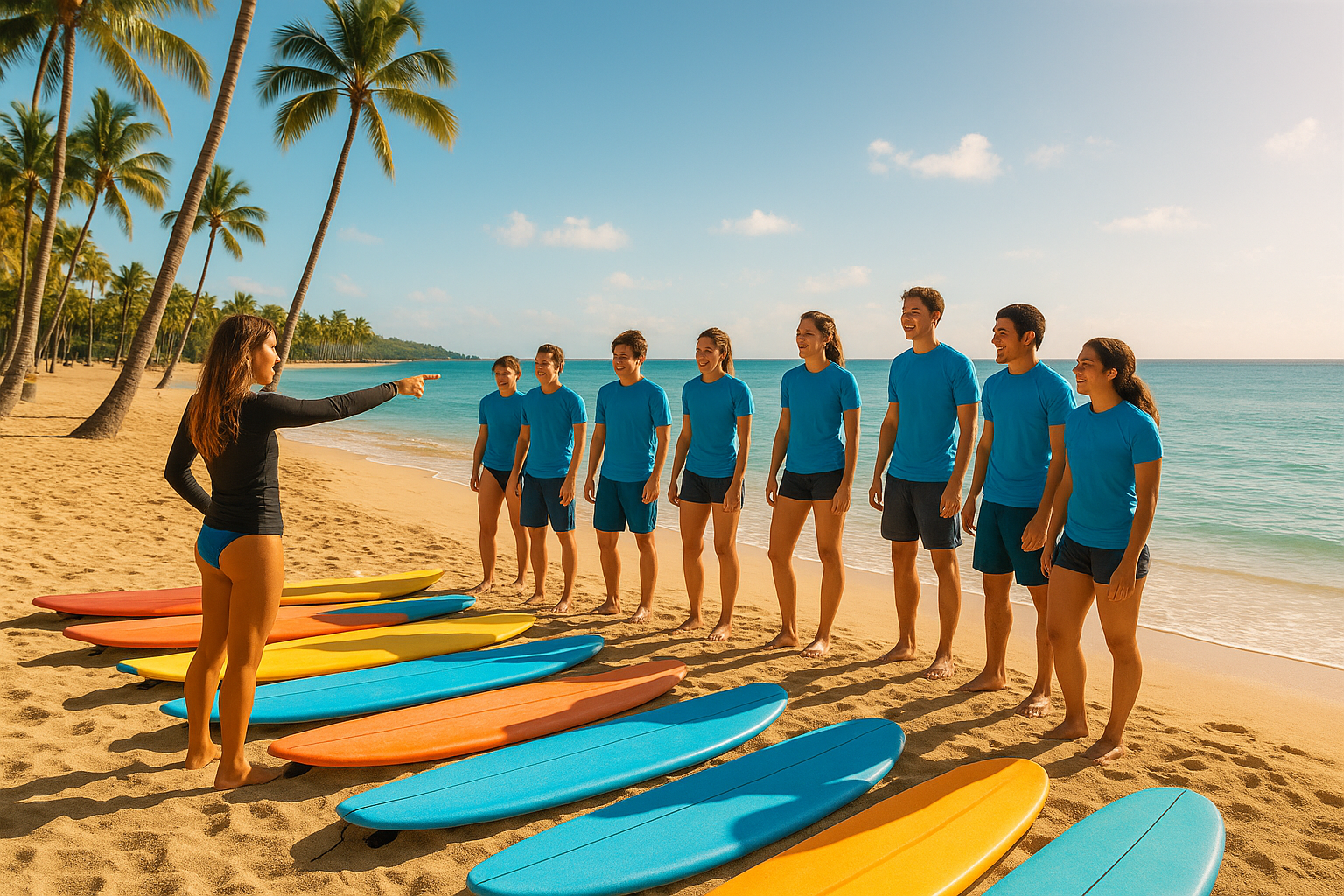
Waikiki surf lessons bring together beginners of all ages on one of the world’s most iconic beaches.
What Are Waikiki Surf Lessons?
Waikiki surf lessons are structured, instructor-led sessions held directly on Waikiki Beach in Honolulu, Oahu, Hawaii. Certified coaches guide students through every stage of learning — from paddling technique and the pop-up move to reading waves and practicing surf etiquette — all within one of the world’s safest and most consistent surf environments.
Every lesson follows a proven structure: a 15–20 minute land-based briefing on the sand covers the mechanics of the pop-up (the quick motion from lying flat to standing), how to position yourself on the board, paddling technique, and critical ocean safety rules. Then students enter the water with their instructor for hands-on wave riding.
Unlike surf spots with cold water, powerful shore breaks, or rocky bottoms, Waikiki offers a combination of conditions that makes learning almost effortless: warm 78°F (26°C) water, small 1–3 foot waves, a sandy bottom, and shallow water close to shore. This is why surf schools have operated here continuously for over a century, and why Waikiki remains the undisputed capital of beginner surfing worldwide.
Why Waikiki Is the World’s Best Place to Learn to Surf
Many beaches around the world offer surf lessons. None of them compare to Waikiki for beginners — explore the best Waikiki beaches. Here is why this stretch of coastline stands in a class of its own.
Perfect Wave Conditions for Beginners
Waikiki’s reef creates slow, long-period waves that give beginners extra time to pop up and find their footing. Summer south swells produce consistent 1–3 foot waves. These are not the powerful, hollow waves of the North Shore — they are gentle, rolling, and forgiving. Even if you fall (and you will), the soft sandy bottom and shallow water mean the consequences are minimal.
Warm Water Year-Round
Water temperature at Waikiki hovers between 75°F and 82°F (24°C–28°C) throughout the year. You never need a wetsuit. This makes the experience dramatically more comfortable for first-timers, who are already managing their balance, their breathing, and the instructor’s instructions — adding cold-water discomfort to that mix would make everything harder.
A Rich History of Teaching Surfing
Surfing was invented by ancient Hawaiians at Waikiki over 1,000 years ago. The legendary Duke Kahanamoku — considered the father of modern surfing — learned and taught on this very beach in the early 20th century. Waikiki’s surf culture runs so deep that teaching beginners is baked into its identity. The instructors here have refined their craft over generations.
The Highest First-Wave Success Rate in the World
Studies and school data consistently show that more than 90% of beginner surfers stand up on their first wave during a Waikiki surf lesson. This is not a marketing claim — it is a direct result of Waikiki’s ideal conditions combined with its experienced coaching culture. No other beginner surf destination comes close to this statistic.
Types of Waikiki Surf Lessons: Which One Is Right for You?
Waikiki surf schools offer several lesson formats to match different skill levels, budgets, and goals. Understanding the differences helps you pick the right experience from day one — learn where to find lessons.
Group Surf Lessons
Group lessons are the most popular format at Waikiki, pairing one certified instructor with two to four students. They are social, energetic, and affordable — typically costing between $30 and $75 per person for a 60–90 minute session. Group lessons are ideal for travelers, families, and casual learners who want a fun experience without needing rapid technical improvement.
Private Surf Lessons
Private lessons deliver undivided, one-on-one attention from start to finish. Your instructor can observe every detail of your paddling, pop-up, and stance, providing tailored corrections in real time. Private sessions typically cost between $100 and $200 per hour and are the fastest way to build skills if you plan to surf more seriously. They are also ideal for children who benefit from dedicated supervision.
Semi-Private Lessons (2-Person)
Some schools offer semi-private lessons for two students sharing one instructor. This is a smart middle-ground option — you get significantly more personalized attention than a group lesson, at a lower price than a full private session. It is particularly well-suited for couples or two friends learning together.
Multi-Day Surf Packages and Clinics
Visitors staying in Honolulu for a week or more should seriously consider a multi-lesson package. Most schools offer 3–5 session bundles at a 15–25% discount compared to single-lesson rates. Progressive instruction across multiple days builds fundamentally stronger surfing than a single session ever can. By lesson three, most students are paddling out independently and selecting their own waves.
Kids’ Surf Programs
Many Waikiki surf schools run dedicated kids’ programs for ages 5 and up. These use age-appropriate foam boards, child-friendly instructors, and modified lesson pacing to make learning surfing safe and enjoyable for young students. Learn more about kids surf lessons. Children as young as five have successfully stood up on their first wave at Waikiki under proper instruction.
How to Book and Prepare for Your Waikiki Surf Lesson
Booking a book a surf lesson in Waikiki is straightforward, but a little preparation goes a long way toward making your experience smoother, safer, and more enjoyable. Follow these five steps:
- Choose a reputable, certified surf school. Research schools by reading verified reviews on Google or TripAdvisor, checking that instructors hold certifications from recognized bodies like the International Surfing Association (ISA), and confirming small group-size policies. Look for schools with transparent pricing, clear safety protocols, and a strong local reputation. Established providers like Star Beach Boys have built decades of credibility on Waikiki Beach. Learn more about local options at Honolulu surf lessons.
- Book in advance, especially in summer. Waikiki’s most popular lesson windows — particularly weekend mornings from June through August — fill up quickly. Reserve your spot at least 2–3 days ahead during peak season. Most schools offer convenient online booking and accept credit cards. If your plans are flexible, weekday morning sessions often have more availability and smaller groups.
- Prepare your gear and arrive 15 minutes early. Wear a well-fitted swimsuit. Apply a generous layer of reef-safe, water-resistant sunscreen before leaving your accommodation — not in the parking lot. Bring a towel, a bottle of water, and a small snack for after. Most schools provide surfboards (typically large, stable foam “longboards” or “softtops”) and rash guards at no extra charge. Leave jewelry and valuables at your hotel.
- Engage fully during the land-based safety briefing. This 15–20 minute session on the sand is not filler — it is the foundation of your entire lesson. Your instructor will demonstrate the pop-up technique, explain correct board positioning, cover how to read incoming waves, teach you how to fall safely (yes, there is a right way), and walk through surf etiquette rules so you can interact safely with other surfers in the water. The more you absorb here, the faster you will progress in the ocean.
- Enter the water and commit to the process. Follow your instructor into the surf zone, practice your paddle strokes, and be ready to pop up the moment your coach says “go.” Instructors will often push students into waves from behind to give them a controlled boost. Trust the process — most students ride their first wave within 20 minutes of entering the water. After each ride, your instructor will give specific, actionable feedback to help you improve immediately.
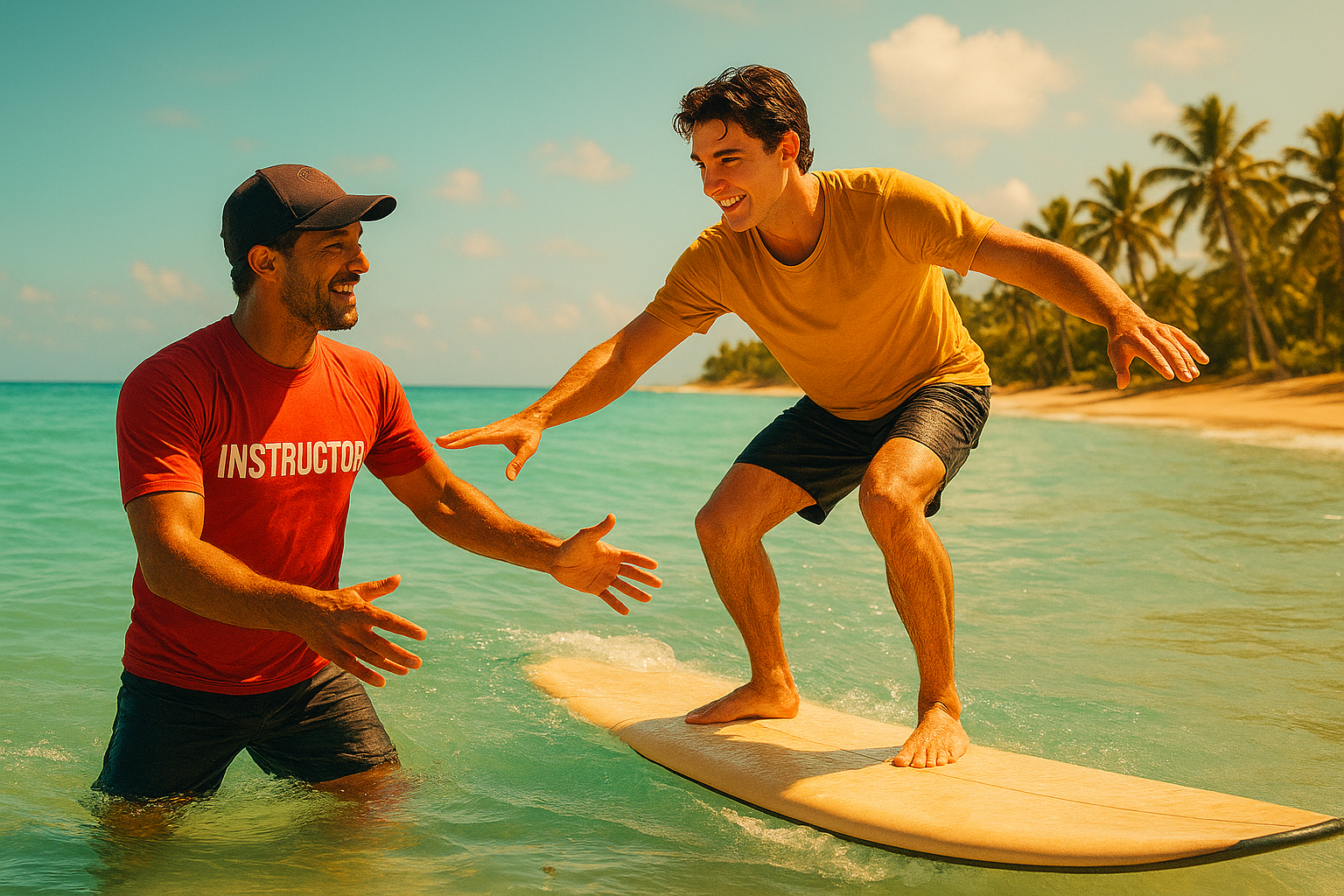
Expert instructors provide hands-on support to help every student ride their first wave with confidence.
What to Expect During Your First Waikiki Surf Lesson
First-time nerves are completely normal. Nearly every student feels a flutter of anxiety before entering the ocean for the first time with a surfboard. Within minutes of starting, that anxiety almost universally transforms into excitement. Here is exactly what your lesson will look like:
The Land Briefing (First 15–20 Minutes)
You will meet your instructor on the beach, where they will lay a board flat on the sand and walk you through the fundamental movements. You will practice the pop-up multiple times until the sequence — lying flat, hands planted near your chest, explosive push-up, front foot forward, arms out for balance — starts to feel natural. This muscle memory practice makes a significant difference once you are on a moving wave.
Paddling Out (Minutes 20–30)
Your instructor will lead you into the water, guiding you past the small shore break into the lesson zone. You will practice paddling technique — long, deep strokes with cupped hands, keeping your chest raised and your feet together at the tail of the board. Efficient paddling is the foundation of all surfing, and instructors spend real time on this phase rather than rushing students to catch waves before they are ready.
Catching Your First Waves (Minutes 30–75)
This is the moment every student has been waiting for. Your instructor will position you on the board, call out when a wave is approaching, and give you a push at exactly the right moment. As the wave catches the board and you feel the acceleration, you will hear “pop up!” — and if you have practiced the movement on land, your body will respond. Most beginners successfully stand up within their first three attempts at Waikiki.
Between rides, your instructor will give you specific feedback: maybe your feet were too close together, maybe you looked down instead of forward, maybe you need to arch your back more during the push. This real-time coaching loop — try, fall, feedback, try again — is what accelerates learning so dramatically at Waikiki.
After the Lesson: What Comes Next
After your session, most instructors offer brief post-lesson feedback covering what you did well and specific areas to work on. This is an ideal time to ask about booking a follow-up session, renting a board for independent practice later in the day, or upgrading from a group to a private format for your next lesson. Many schools also allow students to keep their rented board on the beach for an additional hour of solo practice at a nominal cost.
Expert Tips for Getting the Most Out of Your Waikiki Surf Lesson
The difference between a good first lesson and a great one often comes down to a handful of details that no one tells beginners in advance. These tips come from experienced Waikiki instructors:
- Book a morning lesson (8am–10am). Trade winds in Hawaii pick up in the afternoon, creating choppier, less predictable surf conditions. Morning sessions offer the calmest, glassiest water and the cleanest wave faces — ideal for beginners.
- Stay loose and breathe. Physical tension is the number-one enemy of balance on a surfboard. Consciously relax your shoulders, loosen your grip on the rails, and breathe steadily. You are not fighting the ocean — you are working with it.
- Fix your gaze on the horizon, not the board. Looking down is the single most common mistake beginners make, and it almost always leads to a fall. Pick a point on the horizon and keep your eyes there from the moment you pop up.
- Bend your knees and drop your hips. A lower center of gravity gives you dramatically more stability. Most beginners instinctively stand straight-legged, which is why they wobble. Bend those knees — it makes everything easier.
- Commit to the pop-up without hesitation. A half-hearted pop-up is worse than no pop-up at all. When your instructor says go, go fully. Hesitation causes the weight shift that sends you sideways.
- Apply sunscreen before you leave the hotel. Many beginners apply sunscreen hastily at the beach, don’t let it absorb, and end up with it in their eyes the moment they hit the water. Apply it 30 minutes before your lesson begins.
- Eat a light meal, not a full one. You will be physically active in the water. A heavy meal 30 minutes before paddling is not a combination that works in your favor. Eat a light snack 1–2 hours before the lesson.
- Ask your instructor about your stance. Roughly 65% of surfers are regular-stance (left foot forward), and 35% are goofy-stance (right foot forward). If your instructor doesn’t determine your natural stance during the land briefing, ask — surfing from the wrong stance makes everything significantly harder.
How Much Do Waikiki Surf Lessons Cost?
Waikiki surf lesson pricing is competitive and relatively standardized across schools, though there is some variation based on lesson type, instructor credentials, group size, and session duration. Here is a detailed breakdown:
Waikiki Surf Lesson Price Guide
- Group lesson (1 instructor : 2–4 students): $30–$75 per person / 60–90 minutes
- Semi-private lesson (1 instructor : 2 students): $80–$130 per person / 60–90 minutes
- Private lesson (1-on-1): $100–$200 per hour
- Multi-lesson package (3–5 sessions): 15–25% discount off single-session rates
- Kids’ surf program: $40–$80 per child / 60 minutes (varies by school)
- Board and rash guard rental (post-lesson solo practice): $15–$30 per hour
Most schools include surfboard and rash guard rental in the lesson price. There are typically no hidden fees, though some schools charge separately for parking or locker use. Always confirm exactly what is included before booking.
Resort activity desks at Honolulu hotels sometimes offer surf lesson packages bundled with other water activities at a discount. If your accommodation has an activity concierge, it is worth asking about bundled rates before booking directly with a surf school.
For current pricing, availability, and to book directly with one of Waikiki’s most respected operators, visit starbeachboys.com.
How to Choose the Best Waikiki Surf School find the best instruction
There are dozens of surf schools operating on Waikiki Beach, and the quality difference between them is real. These are the criteria that actually matter when choosing where to book your lesson — read our best surf school recommendations:
- ISA-certified or equivalent instructor credentials. The International Surfing Association offers globally recognized instructor certification. Schools whose instructors hold ISA credentials have met a defined standard for surf coaching competency and safety knowledge.
- Small, enforced group sizes. A ratio of more than 4 students per instructor dilutes the quality of instruction and reduces safety supervision. Ask explicitly what the maximum group size is — not what it typically is.
- Verified reviews across multiple platforms. Check Google, TripAdvisor, and Yelp. Look for consistent praise of specific instructors by name, and pay attention to how schools respond to negative reviews. Volume of reviews matters too — a school with 1,000 reviews averaging 4.8 stars is more reliable than one with 12.
- Clear refund and cancellation policy. Weather changes, schedules shift. A reputable school has a transparent, fair policy for cancellations and rescheduling. Avoid schools with aggressive no-refund terms.
- Quality equipment. Better schools use modern foam longboards from brands like Wavestorm or custom school boards — wide, stable, and forgiving. Ask what boards they provide before booking. A poor board choice can undermine even excellent instruction.
- Physical location on the beach. Schools with a dedicated beach presence (not just a booking office) typically offer a more seamless experience — instructors are already there, equipment is on-site, and there is no scrambling to get organized before the lesson starts.
Best Time of Year for Waikiki Surf Lessons
One of Waikiki’s greatest advantages is that surf lessons are viable and enjoyable year-round. However, conditions do shift with the seasons, and understanding the seasonal calendar helps you plan the right experience for your skill level.
Summer (May–September): Best for Absolute Beginners
South swells arrive during summer, producing Waikiki’s classic small, slow, gentle waves — the ones that make the 90% first-wave success rate possible. Water temperature peaks at around 80–82°F (27–28°C). This is peak tourist season, so schools are at their busiest. Book well in advance if you are visiting in July or August.
Fall (October–November): Uncrowded and Excellent Conditions
Fall is arguably the best time to visit Waikiki for first-time surfers who want a calmer experience. Crowds drop significantly after Labor Day, wave conditions remain excellent for beginners, and water temperature is still warm. You will also find better availability and sometimes lower pricing compared to peak summer.
Winter (December–February): Suitable for Intermediate Learners
North swells wrap around to the south side of Oahu during winter, producing slightly larger and more powerful waves at Waikiki — typically 3–5 feet. This makes winter conditions a step up from the gentle summer surf. Beginners can still learn, but instructors will be more selective about which breaks they use. Students with at least 2–3 lessons under their belt will enjoy the slightly more challenging conditions. Water temperature dips to around 75°F (24°C) — still extremely comfortable with no wetsuit needed.
Spring (March–April): Hidden Gem Season
Spring brings transitional swell patterns — a mix of residual north swells and early south activity — with moderate, learner-friendly conditions at Waikiki. Crowds are lighter than summer, prices are often lower, and the beach has a relaxed energy. If your schedule allows spring travel, this is one of the best times to take your first Waikiki surf lesson.
Safety and Ocean Awareness for New Surfers at Waikiki
Waikiki is one of the safest surf environments in the world for beginners. City and County of Honolulu lifeguards patrol the beach daily, the water is shallow close to shore, and the surf community here has a well-established culture of looking out for newcomers. That said, safety awareness is still essential.
The Right Way to Fall Off a Surfboard
Falling is unavoidable, and knowing how to fall reduces injury risk significantly. The rule is simple: fall flat, like a starfish. Avoid diving headfirst or stabbing your feet down into the sand. When you fall, cover your head with your arms as you surface, in case your board has rebounded toward you. Your instructor will cover this in the land briefing.
Surf Etiquette and the Right of Way Rules
Waikiki is a busy surf break, and understanding basic right-of-way rules protects everyone in the water. The surfer closest to the peak of the wave (the breaking curl) has priority. Do not paddle in front of a surfer already riding a wave — this is called “dropping in” and is the most common cause of surfing collisions. Your instructor will teach the key etiquette rules before you enter the water.
Swimming Ability Requirements
All reputable Waikiki surf schools require students to be comfortable in the water. This does not mean you need to be a strong swimmer — Waikiki’s surf zone is shallow and you have a large foam board as flotation at all times. However, being unable to swim in ocean conditions is a genuine safety concern. Most schools ask students to confirm basic swimming comfort when booking.
ISA Guidelines for Certified Instruction
The International Surfing Association recommends that all beginners complete a certified, structured lesson before surfing independently. This recommendation exists because unsupervised beginners lack the ocean awareness, positioning skills, and surf etiquette knowledge to surf safely around others. Every reputable Waikiki school already adheres to this standard.
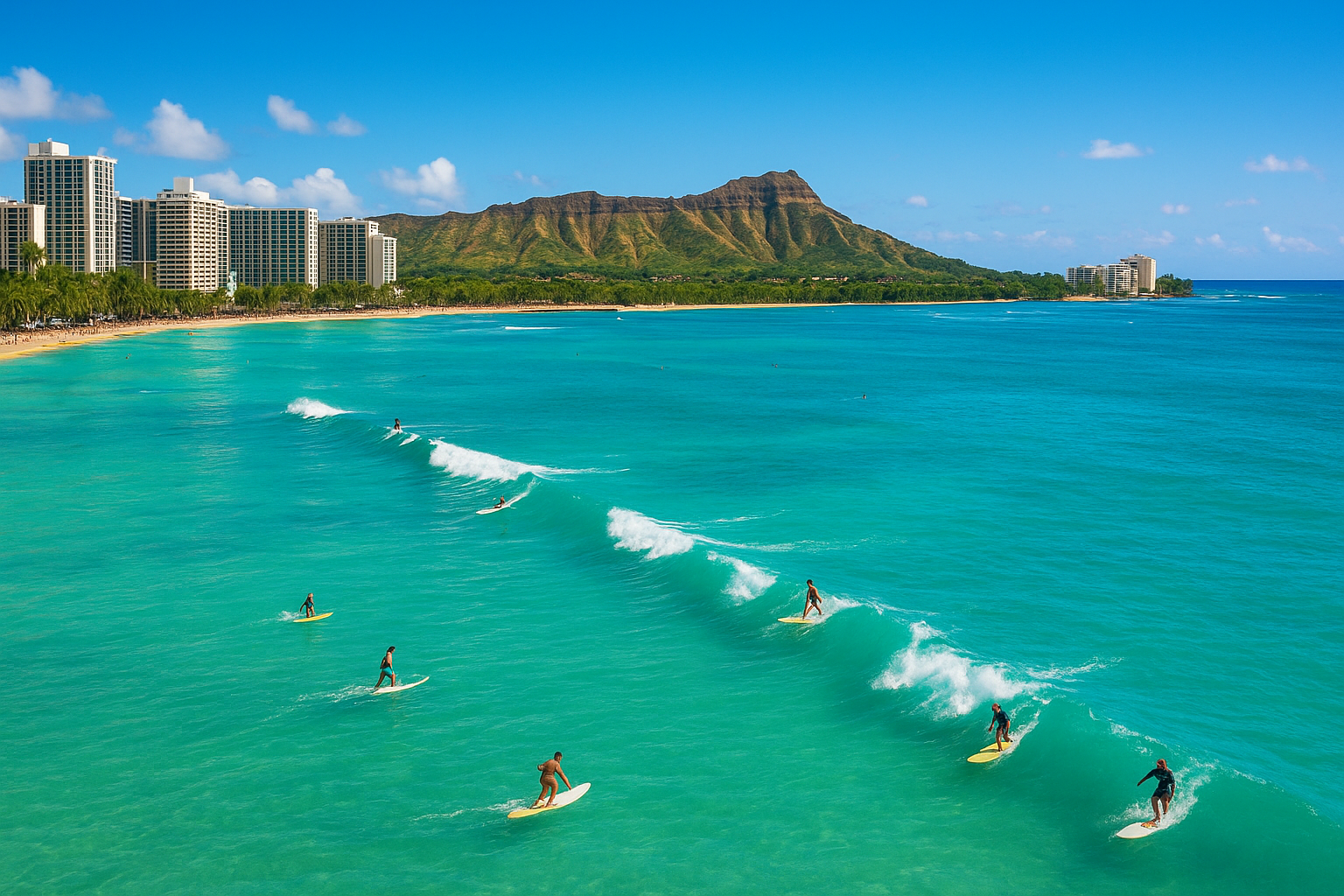
The iconic Waikiki coastline, with Diamond Head in the background, offers a magical setting for learning to surf. For a deeper walkthrough, see our Learn to Surf in Waikiki: Your Complete Beginner’s Guide.
Beyond Your First Lesson: Progressing as a Waikiki Surfer
One of the most common reactions after a first Waikiki surf lesson is: “I need to do that again.” The sport is genuinely addictive, and Waikiki’s infrastructure supports progression far beyond a single beginner session.
Board Rental for Independent Practice
After your lesson, you can rent a foam longboard directly on Waikiki Beach for around $15–$30 per hour. This is one of the best investments you can make in your surfing — muscle memory builds fastest through repetition immediately after structured instruction. Many schools allow students to keep their rented board for an extra hour at the end of the lesson at a discounted rate.
Advancing to Intermediate Techniques
After mastering the basic pop-up and riding straight toward shore, intermediate techniques to work on include: turning on the wave face, paddling out through broken whitewater efficiently, reading wave sets before they break, and adjusting foot positioning for better control. These skills typically develop across 3–6 sessions for a motivated learner. Waikiki’s instructors regularly teach intermediate clinics focused specifically on these progressions.
When You Are Ready to Explore Beyond Waikiki
Once you are comfortable riding unbroken waves and can paddle out independently at Waikiki, other beginner-friendly spots on Oahu become accessible — places like Canoes, Queens, and Publics (all within the Waikiki surf zone), as well as spots further afield like Tracks Beach and Ala Moana Bowls for more advanced students. Waikiki’s instructors can recommend the right next spot based on your current skill level and the day’s conditions.
Frequently Asked Questions About Waikiki Surf Lessons
What are Waikiki surf lessons and who are they for?
Waikiki surf lessons are certified, instructor-led surfing sessions held on Waikiki Beach in Honolulu, Hawaii. They are designed for complete beginners through intermediate surfers of all ages and fitness levels. Anyone who wants to learn to surf in a safe, supportive environment with ideal conditions can benefit from a Waikiki surf lesson.
How much do surf lessons in Waikiki cost?
Group lessons typically cost $30–$75 per person for a 60–90 minute session. Semi-private lessons (2 students, 1 instructor) run $80–$130 per person. Private one-on-one lessons range from $100–$200 per hour. Multi-lesson packages offer 15–25% savings over single sessions. Surfboard and rash guard rental are usually included in the lesson price.
Do I need prior surfing experience to take a Waikiki surf lesson?
No prior experience is necessary. Waikiki is specifically designed — by nature and by culture — for first-timers. The gentle, slow-rolling waves give beginners plenty of time to pop up, and certified instructors have refined their teaching methods specifically for people who have never touched a surfboard before.
How long does a typical Waikiki surf lesson last?
Most group lessons last 60–90 minutes, including a 15–20 minute land-based briefing followed by 45–70 minutes in the water. Private lessons can be customized in length. Some schools offer 2-hour extended sessions for students who want more time in the water.
What should I bring to my Waikiki surf lesson?
Bring a well-fitted swimsuit, reef-safe water-resistant sunscreen (applied 30 minutes before), a towel, a bottle of water, and a light snack for after. Leave jewelry, valuables, and electronics at your hotel. Most schools provide surfboards and rash guards at no extra charge.
Will I actually stand up on the surfboard during my first Waikiki lesson?
Most students do. Data from Waikiki surf schools consistently shows that more than 90% of first-time students successfully stand up on at least one wave during their first lesson, thanks to the ideal conditions and skilled instruction available at Waikiki. Many schools guarantee it explicitly.
Is Waikiki Beach safe for beginner surfers?
Yes — Waikiki is considered one of the safest beginner surf environments in the world. The waves are small and slow, the water is shallow near shore, the bottom is sandy, and lifeguards patrol the beach every day. Beginner lessons are conducted in a supervised zone away from more experienced surfers.
What is the best time of year to take surf lessons in Waikiki?
For absolute beginners, summer (May–September) delivers the gentlest conditions with small, slow south swells — ideal for first-timers. Fall (October–November) offers similar conditions with fewer crowds and better availability. Winter and spring are excellent for students with some experience who are ready for slightly more challenging waves.
What is the minimum age for Waikiki surf lessons?
Most Waikiki surf schools welcome children aged 5 and up. Children typically require parental consent and may be placed in dedicated kids’ programs with age-appropriate equipment and child-focused instructors. Some schools have no maximum age limit — surfing is a sport that people enjoy well into their 70s and beyond.
Do I need to know how to swim to take surf lessons in Waikiki?
Basic comfort in the water is strongly recommended and required by most schools. You do not need to be a competitive swimmer, but you should be able to stay afloat and move through the water with some confidence. Your surfboard serves as a large flotation device, but ocean environments are unpredictable and basic swimming ability is a genuine safety necessity.
How do I choose the right Waikiki surf school?
Look for ISA-certified or equivalently credentialed instructors, enforced small group sizes (maximum 4 students per instructor), verified reviews across Google and TripAdvisor, transparent pricing and cancellation policies, and quality modern foam boards. A physical beach presence is a good sign of an established, serious operation. Reputable providers like Star Beach Boys tick all these boxes.
What is the difference between a regular stance and a goofy stance in surfing?
Regular stance means your left foot leads (closest to the nose of the board) — used by approximately 65% of surfers. Goofy stance means your right foot leads — used by roughly 35% of surfers. Neither is better, and neither is a handicap. Your instructor will help determine your natural stance early in the lesson, usually by asking which foot you lead with when you run or kick a ball.
What is the difference between a group and a private Waikiki surf lesson?
Group lessons (typically $30–$75/person) are social, affordable, and excellent for casual learners — one instructor works with 2–4 students simultaneously. Private lessons ($100–$200/hour) provide one-on-one coaching with real-time feedback tailored entirely to you, resulting in faster technical improvement. Private lessons are ideal for students who are serious about learning quickly or who have specific technique challenges to address.
Conclusion: Book Your Waikiki Surf Lesson and Start Riding
Waikiki surf lessons offer something genuinely rare: a world-class experience that is accessible to almost everyone, regardless of age, fitness level, or prior experience. The combination of perfect beginner conditions, over a century of refined instruction culture, warm water, and the unmatched beauty of Honolulu’s coastline creates a surfing experience that no other destination on Earth can replicate.
Whether you choose a group lesson for the social energy, a private session for faster progression, or a multi-day package to genuinely develop your surfing skills, Waikiki delivers. Most first-timers catch their first wave within 20 minutes of entering the water. Nearly all of them book a second session before leaving the beach.
The ocean is waiting. Choose a reputable school, book your lesson in advance, apply your sunscreen, and get ready to stand up on a surfboard in one of the most breathtaking places on the planet. Your surfing journey starts at Waikiki — and it starts the moment you book. This article should include an "About the author" box (name, ISA credential or equivalent, short bio) and a visible "Last updated" date to boost credibility and trust. Last updated: 2026-07-12. Author: Star Beach Boys.